- The paper introduces a 4PM analytic computation of the gravitational Compton amplitude, establishing a benchmark for three-loop gravitational observables.
- It applies worldline QFT with IBP reduction to derive master integrals and reveals the significance of elliptic iterated integrals in resolving complex gravitational interactions.
- The study rigorously matches BHPT results and outlines avenues for extending the method to include spin effects, tidal deformations, and enhanced waveform modeling.
Gravitational Compton Scattering at the Fourth Post-Minkowskian Order: A Technical Analysis
Introduction and Context
The paper "Gravitational Compton scattering at the fourth post-Minkowskian order" (2606.28239) presents a comprehensive calculation of the classical gravitational Compton amplitude for a spinless compact object at fourth post-Minkowskian (4PM) order. This work sits at the intersection of amplitude-based general relativity, effective field theory (EFT), and quantum field theoretic worldline approaches (WQFT), targeting the analytic structure of the gravitational-wave (GW) scattering matrix required for high-precision modeling of compact object responses to perturbative GWs.
The motivation is rooted in the necessity for high-accuracy theoretical waveforms for gravitational wave astronomy and, specifically, in the analytic determination of compact-object tidal responses, relevant for both neutron stars and black holes. By extending the Compton amplitude to 4PM, the study achieves a new benchmark in the analytic integration and reduction of three-loop gravitational amplitudes and provides a new avenue for systematic matching with black hole perturbation theory (BHPT).
Methodology: Worldline QFT Framework and Diagrammatics
The computation leverages the WQFT formalism, where the compact object is represented by a worldline action coupled to the bulk gravitational field. The process under consideration is the elastic scattering of a gravitational wave—the so-called gravitational Compton amplitude—off a nonspinning compact object (see kinematic depiction in Figure 1 of the paper).
The calculation proceeds by recursively constructing the graviton two-point function in the presence of the worldline, generating all connected Feynman diagrams contributing at 4PM (three-loop) order. The recursion is managed using a Berends-Giele-type approach, producing 70 diagrams at 4PM, with only 36 surviving the imposition of the transverse-traceless (TT) gauge for graviton polarizations.
The integrand construction results in high-rank tensor integrals, subsequently reduced to scalar integrals using Passarino-Veltman reductions and FORM-based automation. A topology-mapping algorithm organizes all scalar integrals into a unified class.






Figure 3: Reducible top sectors appearing in the three-loop Compton amplitude.
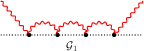
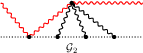
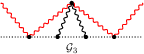
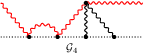
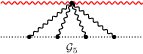
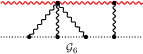
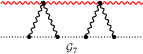
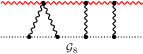
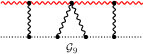
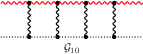
Figure 1: 10 master integral topologies {Gi} after IBP reduction, featuring the full spectrum of three-loop subtopologies relevant to the amplitude.
Integral Reduction and Evaluation
After IBP reduction, the amplitude decomposes into 15 master integrals across 10 topologies. A notable structural simplification is that diagrams involving worldline propagators vanish after reduction in the TT gauge, a pattern conjectured to hold at all orders. The nontrivial top sector features mixed retarded (active graviton) and potential (static field) graviton propagators.
The master integrals' evaluation exploits differential equation techniques in the kinematic variable x=sin(θ/2), where x parametrizes the graviton scattering angle. The systems are brought to canonical form using leading singularities, Magnus expansion, and the Canonica software.
A salient feature at 4PM is the emergence of elliptic sectors, with the canonical system for certain integral families characterized by elliptic iterated integrals. Analytical solutions are provided in terms of these iterated elliptic polylogarithms.
Boundary conditions for the differential equations are fixed in the forward-scattering (x→0) limit, separating into hard and soft regions. The relevant boundary master integrals are computed, some numerically up to high precision using AMFlow and subsequent analytic reconstruction via PSLQ.
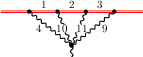
Figure 2: The irreducible three-loop master integral topology after imposing worldline delta functions, showing massive and massless propagators distinguished by line types.
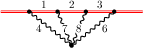
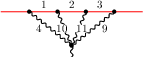
Figure 4: Boundary integral topologies in the hard (left, massive) and soft (right, eikonal) regions, corresponding to different scaling limits of loop momenta.






Figure 5: Six master integrals comprising the hard boundary region's basis.




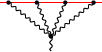
Figure 6: Six master integrals comprising the soft boundary region's basis.
Result: Analytic Structure and Matching with BHPT
The perturbative expansion of the amplitude in the PM parameter features exponentiating infrared divergences, which are systematically canceled to yield a finite remainder compatible with unitarity. The amplitude is organized to all orders in powers of ϵPM=2Gmω, with the 4PM term written as:
iM(4)=ϵ3iM−3(4)+ϵ2iM−2(4)+ϵiM−1(4)+iM0(4).
Phase shifts relevant for matching to BHPT are extracted via the exponential representation of the S-matrix, focusing on the so-called N-matrix, whose elements map onto the gravitational-wave scattering phase shifts. A detailed subtraction procedure removes lower-order Born iterations, enforcing the correct unitarity structure by explicit computation of cut-subtracted master integrals.
Notable numerical and analytic results include:
- The 4PM N-matrix element for helicity-conserving graviton scattering reduces to a remarkably compact, closed-form expression involving only elementary functions, standard polylogarithms, and specific elliptic integrals.
- The helicity-flipping component of the matrix element vanishes identically at leading order.
- The final analytic answer is expressed as a linear combination of log(1+x), Li2(−x), complete elliptic integrals x=sin(θ/2)0 and x=sin(θ/2)1, and their iterated integrals.
All analytic forms are meticulously cross-validated against lower-order results and by explicit numerical matching with BHPT phase shifts up to high multipole order (x=sin(θ/2)2).
Theoretical and Practical Implications
The rigorous matching with BHPT confirms the correctness of the 4PM WQFT-based approach and provides further evidence for the power of amplitude-based methods in classical gravity. The analytic representation of the 4PM Compton amplitude and its phase shift sets a new benchmark for the analytic tractability of three-loop gravitational observables.
The identification and analytic treatment of elliptic sectors strongly suggest a growing prevalence of special functions (beyond ordinary polylogarithms) at higher post-Minkowskian orders, with profound implications for both amplitude technology and the analytic structure of quantum gravity corrections.
On the practical side, the methodology and integral database developed here offer a roadmap for incorporating additional physical effects, such as spin, tidal deformations, and absorptive worldline couplings, by suitable changes in the worldline action and matching with numerically exact BHPT results. This opens the door to further precision improvements in GW waveform modeling and effective-one-body (EOB) theory.
Prospects for Future Developments
Prospective research directions enabled by this work include:
- Incorporation of spin and higher multipole moments into the worldline construction, requiring the extension and possible generalization of current reduction techniques to new vertex classes.
- Analytic determination of tidal and dynamical response coefficients from EFT matching across mass, spin, and frequency, extending the reach of waveform predictions for binary inspirals involving neutron stars and rapidly spinning black holes.
- Extension to radiative observables at next-to-next-to-leading PM order and the study of higher-dimensional analogs, e.g., for string-inspired corrections or beyond-GR gravity.
Conclusion
This study represents the first analytic computation of the classical gravitational Compton amplitude at 4PM order in the spinless sector via a full three-loop reduction. Through advanced WQFT diagrammatics, IBP and canonical differential equations (including elliptic integration), and a careful subtraction scheme aligned with the analytic structure of gravitational scattering, the paper demonstrates both the tractability and the richness of post-Minkowskian gravitational amplitudes. The methods developed and validated here are poised to become central tools in the next era of perturbative gravitational physics and gravitational wave phenomenology.