- The paper demonstrates that integration friction is a repository-level phenomenon, irreducible to individual agent contributions using robust ICC analysis.
- It employs hierarchical variance partitioning on over 930,000 pull requests to measure friction across factors like resolution latency, review rounds, and merge conflicts.
- The findings imply that governance should focus on ecosystem-level risk indicators rather than individual agent metrics to effectively manage AI-native software.
Ecosystem-Level Risk in AI-Native Software: Statistical Non-Reducibility and Implications for Governance
Introduction
The paper "Govern the Repository, Not the Agent: Measuring Ecosystem-Level Risk in AI-Native Software" (2606.28235) presents a rigorous empirical investigation into the locus of integration risk when autonomous coding agents operate at scale within shared software repositories. It interrogates the foundational assumption that individual agent-level correctness suffices for system reliability and presents statistical evidence that integration friction—the measurable manifestation of risk due to concurrent evolution and merging of code—emerges as a repository-level phenomenon, not reducible to the properties of any single contribution or agent.
Methodological Framework
The study leverages extensive observational data, encompassing over 930,000 agent-authored pull requests on GitHub, and applies multilevel (hierarchical) variance partitioning to empirical constructs measuring friction at pull request, agent, and repository levels. Seven friction constructs are defined: deliberation latency, resolution latency, review rounds, comment volume, changes requested, rejection, and merge conflict incidence.
Key to the analysis is the operationalization of statistical non-reducibility, adopting the intraclass correlation coefficient (ICC) as the measure of between-repository variance after extensive covariate adjustment, including controls for pull request size, task type, repository popularity, language, codebase size, and age. A parallel within-repository human-authored baseline allows for specificity analysis of agent-driven ecosystem effects.
Emergence and Non-Reducibility in Integration Friction
The core claim of the paper is that a substantial fraction of the observed integration friction is not explained by agent or contribution-level factors but rather persists as unexplained, repository-level variance. Even after exhaustive adjustment, approximately half of the variance in measures such as resolution and deliberation latency remains at the repository level (e.g., ICC ≈ 0.39–0.41), as shown in Figure 1.
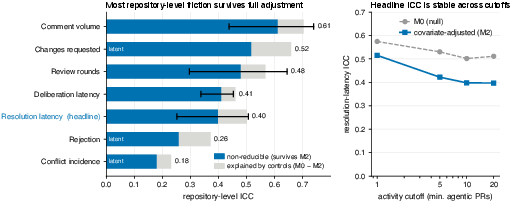
Figure 1: Repository-level ICC for multiple friction constructs indicates a large share of repository-level variance survives covariate adjustment—a necessary statistical signature of emergence.
This effect meets the statistical criterion for emergence: system-level properties are not reducible to the attributes of constituent parts. Notably, the signature appears robust across all seven distinct friction constructs and persists across multiple thresholds for repository activity, supporting the claim that the phenomenon is not an artifact of construct choice or dataset stratification.
The additional inclusion of codebase size and repository age—often the most plausible confounds in software engineering—fails to eliminate the effect. Robustness is further demonstrated via a leave-one-repository-out jackknife, which shows that no single repository disproportionately drives the effect Figure 2.
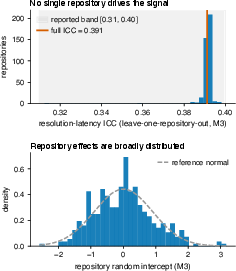
Figure 2: Jackknife analysis confirms the robustness of the repository-level signal after codebase size and age controls; between-repository offsets are broadly distributed.
Specificity to Agent-Authored Contributions
A principal result is the specificity of non-reducibility to agent-authored changes. On matched repositories, agent-authored contributions exhibit repository-level ICC values for friction up to twice those of human-authored contributions (resolution latency ICC of 0.30 for agents vs. 0.16 for humans), a difference that remains statistically significant under all controls.
The marginal increase is largest for frictional latency constructs (ΔICC ≈ +0.14–0.22), and is robust to controls for merge path, review process maturity, task shape, and process-level confounders. The agent-driven ecosystem effect is thus not a generic property of active repositories; it is specifically induced by the introduction of autonomous coding agents.
Contradictions to Intuitive Accounts
The paper decisively rebuts two common intuitive explanations for integration risk in agentic development:
- Agent Interference Hypothesis: If integration friction arose from agent-agent interference, repositories with more agents would show increased conflict and friction, but empirical data shows conflict rates are flat across repositories regardless of agent count, and multi-agent repositories actually demonstrate slightly lower ICCs.
- Repository Activity Hypothesis: Were friction a generic function of repository activity, human-authored contributions would evidence similar variance structure. The baseline analysis exposes the agent-specific nature of repository-level risk.
Implications for Governance and Measurement
The findings have direct implications for both practice and future research directions. The irreducibility and specificity of repository-level risk necessitate a paradigm shift in both evaluation and governance strategies for AI-native software:
- Agent Assessment Requires Ecosystem Context: Performance on benchmark tasks fails to predict in situ effects; robust evaluation must occur within the target repository, with continuous measurement of repository-level friction.
- Govern Change-Rate, Not Agent Headcount: Empirically, integration friction is driven by the velocity of base-branch change, not by the number of contributing agents. Governance should focus on serializing merges and structuring review queues adaptively according to repository-level risk indicators.
- Agent Policies Must Consider Friction Hotspots: Routine auto-merging by agents correlates with increased friction. Routing human review dynamically to high-friction contribution paths promises to mitigate escalation.
- Minimal, Focused Dashboarding: A handful of repository-level indicators—base-branch churn, replayed conflict rates, cross-account review engagement, and ICC trends—provide sufficient surface for early warning and intervention.
The results collectively shift the locus of risk measurement and intervention from the agent to the repository, demanding new metrics, dashboards, and possibly regulatory attention at the ecosystem level.
Potential Theoretical and Practical Extensions
The statistical non-reducibility established here opens several avenues for subsequent research:
- Causal Mechanisms: Future work could apply information-theoretic emergence measures (e.g., effective information [hoel2013]) or dynamical independence frameworks to establish causal, rather than purely statistical, emergence.
- Monitoring Comprehension and Intent Drift: The linkage of friction accumulation to cognitive and organizational comprehension gaps, as theorized in the companion research, raises the prospect of monitoring intent capture and knowledge diffusion using repository meta-data and developer interactions.
- Downstream Harm and Safety Analysis: Linking repository-level friction metrics to downstream production failures or security vulnerabilities could operationalize governance in safety-critical environments.
Conclusion
This work rigorously operationalizes the hypothesis that integration risk from AI coding agents is governed at the repository/ecosystem level and is not explainable by agent-level correctness. Statistical non-reducibility—here instantiated as persistent, covariate-robust between-repository variance in integration friction—demands a decisive shift of both measurement and governance to the ecosystem. Future developments in AI code generation, deployment, and assurance must accommodate the emergent nature of these risks, adapting not only models but also process and structural interventions to the properties of the evolving software ecosystem.