Hybrid quantum-classical neural network for sample-efficient recognition of topological phases
Abstract: With increasing maturity of quantum computers, standard methods for characterizing global properties of their output quantum states via direct measurements and classical post-processing are becoming increasingly impractical due to large measurement costs. Although quantum neural networks could directly process quantum states to identify underlying characteristics with reduced measurement efforts, they often require deep quantum circuits that cannot be implemented on existing devices. To overcome these challenges, we introduce a hybrid quantum-classical neural network that consists of a shallow parameterized quantum circuit, measurements, and a classical neural network. The parameterized quantum circuit performs a nonlocal transformation of the measurement basis, which is jointly trained with the classical neural network to maximize the statistical distance between data obtained by measuring different quantum states. Using supervised learning, we demonstrate that the hybrid neural network distinguishes the topological phase of the surface code from a symmetry-enriched topological phase and random product states. Moreover, this hybrid neural network reduces both inference and training sample complexities of recognizing the topological phase by approximately one order of magnitude compared to a classical neural network trained on randomized Pauli measurements. As this hybrid neural network features a shallow quantum circuit that can be readily implemented on existing quantum computers, it enables the efficient characterization of complex quantum states.
Paper Prompts
Sign up for free to create and run prompts on this paper using GPT-5.
Top Community Prompts
Explain it Like I'm 14
Overview
This paper shows a new way to teach a computer to recognize “topological phases” of quantum matter using both a small quantum circuit and a regular (classical) neural network working together. The key idea is simple: let the quantum part rearrange the information in a quantum state so that the classical part can tell the difference between phases using far fewer measurements than before.
Topological phases are special because their “patterns” live in the whole system, not in any single part. That makes them hard to spot with ordinary measurements. This hybrid approach makes those hidden patterns easier to see.
What questions did the researchers ask?
- Can a small, easy-to-run quantum circuit help a classical neural network recognize topological phases from measurement data?
- Can this combo use far fewer measurements (shots) than standard classical methods?
- Can it tell apart:
- the surface-code topological phase from random product states that have no simple features, and
- the surface-code phase from another, trickier topological phase called a symmetry-enriched topological phase?
How did they do it?
Think of the method as a two-part “camera” for quantum states:
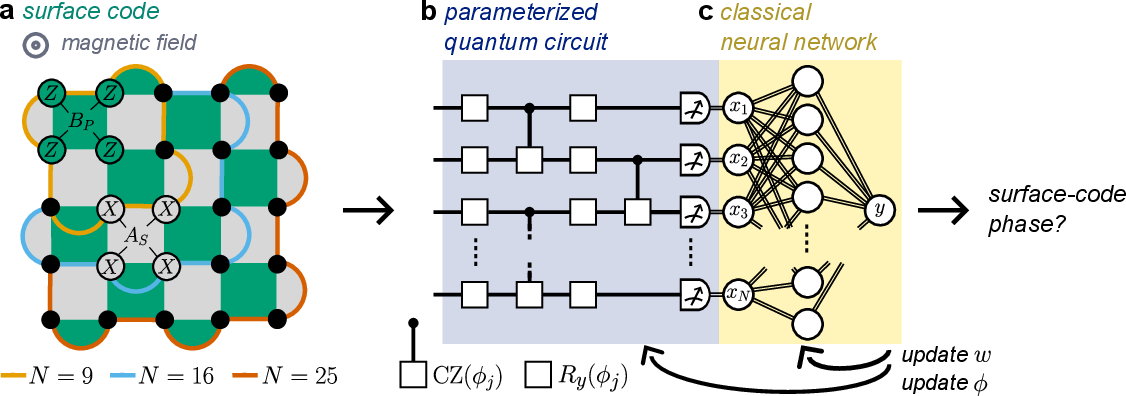
- The quantum “lens”: a shallow (short) quantum circuit that gently changes the measurement basis. This is like turning a knob on a camera to make the differences between two scenes stand out more clearly.
- The classical “classifier”: a normal neural network that looks at the measured bit strings (0s and 1s from the qubits) and learns to say which phase the state likely came from.
Here’s the basic workflow:
- Prepare quantum states from two groups (two phases).
- Pass each state through the shallow quantum circuit and measure all qubits to get many bit strings (repeating the experiment is called taking “shots”).
- Train the classical neural network on these bit strings to predict the phase label.
- Adjust (train) the quantum circuit’s gate angles so that the measured results for the two groups become as different as possible. This makes the classical network’s job easier and reduces measurement needs.
- Repeat training the classical network and tuning the quantum circuit (an inner loop for the classical net and an outer loop for the quantum circuit) until performance stops improving.
Key terms in plain words:
- Shallow quantum circuit: only a few layers of simple gates (single-qubit rotations and two-qubit controlled-phase gates). Shallow = practical on today’s devices.
- Shots: how many times you measure to collect data from the same kind of state. Fewer shots = faster, cheaper experiments.
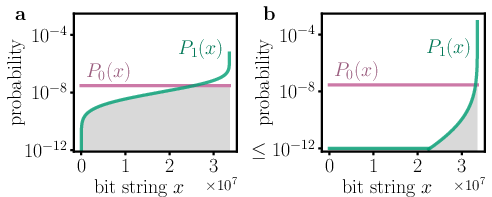
- Statistical distance: how different two sets of measurement results look. Bigger distance = easier to tell apart.
What did they test the method on?
- Dataset 1: The surface-code topological phase vs a “featureless” set of random product states (called a 1-design). The random set is deliberately hard: it doesn’t give away easy clues in local measurements, so the model has to learn truly nonlocal/topological patterns to succeed.
- Dataset 2: The surface-code topological phase vs a symmetry-enriched topological (SET) phase. Both are genuinely topological (no simple local order), so separating them is a tougher, more realistic challenge.
Main findings
For both datasets, the hybrid method needed about 10 times fewer measurements than a strong classical baseline that used randomized Pauli measurements.
Specifically:
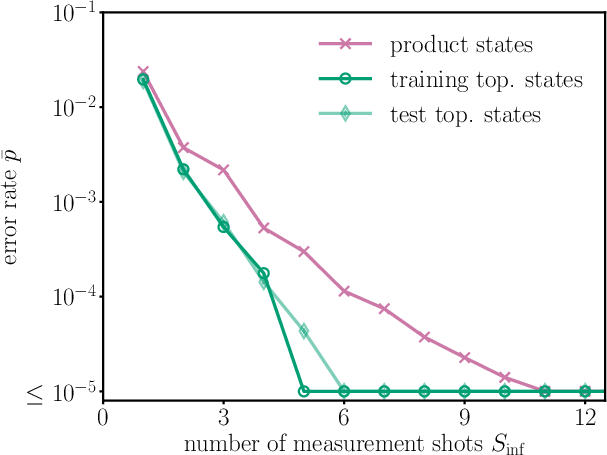
- Surface code vs random product states:
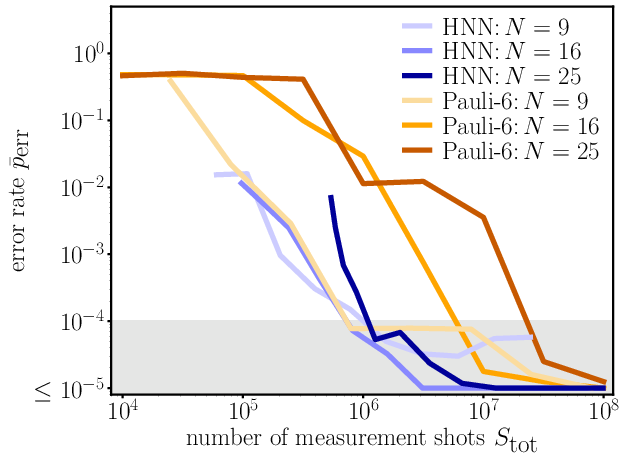
- With the trained hybrid model, just 5–7 shots per state were enough to classify almost perfectly (fewer than 0.01% errors in multi-shot testing).
- A classical neural network trained on randomized Pauli measurements needed about 50 shots to reach similar accuracy.
- During training, the hybrid method also used about 10 times fewer total measurement shots than the classical baseline (around 1 million vs around 10 million).
- Surface code vs symmetry-enriched topological phase:
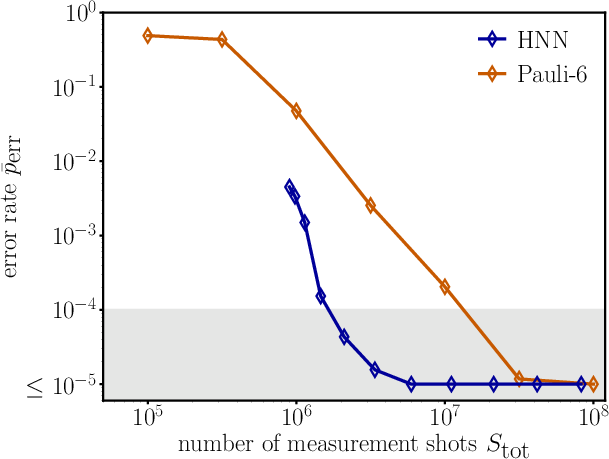
- The hybrid model reached near-perfect accuracy with about 13 shots, while the classical method needed about 52 shots.
- Training again showed roughly a 10× reduction in total measurement budget (about 106 vs 107 shots).
Other important points:
- The quantum circuit is shallow, so it can run on current quantum hardware.
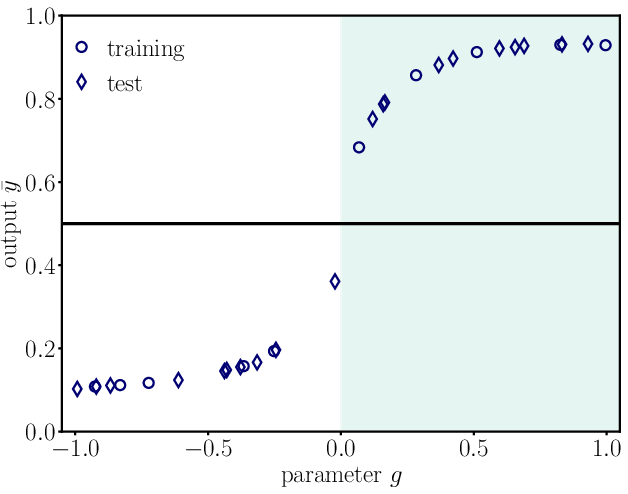
- The approach generalizes: it worked well on test states not seen during training (for different parameters within the same phases).
- The quantum part learns to “re-express” the state so that the measurement results for different phases are more distinct, which directly reduces the number of shots needed.
Why is this important?
- Practical today: Because the quantum circuit is shallow, this approach can run on existing noisy quantum devices. It’s not just a theory exercise.
- Less data, more insight: Measuring quantum systems is expensive and time-consuming. Needing 10× fewer measurements makes studying complex quantum matter much more feasible.
- Finds real topological features: The method succeeds on problems with no simple local clues, showing it captures the global, nonlocal patterns that define topological phases.
- Broad potential: Beyond the surface code, similar hybrid tools could help characterize other hard-to-measure quantum states in condensed matter physics and quantum computing (for example, checking phases in higher-dimensional systems or speeding up diagnostics in quantum simulations and error-correcting codes).
Takeaway
A small quantum circuit plus a classical neural network can team up to spot deep, nonlocal patterns in quantum states using far fewer measurements than standard classical approaches. This makes it a promising tool for understanding and testing complex quantum phases on today’s quantum hardware.
Knowledge Gaps
Knowledge gaps, limitations, and open questions
Below is a concise, actionable list of what remains missing, uncertain, or unexplored in the paper, aimed at guiding future research.
- Scaling laws and asymptotics
- Absent theoretical or empirical scaling laws for S_inf (inference shots), S_tot (training shots), and circuit depth/parameter count as functions of system size N, correlation length, and proximity to criticality.
- No analysis of gradient/optimizer scaling with N (e.g., variance of evolution-strategy gradients, likelihood of barren plateaus even in shallow ansätze).
- Noise robustness on real hardware
- No quantified robustness to realistic noise (gate infidelity, SPAM errors, crosstalk, dephasing) and how D_JS, error rates, and required shot numbers degrade with noise.
- No tolerance bounds (e.g., maximum error rates per gate or readout error) for maintaining target classification accuracy.
- Generalization beyond tested phases
- Unclear applicability to other topological orders: non-Abelian phases, chiral topological states (e.g., Chern insulators), fracton models, or generic SPT phases without membrane-order diagnostics.
- No test on mixed states, finite-temperature states, or excited states with anyonic excitations present.
- Circuit architecture and expressivity
- Limited exploration of the ansatz: no ablation on gate choices, connectivity, entangling range, or minimal depth needed to achieve target D_JS.
- No automated architecture search or constraints study (e.g., restrict to nearest-neighbor CZ only) to determine the minimal nonlocality needed.
- Interpretability of the learned unitary
- Lack of analysis of learned parameters to determine whether U(φ*) approximates the inverse ground-state preparation circuit or implements Wilson-loop diagonalization.
- No symmetry analysis (e.g., whether learned unitaries preserve relevant lattice or antiunitary symmetries).
- Benchmark breadth and fairness
- Comparison limited to a classical NN trained on Pauli-6 POVM outcomes (largely linear-in-state). Missing baselines using:
- More expressive classical methods (e.g., shadow kernels, higher-order shadow features, tensor-network classifiers, graph/convolutional NNs on lattice-structured data).
- Alternative POVMs (local Clifford, global Clifford, derandomized or task-adapted measurements) that might capture nonlocal features more efficiently.
- Explicit Wilson-loop estimation pipelines or classical post-processing tailored to topological order.
- No comparison to shallow QCNNs or dequantized QCNN variants with the same hardware constraints.
- Training stability and optimization
- The two-loop ES-based training exhibits sensitivity to initialization and local minima; no strategies presented for variance reduction, convergence diagnostics, or improved optimizers (e.g., parameter-shift gradients, natural ES, Bayesian optimization).
- No study of how measurement noise and finite-shot stochasticity in C_res affect optimizer bias/variance and convergence.
- Data efficiency near criticality
- Although large correlation lengths are mentioned, there is no systematic study of sample complexity and D_JS behavior as the system approaches the critical point (e.g., h≈h_c), nor quantification of how classification degrades in the critical region.
- Transferability and domain shift
- No evaluation of transfer learning across system sizes, boundary conditions (open vs periodic), lattice geometries, or disorder realizations.
- Unclear robustness to Hamiltonian misspecification, state-preparation errors, or model drift between training and deployment.
- Multi-class and unsupervised settings
- The study is limited to binary supervised classification; no extension to multi-class phase discrimination, multi-label tasks (e.g., sector identification), or unsupervised/semisupervised phase discovery without labels.
- Mixed-state and finite-temperature inputs
- The framework is evaluated only on pure ground states (and product-state 1-design). Performance on noisy mixtures, thermal states, or states with unknown impurity is not assessed.
- Objective choices and theoretical guarantees
- While cross-entropy/Jensen–Shannon divergence is used, no exploration of alternative objectives (e.g., total variation, f-divergences, contrastive objectives) that might improve sample efficiency or robustness.
- No formal guarantees on when shallow circuits can provably increase D_JS for given phase families, or PAC-style bounds linking D_JS gains to sample complexity.
- Resource and runtime costs
- Lack of wall-clock estimates for hardware training (shots, iterations, latency) and practical limits on feasible S_tot for N≈25 and beyond.
- No throughput analysis for scaling to larger devices given connectivity constraints, calibration overheads, and repeated circuit recompilation.
- Choice of measurement model
- Only computational-basis readout post-U(φ) is explored; potential gains from adaptive measurements, mid-circuit measurements, or alternative POVMs are not analyzed.
- No investigation of whether classical post-processing with more elaborate aggregations of raw measurement strings (beyond the NN) could close the gap.
- Dataset representativeness and preparation
- The tensor-network dataset assumes exact preparation circuits; feasibility and fidelity of preparing such states on near-term hardware is not discussed.
- Limited variety of training states per phase (e.g., three h-values; five g-samples); broader sampling over parameter ranges, disorder, and boundary conditions is not evaluated.
- Robustness to class imbalance and priors
- Although the loss balances classes, the effect of highly imbalanced priors, varying per-state shot allocations, or distribution shifts in deployment is not quantified.
- Reproducibility and availability
- Details on code, datasets, random seeds, and full hyperparameter sweeps are deferred; without public artifacts, reproducibility and external validation remain open.
- Beyond topological phase recognition
- Potential extensions to regression (e.g., estimating h or g), anomaly detection (OOD states), or learning other global properties (e.g., entanglement spectra, conserved charges) are not explored.
- Decision thresholds and calibration
- The classifier uses a fixed threshold t=0.5; calibration quality (e.g., reliability diagrams), alternative thresholds, and cost-sensitive settings (asymmetric fp/fn penalties) are not studied.
- Theoretical link to shadow complexity results
- The empirical sample-efficiency advantage is shown but not tied to existing classical-shadow complexity bounds; a unifying theory predicting when quantum pre-processing is advantageous is missing.
Practical Applications
Immediate Applications
The following use cases can be deployed with today’s shallow quantum circuits and standard ML tooling, reducing measurement budgets for state characterization and enabling few-shot inference.
- Efficient certification of prepared quantum states on NISQ hardware
- Sector: quantum computing hardware (superconducting, trapped ions, neutral atoms), AMO/condensed-matter experiments
- Use case: Rapidly verify whether an experiment has prepared a target topologically ordered state (e.g., surface code) using a shallow parameterized circuit and a small number of measurements, instead of tomography or large classical-shadow budgets.
- Tools/products/workflows:
- “Measurement-basis optimizer” module (two-loop HNN training) integrated with lab control stacks and SDKs (Qiskit/Cirq/PennyLane), using Ry and CZ(φ) gates.
- Automated state-check routines in experimental sequencers to certify preparation quality between runs.
- Assumptions/dependencies: Availability of shallow native gates (Ry, CZ with tunable phase), stable state-preparation routines, sufficient shot repetition; noise must not overwhelm the shallow circuit’s advantage.
- Low-shot diagnosis for quantum error-correction experiments
- Sector: quantum computing (QEC R&D, surface-code platforms)
- Use case: Fast confirmation that a device is in the correct code phase (e.g., during lattice-surgery steps or syndrome-extraction development), enabling quick iteration on calibrations and pulse schedules.
- Tools/products/workflows:
- “Surface-code phase checker” callable from calibration pipelines; HNN inference embedded in runtime services.
- Assumptions/dependencies: Labeled examples from the target and non-target phases for initial supervised training; stable device drift during deployment windows.
- Sample-efficient post-processing for quantum simulations of many-body systems
- Sector: materials simulation, condensed-matter physics (academic and industrial)
- Use case: Identify phase boundaries and topological regimes with orders-of-magnitude fewer measurements than randomized measurement baselines when scanning Hamiltonian parameters.
- Tools/products/workflows:
- Add-on to VQE/analog simulation workflows that applies the learned shallow PQC and classical classifier to each parameter point; “few-shot phase map” generators.
- Assumptions/dependencies: Ability to prepare families of states across parameter sweeps; training transferability across nearby regions of the phase diagram.
- Benchmarks and datasets for quantum machine learning
- Sector: standards/consortia, research
- Use case: Provide classically hard (non-local) benchmark datasets and protocols for assessing quantum advantage in classification tasks, replacing “locally easy” benchmarks.
- Tools/products/workflows:
- Open datasets (surface-code vs 1-design; surface-code vs symmetry-enriched phases), reference HNN baselines, and Pauli-6 POVM baselines with standard metrics (Jensen–Shannon divergence, shot budgets).
- Assumptions/dependencies: Community adoption; reproducible dataset generation and access to small quantum devices or high-fidelity simulators.
- Cloud “phase recognition” microservice
- Sector: quantum cloud/software
- Use case: Users upload a circuit/state-preparation routine; the service applies a shallow PQC and returns classification scores with few-shot acquisition, reducing cloud costs and queue time.
- Tools/products/workflows:
- Managed HNN runtime with stored trained PQCs/NNs for common phases; APIs for custom training/inference.
- Assumptions/dependencies: Integration with provider runtimes; billing models that account for reduced measurement counts.
- Education and training labs on topological order
- Sector: education
- Use case: Hands-on labs where students implement shallow PQCs and train a small NN to detect topological order on simulators or small-cloud devices, illustrating nonlocal features and JS-divergence maximization.
- Tools/products/workflows:
- Classroom notebooks (QuTiP + TensorFlow/Keras), prebuilt circuits, and datasets; automated grading via inference metrics.
- Assumptions/dependencies: Access to simulators or limited cloud hardware; simplified datasets for small N.
- Quality control for resource states in measurement-based quantum computing (MBQC)
- Sector: quantum communications/MBQC platforms
- Use case: Few-shot confirmation that a prepared cluster/graph state exhibits the correct global correlations by learning an appropriate measurement-basis transform.
- Tools/products/workflows:
- HNN-derived basis-select modules for verifying global observables without tomography.
- Assumptions/dependencies: Adaptation of PQC ansatz to relevant graph states; sufficient connectivity to implement shallow basis changes.
Long-Term Applications
The following applications require larger, more reliable devices, broader datasets, or methodological extensions (e.g., unsupervised learning), but are natural evolutions of the paper’s results.
- Automated phase-diagram discovery at scale
- Sector: quantum simulation/materials discovery
- Use case: Map complex phase diagrams (including 2D/3D topological and symmetry-enriched phases) by scanning Hamiltonian parameters and using HNNs to classify phases with minimal shots.
- Tools/products/workflows:
- “Autophaser” pipelines combining analog/digital state prep, HNN-based measurement design, and adaptive sampling of parameter space.
- Assumptions/dependencies: Larger qubit counts and coherence; scalable state preparation across parameter regimes; data management for large sweeps.
- Closed-loop controllers for phase-aware experiment optimization
- Sector: quantum hardware/control
- Use case: Real-time feedback where HNN inference steers pulse calibration, coupler settings, or measurement schedules to maintain a targeted phase (e.g., during long calibration sessions).
- Tools/products/workflows:
- Low-latency HNN inference cores integrated with hardware control; controller policies that incorporate classifier confidence.
- Assumptions/dependencies: Millisecond-scale classical inference and control loops; robust generalization of trained PQCs under drift/noise.
- Certification and standards for quantum device performance
- Sector: policy/standards, procurement
- Use case: Define certification protocols for global-state characterization (sample complexity targets, accuracy under noise) as procurement criteria for quantum devices and cloud services.
- Tools/products/workflows:
- Standardized HNN-based tests for topological features; reporting formats for JS divergence, Bayes error, and measurement budgets.
- Assumptions/dependencies: Consensus among standards bodies; reproducibility across platforms.
- Resource-efficient verification in quantum networks
- Sector: quantum networking/security
- Use case: Verify entanglement/resource states (e.g., photonic cluster states) at network nodes with minimal measurements by learning optimal measurement bases that maximize distinguishability from failures/noise.
- Tools/products/workflows:
- HNN-based “network verifier” modules interfacing with photonic sources/detectors.
- Assumptions/dependencies: Tailoring PQC-equivalents to photonic/linear-optics platforms (e.g., programmable interferometers); high-rate data streams.
- Integration with fault-tolerant regimes and advanced PQCs
- Sector: quantum computing (FTQC)
- Use case: Use deeper, error-corrected PQCs to detect subtler phases/invariants (e.g., non-Abelian orders) or to perform nonlinear feature extraction for complex tasks.
- Tools/products/workflows:
- Compiled measurement transforms within logical circuits; co-design with error mitigation/correction layers.
- Assumptions/dependencies: Availability of logical qubits and fault-tolerant gate sets; extended training methods that handle logical noise models.
- Material and device co-design for topological electronics
- Sector: semiconductor/spintronics/energy-efficient electronics
- Use case: Leverage quantum processors to simulate candidate materials exhibiting robust topological features; HNNs accelerate screening by low-shot classification, guiding experimental synthesis.
- Tools/products/workflows:
- End-to-end pipelines linking quantum simulations, HNN classification, and materials databases/ELNs.
- Assumptions/dependencies: Hardware scale sufficient to surpass classical methods for target models; integration with experimental validation loops.
- Generalized “measurement compiler” for quantum ML
- Sector: software/tools
- Use case: Given labeled quantum data, automatically learn a hardware-native measurement-basis transform (PQC) that maximizes class separability for downstream tasks (classification, anomaly detection).
- Tools/products/workflows:
- SDK component that outputs a PQC + classical head for arbitrary supervised quantum-data tasks; APIs for plug-and-play with variational algorithms.
- Assumptions/dependencies: Diverse, labeled quantum datasets; extension beyond topological phases to broader quantum-data modalities.
- Curated repositories and challenges for quantum-advantaged ML
- Sector: research/education/competitions
- Use case: Establish widely used repositories of “non-locally learnable” datasets (e.g., topological phases, symmetry-enriched phases) and host challenges to benchmark hybrid and classical methods.
- Tools/products/workflows:
- Leaderboards tracking sample complexity and accuracy; baseline HNN implementations; unified evaluation protocols.
- Assumptions/dependencies: Sustained community participation; compute/measurement resources for fair comparisons.
Notes on feasibility across applications:
- The method’s advantage relies on shallow, hardware-native circuits and repeated state preparation; extreme noise or drift can erode the JS-divergence gains.
- Supervised training assumes labeled data; broader adoption will benefit from semi/unsupervised extensions and transfer learning across parameter regimes.
- Reported ~10× reductions in shot budgets are demonstrated on specific datasets (surface-code and symmetry-enriched phases); gains may vary with state families, system size, and hardware noise.
- Cross-platform portability requires adapting the PQC gate set (e.g., to ion traps or photonics) while preserving nonlocal basis transformation capability.
Glossary
- 1-design: An ensemble of quantum states whose average equals the maximally mixed state, making single-shot measurement outcomes uniformly distributed in any basis. "the 1-design of product states"
- anti-unitary symmetry: A time-reversal-like symmetry combining a unitary operation with complex conjugation; it is anti-linear and norm-preserving. "the anti-unitary symmetry"
- Bayes error rate: The minimum possible classification error achievable given the true data distributions. "the Bayes error rate"
- binary cross-entropy cost function: A loss function for binary classification that measures the divergence between predicted probabilities and true labels. "the binary cross-entropy cost function"
- classical shadows: A technique using randomized measurements to create compact classical representations that enable estimating many observables efficiently. "classical shadows based on randomized measurements"
- controlled phase gates: Two-qubit gates that apply a phase conditioned on the control qubit; here parameterized as CZ with a tunable phase. "two-qubit controlled phase gates "
- evolution strategy optimizer: A gradient-free stochastic optimization method that estimates parameter updates via random perturbations. "the evolution strategy optimizer"
- feedforward neural network: A neural network where signals flow from inputs to outputs without cycles; used here to map bit strings to class probabilities. "a classical feedforward neural network"
- Heaviside step function: A discontinuous function that is 0 for negative inputs and 1 for nonnegative inputs, used to define classification decisions. "the Heaviside step function"
- Jensen-Shannon divergence: A symmetric, smoothed measure of dissimilarity between probability distributions, bounded and always finite. "the Jensen-Shannon divergence"
- membrane order parameter: A nonlocal observable defined over a membrane-like region that distinguishes certain topological phases protected by symmetry. "a membrane order parameter"
- Pauli-6 POVM: A measurement scheme using the six single-qubit Pauli eigenstates locally, forming an informationally complete POVM. "Pauli-6 POVM"
- parameterized quantum circuit: A quantum circuit with tunable gate parameters optimized to transform states for a learning task. "a parameterized quantum circuit "
- positive operator-valued measure (POVM): The most general quantum measurement described by positive operators that sum to identity. "a positive operator-valued measure (POVM)"
- quantum autoencoders: Quantum circuits trained to compress and reconstruct quantum states by learning low-dimensional latent encodings. "quantum autoencoders"
- quantum convolutional neural networks: Hierarchical quantum circuit architectures inspired by CNNs for extracting multiscale features from quantum data. "quantum convolutional neural networks"
- quantum principal component analysis: A quantum algorithm to extract principal components (eigenvectors/eigenvalues) of a state’s covariance-like operator. "quantum principal component analysis"
- quantum reservoir processing: Processing inputs via a fixed, complex quantum dynamical system (reservoir), training only a readout layer. "quantum reservoir processing"
- QuTiP: An open-source Python library for simulating quantum systems and circuits, especially open-system dynamics. "the QuTiP Python package"
- rectified linear unit (ReLU): A nonlinear activation function defined as max(0, x), commonly used in hidden layers. "rectified linear unit activation functions"
- sigmoid activation function: A smooth squashing function mapping real inputs to (0,1), used for probabilistic binary outputs. "a sigmoid activation function"
- simultaneous eigenbasis: A basis in which a set of commuting operators are all diagonal, enabling joint measurements of their eigenvalues. "the simultaneous eigenbasis of all and operators"
- surface code: A two-dimensional stabilizer code realizing topological order via local plaquette and star operators on a lattice. "the surface code"
- symmetry-enriched topological phase: A topological phase structured further by global symmetries, leading to distinct symmetry fractionalization patterns. "the symmetry-enriched topological phase"
- tensor contraction: The operation of summing over shared indices between tensors to combine them into a lower-rank object. "the tensor contraction"
- tensor-network states: Many-body quantum states represented as networks of interconnected tensors, enabling efficient simulations. "tensor-network states"
- total variation distance: A metric quantifying the maximum difference in probabilities assigned by two distributions. "the total variation distance"
- toric code: A paradigmatic exactly solvable model of topological order (and a parent of the surface code). "the toric code"
- topological entanglement entropy: A subleading constant term in entanglement entropy that signals intrinsic topological order. "the topological entanglement entropy"
- Wilson loops: Nonlocal loop operators whose expectation values diagnose topological order and confinement in lattice gauge theories. "Wilson loops"
- topological order: An intrinsic form of topological order characterized by emergent gauge structure and anyonic excitations. "intrinsic topological order"
Collections
Sign up for free to add this paper to one or more collections.

