- The paper demonstrates a post-selection-free decoding methodology by leveraging a hybrid CNN-attention architecture to accurately classify area-law quantum phases.
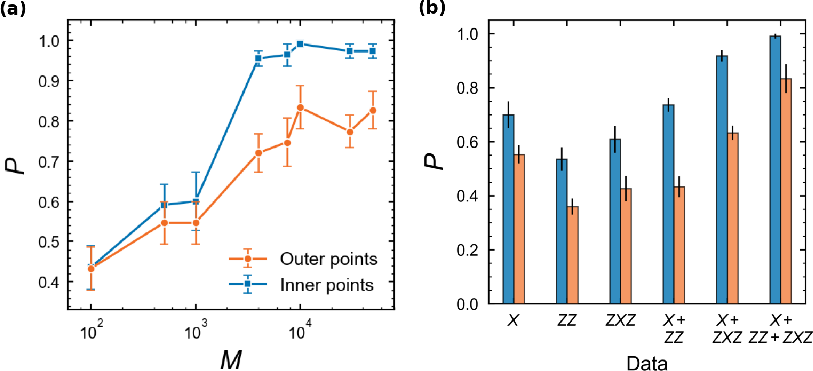
- It quantitatively achieves up to 97% accuracy in phase regions with modest trajectory counts, underscoring its experimental scalability.
- The framework robustly generalizes across system sizes while integrating multi-channel measurement data to resolve subtle phase transitions near critical boundaries.
Post-Selection-Free Neural Network Decoding of Measurement-Induced Area-Law Phases
Introduction
Measurement-induced phase transitions (MIPTs) in monitored quantum circuits represent a canonical example of non-equilibrium transitions between distinct entanglement phases, including transitions between trivial, long-range (LR) entangled, and symmetry-protected topological (SPT) phases. A major experimental obstacle in probing these transitions is the requirement for post-selection to access nonlinear entanglement quantities, leading to exponential overhead in state preparation and measurement for larger quantum systems. The present work provides a post-selection-free machine learning framework for discriminating coexisting area-law entangled phases, leveraging convolutional neural networks (CNNs) with attention mechanisms to robustly classify quantum phases directly from raw measurement records (2604.03550).
Measurement-Only Circuit Model and Phase Landscape
The authors consider a one-dimensional brickwork circuit comprised exclusively of generalized weak measurements along three axes: single-qubit X, two-qubit ZZ, and three-qubit ZXZ measurements. The tuple (γX,γZZ,γZXZ), with normalization γX+γZZ+γZXZ=1, governs the respective measurement strengths (Figure 1).
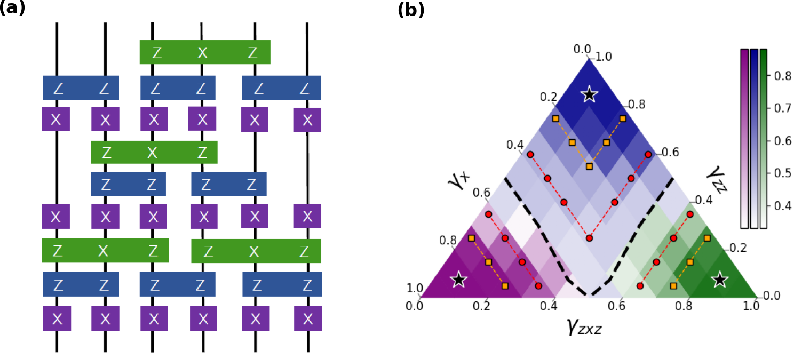
Figure 1: Schematic layout of the measurement-only brickwork circuit (a) and the ternary phase diagram highlighting the three area-law phases (b).
Phase boundaries and structure are determined by the interplay of measurement types: strong X collapses the wavefunction into a trivial product state, strong ZZ induces macroscopic LR entanglement, and strong ZXZ supports SPT order protected by global Z2×Z2 symmetry. Each phase is labeled by the steady-state entanglement structure, and transitions are nontrivial due to the absence of linear order parameters. The architecture is generic and representative of a broad class of monitored circuits exhibiting measurement-induced phenomena.
Neural Network Classifier Architecture
The neural network pipeline is designed to accommodate the natural data structure of the brickwork circuit, with three independent input branches corresponding to raw X, ZZ0, and ZZ1 measurement outcomes (Figure 2). Each channel is passed through an independent CNN encoder and then merged to extract both local and global temporal features of the measurement records.
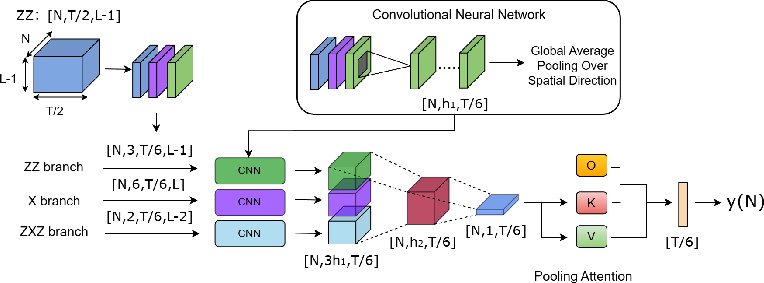
Figure 2: Network architecture showing parallel CNN branches for each measurement type, with final aggregation by a pooling attention mechanism and a classification head.
Spatial global average pooling, linear projection, and a temporal readout further compress the representation. A pooling attention module acts as a mechanism for adaptive aggregation across measurement trajectories, yielding a permutation-invariant summary vector for robust phase discrimination. The final softmax outputs a categorical distribution over the three phase labels, providing a statistically stable assignment for both bulk-phase and near-critical regime input data.
Systematic benchmarking demonstrates several key aspects of the architecture's performance:
Temporal and Spatial Dependencies
Phase classification only becomes reliable after the system has relaxed to its steady state. Accuracy as a function of evolution time ZZ8 exhibits a step-like transition coincident with the saturation of half-chain entanglement entropy (Figure 4). For subsystem-based inputs, increasing the spatial region size ZZ9 systematically enhances phase distinguishability, confirming that essential phase information is locally encoded but global access improves boundary resolution.
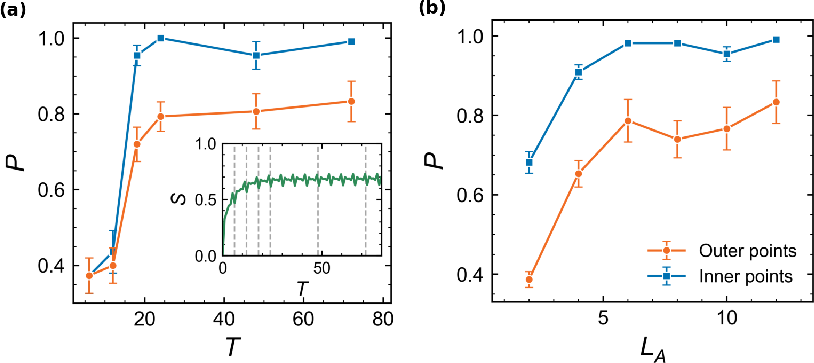
Figure 4: (a) Classification accuracy as a function of evolution time ZXZ0. (b) Accuracy increase with accessible subsystem size ZXZ1.
Generalization and Role of Attention
The network displays robust transfer-learning capabilities: models trained on small systems (e.g., ZXZ2) generalize without retraining to substantially larger systems (ZXZ3) provided that the input data covers a central region of the same size. This implies the learned features are size-independent and universal across the phase diagram.
Critically, the attention mechanism adds a statistically significant accuracy boost over a CNN-only baseline, particularly near phase boundaries (Figure 5). The attention layer provides superior aggregation of multi-trajectory statistics, as evidenced by a ZXZ4–ZXZ5 boost for ambiguous test inputs. A simple MLP approach, processing trajectories independently, exhibits near-random performance on difficult points, underlining the necessity of the attention-based agglomeration.
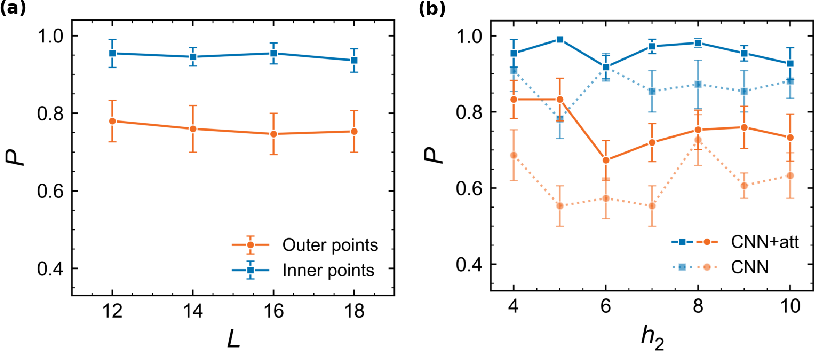
Figure 5: (a) System size transfer without retraining. (b) Comparative accuracy with and without attention for both inner and outer test points.
Theoretical and Experimental Implications
This architecture provides strong evidence that high-fidelity phase discrimination in monitored quantum circuits can be achieved without the exponential experimental overhead associated with post-selection or quantum state tomography. By relying solely on accessible measurement record statistics, this approach streamlines experimental probes of area-law entangled phases and enables exploration of rare-region effects and boundary phenomena in larger, more complex circuits.
The demonstrated modularity and transferability suggest immediate applicability to more intricate measurement protocols, higher-dimensional architectures, and a broader diversity of SPT/topological orders. The systematic architecture search, together with quantification of scaling, provides a pathway to scalable, robust, and statistically efficient classical post-processing protocols for phase recognition in quantum simulation experiments.
Conclusion
This work establishes a post-selection-free, machine learning-based methodology for decoding area-law quantum phases in measurement-driven circuits, using a physically informed neural architecture with hybrid CNN and attention components. The framework achieves high classification accuracy with modest trajectory counts, generalizes across system sizes, and robustly integrates the complementary informational content of disparate measurement channels. These results constitute a practical advance for experimental studies of MIPTs and open new perspectives on the scalable classical inference of topological and entanglement phenomena in quantum many-body systems.