Revisit Static Aether: Exact Vacuum Solution in Einstein-Aether Theory and Its Analytic Extension
Published 26 Jun 2026 in gr-qc | (2606.27995v1)
Abstract: We obtain an exact analytical vacuum solution of Einstein-Aether theory with a strictly static aether configuration and investigate its maximal extension. The solution depends only on the coupling $c_{14}$ and reduces to the Schwarzschild geometry in the limit $c_{14}=0$. We show that Schwarzschild is an isolated member of this family: for any nonzero $c_{14}$ the spacetime ceases to be a black hole and instead becomes either a naked singularity ($c_{14}<0$) or a wormhole-like geometry ($0<c_{14}<2$). By constructing the complete analytic extension, we demonstrate that the internal infinity of the wormhole corresponds to an extremal Killing horizon. Crossing this horizon leads to a new spacetime region where the causal roles of time and radial coordinates are exchanged, and the spacetime ultimately terminates at a spacelike singularity. The resulting global structure, summarized by the corresponding Carter-Penrose diagrams, reveals a previously unexplored causal completion of the static-aether vacuum spacetime.
The paper presents an exact analytic vacuum solution in static Einstein-Aether theory, showing that Schwarzschild emerges only when c14 = 0 while nonzero values yield radically different spacetimes.
The analysis employs a new coordinate system to uncover distinct causal structures, including naked singularities for c14 < 0 and wormhole-like geometries for 0 < c14 < 2.
The construction of analytic extensions and Carter-Penrose diagrams provides insights into traversable internal boundaries and potential observational signatures of Lorentz violation.
Exact Analytical Vacuum Solutions and Causal Extensions in Static-Aether Einstein-Aether Theory
Introduction and Motivation
Einstein-Aether (EA) theory, a prominent Lorentz-violating alternative to General Relativity (GR), augments the gravitational sector with a dynamical, unit-timelike vector field (the "aether") ua. This framework naturally introduces a preferred frame, providing rich phenomenology for gravitational and quantum gravity studies, particularly in scenarios involving potential Lorentz violation at low energies.
This work addresses an outstanding, central question within the static aether sector: the detailed structure and maximal analytic extension of exact vacuum solutions characterized solely by the coupling c14=c1+c4. While previous studies (notably Eling and Jacobson; Chan et al.; Oost et al.) described particular solutions or made partial progress, the absence of compact analytical representations for arbitrary c14 precluded a comprehensive analysis of the global spacetime structure, possible horizons, singularities, and the behavior under analytic continuation.
Analytical Form of the Static Aether Solution
The authors derive a coordinate system in which the static aether vacuum solution is given in remarkably concise analytic form. This metric, in a radial coordinate ρ, reads: ds2=−ρ2dt2+ρ4(ρ−μ−ρμ)44μ4Rs2dρ2+ρ2(ρ−μ−ρμ)2μ2Rs2(dθ2+sin2θdϕ2),
where μ=1−c14/2 and Rs is related to the ADM mass. This new coordinate patch and solution structure allow analytic investigation across the full range c14<2, revealing the intricate causal and geometric properties as a function of c14.
A crucial result is that for c14=0 (c14=c1+c40), this reduces exactly to the Schwarzschild solution, but for any nonzero c14=c1+c41, the metric ceases to describe a black hole. Instead, the solution displays qualitatively distinct behavior depending on the sign and magnitude of c14=c1+c42:
c14=c1+c43 (c14=c1+c44): The spacetime describes a naked singularity, generically cloaked by a photon sphere only for c14=c1+c45.
c14=c1+c46 (c14=c1+c47): The solution exhibits a wormhole-like geometry with a throat; the internal infinity is either a spacelike curvature singularity (for c14=c1+c48) or a non-singular surface at infinite proper distance (c14=c1+c49).
The analytic transformation to standard c140 coordinates is explicitly constructed, providing asymptotically flat behavior in one branch of the solution and facilitating physical interpretation of the global structure.
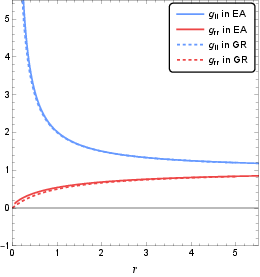
Figure 1: c141 and c142 for the wormhole-like solution with c143 (c144) and c145, showing the metric's behavior exterior and interior to the throat.
Causal Structure: Horizons, Singularities, and Analytical Extensions
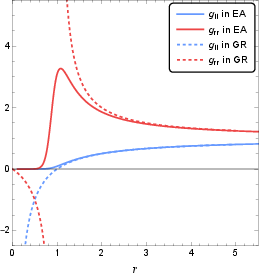
For c146, the solution contains a naked singularity at c147, where both c148 and c149 vanish, verified by calculation of the Kretschmann scalar. The spacetime does not admit a horizon; the geodesic analysis shows that both massive and massless particles reach the singularity in finite affine parameter.
Figure 2: ρ0 and ρ1 for the naked singularity solution (ρ2, ρ3, ρ4).
For ρ5, a pole in ρ6 at a finite radius indicates a wormhole throat (the minimum of the areal radius ρ7), as can also be demonstrated by the double-valuedness of ρ8 and ρ9 across the throat.
Photon Spheres and Light Propagation
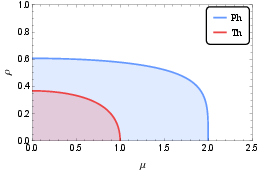
Investigating photon spheres, the authors show that for ds2=−ρ2dt2+ρ4(ρ−μ−ρμ)44μ4Rs2dρ2+ρ2(ρ−μ−ρμ)2μ2Rs2(dθ2+sin2θdϕ2),0 a photon sphere exists at a specific value of ds2=−ρ2dt2+ρ4(ρ−μ−ρμ)44μ4Rs2dρ2+ρ2(ρ−μ−ρμ)2μ2Rs2(dθ2+sin2θdϕ2),1, and is always exterior to the throat for wormhole-like solutions. The relation between the photon sphere and the throat positions as functions of ds2=−ρ2dt2+ρ4(ρ−μ−ρμ)44μ4Rs2dρ2+ρ2(ρ−μ−ρμ)2μ2Rs2(dθ2+sin2θdϕ2),2 is detailed.
Figure 3: Position of the photon sphere and wormhole throat versus parameter ds2=−ρ2dt2+ρ4(ρ−μ−ρμ)44μ4Rs2dρ2+ρ2(ρ−μ−ρμ)2μ2Rs2(dθ2+sin2θdϕ2),3 (or ds2=−ρ2dt2+ρ4(ρ−μ−ρμ)44μ4Rs2dρ2+ρ2(ρ−μ−ρμ)2μ2Rs2(dθ2+sin2θdϕ2),4), highlighting parameter regimes for various global topologies.
Analytic Extension and Carter-Penrose Diagram
A major achievement is the construction of the maximal analytic extension for ds2=−ρ2dt2+ρ4(ρ−μ−ρμ)44μ4Rs2dρ2+ρ2(ρ−μ−ρμ)2μ2Rs2(dθ2+sin2θdϕ2),5. The authors derive a branch where ds2=−ρ2dt2+ρ4(ρ−μ−ρμ)44μ4Rs2dρ2+ρ2(ρ−μ−ρμ)2μ2Rs2(dθ2+sin2θdϕ2),6, via an alternative coordinate choice, and show that the "internal infinity" is an extremal Killing horizon. Crossing this horizon, the causal roles of time and radius invert, leading ultimately to a spacelike singularity.
They provide a detailed Kruskal-like extension, including explicit conditions for analytic branch matching, and present the global spacetime using a Carter-Penrose diagram. Notably, this diagram resembles the maximally extended Schwarzschild spacetime but with an extremal horizon of infinite area (for ds2=−ρ2dt2+ρ4(ρ−μ−ρμ)44μ4Rs2dρ2+ρ2(ρ−μ−ρμ)2μ2Rs2(dθ2+sin2θdϕ2),7 a genuine curvature singularity), and a wormhole throat located outside the horizon.
Connections to the Janis-Newman-Winicour Solution
The constructed metric for ds2=−ρ2dt2+ρ4(ρ−μ−ρμ)44μ4Rs2dρ2+ρ2(ρ−μ−ρμ)2μ2Rs2(dθ2+sin2θdϕ2),8 coincides with the Janis-Newman-Winicour (JNW) solution, the unique static, spherically symmetric solution of GR with a massless minimally coupled scalar. In EA theory, however, ds2=−ρ2dt2+ρ4(ρ−μ−ρμ)44μ4Rs2dρ2+ρ2(ρ−μ−ρμ)2μ2Rs2(dθ2+sin2θdϕ2),9 is fixed by theory parameters, while in the JNW solution it is a free scalar charge. For μ=1−c14/20, the metric is formally similar but physically inequivalent, leading to previously unexplored causal structures in the context of EA theory.
Physical Implications and Theoretical Significance
Key claims of the paper include:
No black holes for μ=1−c14/21: Schwarzschild is an isolated point; any μ=1−c14/22 precludes the existence of a regular black hole structure.
Nature of the internal boundary: For μ=1−c14/23, the internal infinity is an extremal Killing horizon, not a causal boundary in the usual sense, and can be crossed by physical geodesics.
New causal completions: The global structure is richer than anticipated, with possible traversal into causally reversed domains beyond the horizon.
These results have potentially broad implications for the theoretical landscape of Lorentz-violating gravity models:
Quantum Gravity and Lorentz Violation: The altered horizon/singularity structure provides distinct observational and theoretical signatures, valuable for constraining or identifying departures from GR in strong-field regimes.
Global Geometry in Modified Gravity: The intricate causal structures demonstrated here indicate that even small couplings beyond GR can radically alter vacuum spacetime, impacting both astrophysical scenarios and fundamental theory.
Extensions and Applications: The methods and analytic solutions presented furnish templates for further work in more general Einstein-Aether settings, including dynamical aether, matter coupling, or numerical simulations.
Speculation on Future Developments
One important avenue is the dynamical and stability analysis (linear perturbations, quasinormal modes), especially for the wormhole-like geometry and the fate of test particles traversing the internal horizon. Extensions to charged, rotating, and higher-dimensional versions will clarify both astrophysical and theoretical viability. Furthermore, this structure could be leveraged in phenomenological searches for Lorentz violation using strong gravity probes (e.g., gravitational lensing, ringdown signals).
Conclusion
This study produces a compact, exact, and general analytic representation for the static aether vacuum in EA theory for arbitrary μ=1−c14/24, and systematically analyzes its global structure and analytic extensions. By establishing Schwarzschild as an isolated solution and revealing wormhole geometries or naked singularities for all μ=1−c14/25, the work clarifies the essential impact of Lorentz violation in the gravitational sector. The explicit analytic continuation and Carter-Penrose analysis uncover a previously unrecognized class of spacetimes, demonstrating that analytic and causal extensions in Lorentz-violating gravity can be far richer than their GR analogs, with potential consequences for both theory and experiment.