- The paper presents comprehensive methods to infer key cosmological and astrophysical parameters with percent-level precision using SKA-Low data.
- It compares analytical, semi-numerical, full numerical, and emulation frameworks to model the complex, non-Gaussian 21 cm signal.
- The study emphasizes combining multiple statistical probes and field-level inference to overcome model uncertainties and parameter degeneracies.
Inferring Cosmology and Astrophysics from the High-redshift 21cm Signal with SKA-Low
Introduction and Scientific Motivation
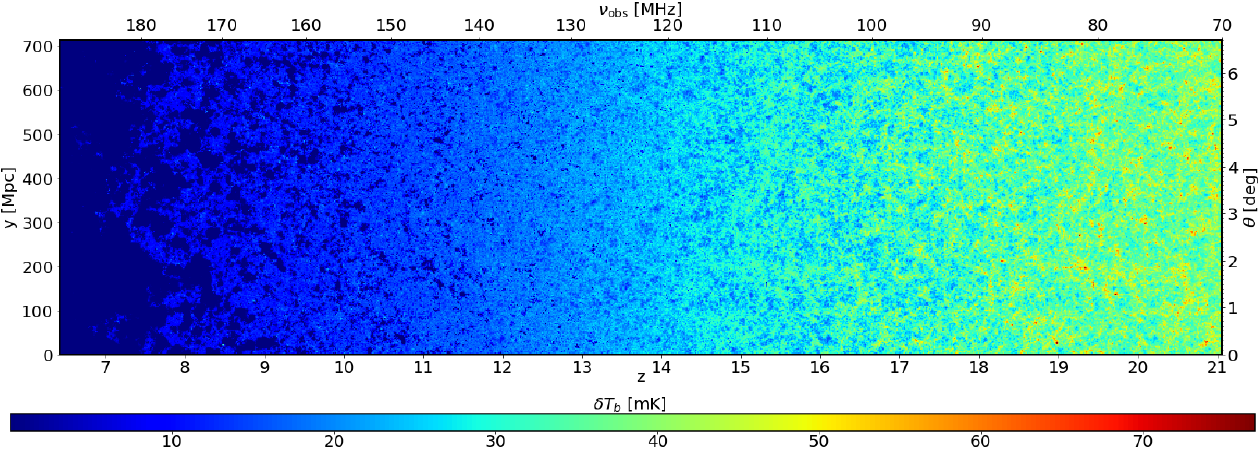
The study presents a comprehensive analysis of the prospects for astrophysical and cosmological parameter inference from redshifted 21 cm observations with the SKA-Low radio telescope, targeting the Cosmic Dawn (CD; z∼30−15) and Epoch of Reionization (EoR; z∼15−6). The 21 cm signal, originating from neutral hydrogen, enables tomographic mapping of the IGM, offering a multidimensional view of early structure formation and the feedback processes that regulated the first luminous sources. While current experiments have imposed upper limits on the 21 cm signal, SKA-Low’s improved sensitivity will allow not only detections but precision inferences on a wide range of physical parameters governing these epochs.
Modelling Frameworks for the 21 cm Signal
Accurate inference requires robust modelling of the 21 cm signal, for which the study reviews and contrasts four major modelling paradigms:
Statistical Probes: Power Spectrum and Beyond
Power Spectrum as Primary Statistic
The power spectrum (PS)—spherically or cylindrically averaged—remains the cornerstone observable for 21 cm science due to its completeness for Gaussian fields, computational tractability, and expected detection feasibility. The study discusses the theoretical basis for different PS estimators, including window function corrections, and the implications of lightcone effects that break statistical homogeneity along the line-of-sight. The authors additionally advocate for use of the Multi-frequency Angular Power Spectrum (MAPS) to better accommodate line-of-sight evolution and maximize information extraction.
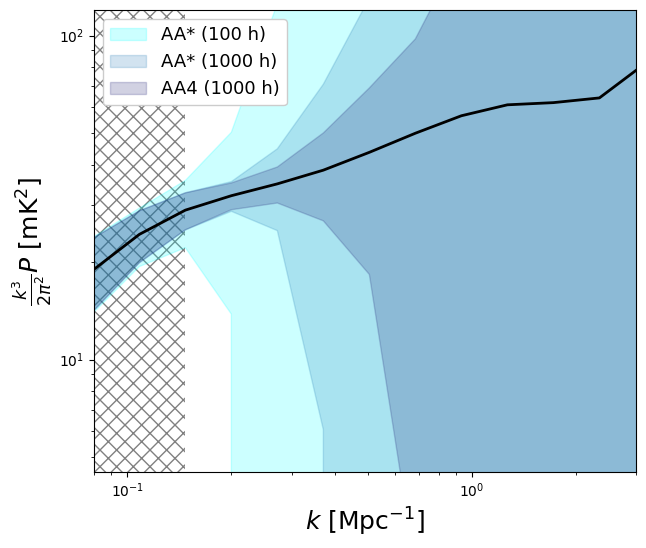
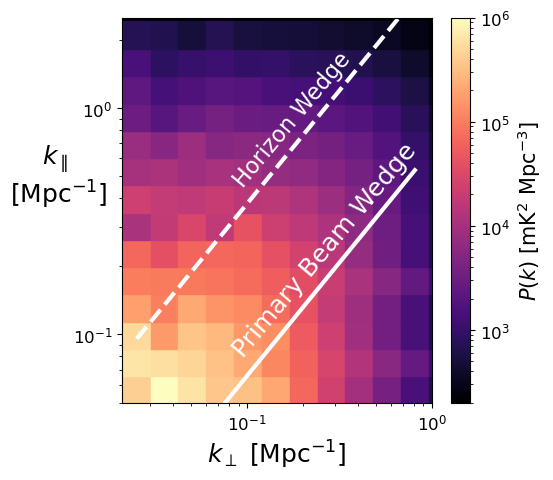
Figure 2: 1D and 2D power spectra of a fiducial SKA-Low simulation, highlighting noise levels, foreground-dominated regions, and the EoR window.
Fisher Forecasts and Bayesian Inference
Fisher-matrix forecasts for SKA-Low configurations (AA*, AA4) reveal that increasing integration times (100→1000 hours) and denser antenna layouts yield substantial tightening in constraints on reionization parameters, such as minimum virial temperature, effective ionizing radius, and photon production efficiency. The cylindrical PS can outperform the spherically-averaged PS if wedge (foreground) modes can be reliably recovered, though information loss due to avoidance strategies can degrade constraints by factors of 2–3.
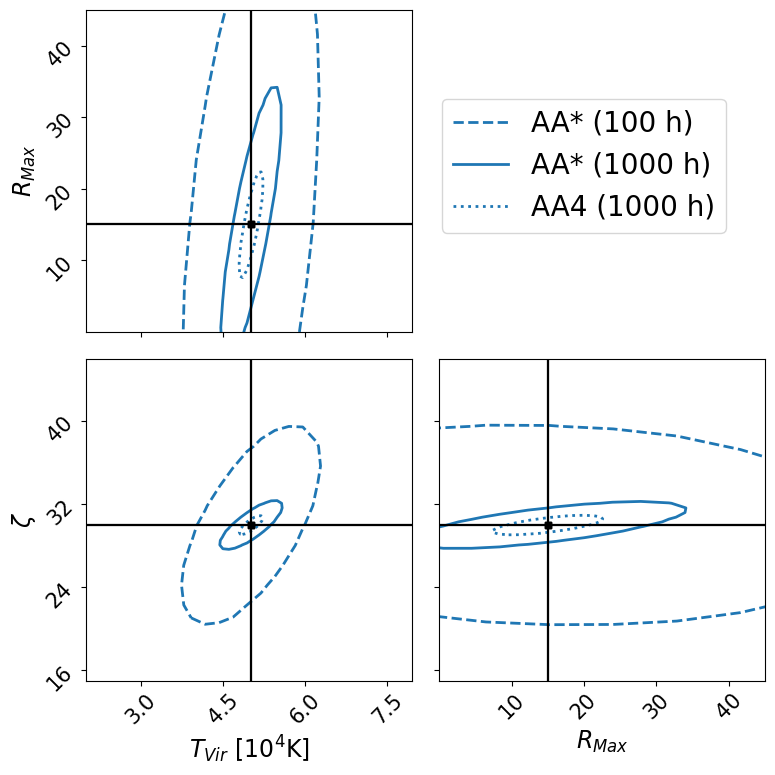
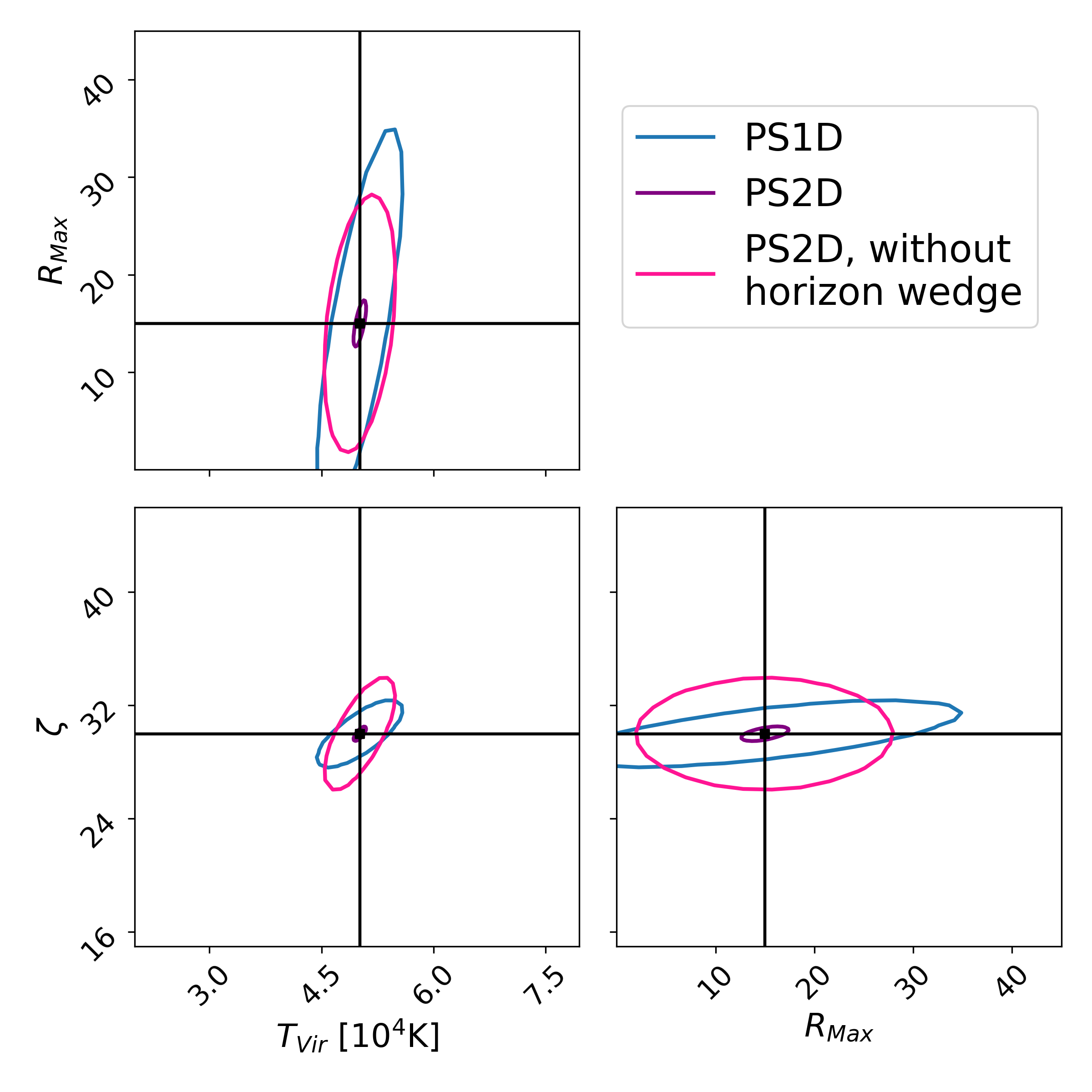
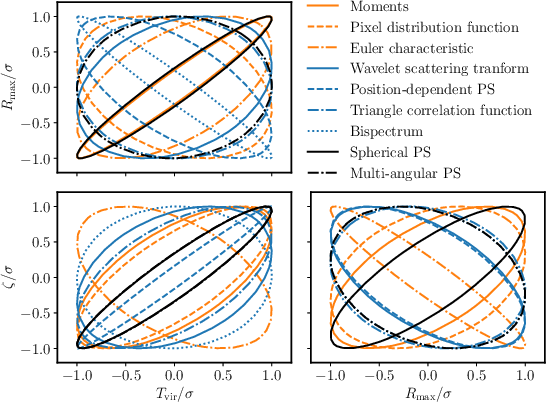
Figure 3: Posterior distributions from Fisher forecasts show the progressive tightening of parameter constraints with increasing survey depth and antenna density, and the impact of foreground avoidance.
Bayesian inference using state-of-the-art emulators and nested sampling (e.g., 21cmEMU, MultiNest) demonstrates that 108–1080 hours of SKA-Low data alone can constrain key CD/EoR parameters to percent-level precision, outpacing the combined constraining power of current multiwavelength probes and upper limits. Simulation-Based Inference (SBI) methods are highlighted as crucial for cases where the likelihood is intractable or the true summary statistic distribution is non-Gaussian.
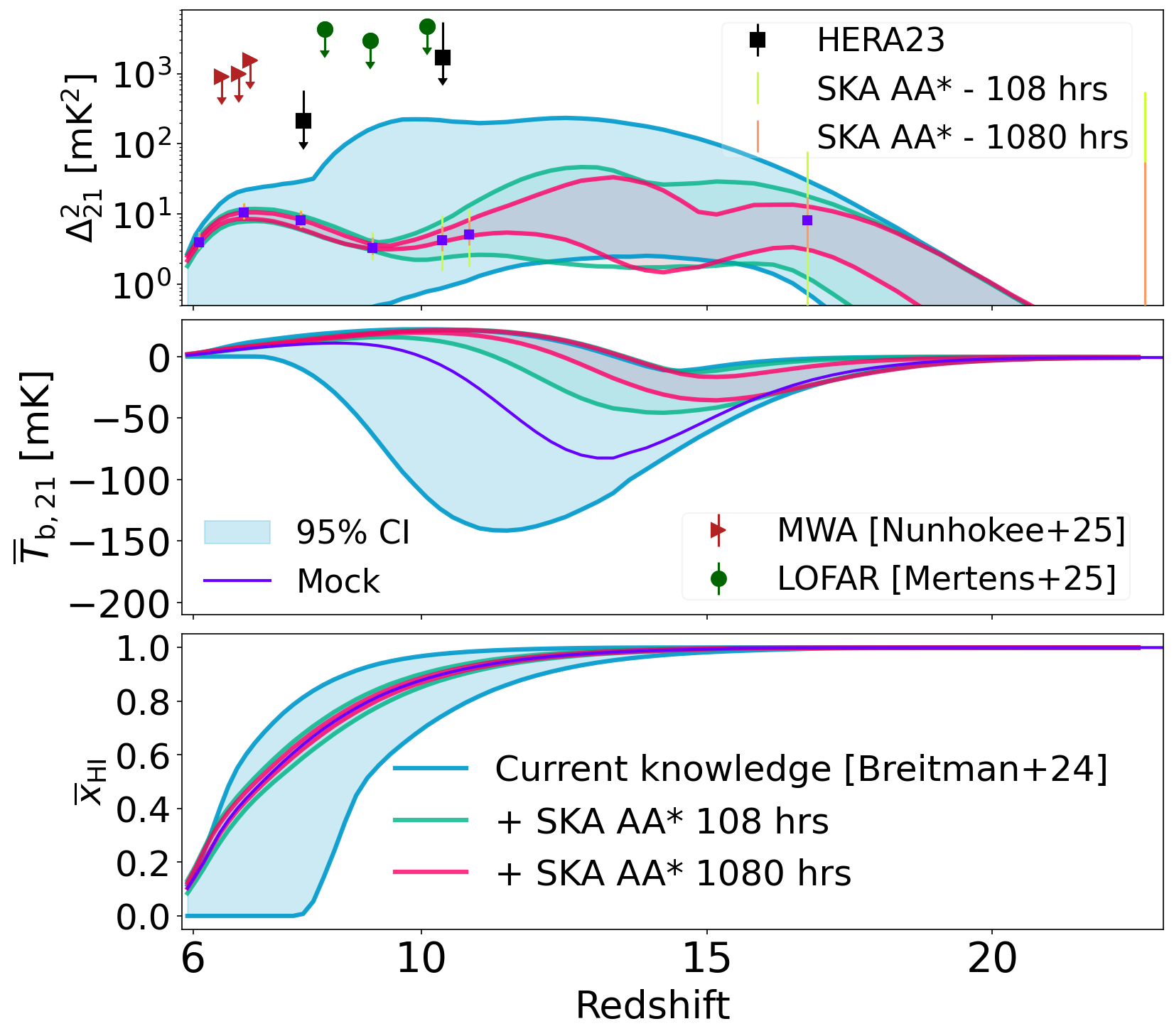
Figure 4: Inference posteriors for the PS, global signal, and EoR history from different combinations of current and projected SKA-Low observations, highlighting dramatic improvement in parameter recovery with increased exposure.
The authors emphasize the necessity of moving beyond the two-point PS, given the strongly non-Gaussian nature of reionization:
Given that no single statistic is sufficient, the study discusses three complementary strategies for maximized information extraction:
- Information Maximizing Summaries: Machine learning approaches (IMNN, contrastive learning, self-supervised transformers) can be trained to compress data while retaining parameter information, potentially achieving near-optimal performance when paired with SBI.
- Combination of Summary Statistics: Empirically, joint inference with multiple statistics outperforms any alone. Simulation-based neural posterior estimator networks circumvent the challenges of high-dimensional likelihood evaluation.
- Field-level Inference: Recent advances in field-level Bayesian inference, especially with emerging high-dimensional samplers and generative models, open the possibility for lossless extraction of cosmological and astrophysical information directly from 3D tomographic data cubes.
Modelling Uncertainties and Their Impact
Despite the projected advances in statistical methodologies and SKA-Low sensitivity, the authors caution that modelling uncertainties—stemming from halo formation physics, parameterization choices, and instrumental complexity—introduce non-negligible biases into parameter recovery if not systematically marginalized or controlled. Comparative analyses using emulators and mock observations trained on different models demonstrably recover biased histories when models are mismatched, underscoring the importance of robust uncertainty quantification.
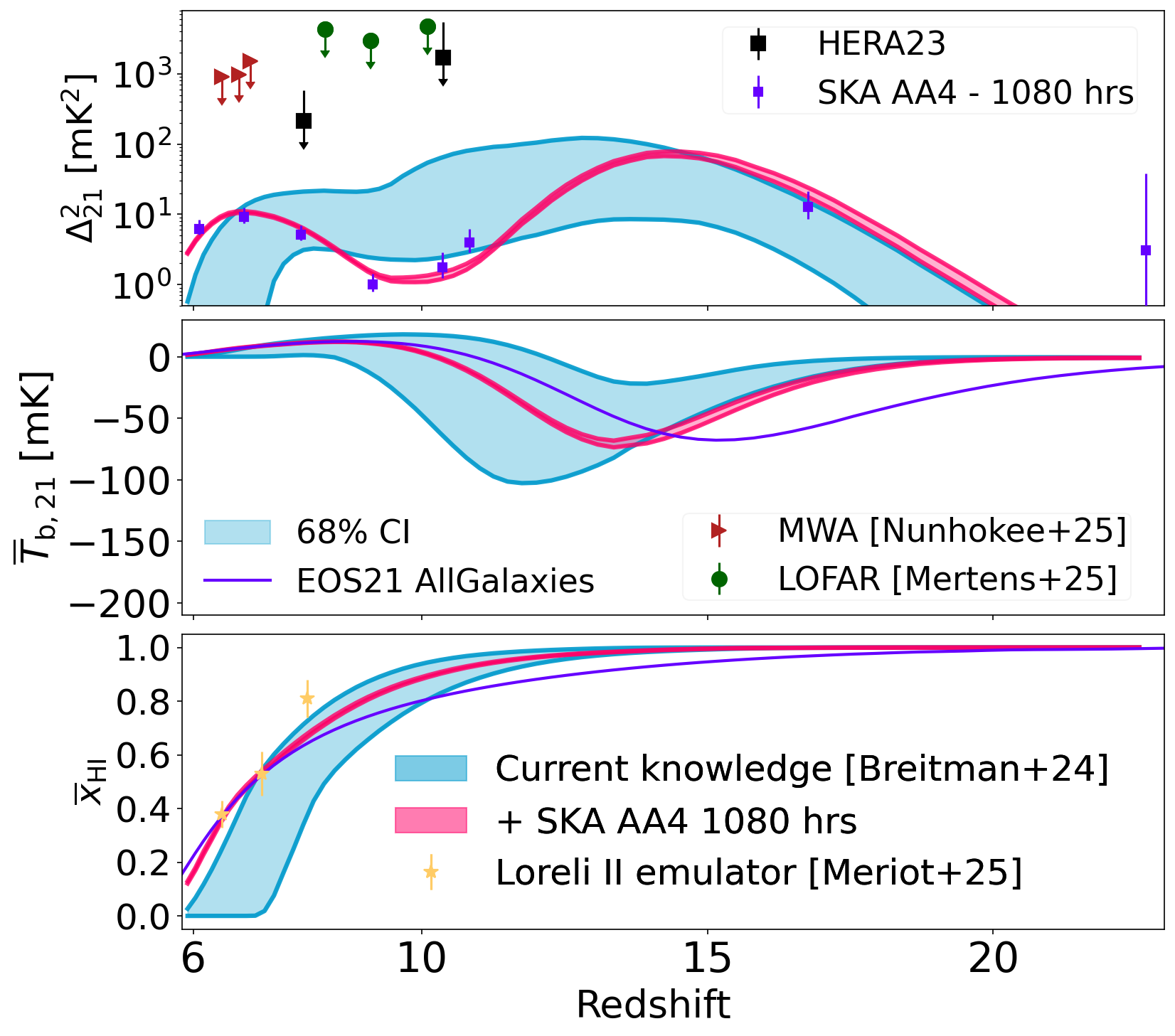
Figure 6: Posterior recovery from mismatched emulators and observations, illustrating deviation of EoR histories due to model misspecification.
Broader Implications and Future Directions
The SKA-Low-era 21 cm data will constitute one of the most sensitive probes of the cosmological model in the early Universe. Beyond standard ΛCDM cosmology, the review describes applications to inflationary physics (e.g., scale-dependent non-Gaussianity), non-standard dark matter models, and extensions such as modified gravity, with studies showing the discriminating power of 21 cm statistics for a range of new physics scenarios. Coupling with ancillary probes (multiwavelength, cross-correlations with galaxy/line-intensity mapping) is highlighted as necessary for breaking cosmology-astrophysics degeneracies. Realistic assessment of constraints must account for foreground avoidance, calibration uncertainties, and the full instrumental covariance.
Conclusion
The reviewed work provides a detailed roadmap for how SKA-Low will transition 21 cm cosmology from upper-limit science to precision astrophysics and cosmology. By integrating a diverse arsenal of statistical probes, advanced inference algorithms, and physically-calibrated forward models, the SKA-Low community is poised to deliver quantitative reconstructions of the early Universe’s thermal and ionization history. Future advances will depend not only on instrumental realization but continued methodological innovation, synergistic use of higher-order and topological statistics, and systematic marginalization over uncertainties in both physical and observational modelling.
This essay summarizes "Inferring Cosmology and Astrophysics from the High-redshift 21cm Signal with SKA-Low" (2606.27858).