- The paper introduces advanced modeling and simulation techniques to capture 21 cm forest absorption features, providing insights into IGM thermal evolution and reionization dynamics.
- It employs both direct counting and statistical methods, including the 1D power spectrum and high-dimensional PCA, to extract key astrophysical and cosmological parameters.
- Findings underscore the crucial role of SKA observations and high-redshift radio sources in constraining early Universe heating, dark matter microphysics, and exotic energy injections.
Probing the Cosmic Dawn with the 21 cm Forest and High-redshift Radio Sources Using SKA
Introduction: The 21 cm Forest as a Precision Probe of the Early Universe
The 21 cm forest, a collection of narrow absorption features in the radio spectra of distant, radio-loud sources, offers a direct method for investigating the neutral hydrogen (HI) content and small-scale structures of the intergalactic medium (IGM) during the epoch of reionization (EoR) and cosmic dawn. This paper provides a comprehensive synthesis of theoretical modeling, simulation strategies, data analysis methodologies, and observational prospects for exploiting the 21 cm forest with the Square Kilometre Array (SKA), with particular attention to both astrophysical and cosmological constraints accessible through these measurements (2606.24665).
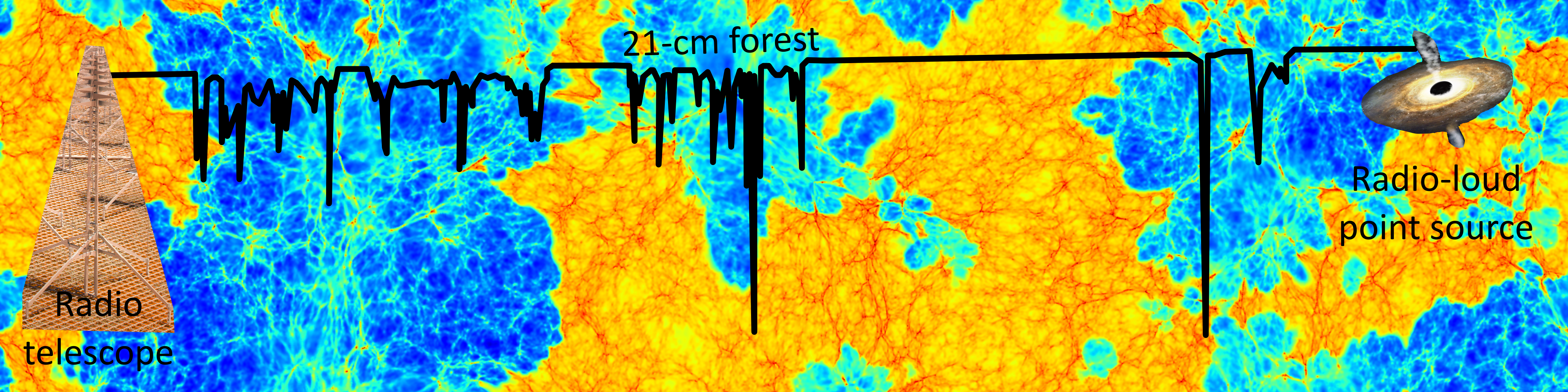
Figure 1: Schematic view of the 21~cm forest and its absorption geometry against a background radio-loud quasar.
Theoretical Modeling of the 21 cm Forest: Analytical, Semi-analytical, and Numerical Approaches
Detection and interpretation of the 21 cm forest requires rigorous modeling of the HI absorption signal. Semi-analytic frameworks enable the characterization of minihalos and infalling gas surrounding dark matter halos, providing high dynamic range with manageable computational cost but requiring simplifying assumptions for radiative and thermal processes. Fully numerical hydrodynamic and radiative transfer simulations—such as Aurora, CRASH, Sherwood-Relics—capture non-linear gas dynamics and patchy reionization topology, albeit at the cost of computational scalability and limited coverage of physical parameter space. Semi-numerical tools like 21cmFAST bridge this gap, enabling rapid exploration of extended parameter spaces for X-ray background efficiency (fX), reionization morphology, and dark matter physics.
The absorption signal is exquisitely sensitive to the thermal and ionization state of the IGM and the spin temperature coupling. Inclusion of X-ray background heating is shown to be critical: increased fX strongly suppresses the number of observable absorption features and their optical depths. Physical approximations—such as assuming TS=TK, neglecting redshift-space distortions, or treating reionization as homogeneous—are demonstrated to induce order-of-magnitude differences in signal amplitude, particularly in the high-optical-depth regime.
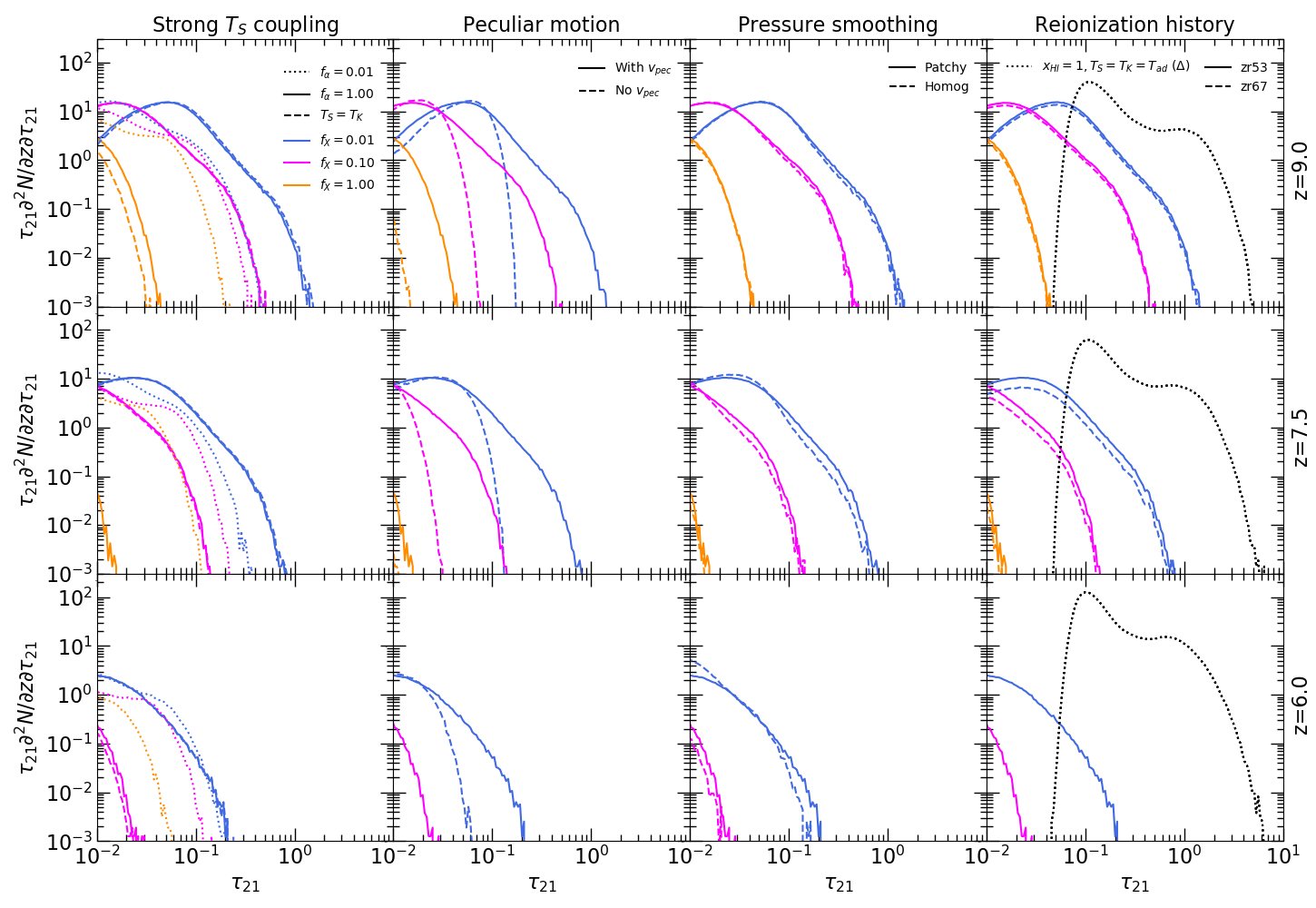
Figure 2: Redshift and X-ray background dependence of synthetic 21~cm forest absorption features, illustrating the dominant suppression by increased X-ray heating efficiency and the effects of Ly-α coupling, RSDs, and reionization timing.
High-resolution hydrodynamic simulations remain essential to determine the minihalo contribution, accurately describe feedback, and validate analytical models. However, numerical resolution and feedback uncertainties currently preclude definitive quantification of the minihalo signal's contribution to the total observable 21 cm forest.
Statistical and Direct Detection Strategies: Signal Extraction and Data Analysis Innovations
Direct detection and statistical inference techniques are both pursued for 21 cm forest science with SKA. Direct counting of individual absorption features in high-SNR spectra of radio-loud sources provides a measure of small-scale structure, sensitive to the mass function and density profiles of minihalos and the ambient IGM [Furlanetto_2002, Shimabukuro_2014]. However, the requirements for continuum brightness, frequency resolution, and integration time are demanding, and the number of suitable high-z sources is limited.
Statistical approaches, such as measuring the 1D power spectrum along sightlines, substantially improve sensitivity and robustness against systematics and sampling variance. The 1D power spectrum of the 21 cm forest captures a combination of astrophysical heating and cosmological fluctuation power, enabling the decorrelation of dark matter free-streaming (e.g., WDM suppression) from IGM temperature effects. Distinct suppression signatures in amplitude (heating) versus slope (WDM mass) manifest in the power spectrum, and can be captured at feasible noise levels with SKA given O(100) independent sightlines and moderate integration times.
Principal Component Analysis (PCA) and novel high-dimensional statistics (HDLSS) are necessary given the "small n, large d" nature of 21 cm forest datasets, where the sample size of backgrounds is much smaller than spectral or spatial data dimensions. High-dimensional PCA techniques rigorously subtract the noise sphere in feature space, enabling extraction of physically meaningful variance components even when the rank deficiency is severe.
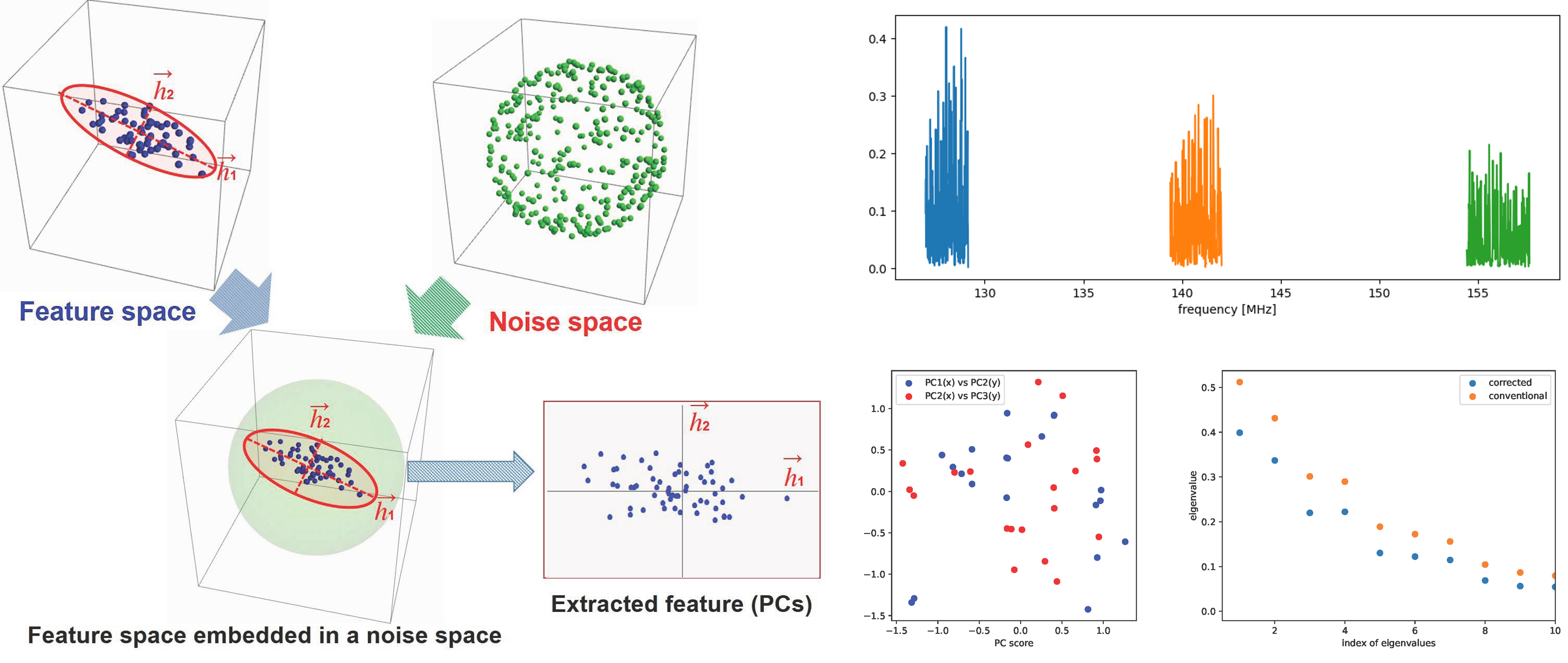
Figure 3: Schematic and application of high-dimensional PCA for denoising and feature extraction in HDLSS 21~cm forest datasets.
Recent developments also include the application of wavelet scattering transforms, which offer hierarchical, robust, non-Gaussian-sensitive feature extraction, and enable parameter inference well beyond the power spectrum approximation.
Astrophysical and Cosmological Constraints from the 21 cm Forest
The combined sensitivity of the 21 cm forest to IGM temperature, spin temperature coupling, and HI fraction allows robust constraints on pre-reionization heating processes, the timing and topology of reionization, and the evolution of neutral islands. Bayesian parameter inference using power spectrum and higher-order statistics yields tight posteriors on fX and ⟨xHI⟩, outperforming traditional Fisher-based approaches, especially in non-Gaussian or strongly heated regimes. Machine learning (normalizing flows, U-Nets, XGBoost) pushes the state of the art in simulation-based likelihood-free inference, allowing fast, accurate, and scalable parameter inference even with limited data.
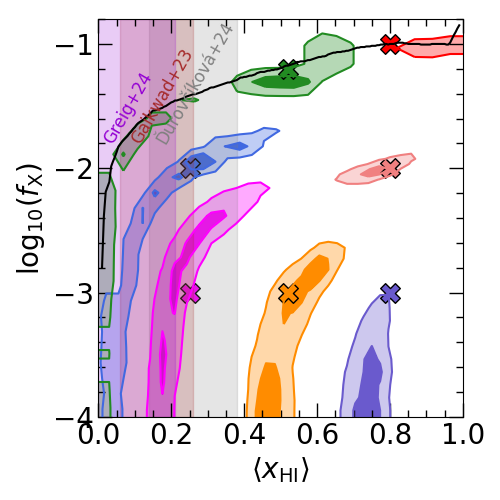
Figure 4: Posterior distributions for fX0 and fX1 from 1D power spectrum MCMC analyses, demonstrating the constraining power of SKA on IGM thermal and ionization parameters.
On the cosmological frontier, the 21 cm forest uniquely probes small-scale structure and dark matter microphysics inaccessible to CMB or Lyman-fX2 forest techniques. It delivers leading limits on WDM particle mass, axion-like particles, and scenarios with isocurvature or PBHs, as well as constraining exotic energy-injection mechanisms and dark matter-baryon couplings responsible for the anomalous EDGES absorption profile. Interactions leading to IGM cooling or heating are distinguishable via their characteristic imprints on absorption- and power-spectrum statistics.
The Crucial Role of High-redshift Radio-loud Quasars: Population, Discovery, and SKA Prospects
The primary bottleneck for 21 cm forest studies is the paucity of suitably bright, high-redshift background radio sources. The last decade has seen a significant increase in known fX3 radio-loud quasars, quadrupled to fX4 with redshifts as high as fX5 and measured 150 MHz flux up to fX6110 mJy [Banados_2024]. The SKA and its precursor surveys (ASKAP-RACS) are expected to discover dozens more, with physically motivated forecasts predicting fX720 suitable targets at fX8 in a one-year all-sky SKA-Low survey.
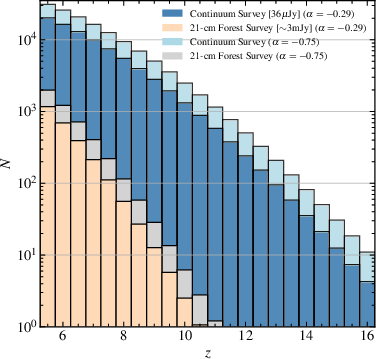
Figure 5: Predicted redshift distribution of radio-loud quasars detectable in one year by SKA-Low, sufficient for high-spectral-resolution 21~cm forest studies.
Identification and redshift measurement require synergy with IR/optical surveys (Euclid, Roman, JWST) to exploit the Lyman-fX9 break and enable cross-correlation of IGM and source properties. The combination of SKA and advanced space-based IR observatories will provide complete samples of suitable high-TS=TK0 backgrounds for comprehensive 21 cm forest spectroscopy.
Fast Radio Bursts and Alternative High-TS=TK1 Probes
Fast Radio Bursts (FRBs) provide independent probes of the ionized IGM via their dispersion measures (DM). The paper discusses the complementarity of FRB statistics and 21 cm forest absorption: while forest absorption traces neutral HI, DM measurements from FRBs at TS=TK2 probe the ionization morphology and bubble size statistics. The expected SKA detection rate in the EoR window provides a realistic pathway for joint constraint of the reionization history, bubble size distributions, and IGM thermal state.
Practical Limitations, Systematics, and Future Analysis Pipelines
Instrumental and analysis systematics—such as frequency-dependent gain, beam chromaticity, ionospheric effects, and RFI—impose practical limitations on both direct and statistical detection strategies. Realistic sensitivity forecasts and robust statistical validation (end-to-end signal injection, null tests) are emphasized as essential for reliable SKA-based inferences.
The authors argue for continued development of cross-validated analysis pipelines, leveraging both traditional Bayesian methods and amortized, simulation-based neural density estimators capable of robust inference in data-limited, high-dimensional, and non-Gaussian regimes. The integration of high-dimensional statistical techniques, machine learning, and rigorous instrumental characterization is highlighted as a prerequisite to realizing the full scientific potential of SKA 21 cm forest observations.
Conclusion
This work defines the methodology and scientific case for using the 21 cm forest as a probe of the cosmic dawn, focusing on the transformational potential of SKA observations. Through detailed modeling, simulation, and data analysis innovation, the study demonstrates the promise of the 21 cm forest for joint constraints on IGM thermal evolution, reionization history, and small-scale cosmological structure—including non-standard dark matter and exotic energy injection. Realization of this potential fundamentally depends on the discovery and spectroscopic confirmation of high-redshift radio-loud quasars, advances in statistical inference and noise control, and the integration of multi-wavelength observations with SKA data. The results provide a comprehensive roadmap for future observational, theoretical, and computational work in the precision characterization of the high-redshift Universe, establishing clear priorities and highlighting the central scientific roles played by the 21 cm forest in the next generation of cosmological inference.

