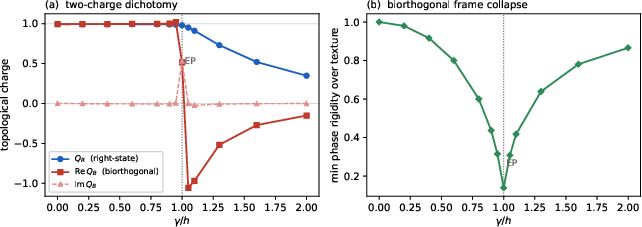
- The paper demonstrates that non-Hermitian deformations split the topological charge into homotopy-protected (Q_R) and biorthogonal (Q_B) measures.
- The biorthogonal charge becomes complex and loses integer quantization, collapsing at exceptional points marked by a real-space equatorial ring.
- Numerical analyses confirm that while Q_R remains near its integer value, Q_B exhibits discontinuous behavior as gain/loss is varied across EPs.
Topological-Charge Breakdown at Exceptional Points in Non-Hermitian Skyrmions
Overview
This paper investigates the fate of the quantized topological charge, traditionally associated with the robustness of magnetic skyrmions, in a non-Hermitian context featuring balanced gain/loss or PT-symmetric anisotropy. The central result is the identification of two distinct charge measures—one homotopy-protected, one biorthogonal—that coincide in Hermitian systems but diverge upon non-Hermitian deformation. The study reveals that the biorthogonal charge becomes complex, loses integer quantization, and collapses at exceptional points (EPs) defined by the local generator, manifesting as a real-space equatorial ring on the skyrmion texture. This real-space topological charge breakdown at EPs is analogous to analyticity breakdown in response functions, underscoring the fundamental consequences of non-Hermitian degeneracy for topological protection.
Two Distinct Charges in Non-Hermitian Skyrmion Textures
The analysis employs the CPN−1 field framework, focusing on CP1 (N=2) as a concrete case. The conventional topological charge, defined by the real Bloch vector na, remains integer-quantized in the Hermitian regime. The introduction of non-Hermiticity splits the physical state into distinct right and left eigenvectors, necessitating the use of a biorthogonal Bloch vector ma that is, in general, complex.
- Right-State Charge (QR): Formulated strictly from the normalized right eigenstate. This charge stays on the unit sphere and is protected by homotopy under any smooth deformation, including non-Hermitian Gilbert-type relaxation, so long as true singularities are avoided.
- Biorthogonal Charge (QB): Defined via the left and right eigenstates, this charge is quantized only in the Hermitian limit, acquires an imaginary component once non-Hermiticity is introduced, and becomes singular precisely at EPs where the biorthogonal frame collapses. The charge is not a homotopy invariant in the non-Hermitian regime due to the noncompactness of the manifold it inhabits.
Homotopy Protection and Breakdown Mechanism
The right-state charge is shown to be rigorously homotopy-protected even with non-Hermitian, PT-symmetric perturbations. The projective evolution of the normalized spinor reduces exactly to a Gilbert damping form, ensuring that the right Bloch vector n always resides on N−10, preserving the integer winding number under continuous evolution.
In contrast, the biorthogonal charge exhibits a fundamentally different behavior. It is sensitive to the exceptional point condition where the left and right eigenstates coalesce, specifically on the skyrmion's equator. This is characterized by the vanishing of the out-of-plane magnetization and is accompanied by collapse of phase rigidity and divergence of the biorthogonal Bloch vector.
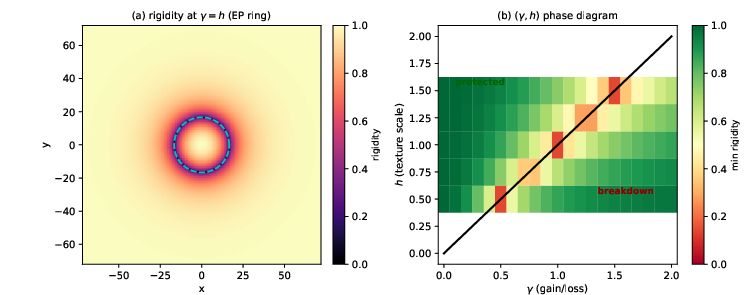
Figure 1: The phase rigidity across the skyrmion collapses on an equatorial ring at N−11, pinpointing the real-space locus of the exceptional point.
Numerical sweeps across increasing gain/loss strength (N−12) confirm:
Physical Implications and Relation to Analyticity Breakdown
The demonstrated splitting of topological charge protection at EPs is a quintessential non-Hermitian phenomenon. It exposes the fragility of physical, biorthogonal observables to non-Hermitian degeneracy, challenging the conventional wisdom about topological stability of skyrmion textures in open systems.
This work establishes a correspondence between topological and analytic breakdowns: the collapse of biorthogonal charge at EPs mirrors the loss of analyticity in response functions when encountering non-Hermitian degeneracies. Both are governed by the same imaginary deformation, linking real-space topology and analytic structure in a unified EP mechanism.
Experimental Observability and Future Directions
The paper outlines feasible experimental probes for each charge:
- N−18 (right-state/topological winding): Accessible via standard magnetic imaging techniques.
- Exceptional ring/phase rigidity collapse: Detectable via spatial anomalies in local density of states or spin resonance.
- N−19 (biorthogonal charge): Requires polarization-resolved far-field measurements capable of extracting biorthogonal structure, following advances in non-Hermitian Berry curvature detection.
The practical impact is substantial for skyrmion-hosting platforms such as magnonic 10 structures, optical microcavities, and driven polariton condensates. Tuning gain/loss to reach the EP provides a route to nucleate or annihilate skyrmions, potentially circumventing fractonic conservation rules.
Future work should extend these results to general CP11 targets, establish dynamical protocols, and develop lattice realizations of the exceptional ring phenomenon. Mapping the biorthogonal charge to observable bulk and far-field properties remains an open challenge.
Conclusion
This study reveals that topological protection in non-Hermitian skyrmions is no longer a unified statement: the homotopy-protected right-state charge persists, while the physically pertinent biorthogonal charge loses quantization at the exceptional point, which in real-space textures manifests as a ring with collapsed phase rigidity. These findings provide a topological counterpart to analyticity breakdown at EPs, indicating that the exceptional point generically marks the boundary where the protected structures of Hermitian physics yield to new non-Hermitian behavior.