- The paper introduces a quantized topological charge (Blaschke winding number) to characterize causality transitions in PT-symmetric dimer systems.
- It rigorously derives residue-corrected Kramers–Kronig relations that reveal Lorentzian KK residual peaks and power-law scaling with an exponent of approximately -1.08.
- Numerical verification and proposed THz spectroscopy experiments validate the approach, offering a practical method to diagnose acausality in non-Hermitian quantum systems.
Topological Charge and Causality Transitions at PT-Symmetric Exceptional Points
Abstract and Motivation
The manuscript "Topological Charge of Causality at a PT-Symmetric Exceptional Point" (2605.00117) introduces a rigorous framework to classify the breakdown of causality in linear response for open, non-Hermitian quantum systems by connecting it to a topological invariant. In particular, causality—understood as upper-half-plane analyticity of response functions—is shown not to be simply binary, but to possess a quantized, parameter-space "topological charge" in the form of a Blaschke winding number. The transition corresponds to the passage of a pole of the reflection coefficient across the real axis at the exceptional point (EP) of a PT-symmetric dimer system, with empirical observables directly traceable to this transition.
Model: PT-Symmetric Open Dimer and Reflection Coefficient Analysis
The system considered is a PT-symmetric dimer with asymmetric gain and loss, subject to single-port or symmetric coupling to a waveguide. The effective non-Hermitian Hamiltonian for the single-port case is given by Heff=H(γ)−i(γex/2)∣1⟩⟨1∣, where gain (γ) and coupling (γex) parameters control the dynamical regime.
The frequency-dependent reflection coefficient r(ω;γ) is exactly derived as
r(ω;γ)=1+iγexG11eff(ω),
where G11eff(ω) is the resolvent element. The poles of r(ω;γ) are the roots of a quadratic determinant and their locations in the complex plane dictate the system's causality structure.
As parameters sweep across the EP, a single pole migrates into the upper half-plane, resulting in an abrupt topological transition.
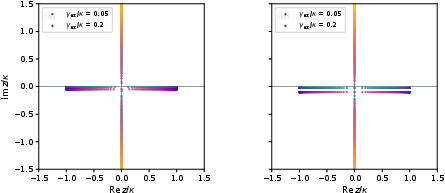
Figure 1: Pole trajectory of the PT-dimer reflection coefficient in the complex z-plane as γ/κ sweeps; the upper pole crossing into H marks the causality transition.
Topological Charge: Blaschke Winding Number and Meromorphic KK Relations
The central result is that the number of upper half-plane (UHP) poles in γ0 constitutes a Blaschke winding number γ1. At the EP, γ2 jumps discretely from γ3 to γ4, representing a topological charge of causality. This invariant is protected by the codimension-one structure of the EP in the space of PT-symmetric matrices.
Standard Kramers–Kronig (KK) relations fail in this regime, but the authors rigorously derive residue-corrected dispersion relations accommodating the presence of UHP poles. Explicitly, deviation from KK reconstruction is dictated by pole residues at the UHP locations, yielding Lorentzian-shaped residuals observable in response measurements.
The phase diagram illustrates the sharply delineated boundary between causal and acausal regimes as a function of gain and coupling parameters.
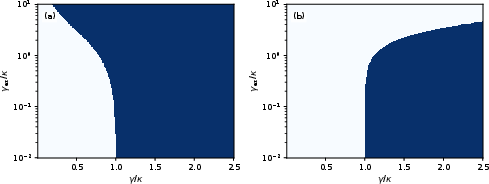
Figure 2: Phase diagram in γ5 showing causal (γ6) and acausal (γ7) phases in single-port coupling.
Numerical Verification and Scaling Analysis
Numerical studies quantitatively verify the residue-corrected KK relation for representative parameters. The uncorrected KK residual displays a Lorentzian peak; subtracting the residue correction reduces the γ8 norm of the deviation by γ9. This substantiates the analytic derivation.
Moreover, the magnitude of KK violation near the EP exhibits power-law scaling:
γex0
with a robust negative exponent γex1 for single-port geometry. Contrary to prior heuristic expectations (γex2), violation magnitude is maximal at threshold and decays deeper in the broken phase, with residue amplitude decreasing as the UHP pole migrates upward.
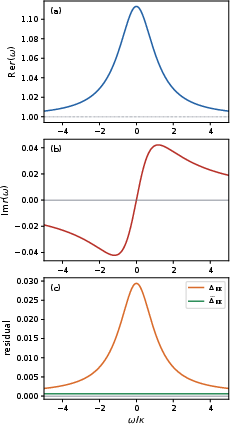
Figure 3: KK residual at γex3, demonstrating Lorentzian form and strong reduction upon residue correction.
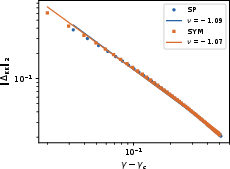
Figure 4: Log-log scaling of γex4 versus γex5, extracting the scaling exponent γex6.
Experimental Implications
The authors propose a THz time-domain spectroscopy protocol capable of empirically measuring this topological charge through direct fits to the KK residual. The approach leverages the extraction of pole residues and locations solely from finite-band response measurement, enabling model-independent diagnostics of non-Hermitian gain. The methodology is applicable to PT-symmetric plasmonic metasurfaces, and electronic prototypes (e.g., negative impedance RLC dimers) are suggested for validation.
Theoretical Context and Distinctions
This topological classification is distinguished from momentum-space spectral windings in non-Hermitian band theory; here, the topological charge arises in parameter space and is tied to dynamical gain–loss mechanisms. The causality breakdown is not due to initial-state structure or coarse-graining effects, but instead is enforced by pole movement associated with open-system gain channels. Related work confirms that exceptional points alone do not induce causality violation—a critical insight for open quantum system theory.
Additionally, complementary results on the analyticity protection of the memory kernel generator (projected Liouvillian) highlight that causality is a property of both the response and the generator, with symmetry-protected transitions on each side.
Notably, the scaling behavior is specific to single-pole, codimension-one EP transitions; multi-site chains exhibit non-universal oscillatory scaling due to interference between multiple UHP poles.
Conclusion
The research establishes that causality in linear response functions possesses a quantized topological charge, rigorously expressed via the Blaschke winding number. The transition at the PT-symmetric exceptional point marks a sharp, measurable jump in acausality, rendered observable through residue-corrected KK relations and power-law scaling of violation magnitude. The framework unifies analytic, topological, and practical aspects of causality in open non-Hermitian quantum systems, with direct implications for spectroscopic protocols and the design of non-Hermitian materials. Extension to higher-order EPs and systems with multiple gain channels is anticipated to yield winding numbers γex7, opening further directions in the topological analysis of dynamical response.

