- The paper reports large-scale, reproducible fabrication of III–V quantum dot micropillar devices with photon extraction efficiencies exceeding 80% and single-photon indistinguishability above 95%.
- It employs advanced quantum state engineering via Wigner-function tomography, achieving a record negativity of -0.33(1) for high-purity single-photon states.
- The study demonstrates deterministic generation of multi-photon spin entanglement and high-fidelity remote photon interference, paving the way for error-corrected hybrid photonic quantum computing.
Industry-Ready Spin–Photon Interfaces for Hybrid Photonic Quantum Computing
Introduction
The integration of stationary matter qubits with photonic qubits—hybrid photonic quantum computing (HPQC)—addresses key scaling challenges in fault-tolerant, resource-efficient quantum computation. A central requirement is the development of deterministic, high-purity spin–photon interfaces supporting high-efficiency single-photon generation, near-unity indistinguishability, long spin coherence, and scalable device manufacturability. This work presents the large-scale, reproducible fabrication of III–V semiconductor quantum dot (QD) micropillar devices optimized for industrial deployment in HPQC, and offers a comprehensive assessment of device metrics in the context of error-correction thresholds required for scalable quantum computing (2606.27787).
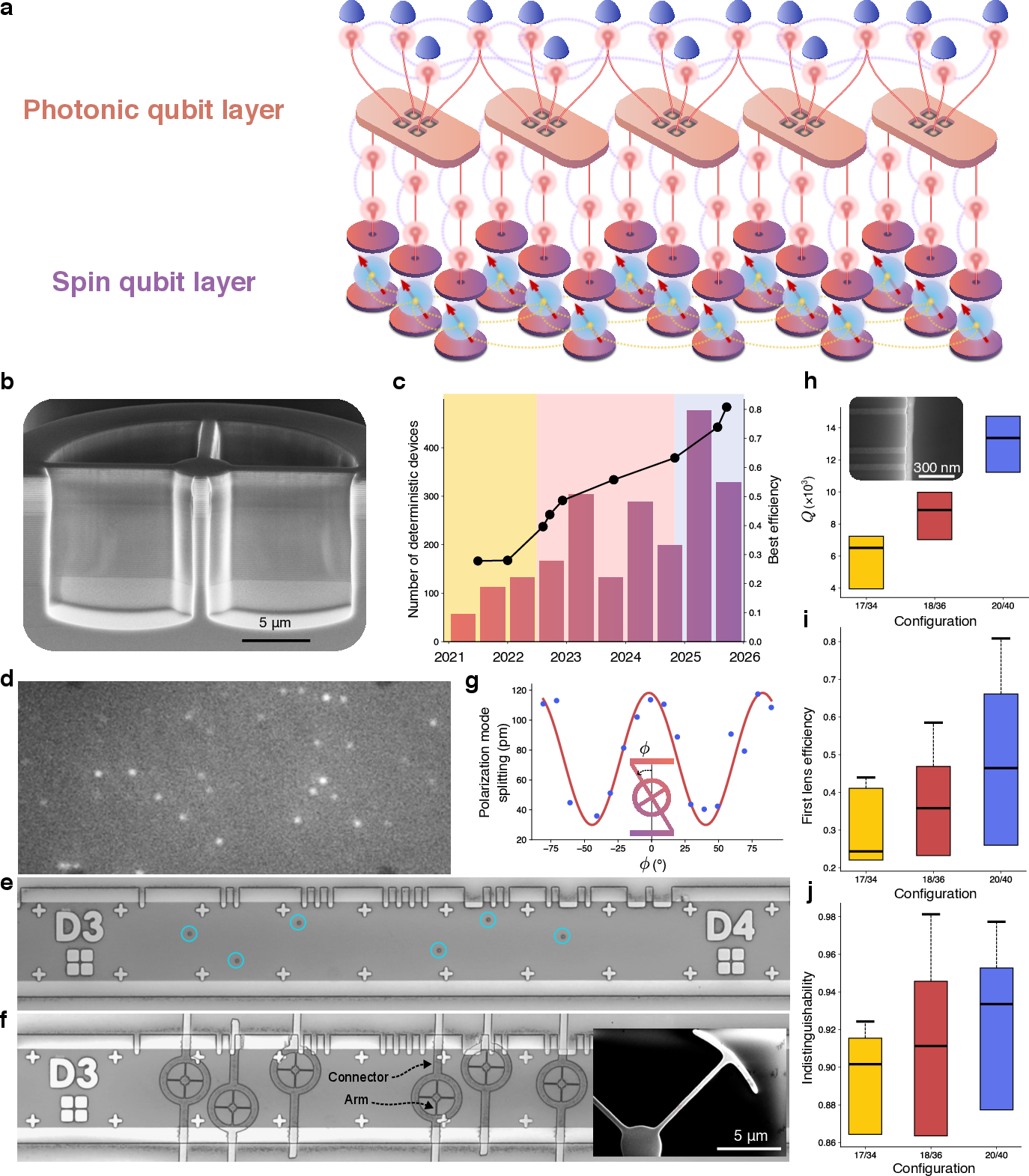
Figure 1: Pilot production-line for semiconductor spin-photon interfaces, including process flow, device images, and device performance benchmarks for different wafer generations.
Scalable Production and Device Parameter Control
The authors detail a pilot production line for III–V monolithic QD–cavity devices that achieves reproducible high-performance metrics at scale. By systematically controlling critical fabrication parameters—primarily the distributed Bragg reflector (DBR) pair numbers, cavity quality factor Q, and sidewall/corrugation morphology—over several wafer generations, they demonstrate state-of-the-art photon extraction efficiencies exceeding 80%, with mean single-photon indistinguishability above 95%. The platform enables precise spectral and spatial matching, cavity-enhanced Purcell factors, and deterministic emitter positioning (accuracy ∼50 nm), as evidenced by scanning electron microscopy (SEM) and photoluminescence mapping.
Critically, the device yield, reproducibility, and performance stability are systematically benchmarked across thousands of fabricated devices. The process is compatible with further efficiency gains via DBR doping optimization and advanced pillar designs (e.g., concentric ring geometries for reduced background emission), targeting the ∼94% efficiency threshold for quantum error correction in spin–optical architectures [dessertaine_enhanced_2026].
Quantum State Engineering: Wigner Function Tomography
The full quantum characterization of single-photon states, particularly non-classical features such as Wigner-function negativity, is performed via quadrature phase space tomography using homodyne detection with high mode overlap to a local oscillator. The devices achieve a record Wigner-function negativity of −0.33(1) for single-photon states, demonstrating both high purity and strong quantum non-Gaussianity at the device output. The photon indistinguishability measured over extended timescales (<30 min) reveals stable coherence protected from charge and spectral noise.
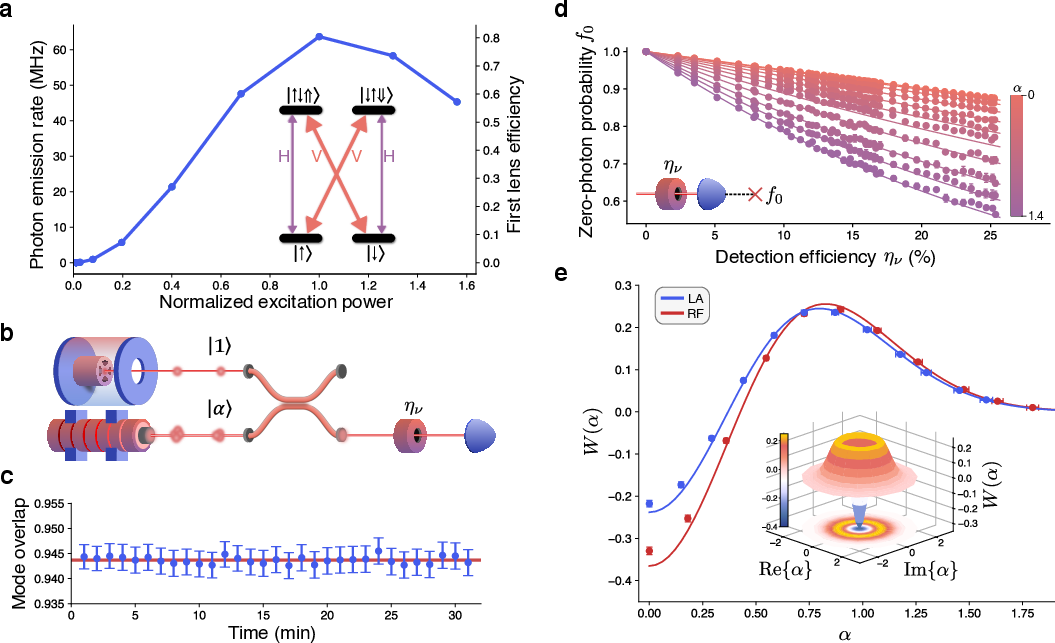
Figure 2: Wigner function reconstruction of the single-photon state, with experimental setup and retrieved Wigner negativity for different excitation protocols.
This level of quantum state control meets and surpasses thresholds required for continuous-variable and bosonic photonic error correction protocols, and sets a new standard among solid-state emitters for non-classical state generation [Kenfack2004, Lvovsky2009_review].
Deterministic Generation of Spin–Multi-Photon Entanglement
The authors demonstrate on-demand generation of spin–multi-photon linear cluster states by orchestrating the spin precession in a positively charged QD coupled to a cavity and driven by periodic laser pulses. The cluster state generation protocol yields up to seven-partite entanglement, with stabilizer-based multipartite fidelity exceeding 50% for cluster sizes up to six photons. This fidelity triples the size of deterministic photonic cluster states previously reported using QDs [Su_ContinuousDeterministicAllphotonic_2024, huet_deterministic_2025].
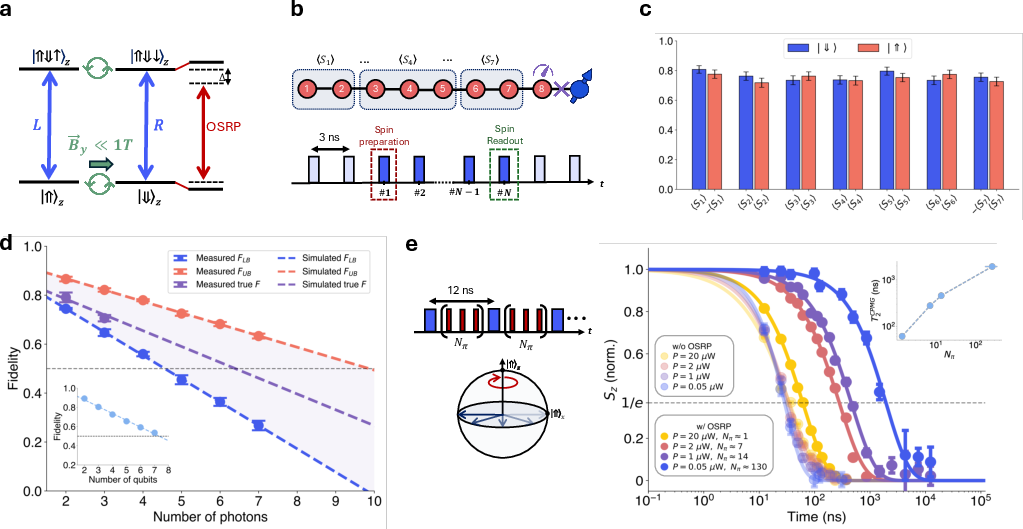
Figure 3: Protocols and results for spin–multi-photon entanglement, detailing the cluster-state generation sequence, stabilizer measurements, and extended spin coherence via dynamical decoupling.
Additionally, dynamical decoupling sequences are integrated to mitigate decoherence from the nuclear spin bath, extending the spin T2 coherence time to almost 2 μs in the relevant low magnetic field regime. This supports error-corrected "repeat-until-success" photonic fusion-based operations.
High-Fidelity Remote Photon Interference
A critical demonstration of scalability is the generation of mutually indistinguishable photons from independent QD-cavity devices. The authors achieve device-to-device resonance matching via electrical and strain tuning, reaching a mutual indistinguishability M12=88(1)%, closely approaching the performance of consecutively emitted photons from the same source. No active feedback or post-selection is required, emphasizing the intrinsic stability and reproducibility of the platform.
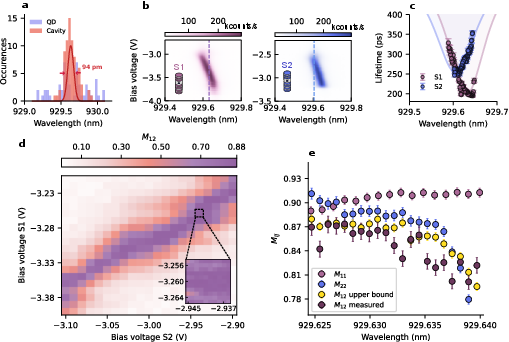
Figure 4: Measurements of photon indistinguishability from spatially separated devices, with resonance tuning and Hong-Ou-Mandel (HOM) visibilities.
This level of remote source performance directly addresses the requirements for modular and distributed architectures in large-scale quantum computing and communication networks, and approaches the 2.3% indistinguishability error threshold for spin–optical architectures identified in recent resource analyses [gliniasty_spin-optical_2024, chan_tailoring_2025].
Implications and Future Directions
This work provides definitive evidence that foundry-compatible monolithic quantum dot–cavity devices can simultaneously satisfy key figures of merit for scalable, error-corrected HPQC: photon extraction efficiency, photon indistinguishability, spin coherence, and multi-device uniformity. The combination of spin–photon and photonic layers enables efficient, modular implementations of fusion-based quantum computing protocols with orders-of-magnitude reduction in physical resource overhead compared to traditional fully-photonic schemes [wein_minimizing_2025, Paesani2026].
These advancements open multiple development pathways:
- Integrated System-Scale Architectures: The demonstrated fabrication pipeline can be further industrialized, supporting photonic processor arrays with embedded spin–photon interfaces for cluster-state or fusion-based computation.
- Enhanced Fault-Tolerance: Achieving low-loss and high-indistinguishability thresholds enables the practical implementation of advanced error-correcting codes, such as honeycomb Floquet codes and qLDPC codes, with lower hardware and time costs [dessertaine_enhanced_2026, Paesani2026].
- Distributed Quantum Computing: Demonstrated remote interference paves the way for distributed or networked quantum information processing, including quantum repeaters and secure communication nodes [distributedReview2024].
- Non-Gaussian and Bosonic Codes: The direct generation of non-Gaussian states with high Wigner negativity supports the native implementation of bosonic error correction and measurement-based computation with continuous variables.
Conclusion
The reported pilot-line production of monolithic III–V quantum dot–cavity devices achieves all essential requirements for system-scale, error-corrected hybrid photonic quantum computing. The simultaneous optimization of all performance metrics—extraction efficiency, coherence stability, entanglement fidelity, and inter-device compatibility—repositions the remaining technical challenges squarely within the domain of system integration, fault-tolerant code deployment, and architectural scaling.
This work thus marks a transition in the HPQC roadmap: the quantum-dot spin–photon interface is now an industrially viable, platform-level building block for both centralized and distributed quantum information processing (2606.27787).

