- The paper introduces a compact, rack-based system integrating a high-performance quantum dot entangled photon source with automation and remote control.
- It demonstrates near-unity polarization entanglement (2n = 0.98 ± 0.01) and 99.2% single-photon purity with sustained stability over six hours.
- The design meets industrial requirements by employing modular, vibration-isolated subsystems and precise in situ fiber coupling for reliable quantum networking.
Compact, Rack-Based System for Industrially Deployable Entangled Photon Pair Sources
Introduction and Motivation
The realization of scalable quantum communication networks crucially depends on robust sources of polarization-entangled photon pairs featuring near-unity fidelity, high brightness, and effective integration within conventional IT infrastructures. The majority of quantum-entangled photon sources, particularly those leveraging GaAs quantum dots (QDs) via the exciton–biexciton radiative cascade under two-photon excitation, have demonstrated promising performance metrics such as high single-photon purity and entanglement negativity. However, these demonstrations typically remain limited to laboratory environments due to persistent challenges in operational stability, alignment sensitivity, and lack of modular, automated system architectures compatible with industrial deployment.
This study introduces a compact, rack-mounted system integrating a high-performance quantum dot entangled photon source with full automation and remote operability, bridging the pressing gap between laboratory quantum light sources and scalable, deployable network infrastructure.
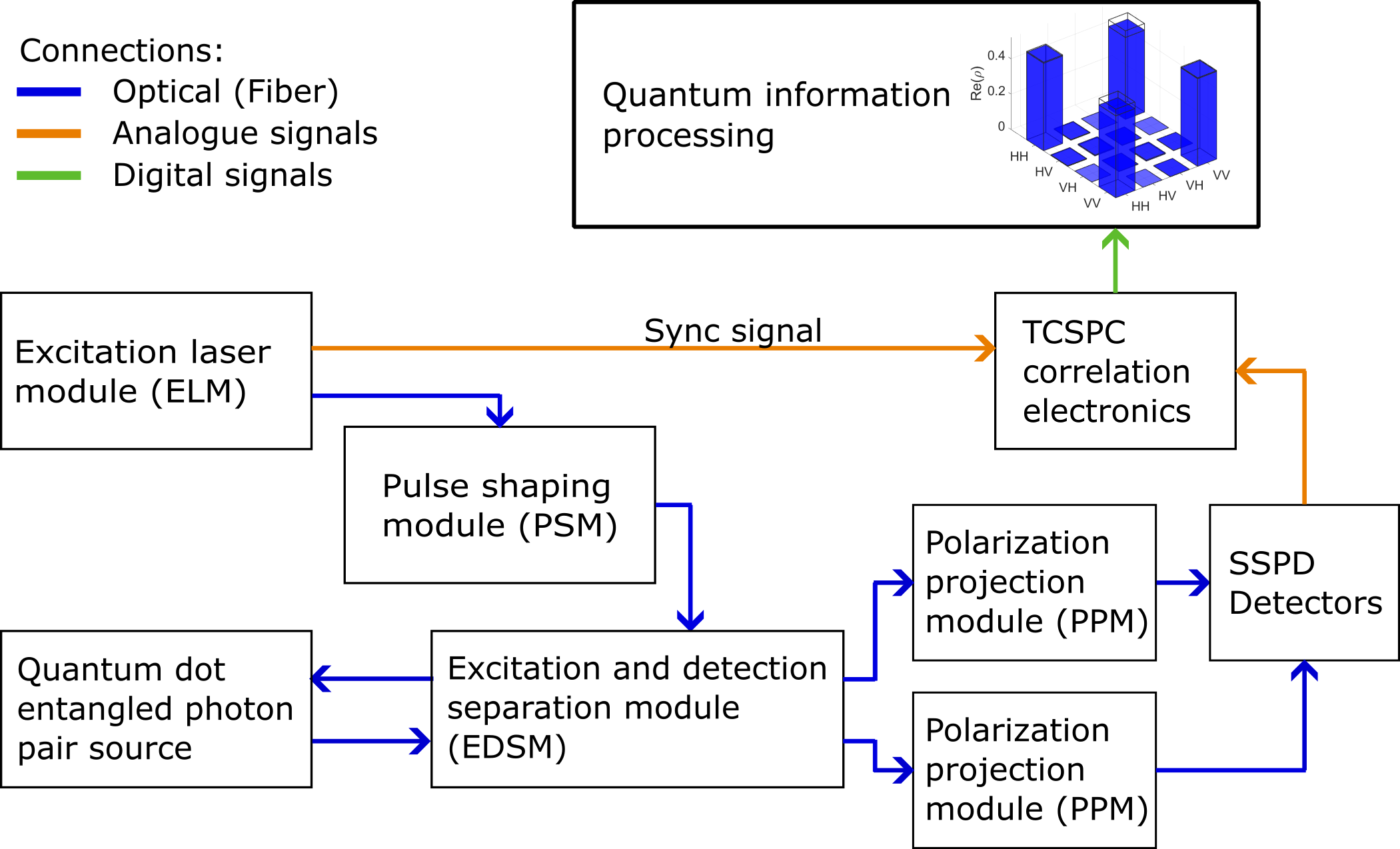
Figure 1: High-level system overview illustrating modular integration and 19-inch rack compatibility of all subsystems required for robust entangled photon pair generation and analysis.
System Architecture and Design
The developed system utilizes a modular two-rack configuration: one rack accommodates the cryogenically cooled QD source and superconducting nanowire single-photon detectors (SNSPDs), while the second hosts all necessary optical instrumentation, including a GHz-clocked Ti:Sapphire laser system, pulse shaping and spectral filtering modules, and polarization projection units. All optical subsystems are built as vibration-isolated, thermally insulated modules with low-loss single-mode fiber interconnections and standardized footprints, ensuring minimal transmission losses and maximizing accessibility for maintenance and upgrade.
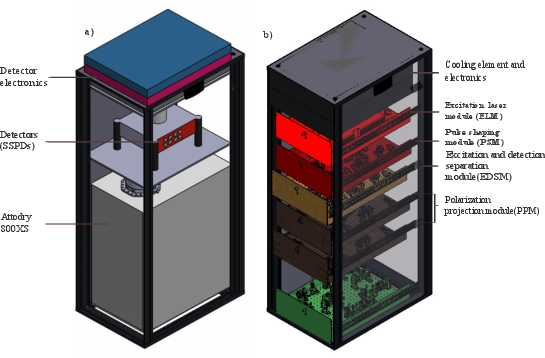
Figure 2: Schematic illustration of the dual-rack structure, highlighting separation of cryogenic source/detection (left) from all laser, filtering, and polarization control modules (right), interconnected via low-loss fiber links.
Fiber coupling of the QD emission is implemented using in situ 3D-printed micro-objectives, enabling precise lateral and axial alignment at cryogenic temperatures and mitigating strain sensitivity and alignment inflexibility inherent to glue-fixed approaches. The QD chip, featuring a high-density array of monolithic microlenses on a gold-coated GaAs substrate, provides reconfigurable selection of high-brightness, low-FSS dots for optimal performance.
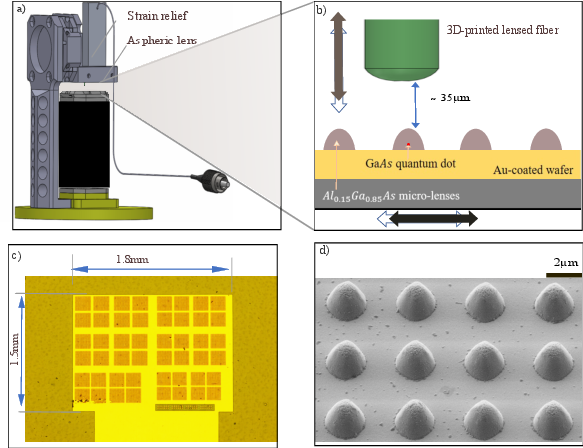
Figure 3: Detailed view of in situ fiber-coupled QD-microlens integration using 3D-printed micro-objectives and strain-relief mechanisms.
Candidate QDs are identified via above-band photoluminescence spectroscopy, with selection criteria focusing on brightness, emission wavelength, and minimal fine-structure splitting (FSS). Selected dots are resonantly driven with π-pulse two-photon excitation, achieving efficient population inversion to the biexciton state. The coherent excitation enables deterministic polarization-entangled photon pair emission through the XX-to-X and X-to-ground cascaded transitions, with polarization entanglement protected by angular momentum conservation throughout the emission process.
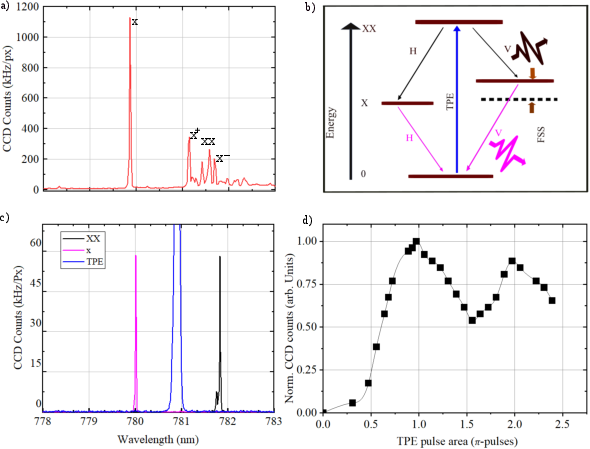
Figure 4: (a) Emission spectrum under above-band excitation, (b) excitation/detection schematic, (c) spectrum at π-pulse excitation, (d) Rabi oscillation trace confirming deterministic XX-state preparation.
Polarization-resolved tomography over a 6×6 measurement basis reconstructs the full two-photon density matrix in temporally resolved windows, enabling precise quantification of entanglement via the negativity measure (2n). The reconstructed state consistently approaches the maximally entangled Bell state, achieving 2n=0.98±0.01 in a short time window and an average $2n$ of 0.94±0.01 over the exciton lifetime, even in the presence of finite FSS. The source delivers a single-photon purity of 99.2±0.2% as inferred from XX autocorrelation measurements.
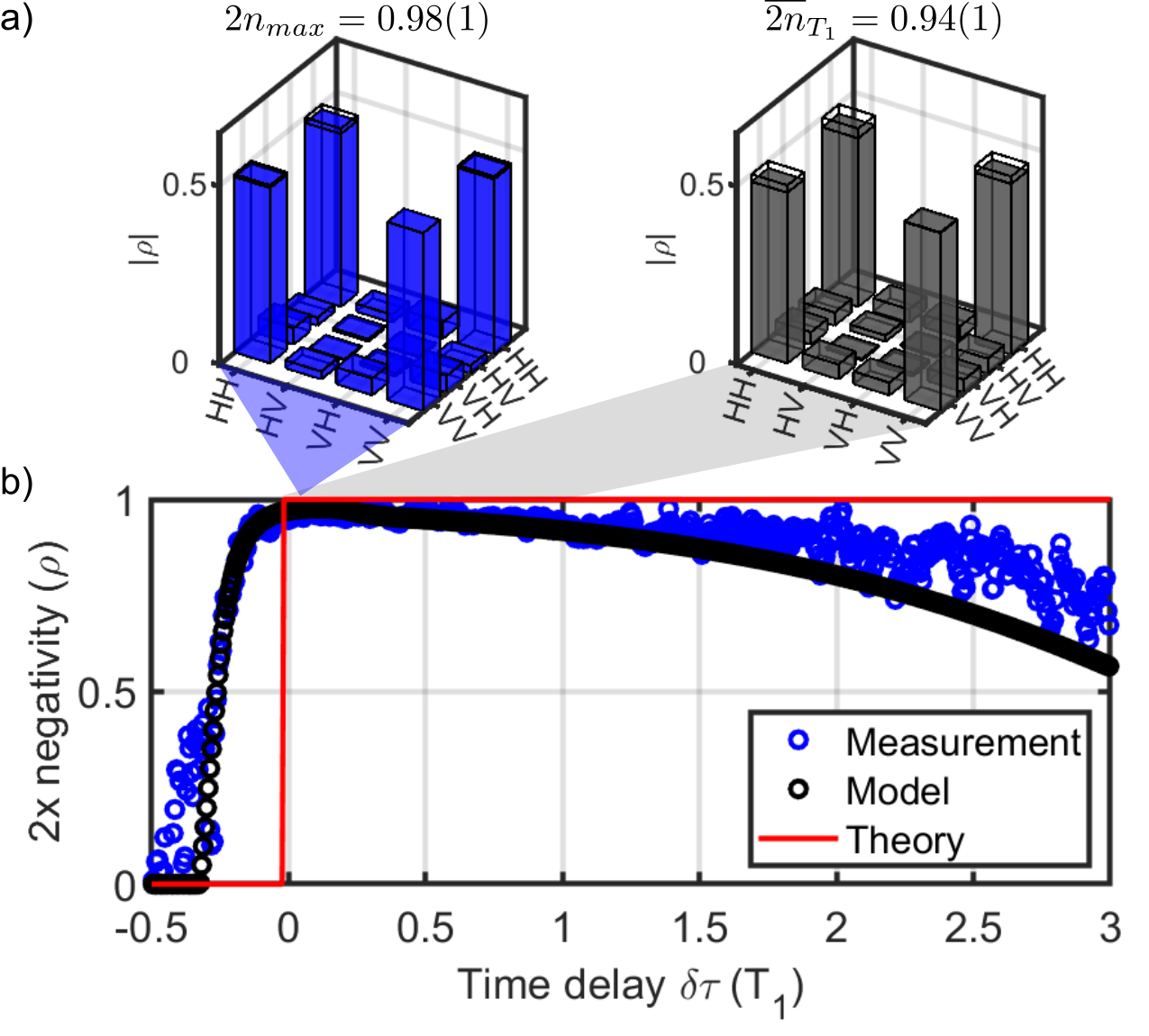
Figure 5: Reconstructed two-photon density matrix (left) and time-dependent entanglement negativity (right), benchmarking measured data against idealized and instrument-limited models.
Long-Term Operational Stability
A crucial aspect for real-world applicability is extended autonomous operation under realistic, uncontrolled environmental conditions. Six-hour hands-off operation is demonstrated without active polarization or temperature stabilization, with average single-photon count rates of 697±8Hz, maximal rates of 740±7Hz, count rate fluctuations under 15%, and 2n always exceeding π0. These metrics decisively validate the robustness and stability required for industrial quantum networking nodes.
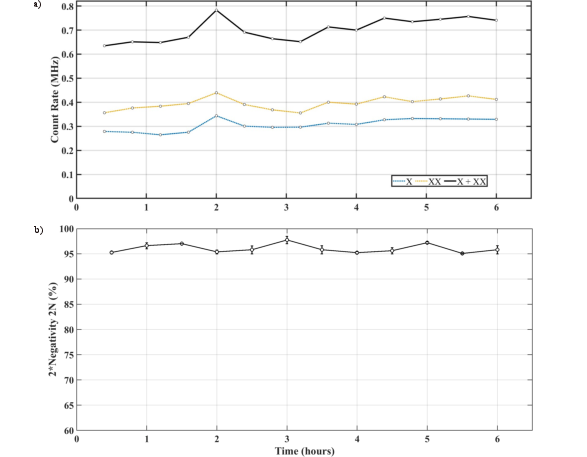
Figure 6: Long-term tracking of single-photon emission rates (top) and entanglement negativity (bottom), evidencing operational stability and preservation of quantum characteristics over six hours.
Practical and Theoretical Implications
This system realizes, for the first time, an industry-aligned, mobile entangled photon pair source achieving near-optimal quantum performance comparable to state-of-the-art laboratory systems while fulfilling modularity, standardized rack integration, automated operation, and remote software control criteria essential for quantum internet infrastructure. The architecture directly addresses common industry requirements: minimal manual intervention, sharply reduced environmental sensitivity, and reliable fiber-network interconnection capability.
By providing a scalable blueprint for integrating both photonic and electronic control subsystems, the work underpins the practical advancement of quantum repeaters, QKD distribution nodes, and multi-node networked quantum systems, where persistent operational reliability in datacenter-style environments is mandatory. The results also indicate that industrialization of QD-based entangled photon sources need not be predicated on accepting compromises in quantum state purity or brightness.
Furthermore, the modular approach and clear mapping of system-level metrics to industrial requirements will likely drive the development of self-calibrating, multi-channel entangled photon sources and facilitate the emergence of autonomous federated quantum networks. Future efforts to introduce closed-loop feedback, active thermal control, and integrated multiplexing can further extend the operational window and broaden applicability in field deployments.
Conclusion
This work demonstrates a compact, fully integrated rack-based entangled photon pair source leveraging monolithic GaAs quantum dot emitters and in situ fiber coupling, achieving both near-unity entanglement measures and high single-photon purity within a modular, industry-compatible architecture. The system's sustained autonomous operation, robustness to environmental perturbation, and compatibility with standard network infrastructures mark a significant advancement toward the practical roll-out of scalable, high-fidelity quantum networks, enabling future distributed quantum information processing and secure communication.

