- The paper introduces a unified framework that employs HJB feedback control and Lyapunov-based stability to achieve instantaneous black-swan recovery and robust AI operation.
- The paper demonstrates that incorporating fairness and interpretability directly into the utility function improves resilience and mitigates bias under dynamic resource constraints.
- The paper validates its approach with synthetic experiments showing a 29% improvement in quantile performance and superior tail-risk management compared to standard controllers.
Adaptive Utility-Driven Resource Orchestration for Resilient AI: AURORA-AI
Introduction
The "Adaptive Utility driven Resource Orchestration for Resilient AI (AURORA-AI)" framework addresses the persistent challenges of deploying AI systems in real-world, non-stationary environments where static resource allocation policies often result in degraded performance, fairness violations, and diminished explainability. Grounded in mathematical control theory, AURORA-AI proposes a unified closed-loop orchestration approach synthesizing Hamilton-Jacobi-Bellman (HJB) feedback control, Lyapunov-based stability monitoring, and a composite human-centric utility function that explicitly integrates fairness and interpretability considerations.
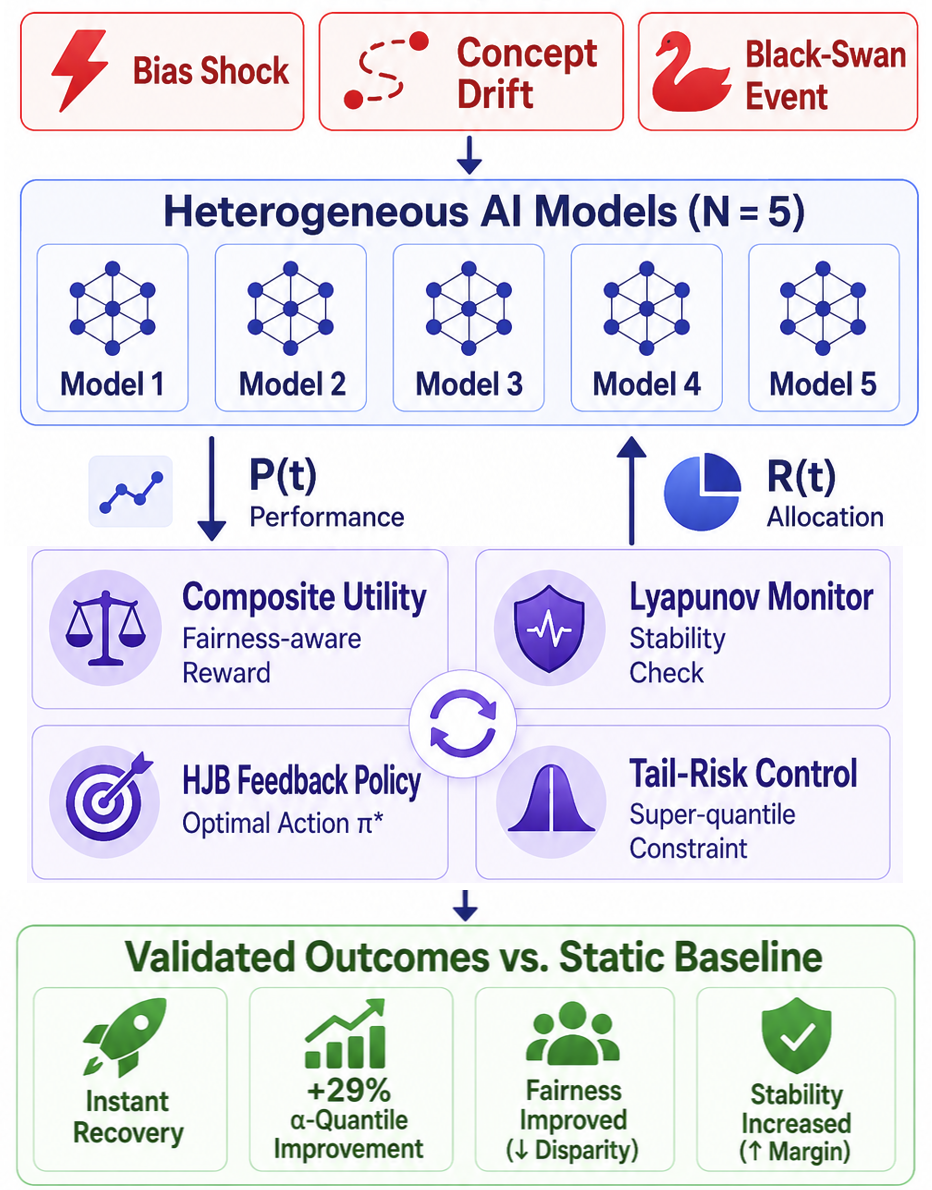
Figure 1: Diagram of the proposed AURORA-AI framework unifying control-theoretic and human-centric components for adaptive orchestration.
Theoretical Framework
AURORA-AI constructs the orchestration problem as a controlled Markov decision process (MDP) over a population of N heterogeneous AI models, each differing in utility axes such as accuracy, fairness, robustness, cost, latency, and interpretability. The policy dynamically reallocates a continuous resource budget by maximizing a discounted global utility J(π) subject to both stability and fairness constraints.
The key technical innovations include:
- Lyapunov-Guided Stability: A quadratic Lyapunov function V(θ,t) ensures dissipative recovery from perturbations. Stability is enforced by ensuring V˙<0 outside equilibrium.
- HJB Feedback Control: The HJB equation produces a closed-form optimal policy π∗, yielding rapid corrective response to abrupt performance shocks.
- Elastic Weight Consolidation (EWC): An EWC-augmented loss preserves knowledge against concept drift, mitigating catastrophic forgetting.
- Fairness-Integrated Utility: Explicit bias-decay dynamics measure and penalize violations of demographic parity, ensuring fairness is a first-class objective rather than a post-hoc constraint.
- Tail-Risk Minimization: Optimization of α-quantile and super-quantile (qˉα) metrics limit exposure to low-probability, high-impact (black-swan) disruptions.
Experimental Methodology
The evaluation leverages a synthetic non-stationary environment simulating real-world deployment stressors: demographic bias shocks, gradual concept drift, and abrupt black-swan disruptions. Across T=350 timesteps, five controllers—Static, Round-Robin, Greedy, LinUCB, and PPO—are compared against AURORA-AI on key metrics: recovery time, quantile performance, fairness gap, Lyapunov stability, and interpretability.
Empirical Results
Empirical results demonstrate that AURORA-AI achieves zero-step recovery from black-swan events, contrasted with 88 steps for Static and 22 steps for PPO. AURORA-AI raises both the α-quantile (29% improvement) and super-quantile (25% improvement) of performance compared to Static, illustrating effective tail-risk management.
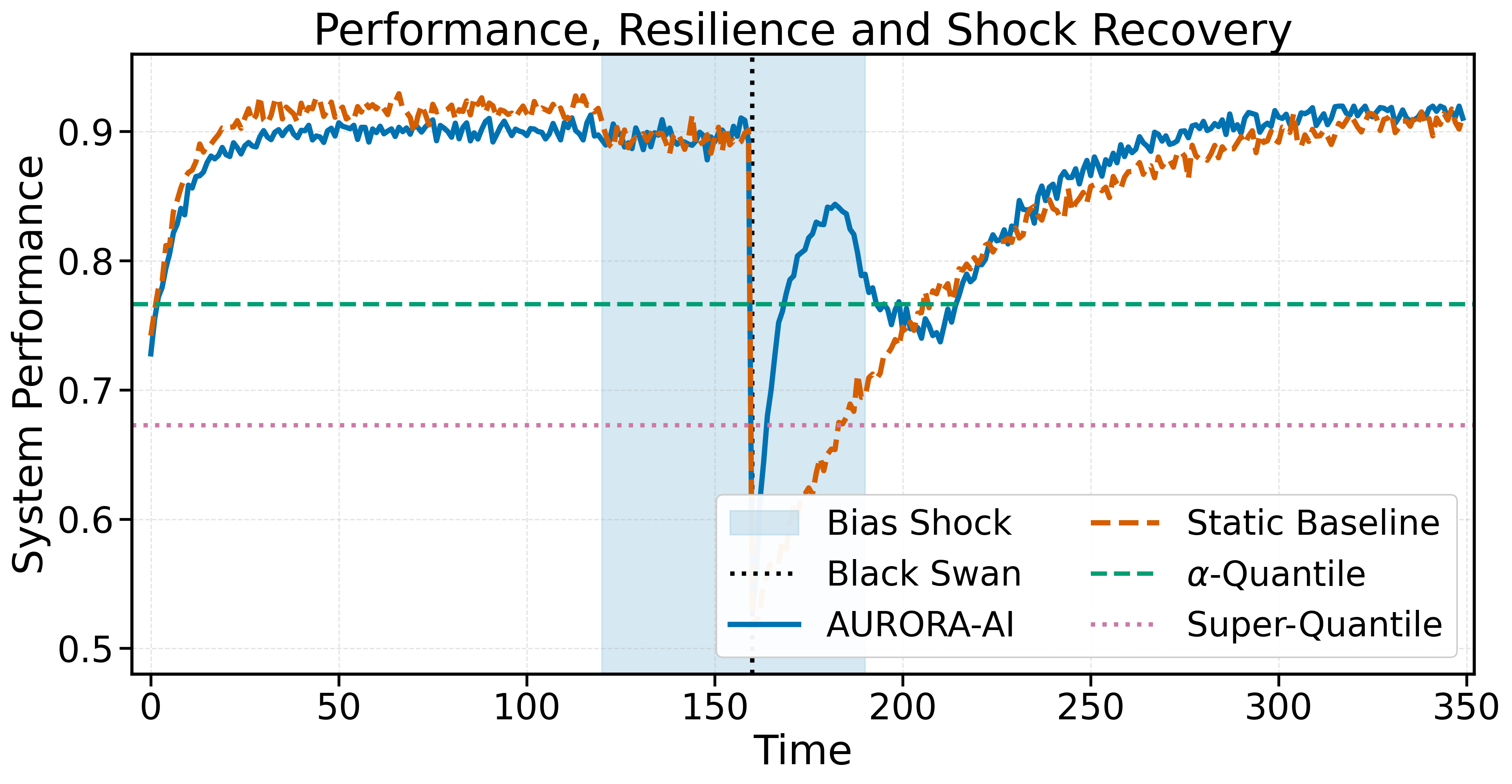
Figure 2: Time trajectory of system performance under AURORA-AI and Static policy, with rapid post-shock recovery only for the proposed controller.
State-of-the-Art Controller Comparison
Across all tested stress scenarios, AURORA-AI consistently ranks superior to exploitation-based, contextual-bandit, and model-free RL baselines. The Greedy policy is highly volatile, LinUCB is limited under nonstationarity, and PPO—while the strongest comparator—is dominated throughout the episode.
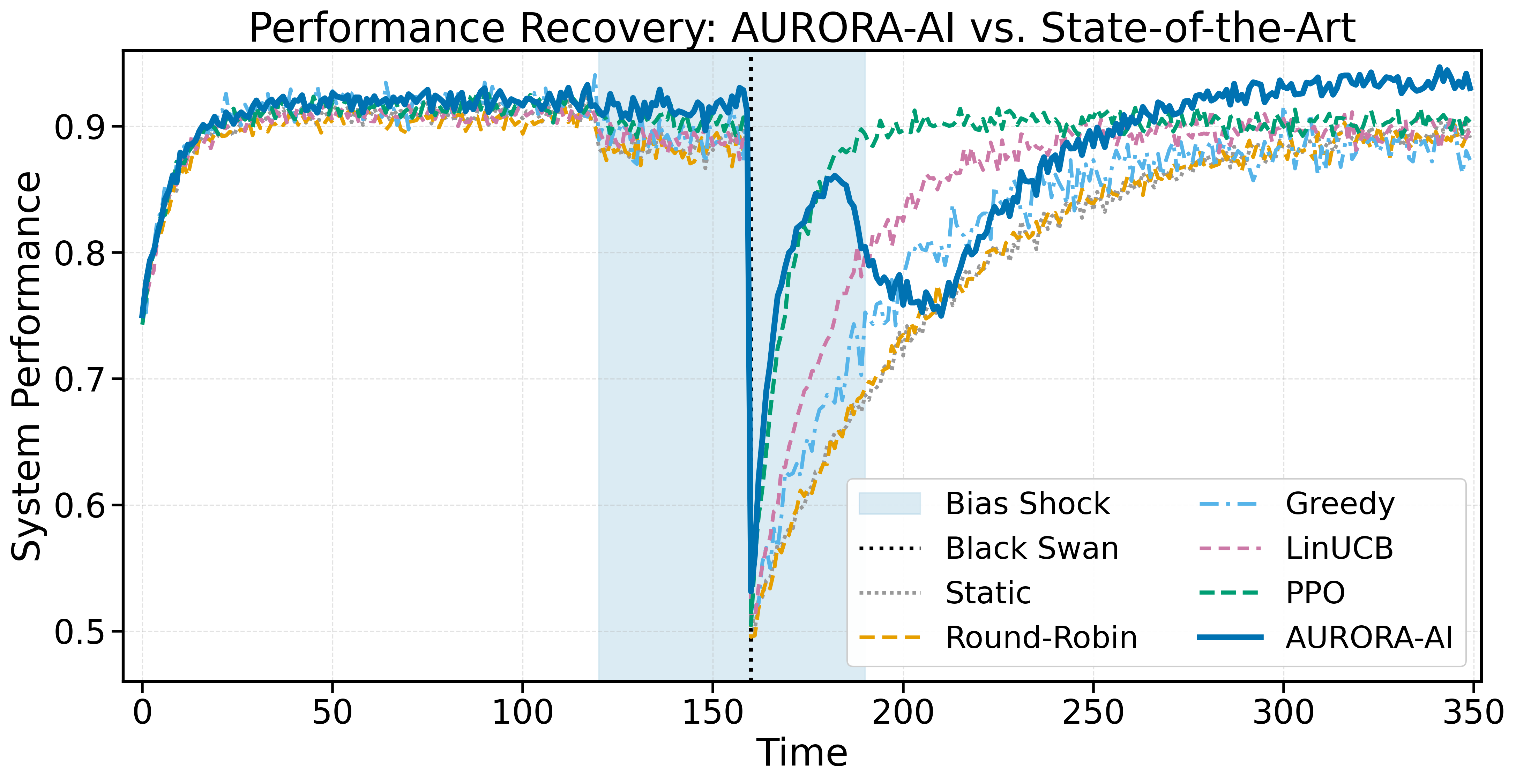
Figure 3: Comparative performance recovery for AURORA-AI and five leading controllers under black-swan shock events.
Tail-Risk Attenuation
The per-step performance histogram under AURORA-AI shows a truncated lower tail, with the proximity of qˉα to J(π)0 indicating a light-tailed, low-risk regime. This empirically confirms contraction properties induced by the Lyapunov-HJB feedback loop.
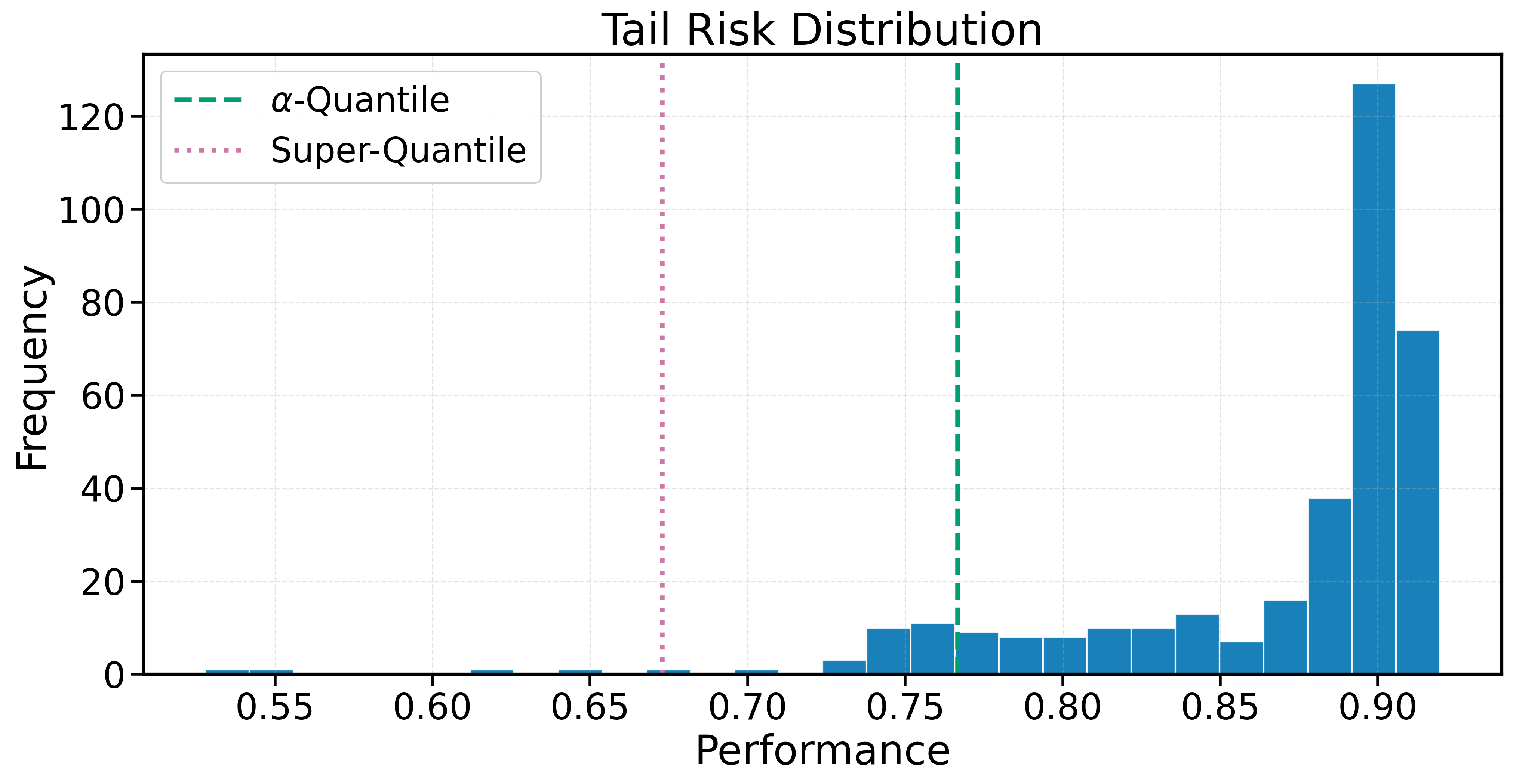
Figure 4: Performance distribution with J(π)1-quantile and super-quantile references, exhibiting minimized tail risk.
Resource Allocation Dynamics
Three distinct operating regimes emerge: balanced nominal, emergency (post-shock), and re-balancing. Notably, pre-shock resource withdrawals from unstable models illustrate anticipatory behavior derived from Lyapunov-fairness interplay.
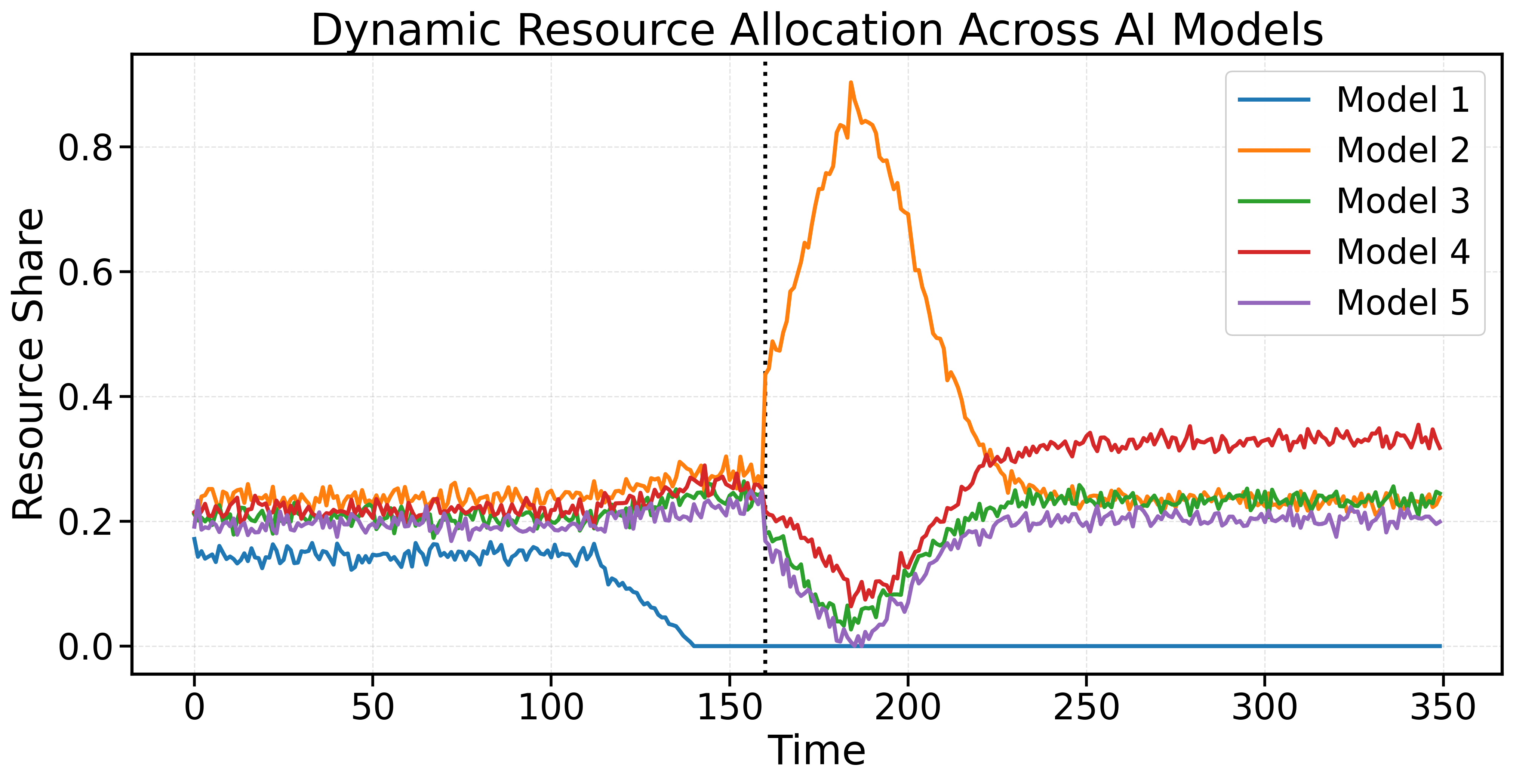
Figure 5: Resource allocation over time, showing proactive budget shifts among models corresponding to stability and fairness dynamics.
Lyapunov Energy and Stability
Lyapunov analysis reveals more aggressive energy dissipation and a higher fraction of negative J(π)2 steps (46.99% for AURORA-AI versus 43.27% for Static), substantiating elevated system stability under the proposed controller.
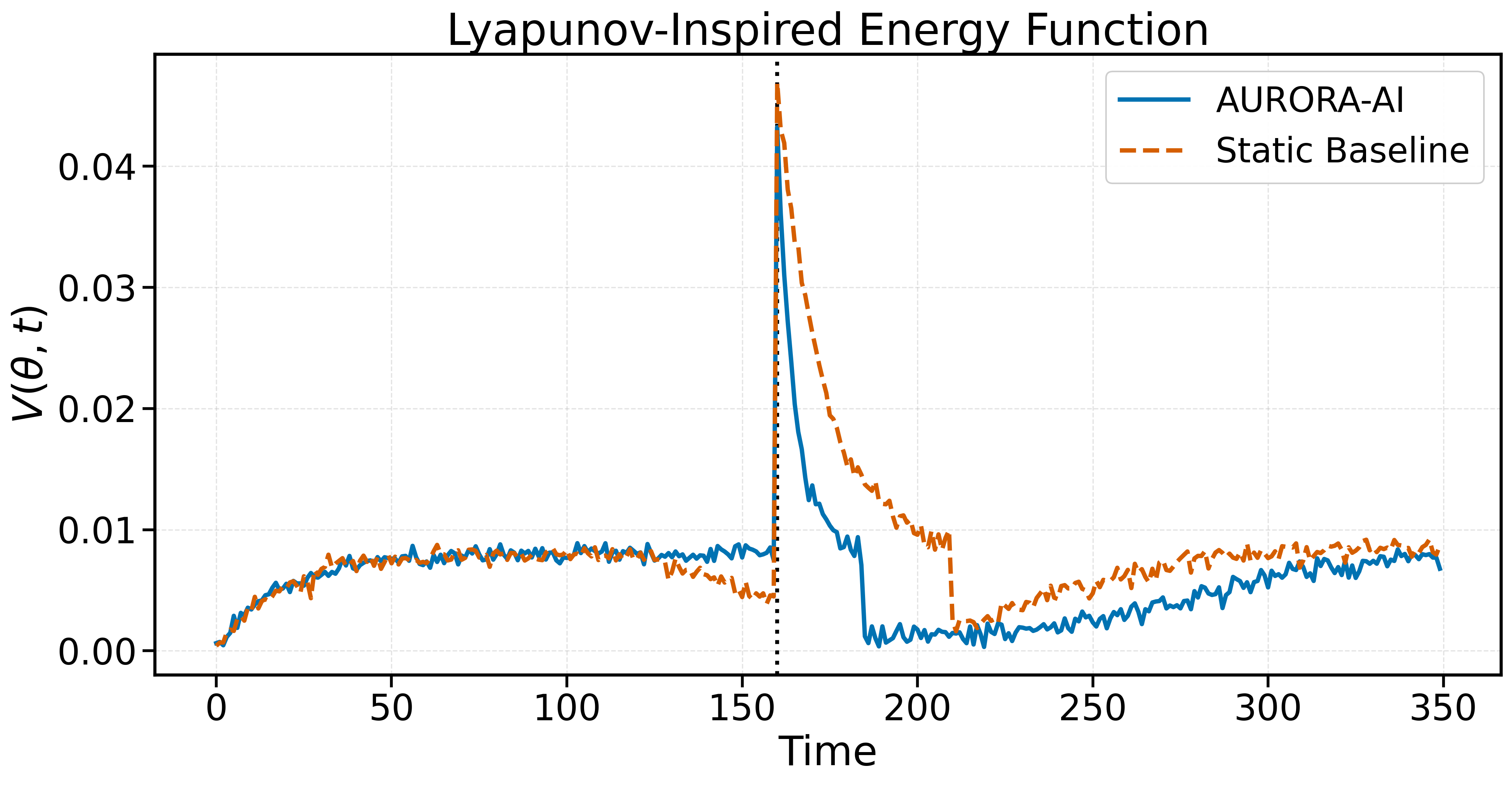
Figure 6: The Lyapunov "energy" J(π)3 demonstrates expedited shock absorption under AURORA-AI versus static baseline.
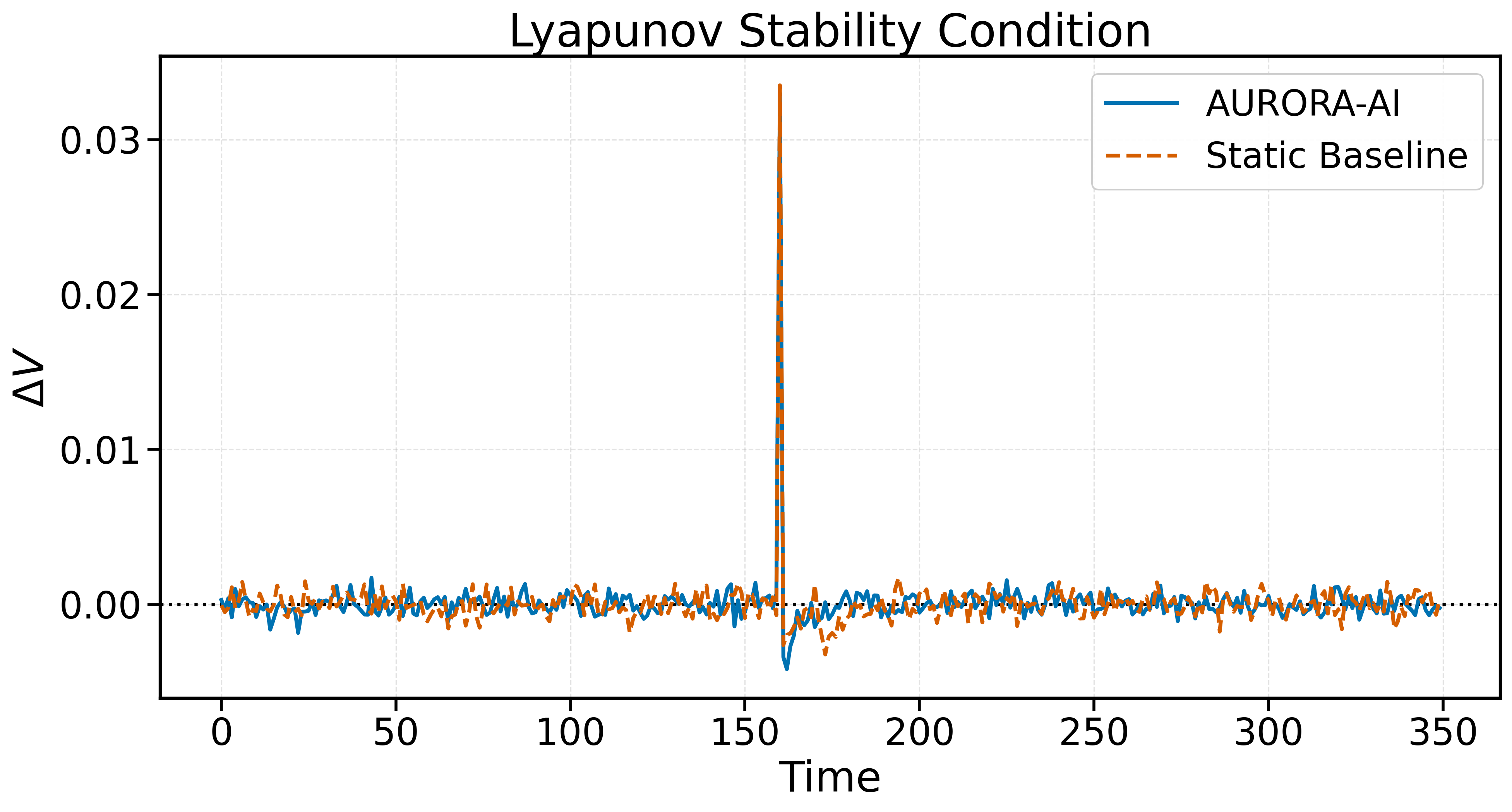
Figure 7: Discrete Lyapunov derivative J(π)4 confirms a greater fraction of stabilizing (negative) steps under AURORA-AI.
Human-Centric Explainability
Explainability receives explicit consideration: AURORA-AI maintains a mean interpretability score of 0.7442 versus 0.7040 for Static, only transiently sacrificing interpretability during crisis budget reallocation.
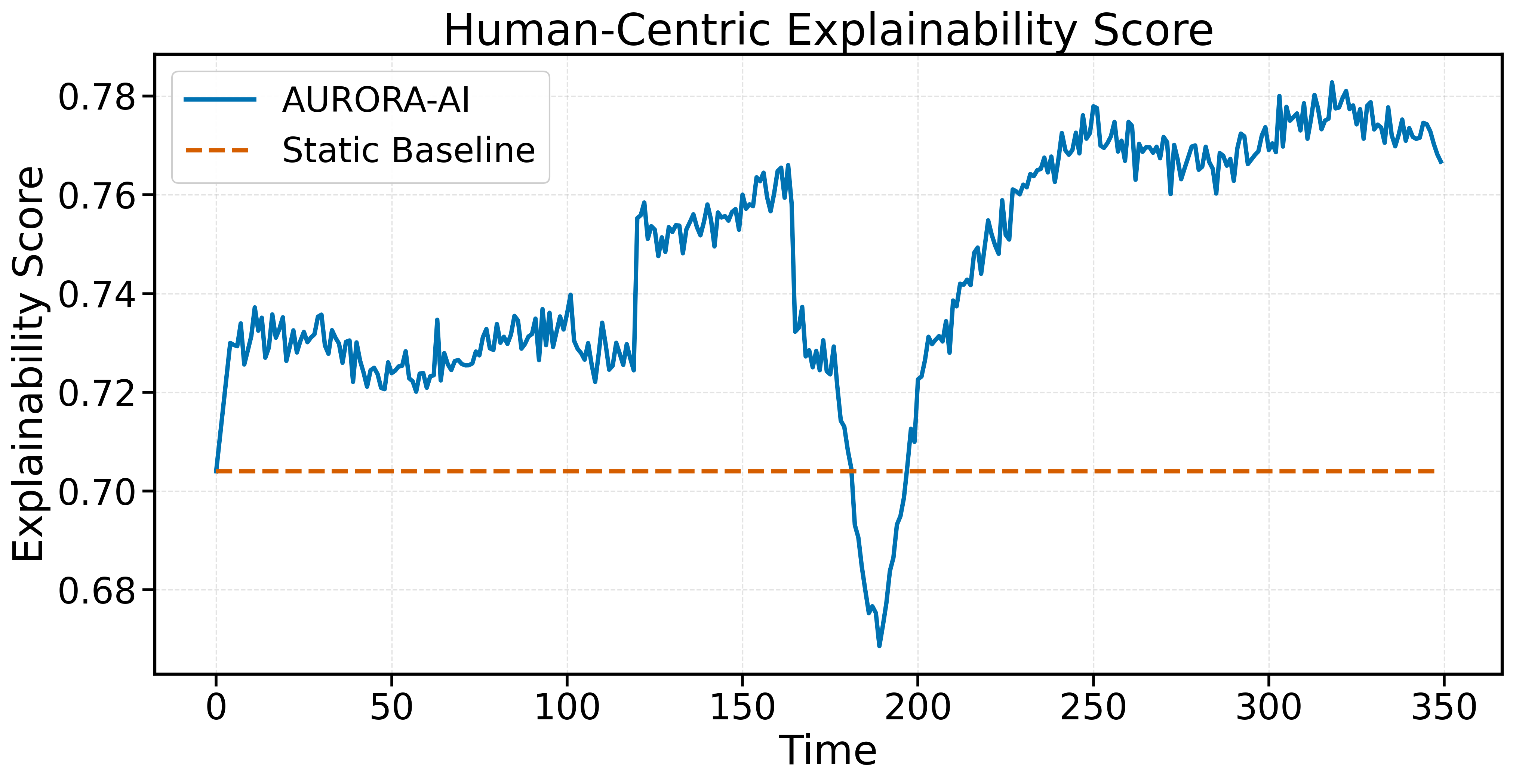
Figure 8: Budget-weighted explainability scores show consistently higher human-centric interpretability for AURORA-AI.
Implications and Future Directions
AURORA-AI demonstrates that closed-loop, stability-informed orchestration that explicitly incorporates fairness and explainability metrics substantially advances resilience in AI deployments. By rooting recovery dynamics and resource allocation in structured control theory, the framework achieves both stronger quantitative guarantees and more robust human-centric outcomes than RL- or bandit-based alternatives.
This work sets the stage for future research in several directions:
- Decentralized orchestration among multiple interacting agents while preserving system-level Lyapunov stability.
- Broadened composite utility functions to encompass additional axes, such as sustainability and privacy budgets.
- Hardware-in-the-loop evaluation for characterizing policy dynamics under real-world network latencies and stochasticities.
Conclusion
AURORA-AI formalizes adaptive resource orchestration as a closed-loop control problem embedded in the fabric of Lyapunov stability and HJB feedback, with composite utility spanning fairness and interpretability. The empirical evidence validates theoretical claims regarding resilience, rapid recovery, tail-risk abatement, and explicit human-centricity, and offers a mathematically principled architecture for the next generation of robust AI systems (2606.27005).