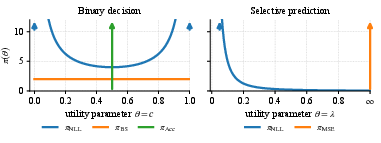
- The paper introduces a decision-theoretic framework that aligns UQ metrics with actual downstream decision utility.
- It reveals that standard metrics (NLL, BS, ECE) can mislead model selection due to pathological prior assumptions.
- It proposes prior-weighted utility (PWU) metrics that robustly correlate with real-world utility in both classification and regression tasks.
Decision-Aligned Evaluation of Uncertainty Quantification: Expert Analysis
Introduction
Despite significant advances in uncertainty quantification (UQ) methods within ML, the evaluation of UQ remains dominated by generic metrics such as negative log-likelihood (NLL), Brier score (BS), and expected calibration error (ECE). These surrogate metrics, while statistically motivated, may be poorly aligned with the actual utility realized in downstream decisions. The paper "Decision-Aligned Evaluation of Uncertainty Quantification" (2606.26990) introduces a decision-theoretic framework—decision-alignment—to bridge this gap, demonstrates the misalignment and pathologies in standard UQ metrics, and proposes prior-weighted utility (PWU) metrics to robustly align UQ evaluation with real-world decision utilities.
The central theoretical construct is decision-alignment, which formalizes when a UQ metric genuinely reflects expected downstream utility. A metric M is decision-aligned with a decision utility family {Uθ}θ∈Θ and prior π if there exists an increasing transformation such that
hy(M(f,y))=∫Θ−Uθ(f,y)π(θ)dθ,
for all predictions f.
Key implications:
- Strict order- and tie-preservation: Decision-aligned metrics guarantee that metric-based model rankings agree with rankings by expected utility under the induced prior.
- Interpretability: Identification of the implicit "decision prior" encoded by any metric reveals whether standard metrics correspond to reasonable real-world settings.
Standard metrics (NLL, BS, Acc, ECE, etc.) are shown to be decision-aligned only under "pathological" priors, disproportionately weighting unlikely cost conditions or encoding unrealistic assumptions (e.g., symmetric misclassification cost).
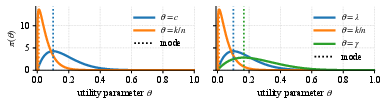
Figure 1: Prior choices for our classification (left) and regression (right) prior-weighted utility metrics.
Pathologies of Common UQ Metrics
Through systematic analysis in both classification and regression settings, the work demonstrates:
Fundamentally, these pathologies mean that most common UQ metrics are not capable of reliably selecting models that maximize real downstream utility under plausible assumptions.
Prior-Weighted Utility (PWU) Metrics
To address the systematic misalignment, the authors propose PWU metrics, defined by explicitly specifying a plausible prior π over the decision parameters and integrating the relevant decision utility:
Mπ(f,y)=∫Θ−Uθ(f,y)π(θ)dθ.
PWU metrics are, by construction, decision-aligned and can be instantiated for any relevant utility model (e.g., cost-sensitive classification, selective prediction, top-k subset selection).
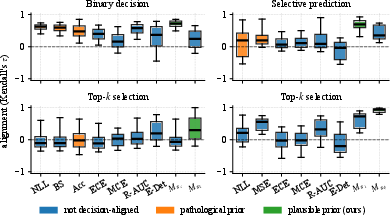
Figure 3: Metric--utility alignment in classification (left) and regression (right), averaged over five datasets. The coloring corresponds to theoretical findings regarding alignment.
Key properties:
- Proper Scoring: PWUs inherit properness; they incentivize truthful uncertainty estimation under the corresponding utility.
- Flexibility: The approach can systematically cover all relevant decision families if a variety of priors are used.
- Robustness: Empirically, PWU alignment is robust to moderate misspecification of the prior.
Empirical Results
Extensive experiments on benchmark datasets and real-world case studies (electricity market bidding, credit approval, and peer-to-peer lending) empirically validate the theory:
- PWU metrics always exhibited maximal alignment with realized downstream utilities, as measured by model ranking correlation and agreement with utility optimization.
- Conventional metrics (including ECE, R-AUC, standard NLL) often demonstrated low or even negative correlation with downstream utility, making them actively misleading in model selection.
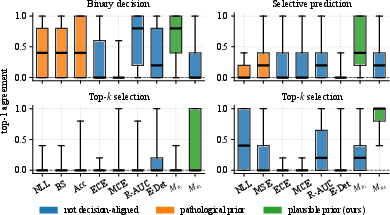
Figure 4: Top-1 agreement in classification (left) and regression (right), averaged over five datasets.
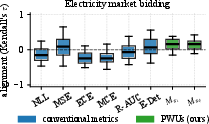
Figure 5: Metric--utility alignment in the electricity market case study. The PWU metrics are the only metrics with stable positive bidding utility alignment.
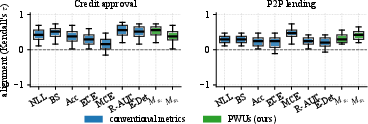
Figure 6: Metric--utility alignment in the credit approval case study (left) and the P2P lending case study (right). PWU metrics exhibit strongest correlation with actual utilities.
The empirical findings also highlight the instability of commonly used metrics—both under benign prior misspecification and under realistic task drift in practice.
Sensitivity and Robustness
To probe the robustness of PWU metrics, the authors performed a sensitivity analysis under various degrees of prior perturbation. The results show that—as the prior moves away from the base scenario—PWU metrics remain reliably utility-aligned, whereas metrics like NLL or ECE deteriorate or change their model rankings unpredictably.
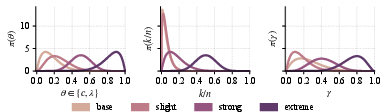
Figure 7: Prior perturbations considered in the sensitivity analysis; darkest shades indicate the most severe prior misspecification.
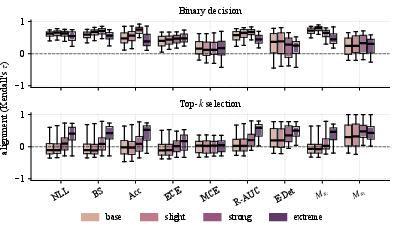
Figure 8: Metric--utility alignment in binary classification under increasing levels of prior perturbation; only PWU metrics are robust.
Implications and Future Directions
Practical
- Benchmarking: Standard benchmarks and leaderboards for UQ algorithms should adopt diverse PWU metrics relevant to anticipated operational contexts, avoiding reliance on single, generic surrogates.
- Model selection and audit: Model evaluation protocols in sensitive domains (healthcare, finance, critical infrastructure) must consider the specific utility structure; otherwise, performance metrics may yield dangerously misleading guidance for deployment.
- Tailored metric selection: Selection or design of metrics must reflect the intended set of downstream interventions, not a notional task-independent ideal.
Theoretical
- Generalization to higher-order uncertainty: The authors focus on first-order UQ but extension to evaluation protocols aligned with second-order (or higher) epistemic uncertainty, as would be required for robust adaptive decision-making, is a compelling direction.
- Broader application: End-to-end decision-centric ML pipelines: The PWU construction is compatible with end-to-end training of learning systems for task-based or utility-focused optimization and can inform loss-calibrated learning objectives and calibration strategies (see also (Cobb et al., 2018), [2011], [2025]).
- Calibration and coverage: Connection to advanced task-aware calibration paradigms is evident, and future work may unify utility alignment, calibration loss guarantees, and dynamic decision assignment for complex multi-agent systems.
Conclusion
This work establishes that most standard uncertainty quantification metrics are not rational proxies for real-world utility and often encode implicit, pathological assumptions about downstream decision contexts. The decision-alignment criterion provides a principled diagnostic for metric selection, and PWU metrics offer a practically robust solution, demonstrably leading to model rankings that are actually useful for operational deployment. Theoretical and empirical results underscore the importance of decision-aware evaluation throughout the ML lifecycle, and adoption of PWU metrics will be central to meaningful progress in trustworthy, application-oriented probabilistic learning.