Non-Hermiticity of an anomalous superradiant phase
Published 25 Jun 2026 in quant-ph | (2606.26770v1)
Abstract: We counterintuitively present a Hermitian squeezing-Dicke model as a minimal setting for non-Hermitian physics in many-body light-matter systems. It enables the realization of a non-Hermitian Hamiltonian of interest using a Hermitian quadratic bosonic system. Unlike previous dissipation-driven non-Hermitian mechanisms, effective parity-time ($\mathcal{PT}$) symmetry arises purely from squeezing and exchanges gainy and lossy eigenmodes. We identify non-Hermiticity of an anomalous superradiant phase for strong spins squeezing, exhibiting spontaneous breaking of the unique $\mathcal{PT}$ symmetry beyond $Z_2$ symmetries. Such exotic phase exhibits a complex excitation spectrum and undergoes a dynamical phase transition to a conventional superradiant phase at an exceptional point. An artificial magnetic field combined with the broken Hermiticity yields nonreciprocal dynamics with striking quantum amplification, exhibiting unidirectional enhanced transmission. Our Hermitian light-matter system offers an alternative pathway to exotic non-Hermitian physics and nonreciprocal quantum amplification.
The paper demonstrates that engineered squeezing interactions induce non-Hermitian dynamics in a closed Dicke model system.
The paper employs Holstein-Primakoff and Bogoliubov de Gennes mapping to reveal a dynamical superradiant phase with spontaneous PT-symmetry breaking.
The paper shows that synthetic magnetic flux and squeezing parameters enable nonreciprocal quantum amplification and tunable phase transitions.
Non-Hermiticity and Dynamical Superradiant Phases in the Squeezing Dicke Model
Model Formulation and Effective PT Symmetry
The paper introduces a squeezing-Dicke model consisting of N two-level atoms collectively interacting with a single cavity mode subject to both standard Dicke coupling and photon/spin squeezing terms. Critically, the light-matter coupling is complex, parameterized by a phase θ that acts as a synthetic magnetic flux. The resulting Hamiltonian is explicitly
Unlike conventional paradigms where non-Hermitian physics is introduced via explicit gain/loss or dissipation channels, this work demonstrates that squeezing interactions alone can induce effective non-Hermitianity in a closed, Hermitian many-body system. The phase θ introduces a non-trivial geometric (artificial magnetic) flux that cannot be removed by any unitary transformation. Through Holstein-Primakoff and Bogoliubov de Gennes (BdG) mapping, the authors show that the resulting quadratic bosonic Hamiltonian yields a non-Hermitian BdG matrix; however, pseudo-Hermiticity is retained (τzHBdGτz−1=HBdG†). This gives rise to an effective parity-time (PT) symmetry, realized by mapping to gain/loss eigenmodes and parity operations in quadrature space.
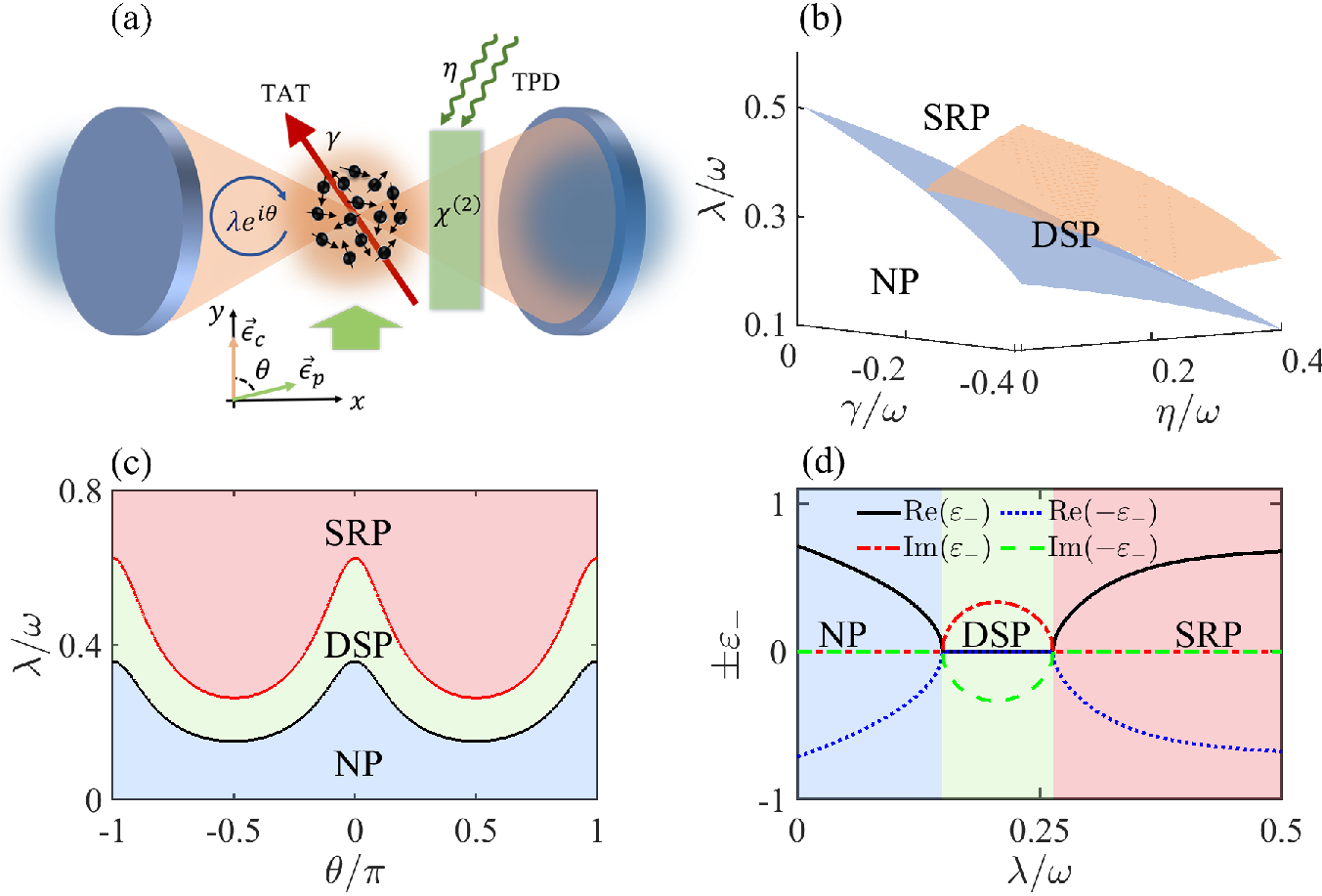
Figure 1: Schematic of the system—collective atomic spin ensemble in a cavity with complex coupling—and the phase diagram, highlighting the appearance of the dynamical superradiant regime (DSP) with PT-broken spectrum.
Emergence of a Dynamical Superradiant Phase with Broken Hermiticity
A central result is the identification of an "anomalous" dynamical superradiant phase (DSP) that emerges between the normal phase (NP) and the conventional superradiant phase (SRP) as the light-matter coupling λ is tuned. The critical point λcNP separates NP from DSP, and an exceptional point (EP) N0 demarcates DSP from SRP. In the DSP, the effective N1 symmetry associated with the BdG Hamiltonian is spontaneously broken, resulting in complex conjugate excitation energies—i.e., modes with exponential growth/decay even in an overall Hermitian system.
This regime is fundamentally distinct from the conventional superradiant phase, where the excitation spectrum is real-valued and the only broken symmetry is the discrete N2 parity. Notably, the DSP is stabilized by strong photon and spin squeezing and persists for arbitrary values of the synthetic magnetic flux N3, provided the squeezing ratio N4 remains sufficiently large.
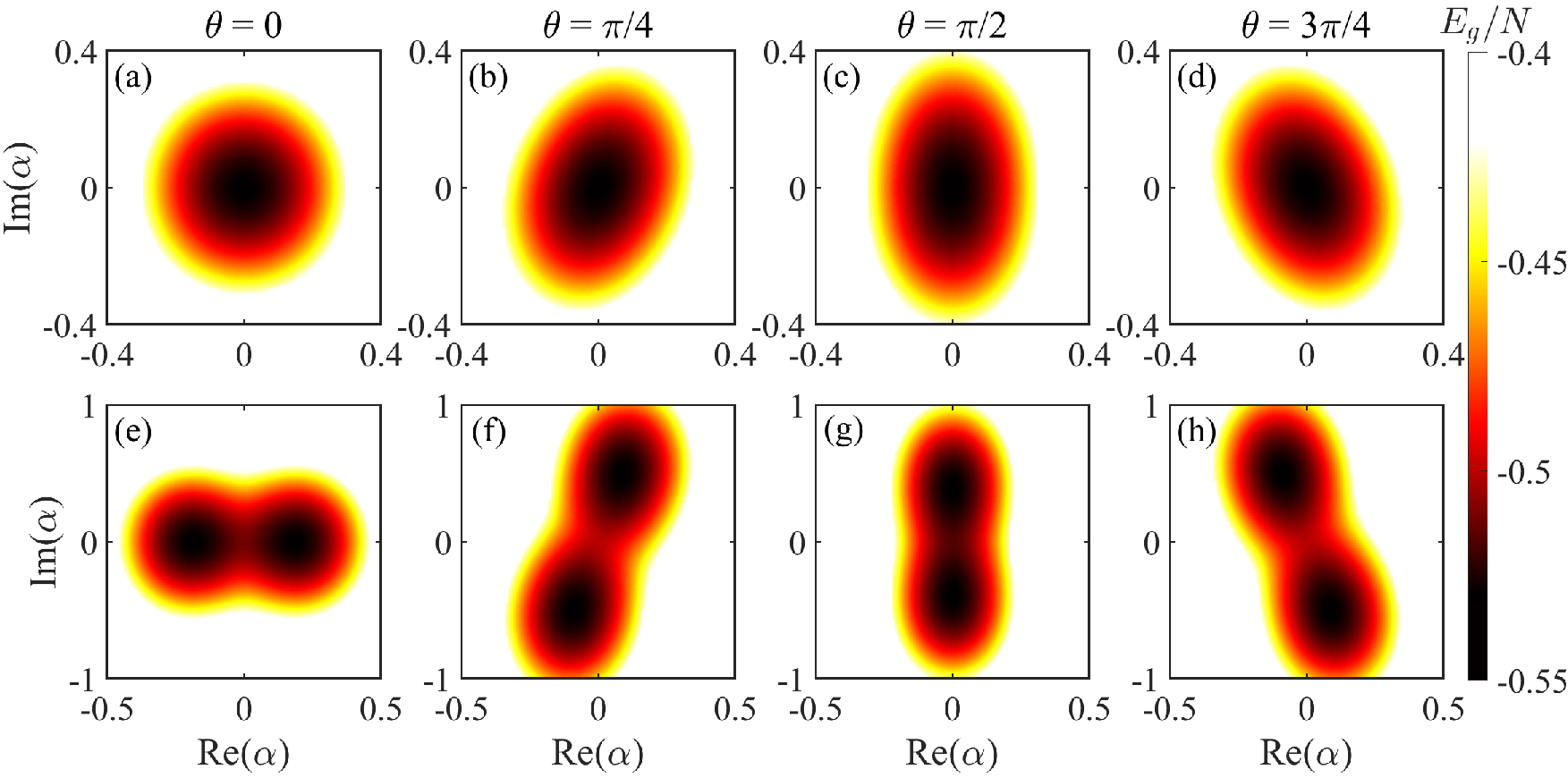
The ground-state energy landscape illustrates the interplay between squeezing strength and flux: In the NP, the energy minimum is unique, while in the DSP and SRP, it bifurcates into two minima corresponding to symmetry-broken order parameters with complex displacement, the geometry of which is flux-tunable.
Figure 2: Ground-state energy surface in the complex order parameter plane, showing single and bifurcated minima as the system crosses from NP to DSP to SRP, with flux N5 controlling the orientation of the minima.
Nonreciprocal Quantum Amplification and Non-Hermitian Dynamics
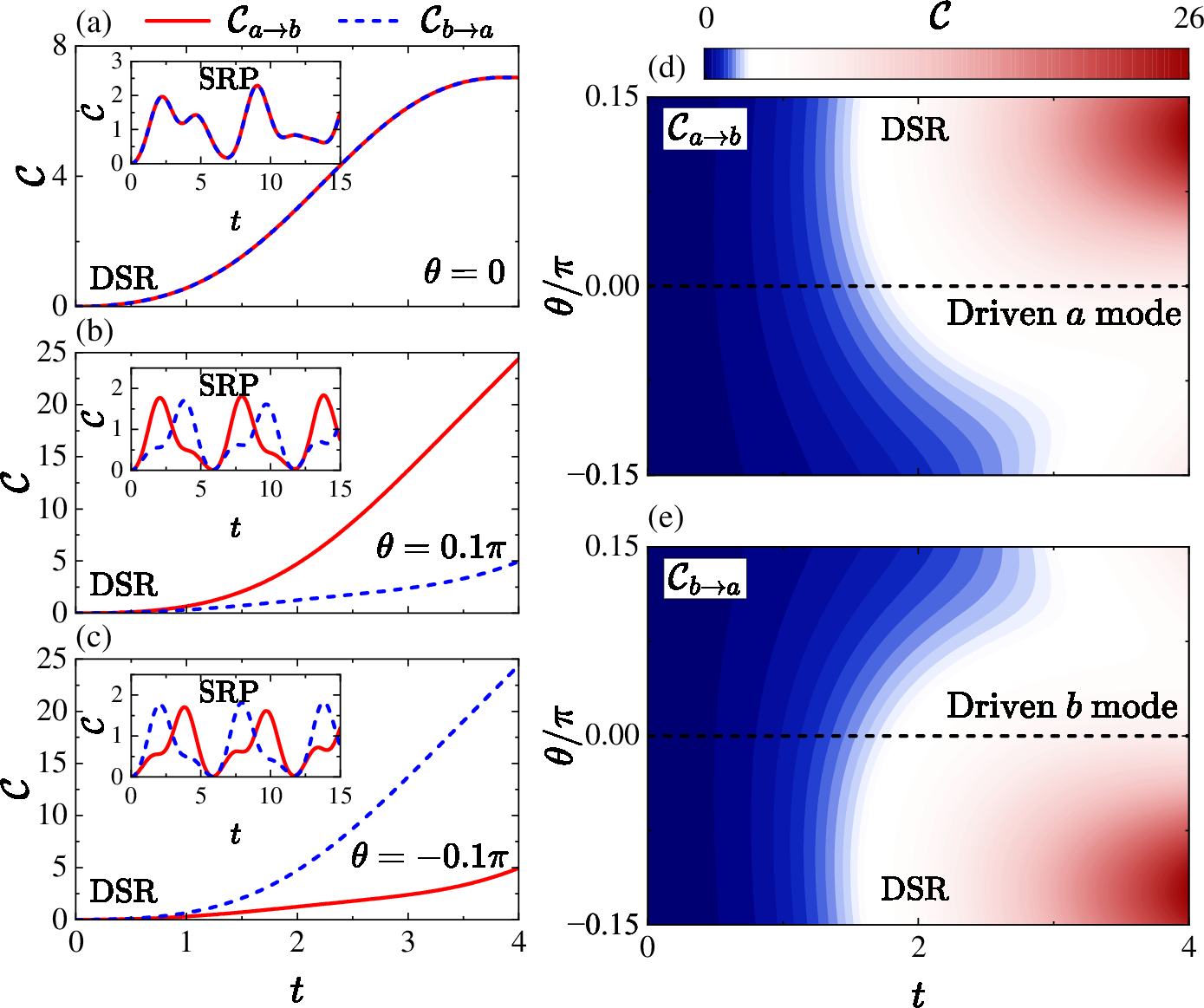
The analysis of quantum dynamics in the DSP reveals regimes of nonreciprocal, chiral quantum amplification: the coherent transfer of excitations between photonic and atomic subsystems can be unidirectionally enhanced or suppressed. The effective non-Hermiticity, together with a nonzero artificial magnetic flux N6, breaks reciprocity of signal amplification—resulting in distinct transmission efficiencies N7. This leads to observable quantum amplification for initial excitations in one subsystem but suppression in the reverse direction.
These effects are absent in the normal and conventional superradiant phases, demonstrating that the DSP is characterized both statically and dynamically by emergent non-Hermitian physics despite the closed, purely Hermitian Hamiltonian.
Figure 3: Time evolution of transmission ratios between photonic and atomic modes, illustrating nonreciprocal amplification under finite synthetic flux in the DSP.
Theoretical and Practical Implications
This work establishes that genuine non-Hermitian phase transitions and dynamics can be realized in closed quantum optical systems through engineered squeezing interactions and artificial gauge fields, without recourse to dissipation or reservoir engineering. The combination of N8-like symmetry breaking, exceptional points, and chirality yields a rich phenomenology with relevance to nonreciprocal quantum devices, directional quantum amplification, and enhanced quantum metrology. The general mechanism provides an alternative, universally applicable pathway to realize non-Hermitian phenomena in light-matter platforms, including cavity/BEC systems and quantum simulators.
The results further suggest novel avenues for exploring topological and critical phenomena driven by squeezing-induced pseudo-Hermiticity, as well as for implementing control protocols leveraging the tunable nonreciprocity and amplification properties. The robustness of the DSP and its associated non-Hermitian spectrum to magnetic flux and squeezing parameter variations indicates broad applicability and experimental accessibility.
Conclusion
The paper presents a comprehensive theoretical framework for realizing effective non-Hermitian, N9-symmetry-breaking physics in closed Hermitian many-body light-matter systems via squeezing interactions and complex coupling. The identification of the dynamical superradiant phase, its associated exceptional point, and the control of nonreciprocal quantum amplification under synthetic magnetic fields represent significant advances in the study of non-Hermitian quantum many-body phenomena and their potential applications in quantum technologies.
“Emergent Mind helps me see which AI papers have caught fire online.”
Philip
Creator, AI Explained on YouTube
Sign up for free to explore the frontiers of research
Discover trending papers, chat with arXiv, and track the latest research shaping the future of science and technology.Discover trending papers, chat with arXiv, and more.