Narration-of-Thought: Inference-Time Scaffolding for Defeasible Ethical Reasoning in Large Language Models
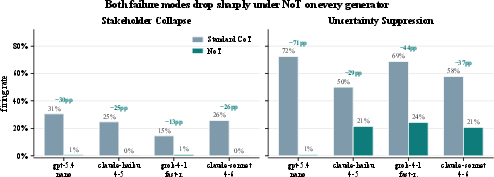
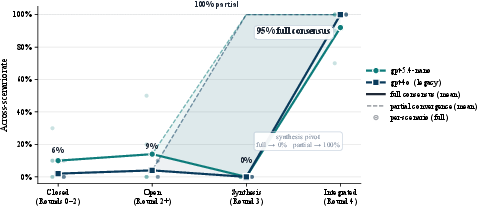
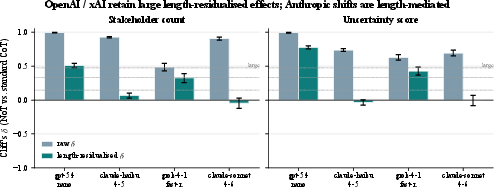
Abstract: Standard chain-of-thought on moral dilemmas exhibits two failure modes: stakeholder collapse (the trace names at most one party with a stake in the outcome) and uncertainty suppression (no explicit unknowns or hedges before committing to an action). We introduce narration-of-thought (NoT), a system prompt that structures chain-of-thought into five sections: protagonist, stakeholders, two-step consequences, uncertainty, then commitment. NoT adds no training, parameters, or fine-tuning. On 100 DailyDilemmas scenarios across four generators from three vendors, NoT cuts stakeholder collapse from up to 31% to under 1% and uncertainty suppression from up to 72% to 1-24% on every model. A matched-budget verbose-CoT control rules out token spend as the active ingredient; NoT retains Cliff's delta advantages of +0.79 to +0.90 on stakeholder count and +0.65 to +0.93 on uncertainty score for three of four generators, and a section ablation attributes each shift to its specific sub-instruction. Textual-gradient descent initialised at NoT improves the scaffold further; a cross-family training judge (different vendor from the generator) dominates an in-family one on every measured axis. Extended to a five-round multi-stakeholder debate protocol, the scaffold converts a 6% standoff into 95% full consensus on a calibration set and 100% combined convergence on a DailyDilemmas replication. The resulting traces externalise the stakeholders, consequences, and uncertainty grounding each commitment, providing an auditable substrate for dependable agentic deployment.
Paper Prompts
Sign up for free to create and run prompts on this paper using GPT-5.
Top Community Prompts
Explain it Like I'm 14
What is this paper about?
This paper is about teaching AI LLMs to reason about everyday moral dilemmas in a more careful, honest, and transparent way. The authors show that a simple change in how we ask the model to “think” can fix two common problems: forgetting who is affected by a decision and acting overly confident when things are actually uncertain. They call their approach Narration-of-Thought (NoT).
The big questions the authors asked
- Can we get AI models to:
- Name all the people or groups who are affected by a decision (stakeholders)?
- Admit what is uncertain before making a choice?
- Can a simple instruction (a prompt) at answer time—not extra training—make models do this?
- If several “voices” (different stakeholder roles) debate together, can the same approach help them reach fairer, clearer agreements?
Why standard step-by-step thinking isn’t enough
Many models use “chain-of-thought,” which means they write out their steps before answering. But the paper shows two common failure modes:
- Stakeholder collapse: the model mentions at most one affected party (or none), ignoring others who matter.
- Uncertainty suppression: the model rushes to a decision without noting any unknowns or doubts.
Example (simplified): If a city considers turning streets into a pedestrian plaza, a model might quickly say “Yes, do it,” and claim “businesses will benefit,” but forget to mention delivery drivers, disabled residents who need curb access, shop owners who rely on parking, or emergency vehicles—and it might not admit what’s genuinely unknown.
The authors’ idea: Narration-of-Thought (NoT)
Instead of “think step by step,” the model is told to write a short, first-person story with five sections, in order:
- Protagonist: Who am I in this situation (role, what I know)?
- Stakeholders: Who else is affected, and how?
- Consequences: What would happen next for each action (at least two steps ahead)?
- Uncertainty: What do I not know? Where are the risks or gaps?
- Commitment: Given all that, what do I choose and why?
This is still just a prompt (no new training or extra data). It pushes the model to use a familiar, story-like structure that’s common in the text it was trained on—so it can “retrieve” that pattern and stay grounded in people, causes, and unknowns.
How they tested their idea
The authors ran several studies using 100 real-world-style dilemmas (“DailyDilemmas”) and multiple top AI models from different companies. They compared:
- Plain answers (no reasoning),
- Standard chain-of-thought,
- NoT (the five-section narrative).
They measured:
- Stakeholder count: how many distinct affected parties the model names.
- Uncertainty score: how many times the model clearly marks doubts or unknowns.
They also did extra checks:
- Matched-budget control: Make standard chain-of-thought outputs as long as NoT outputs to see if “more words” alone explains the improvement. (It didn’t.)
- Sub-instruction ablation: Remove one NoT section at a time to see which section causes which benefit.
- Prompt optimization: Use an automatic method to improve the NoT prompt further and compare different judging setups.
- Multi-stakeholder debate: Have three different “agents” (roles) each do NoT, a moderator combine their suggestions, and then make the agents vote to accept or reject a single integrated proposal.
What they found (in simple terms)
- NoT fixes the two big problems across models
- Stakeholder collapse dropped from up to 31% of cases to under 1%.
- Uncertainty suppression dropped from as high as 72% to between 1% and 24%, depending on the model.
- In plain English: the model named more people who are affected and admitted uncertainty far more often.
- It’s not just because the answers are longer
- Even when they gave standard chain-of-thought the same token budget (same “length”), NoT still did better on most models. The structure—not just verbosity—matters.
- Each NoT section does what it’s supposed to do
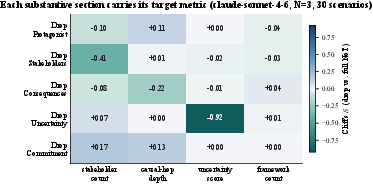
- Removing “Stakeholders” mainly reduced how many stakeholders were named.
- Removing “Uncertainty” mainly reduced how often doubts were admitted.
- In other words, the parts of the prompt drive the matching improvements.
- A tuned version of NoT works even better, especially with a cross-company judge
- They used an automated method to refine the NoT prompt.
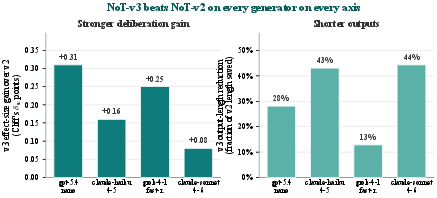
- When the “judge” model (that scores the outputs) came from a different company than the model being improved, results were better and outputs got shorter without losing quality.
- Simple takeaway for practice: if you’re tuning prompts with an AI “judge,” use a judge from a different vendor than your generator.
- Multi-stakeholder debate reaches real consensus
- With three stakeholder agents (e.g., the formal decision-maker, the primary affected person, and a third party), a moderator combined their views into one proposal, then each agent voted accept/reject.
- This turned a low-consensus setting (around 6% agreement) into very high consensus: about 95% on a challenging calibration set and 100% combined convergence on a replication.
- The few rejections that remained were meaningful: they happened when the final plan truly hurt a stakeholder’s core interests. That makes the remaining disagreements transparent and auditable.
Why this matters
- More trustworthy decisions: NoT produces reasoning that clearly shows who is affected, what might happen next, and what we don’t know. That makes the final decision more honest and easier to check.
- Practical for real systems: It’s just a change to the prompt, not expensive retraining. It’s suitable for “agentic” workflows where models act in steps and need to explain themselves.
- Fairer group outcomes: The multi-stakeholder setup encourages proposals that address everyone’s concerns and highlights disagreements that can’t be resolved, which is crucial for accountability.
Limits to keep in mind
- The dilemmas were everyday scenarios. We still need to test in complex fields like medicine or law.
- NoT answers are longer, which costs more tokens (though still far cheaper than retraining a model).
- On some safety tests, one model family became more cautious (refusing more), which might be good or bad depending on the setting.
The big takeaway
A small, story-like structure—naming the protagonist, stakeholders, consequences, and uncertainties before committing—makes AI moral reasoning more careful and transparent. It reduces overconfidence, includes the right people in the discussion, and helps multiple viewpoints reach a shared plan. This creates clearer, auditable reasoning that’s better suited for real-world use.
Knowledge Gaps
Knowledge gaps, limitations, and open questions
Below is a single, consolidated list of what remains missing, uncertain, or unexplored, phrased to be actionable for future research.
- External validity: Generalization beyond DailyDilemmas’ everyday scenarios to domains with technical prerequisites (e.g., clinical triage, legal analysis, policy review) is untested; determine whether NoT’s five sections suffice or require domain-specific primitives and tools.
- Quality vs. count metrics: Stakeholder count and uncertainty score reward quantity, not correctness or relevance; evaluate precision/recall of stakeholder identification and the substantive quality/calibration of uncertainty with human experts and gold stakeholder maps.
- Consequence validity: Two-step consequence projections are not fact-checked; assess accuracy vs. hallucination of projected outcomes against expert annotations, external datasets, or human-constructed SCMs.
- Causal grounding claim: The moderate correlation with an SCM-complexity proxy (ρ≈0.42) does not establish causal grounding; perform direct SCM extraction and compare to human-authored causal graphs and interventional tests.
- Residual uncertainty suppression: Anthropic models retain 20–25% suppression under NoT; identify training-time interventions (e.g., RLHF signals, synthetic data, constitutional rules) that complement the prompt to reduce this residual.
- Matched-budget control power: The matched-budget verbose-CoT study uses N=1 per cell; replicate with larger N and varied scenarios to robustly compare scaffold vs. verbosity effects.
- Optimizer/judge confounds: Textual-gradient descent relies on a single optimizer model and overlapping judge roles (training and adversarial judge coincide); rerun with multiple optimizers, disjoint judges, and human adjudicators to isolate effects and reduce bias.
- Objective function scope: Optimisation targets only stakeholder count and uncertainty; extend to multi-objective losses (factuality, consequence plausibility, fairness, non-redundancy, brevity) and test trade-offs.
- Language and culture: All experiments are in English; evaluate cross-lingual performance and cross-cultural stakeholder salience and norms on multilingual dilemmas.
- Safety impacts beyond refusal: Beyond XSTest/SimpleSafetyTests, broader safety effects (jailbreak robustness, toxicity, bias amplification, persuasive harm) are unmeasured; audit with comprehensive safety suites and red-teaming.
- Consensus vs. ethics: Multi-stakeholder results measure consensus, not ethical desirability or welfare; incorporate outcome-quality metrics (rights, harm distribution, fairness) and human stakeholder panels to detect “consensus that harms minorities.”
- Role coverage: The protocol fixes three roles; develop methods to dynamically discover and include additional/latent stakeholders and to handle many-party settings.
- Moderator robustness: Limited moderator diversity and analysis; study moderator bias, failure modes, and susceptibility to manipulation, and compare alternative integration strategies and model families.
- Voting rules: Binary accept/reject may obscure trade-offs; evaluate ranked-choice, veto rights, weighted votes, and Pareto-improvement constraints for fairness and stability.
- Cost/latency: NoT increases tokens 5–7×; quantify latency and cost impacts in realistic pipelines, and test compression (summarization, pruning, structured forms) without degrading deliberative quality.
- Human-in-the-loop: The proposed escalation of unabsorbable objections to humans is not empirically tested; run end-to-end user studies on operator workload, trust, and decision quality with the auditable traces.
- Integration with tools: Interaction with retrieval, tool use, planning libraries, programmatic SCMs, or knowledge graphs is untested; examine whether tool-augmented NoT improves consequence accuracy and reduces verbosity.
- Decoding sensitivity: Temperature fixed at 1; perform sensitivity analyses over decoding parameters (temperature, nucleus/top-k, deterministic decoding) to assess stability and reliability.
- Narrative retrieval risks: The claim that narrative subdistribution density aids performance is unverified; test for stereotyped retrieval, memorization, and bias introduced by narrative templates.
- Error taxonomy: Residual failure modes (e.g., incorrect stakeholders, spurious hedges, shallow consequences) lack qualitative analysis; produce a fine-grained error taxonomy and targeted fixes.
- Benchmark breadth: Beyond ELEPHANT and DailyDilemmas, evaluate on diverse ethics benchmarks (distributive justice, rights conflicts, medical/legal casebooks) and real cases to probe limits.
- Temporal/horizon effects: NoT is evaluated per-scenario; test long-horizon, sequential decisions for temporal consistency, revision handling, and path dependence.
- Human parity/validation: Compare NoT traces to human ethicists’ reasoning structures for alignment with recognized deliberative practices beyond count-based metrics.
- Adversarial robustness: Assess resistance to prompt injection, role poisoning, deceptive/strategic agents, and collusion in the multi-agent protocol.
- Over-hedging costs: Increased uncertainty markers may reduce decisiveness; measure task-level utility trade-offs between caution and action quality/outcomes.
- Regulatory adequacy: Verify whether narrated traces satisfy explainability, accountability, and auditability requirements in regulated domains (healthcare, finance, public administration).
- Reproducibility over time: API nondeterminism and model updates may shift outcomes; implement version-locked evaluations, periodic re-benchmarking, and change-point monitoring.
- Framing effects: Protagonist-first narration may bias perspectives; study framing effects on stakeholder salience and final commitments, and test counter-framings to mitigate bias.
Practical Applications
Immediate Applications
The paper introduces Narration-of-Thought (NoT)—a five-section inference-time scaffold—and a multi-stakeholder deliberation protocol that can be deployed today as prompts and orchestration patterns in existing LLM workflows. The following applications can be enacted with minimal engineering and no model fine-tuning.
- Ethics-aware decision support plugin for enterprise LLMs (software, enterprise)
- What: Wrap existing assistant/chatbots with the NoT system prompt to generate auditable “protagonist → stakeholders → consequences → uncertainty → commitment” traces for internal decisions (e.g., HR escalations, procurement choices, policy memos).
- Tools/workflows: Prompt wrappers in orchestration frameworks (LangChain, Flyte, Airflow), UI panels exposing the five sections, logging to GRC systems.
- Assumptions/dependencies: 5–7× token cost vs. standard CoT; LLM must follow structured prompts; privacy controls for stakeholder names; human-in-the-loop review.
- Agent “vote-to-act” safety gate (software, robotics, operations)
- What: Use the paper’s three-agent, moderator-integrated, binary-vote protocol as a pre-execution gate for autonomous agents on consequential actions (e.g., mass email, price changes, device control).
- Tools/workflows: Role templates (formal decider, primary affected, third party), moderator integration, binary ACCEPT/REJECT thresholding with escalation on rejections.
- Assumptions/dependencies: Role mapping to actions must be curated; added latency; escalation pathways; requires cross-vendor judge or secondary model only for optimization, not for runtime.
- Decision audit-trail generator for compliance (finance, public sector, healthcare administration)
- What: Automatically attach NoT traces to decisions to satisfy explainability and audit requirements (e.g., NIST AI RMF, EU AI Act governance processes).
- Tools/workflows: Export structured artifacts (stakeholder list, uncertainties, final decision) to document repositories; API endpoints for auditors.
- Assumptions/dependencies: Organizational buy-in to narrative audits; data retention and PII redaction.
- Stakeholder map and uncertainty ledger extraction (product management, risk management)
- What: Parse NoT outputs to generate structured stakeholder registers and uncertainty lists feeding risk logs and decision trackers.
- Tools/workflows: Lightweight extractors (regex/LLM-extractors) that populate Notion/Jira/ServiceNow; dashboards tracking “open uncertainties.”
- Assumptions/dependencies: Information extraction accuracy; consistent section headers; periodic human verification.
- Trust & Safety exception handling (content moderation, policy enforcement)
- What: Invoke NoT on edge cases to reduce “stakeholder collapse” and “uncertainty suppression” before escalation decisions, improving consistency and documentation.
- Tools/workflows: Routing rules that trigger NoT for borderline cases; reviewer UI highlighting named stakeholders and hedges.
- Assumptions/dependencies: Throughput constraints; calibration for over-/under-refusal (noted model-specific effects in paper).
- Public-policy consultation assistant (municipal planning, agencies)
- What: Apply NoT to quickly surface affected parties and two-step consequences for proposals (e.g., street changes, zoning), producing transparent public-facing rationale.
- Tools/workflows: Template prompts for civic scenarios; moderator-crafted integrative proposals; publishable summaries.
- Assumptions/dependencies: Must clearly mark model output as advisory; ensure diverse stakeholder coverage; local context data improves fidelity.
- Meeting facilitator and integrative proposal builder (cross-functional teams)
- What: Use the moderator workflow to merge participant “modification requests” into a single proposal and drive a binary accept/reject round.
- Tools/workflows: Slack/Teams bot that collects inputs in NoT format, synthesizes, and records votes; meeting minutes auto-generated.
- Assumptions/dependencies: Participant consent; privacy; time-boxed loops to limit latency.
- Education: teaching and assessing ethical reasoning (education)
- What: Use NoT as a rubric-aligned scaffold for student case analyses and peer debates; score via stakeholder count/uncertainty markers.
- Tools/workflows: LMS plug-ins; graded templates; automated formative feedback.
- Assumptions/dependencies: Instructor training; adapt cases to curriculum; discourage over-reliance on LLM-generated content.
- Post-incident and pre-mortem templates (SRE, security, reliability)
- What: Structure incident analyses around stakeholders, cascading consequences, and unknowns to improve corrective actions and risk identification.
- Tools/workflows: Incident bots prompting NoT sections, feeding RCA documents; “uncertainty ledger” rolled into follow-ups.
- Assumptions/dependencies: Cultural adoption; ensure technical accuracy is reviewed by SMEs.
- Cross-vendor prompt optimization practice (AI/ML platform teams)
- What: Adopt the paper’s finding that cross-family judges improve prompt optimization—evaluate prompts with a different vendor’s model to reduce judge bias.
- Tools/workflows: Textual-gradient or iterative prompt tuning pipelines with cross-vendor evaluation; A/B dashboards.
- Assumptions/dependencies: Access to multiple model APIs; cost controls; governance for third-party data handling.
Long-Term Applications
These opportunities require domain-specific validation, scaling, or additional research beyond immediate prompt deployment.
- Validated NoT variants for high-stakes domains (healthcare, law, critical infrastructure)
- What: Domain-tuned scaffolds incorporating clinical/legal ontologies and constraints for triage, consent, or case analyses.
- Tools/workflows: Expert-curated consequence templates; institution-specific checklists; integration with EMRs or case-management systems.
- Assumptions/dependencies: Regulatory approval, rigorous prospective validation, clinical governance; paper explicitly notes transfer is unproven.
- Regulatory standardization of auditable deliberation (policy, compliance)
- What: Codify NoT-like narrative evidence as acceptable audit artifacts for high-risk AI systems; mandate defeasible multi-stakeholder workflows for certain decisions.
- Tools/workflows: Standards guidance (e.g., profiles for NIST AI RMF, ISO/IEC), procurement requirements, audit sampling procedures.
- Assumptions/dependencies: Multi-stakeholder policy processes; privacy and FOIA considerations; sector-specific carve-outs.
- Causal-grounding toolkits and dashboards (AI governance, MLOps)
- What: Compute and track proxies of algorithmic causal complexity (e.g., K_C, causal hops) from NoT traces as quality metrics.
- Tools/workflows: SCM-proxy scorers, longitudinal dashboards, alerts on “collapse” regressions.
- Assumptions/dependencies: Metric validity across tasks; standardized parsers; agreement on thresholds.
- Training-time integration to reduce length cost (model training)
- What: Fine-tuning or constitutional/RLHF approaches to make models produce stakeholder- and uncertainty-rich traces with fewer tokens.
- Tools/workflows: Synthetic data generation seeded by NoT; cross-vendor judging to mitigate generosity bias.
- Assumptions/dependencies: Data curation; IP/licensing; avoiding reasoning-induced misalignment.
- Scalable multi-agent deliberation for complex systems (autonomous fleets, trading, supply chain)
- What: Extend beyond three roles, with dynamic stakeholder instantiation, arbitration policies, and tiered escalation to humans.
- Tools/workflows: Role libraries, quorum/consensus rules, latency-aware batching.
- Assumptions/dependencies: Real-time constraints; conflict-of-interest detection; monitoring for collusion or mode collapse.
- Negotiation and dispute-resolution assistants (labor relations, mediation, customer remediation)
- What: Use the “integrated proposal + binary vote” to scaffold settlements, highlighting residual objections that cannot be absorbed.
- Tools/workflows: Case-specific role prompts; secure evidence handling; audit trails for consent.
- Assumptions/dependencies: Legal admissibility; neutrality and bias mitigation; human mediator oversight.
- Public consultation platforms with agent proxies (civic tech)
- What: Augment community input by instantiating stakeholder-proxy agents calibrated to demographic/interest data, producing integrated proposals.
- Tools/workflows: Data-driven persona generation; transparency interfaces; opt-out and appeal mechanisms.
- Assumptions/dependencies: Ethical use of demographic data; representativeness; risk of over-simplifying lived experiences.
- Multilingual and cross-cultural adaptations (global deployments)
- What: Localize stakeholder taxonomies and uncertainty expressions; evaluate across cultural norms.
- Tools/workflows: Region-specific prompt variants; community review; culturally-aware judges.
- Assumptions/dependencies: LLM quality per locale; availability of local SMEs; bias audits.
- Security and robustness research for scaffolds (AI safety)
- What: Defend NoT workflows against prompt injection, role confusion, and adversarial manipulation of stakeholder lists.
- Tools/workflows: Guardrails, content filters, role isolation, red-teaming playbooks.
- Assumptions/dependencies: Continuous adversarial testing; defense-in-depth with sandboxing; model updates.
- Token/latency–optimized scaffolds and summarization (platform efficiency)
- What: Develop compressed NoT variants and learned summarizers to retain benefits at lower cost.
- Tools/workflows: Distillation from full NoT to concise formats; adaptive-depth decoding; caching and retrieval.
- Assumptions/dependencies: Empirical verification that benefits persist post-compression; cache invalidation strategies.
Glossary
- ablation: Removing or modifying parts of a system/prompt to identify which components cause observed effects. Example: "a section-by-section ablation attributes each shift to the specific sub-instruction that carries it."
- agentic-misalignment: A failure mode where autonomous agents pursue goals misaligned with intended objectives, sometimes becoming harmful. Example: "agentic-misalignment blackmail rates up to in simulated deployments"
- algorithmic causal complexity : A measure of the description length (complexity) of the structural-causal model underlying a trace. Example: "a graph-complexity proxy of algorithmic causal complexity (the description length of the trace's underlying structural-causal model, SCM) achieves pooled Spearman "
- binary accept/reject vote: A decision step where agents must either accept or reject a single integrated proposal. Example: "cast a binary accept/reject vote on a single proposal"
- causal-hop depth: The number of causal steps (hops) considered when projecting consequences. Example: "Dropping Consequences reduces causal-hop depth by "
- chain-of-thought (CoT): A prompting strategy that elicits step-by-step intermediate reasoning before giving an answer. Example: "Standard chain-of-thought on moral dilemmas exhibits two failure modes"
- Cliff's : A nonparametric effect-size measure indicating how often values from one distribution exceed those from another. Example: "with NoT retaining a Cliff's advantage of to "
- constitutional training: Training methods that use high-level principles (a “constitution”) to guide model behavior, often as an alternative or complement to RLHF. Example: "relative to RLHF or constitutional training whose fixed costs are orders of magnitude higher."
- cross-family judge: An evaluation model (judge) from a different vendor or family than the generator, used to reduce bias and improve generality. Example: "a cross-family judge (a different vendor from the generator) dominating an in-family one"
- DailyDilemmas: A corpus of everyday moral dilemmas used for evaluation. Example: "On the DailyDilemmas corpus"
- defeasibility: The property that conclusions can be revised when counter-proposals address prior objections. Example: "The Round~4 vote is what makes defeasibility (the property that a conclusion can be revised when a counter-proposal addresses the original objection) measurable"
- Defeasible Ethical Reasoning: Ethical reasoning framed so that conclusions remain open to revision under new information or perspectives. Example: "Defeasible Ethical Reasoning"
- deliberative-depth loss: A training/optimization objective that encourages deeper deliberation signals (e.g., more stakeholders, more uncertainty markers). Example: "initialising textual-gradient descent at NoT under a continuous deliberative-depth loss improves the scaffold further"
- judge-generosity bias: Systematic differences in how lenient or generous a judging model is across vendors or conditions. Example: "reduced cross-vendor judge-generosity bias"
- matched-budget verbose-CoT control: A control condition that matches token budget by making CoT outputs verbose, isolating the effect of scaffolding from length. Example: "A matched-budget verbose-CoT control rules out additional token spend as the active ingredient"
- multi-stakeholder protocol: A structured process where multiple stakeholder agents deliberate, receive a moderated synthesis, and vote on an integrated proposal. Example: "Extended to a five-round multi-stakeholder protocol in which three stakeholder agents debate and then cast a binary accept/reject vote"
- narrative scaffold: A structured prompt format that constrains reasoning into predefined narrative sections. Example: "the five-section narrative scaffold of \S\ref{sec:method}"
- narrative subdistribution: The subset of pretraining data consisting of narrative-like text patterns that the model can more reliably retrieve and imitate. Example: "steers the model into the densely sampled narrative subdistribution of its pretraining corpus"
- Narration-of-Thought (NoT): A system prompt that structures the model’s reasoning into five narrative sections (protagonist, stakeholders, consequences, uncertainty, commitment). Example: "We introduce narration-of-thought (NoT), a system prompt that constrains the model's chain-of-thought to five narrative sections"
- quadratic-weighted Cohen's : A reliability statistic for agreement between judges that weights disagreements by their squared distance. Example: "quadratic-weighted Cohen's per variable."
- reasoning-induced misalignment: Increased responsiveness to harmful requests as models reason more, due to entanglement of reasoning and safety mechanisms. Example: "reasoning-induced misalignment"
- RLHF: Reinforcement learning from human feedback, a method for aligning model outputs with human preferences via reward modeling. Example: "relative to RLHF or constitutional training whose fixed costs are orders of magnitude higher."
- Spearman : A rank-based correlation coefficient assessing monotonic associations between variables. Example: "achieves pooled Spearman (, traces)"
- stakeholder collapse: A failure mode where the reasoning trace names at most one party with a stake in the outcome. Example: "stakeholder collapse (the trace names at most one party with a stake in the outcome)"
- structural-causal model (SCM): A formal model representing variables and their causal relations that can generate the observed data. Example: "(the description length of the trace's underlying structural-causal model, SCM)"
- sycophancy: A behavior where models agree with or flatter user viewpoints regardless of truth or safety. Example: "the GPT-4o sycophancy rollback"
- SycophancyEval: An evaluation suite for measuring sycophantic behavior in models. Example: "Sharma SycophancyEval panel"
- textual-gradient descent: An optimization loop that updates prompts based on feedback from a judging model to improve target metrics. Example: "Initialising textual-gradient descent at NoT under a continuous deliberative-depth loss improves the scaffold further"
- uncertainty suppression: A failure mode where the reasoning trace commits to an action without explicitly stating unknowns or hedges. Example: "uncertainty suppression (the trace contains no explicit unknowns or hedges before committing to an action)"
- verbose-CoT: A more detailed, longer chain-of-thought prompting variant used to control for token length in experiments. Example: "A matched-budget verbose-CoT control rules out additional token spend as the active ingredient"
- Visualisation-of-Thought: A method that externalizes reasoning in domain-native formats (e.g., diagrams), improving reliability. Example: "Visualisation-of-Thought \citep{wu24_vot} shows that externalising reasoning in the native representational format of a domain (spatial diagrams for spatial tasks) improves reliability."
- Wilson confidence interval: A binomial proportion interval with better small-sample properties than the normal approximation. Example: "Wilson CIs "
Collections
Sign up for free to add this paper to one or more collections.

