- The paper demonstrates that quantum well lasers exhibit frequency-dependent quadrature squeezing, uncovering both optimal and hidden regimes via a quantum Langevin framework.
- It employs covariance matrix analysis to quantify noise correlations and reveal the impact of carrier-field dynamics and the linewidth enhancement factor on squeezing trajectories.
- The study identifies practical regimes for sub-shot-noise operation, pointing to new opportunities in quantum sensing and metrology using semiconductor lasers.
Complex Frequency-Dependent Quadrature Squeezing in Semiconductor Lasers
Introduction
This work establishes a comprehensive quantum description of quadrature squeezing phenomena in semiconductor lasers, specifically quantum well lasers, by employing a fully quantum linearized Langevin framework that avoids adiabatic elimination of the carrier dynamics. The analysis advances beyond semiclassical treatments or approaches restricted to amplitude noise, elucidating both frequency-dependent optimal squeezing and the existence of "hidden" (complex) squeezing, and systematically quantifies the impact of the linewidth enhancement factor (αH). The formalism provides not only a richer understanding of quantum noise in these technologically relevant devices but highlights the potential for new quantum sensing and metrological protocols leveraging these microscopic sources.
The system is modeled by quantum Langevin equations capturing the coupled fluctuations between the optical field (creation/annihilation operators) and the carrier number within the quantum well. Crucially, the Langevin approach retains the full carrier-field dynamics rather than eliminating the carrier variables, which is necessary for a correct treatment in semiconductors (in contrast to atomic lasers). Fluctuations are separated into amplitude (X) and phase (Y) quadratures, and all relevant noise channels (including correlated polarization and carrier-induced noise processes) are preserved.
Fourier-transformed fluctuation equations yield explicit frequency-dependent input-output relations for the output quadratures. This leads to analytic forms for the output covariance matrix Σopt,out(ω), which fully encodes the Gaussian quantum noise properties, including amplitude, phase, and quadrature correlations as well as sideband correlations encoded in the imaginary parts.
Frequency-Resolved Squeezing: Maps and Optimization
By evaluating the variance V(θ,ω) over all quadrature measurement angles θ and frequencies ω, a "squeezing map" is produced, with the amplitude quadrature (θ=0) always yielding the minimum at low frequencies due to phase diffusion (manifest as a divergent phase noise pole at ω=0). The analysis reveals that the quadrature exhibiting minimal noise generally rotates with frequency, a consequence of amplitude–phase coupling induced by the nonzero αH linewidth enhancement factor. For increasing X0, the bandwidth and angular locus of significant squeezing are both modified, resulting in intricate optimal-squeezing trajectories in the X1-X2 plane (Figure 1).
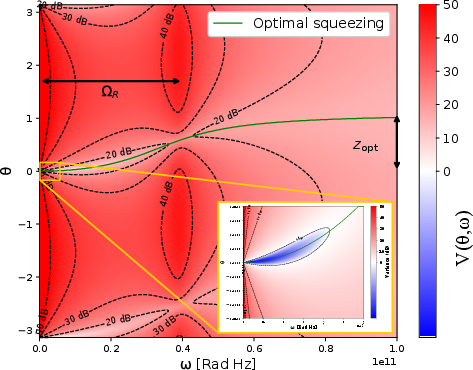
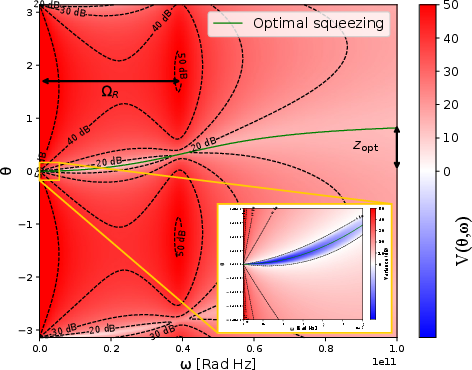
Figure 1: Squeezing maps of X3 at X4: (a) X5, (b) X6. The X7 factor strongly affects the optimal squeezing trajectory.
Comparing the amplitude squeezing spectrum (which is accessible in standard measurements) with the spectrum computed optimally for each frequency by adjusting X8 demonstrates that only for X9 does amplitude quadrature correspond to the true minimum for all frequencies. For finite Y0, there exists frequency shifting and broadening of the optimal squeezing window (Figure 2).
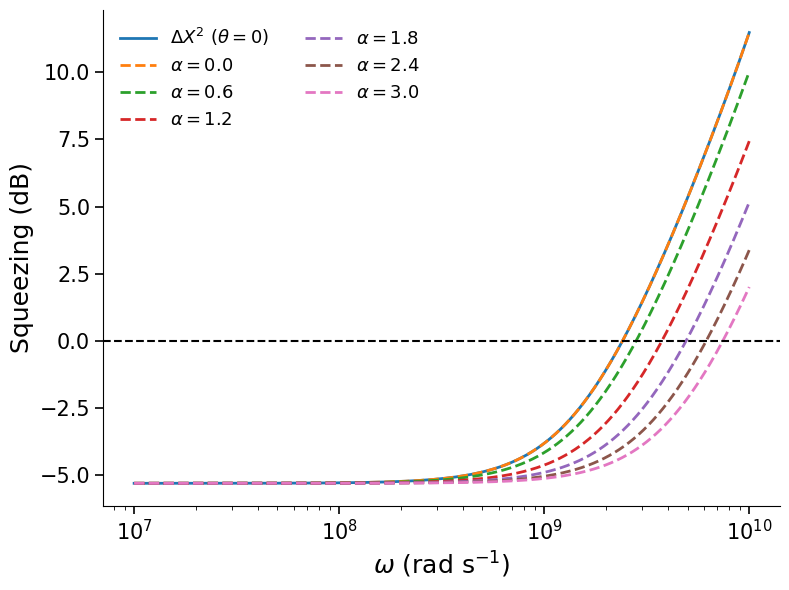
Figure 2: Comparison of amplitude squeezing spectrum Y1 and frequency-optimal squeezing for several Y2 values. Y3 shifts the squeezing bandwidth and enhances the region of sub-shot-noise detectable with optimal quadratures.
Hidden (Complex) Squeezing and Generalized Detection
The complex structure of the covariance matrix enables "hidden squeezing," only accessible via non-standard (e.g., synodyne or resonator) detection schemes sensitive to sideband or cross-spectral correlations. This is formalized by introducing a general two-mode quadrature (via a complex spinor parameterization), and the spectrum of the noise variance is minimized by the smallest eigenvalue of Y4, extending beyond what is accessible by homodyne detection. As quantified in Figure 3, the inclusion of hidden squeezing demonstrates a lower global minimum and a squeezing threshold at weaker pump, compared to pure amplitude squeezing.
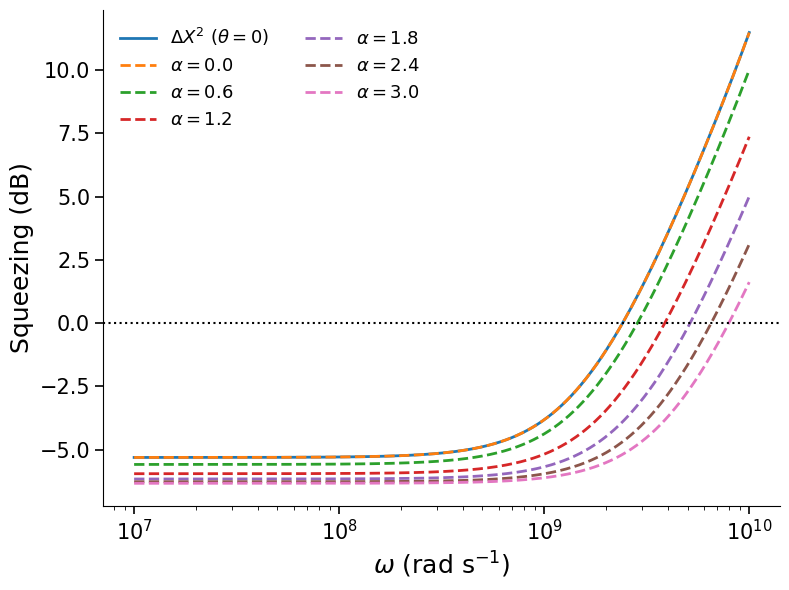
Figure 3: Comparison of amplitude squeezing and hidden/optimal squeezing spectra at Y5 using synodyne detection; nontrivial minima arise from complex covariance terms.
Assessing the evolution of the amplitude squeezing and the global minimum across increasing pump currents reveals the sub-shot-noise region and identifies the thresholds for detectable squeezing. The global minimum accessible via hidden squeezing appears at lower currents and can exceed the degree of squeezing accessible by amplitude detection (Figure 4). Notably, the minimum noise scales as Y6 (with Y7 the normalized pump above threshold) in the relevant range.
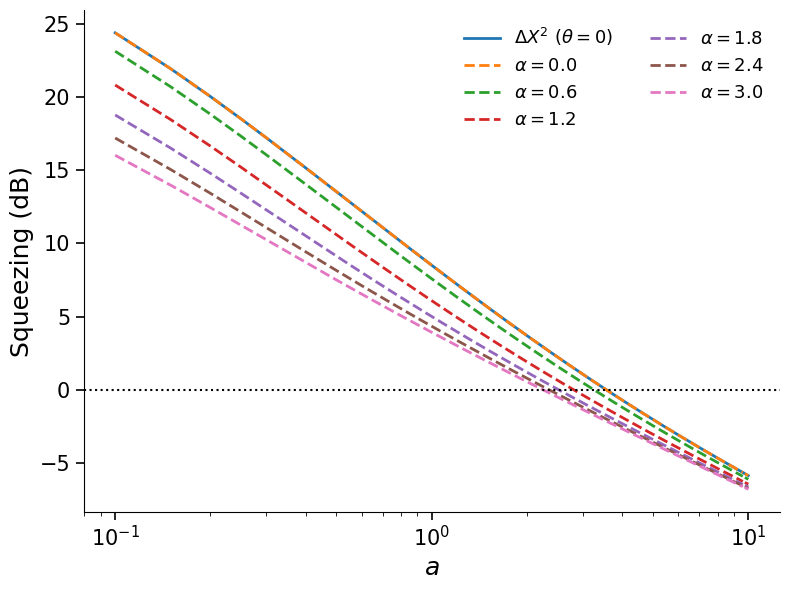
Figure 4: Amplitude squeezing spectrum versus pump current Y8 (log scale). Sub-shot-noise emerges above the threshold; the global minimum (from hidden squeezing) occurs earlier and attains lower noise.
Impact of the Linewidth Enhancement Factor and Pump Regime
The results show that while the Y9 factor does not modify the amplitude quadrature spectrum, it fundamentally alters the shape and frequency dependence of the optimal squeezing trajectory. This is attributed to carrier–field coupling unique to semiconductors and must be considered for all practical quantum applications of such sources. The analysis also delineates the onset and evolution of squeezing as a function of pump current and underscores the "quiet pumping" regime as optimal for pronounced squeezing.
Practical and Theoretical Implications
From a practical perspective, the findings validate semiconductor quantum well lasers as chip-integrable platforms for the generation of non-classical states of light, suitable for applications in CV-QKD, quantum-enhanced sensing, and on-chip metrology. The identification and quantification of hidden squeezing open avenues for engineering advanced measurement setups that can exploit the full non-classical resource capacity, previously invisible in standard detection paradigms.
Theoretically, this approach establishes a rigorous, generalizable framework for frequency-resolved squeezing analysis in all microscopic semiconductor systems. Extension to multimode scenarios (frequency combs, four-wave mixing regimes) and to other semiconductor systems (quantum dot lasers, QCLs) is natural and anticipated.
Conclusion
The quantum Langevin-based analysis undertaken in this work demonstrates that semiconductor lasers support a highly nontrivial, frequency-dependent quadrature squeezing landscape, in which optimal noise reduction is contingent on both the measurement protocol and the device parameters, especially the linewidth enhancement factor. The presence of hidden (complex) squeezing, together with phase-amplitude coupling and its frequency dependence, makes such lasers promising sources of tailored non-classical light for a new generation of quantum technologies. Extensions to multimode and more complex device structures are likely to yield further enhanced non-classical resources and novel system dynamics.
Reference: "Complex frequency-dependent quadrature squeezing in semiconductor lasers" (2606.26266)

