- The paper develops a comprehensive quantum theory for pure-Kerr parametrically driven cavity solitons, elucidating their multimode squeezing and quantum dispersive wave generation.
- The study employs an extended Lugiato-Lefever framework and Bloch-Messiah decomposition to quantify up to 20 dB of squeezing and pinpoint phase-matched noise features.
- The findings imply that PDCS platforms can boost quantum resource generation, facilitating advanced metrology and continuous-variable quantum information processing.
Quantum Dispersive Waves and Multimode Squeezing in Pure-Kerr Parametrically Driven Cavity Solitons
Introduction and Context
This work develops a comprehensive quantum theory for parametrically driven cavity solitons (PDCS) in pure-Kerr nonlinear resonators, focusing on their multimode quantum noise properties and the emergence of quantum dispersive waves (QDWs). PDCSs, as opposed to conventional dissipative Kerr solitons (DKS), are generated via bichromatic continuous-wave (CW) pumping, resulting in a frequency comb with a central mode that does not coincide with any of the pump frequencies. This distinctive configuration supports a fundamentally new regime of soliton formation and dynamical behavior in microresonators—both classically and quantum mechanically.
Previously, quantum squeezing and entanglement in microresonator-based Kerr combs were largely explored in contexts assuming single or dual-pumped cavity solitons with simplified mode structures. The present study extends this description to PDCSs, elucidating new modes of quantum noise suppression—including strong, spectrally isolated single- and multimode squeezing and the analogues of dispersive wave phenomena at the quantum level.
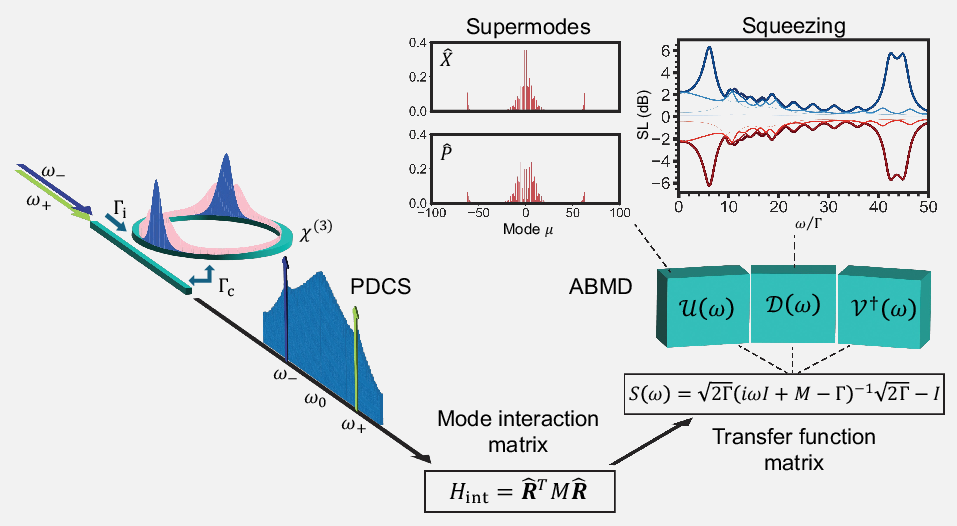
Figure 1: Schematic of quantum multimode analysis for pure-Kerr PDCSs, illustrating bichromatic pumping, formation of temporal solitons with quantum noise envelopes, and characterization via analytical Bloch-Messiah decomposition.
Theoretical Framework
The classical dynamics of PDCSs are governed by an extended Lugiato-Lefever equation (LLE), or equivalently the parametrically driven nonlinear Schrödinger equation (PDNLSE). Here, the crucial parameters are the bichromatic pump amplitudes and frequencies, integrated mode dispersion (including both D2 and D4 terms), and effective detuning, all of which collectively determine phase-matching and the emergence of soliton states.
The quantum multimode extension introduces bosonic operators for each longitudinal cavity mode, with quantum noise and squeezing dynamics described by a linearized Hamiltonian incorporating both the parametric (FWM) and Bragg-scattering processes. A symplectic transfer function characterizes the noisy input-output relations, and the Bloch-Messiah decomposition facilitates extraction of the underlying squeezed supermodes and their frequency-resolved squeezing spectra.
Multimode Squeezing: Regimes and Features
Analyzing the PDNLSE phase diagram, two major regimes are delineated: below-threshold (BT) and above-threshold (stable soliton, SS, and oscillatory soliton, OS) regions.
In the below-threshold regime, strong single-mode and two-mode squeezing are observed. The squeezing spectra exhibit pairwise degeneracies and Lorentzian decay at higher analysis frequencies. The phase-matching conditions enable precise control of which modes exhibit maximal squeezing by tuning dispersion and detuning parameters. Notably, up to 20 dB of squeezing is predicted, fundamentally limited only by routine experimental overcoupling (e.g., Γi=0.01Γc) and intrinsic loss values.
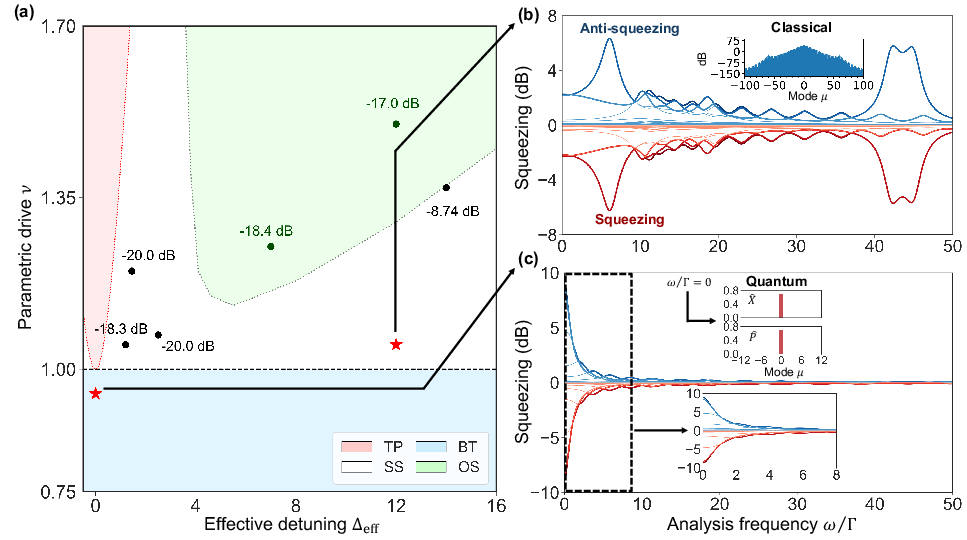
Figure 2: PDNLSE phase diagram highlighting locations of strongest squeezing and sample squeezing spectra for stable soliton and below-threshold phases.
Transitioning above threshold, the study uncovers the existence of quantum dispersive waves (QDWs). These are quantum noise features that are spatially or spectrally localized at phase-matched points corresponding to classical dispersive wave emission zones (analogous to soliton Cherenkov radiation). However, in contrast to classical spectra, QDWs manifest as local maxima in squeezing, even in parameter regions where the classical field spectrum does not show strong peaks.
Single-mode and pseudo-two-mode squeezing coexist and alternate depending on the analysis frequency and underlying phase-matching, with supermode profiles revealing the quantum analogues of dispersive wave excitation.
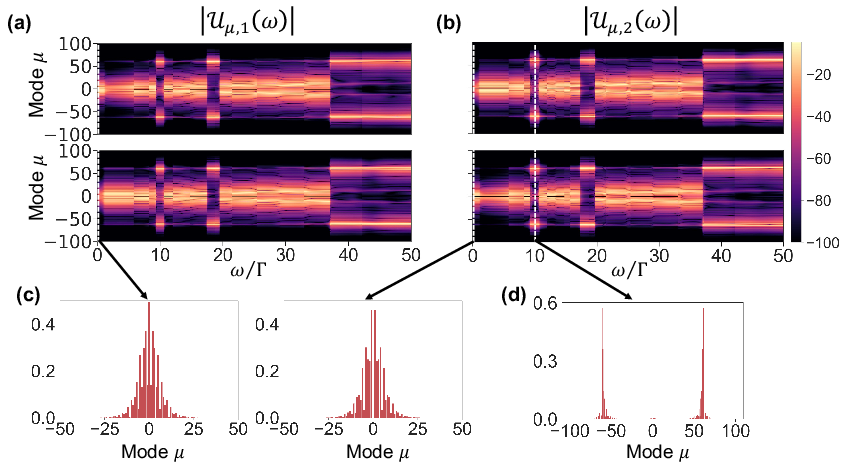
Figure 3: Frequency-resolved supermode amplitudes demonstrate alternation between degenerate mode squeezing and pseudo-two-mode squeezing concentrated at QDW spectral positions.
Quantum Dispersive Waves: Emergence and Signatures
The QDWs are characterized through the analysis of their corresponding supermode quadrature amplitudes and their imprint in the temporal noise envelope of the intracavity field. By selectively engineering the dispersion profile (notably the sign and magnitude of D4), the appearance of double-peaked noise backgrounds and rapid oscillations in the time domain is observed exclusively in the presence of higher-order dispersion, thus affirming the QDW mechanism.
Modification of the dispersion confirms the necessity of zero-crossings (phase-matching points) for QDW emergence. In the purely quadratic regime (D4=0), both QDWs and associated temporal features vanish.
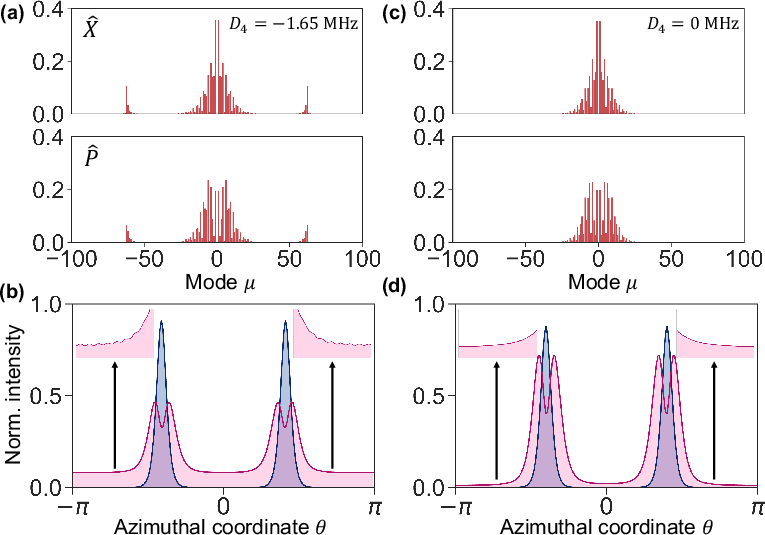
Figure 4: Emergence of QDWs, demonstrated by quadrature localization and elevated temporal noise in the presence of quartic dispersion (top); disappearance of QDWs and noise background when only quadratic dispersion is present (bottom).
Implications and Outlook
This study provides a comprehensive quantum multimode theoretical foundation for PDCSs, opening several avenues for further inquiry and application. Practically, the ability to generate highly squeezed states (up to 20 dB) and isolated single-mode vacuum states at spectrally accessible positions enables advanced quantum metrology schemes and continuous-variable quantum information processing (including cluster state or frequency-encoded protocols). These results imply that PDCS systems can outperform traditional Kerr microcombs in generating scalable, tunable quantum resources, benefiting from easy spectral filtering due to the absence of pump at the comb center.
Theoretically, the identification of quantum dispersive waves as intrinsic features of the multimode quantum noise landscape suggests rich future directions: the study of non-Gaussian quantum correlations, direct experimental observation of QDWs, and the explicit construction of entangled high-dimensional resource states. Investigation of pump phase, higher-order dispersion management, and photonic integration strategies may further optimize squeezing and enable deterministic engineering of the quantum noise network.
Conclusion
A detailed multimode quantum theory for pure-Kerr parametrically driven cavity solitons reveals strong and tunable squeezing, evidenced by both single- and multimode features, including the original prediction and characterization of quantum dispersive waves above parametric oscillation threshold. These phenomena establish PDCSs as highly promising platforms for large-scale quantum resource generation, with both immediate experimental feasibility and broad application potential across quantum optics and information science.