- The paper introduces a classifier architecture that merges the rule-based Tsetlin machine with autonomous thermodynamic neurons for interpretable learning.
- It demonstrates the use of stochastic dynamics and redundancy to suppress errors and achieve reliable, physics-driven computation.
- Benchmark results reveal that, despite noisy substrates, energy-accuracy trade-offs can be managed to match classical performance.
Autonomous Thermodynamic Networks for Interpretable Rule-Based Learning
Introduction
The paper develops a classifier architecture grounded in the physics of stochastic thermodynamic systems. It integrates the Tsetlin machine—a rule-based Boolean classifier—with thermodynamic neurons implemented as autonomous quantum thermal machines that operate without external time-dependent control. The goal is to demonstrate that interpretable, accurate classification can emerge from inherently noisy and dissipative physical substrates, and to quantify the trade-offs between reliability, resource requirements, and physical realism in such architectures.
Thermodynamic Neuron: Architecture and Dynamics
The thermodynamic neuron is a composite quantum thermal machine comprising a linear collector and a nonlinear modulator, physically realized via coupled qubit systems interacting with thermal baths at prescribed inverse temperatures β0, β1, and βz. Inputs are encoded as thermal biases rather than discrete occupation numbers. The collector implements a weighted virtual temperature, mapping input temperatures to a target range unconstrained by the input extrema, while the modulator enforces nonlinear thresholding and state separation through competing heat currents.
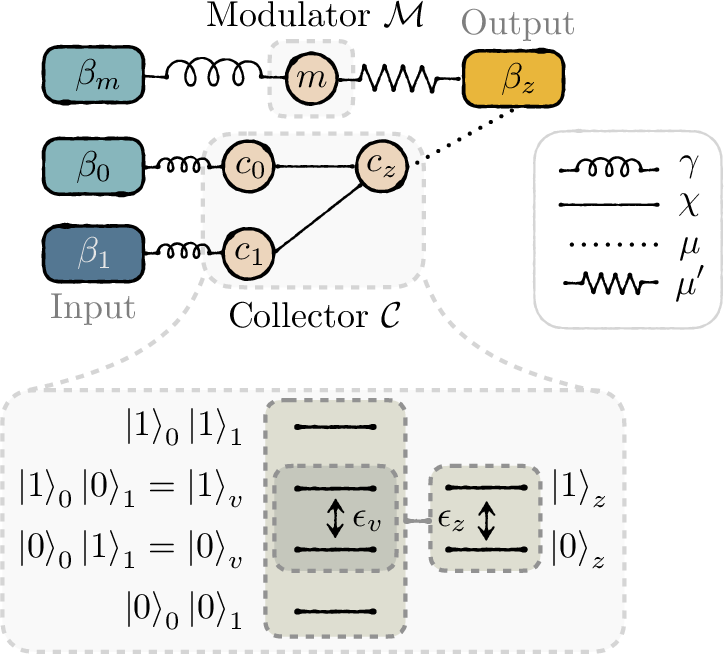
Figure 1: Autonomous quantum thermal neuron architecture, showing the collector and modulator qubits coupled to thermal baths at inverse temperatures β0, β1, and βz.
Logical computation is achieved through steady-state solutions of the quantum dynamical equations, with logical transitions regulated by tunable energy gaps ϵi. The population evolution of a signal qubit in the output chain is shown to be governed by the bath temperature and is used probabilistically to infer logical values. The logical output can be made arbitrarily sharp by increasing the energy scale, as quantified through sigmoidal approximation.
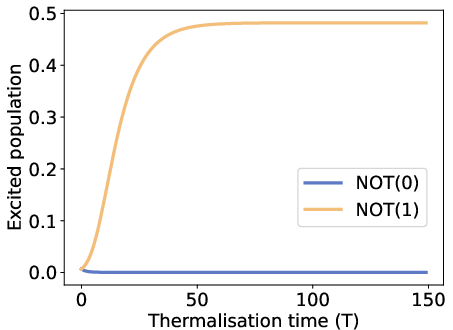
Figure 2: NOT gate signal qubit excitation probability versus time and input value, demonstrating probabilistic logic extraction via first-passage monitoring.
Coupling and Autonomy
Autonomy is ensured both in gate operation and signal propagation. A first-passage readout protocol leverages continuous stochastic monitoring of signal qubits coupled to output baths: a logical False is inferred from any excitation event during a finite observation interval T, while a logical True requires quiescence. The interval is regulated autonomously via a quantum clock, which ticks upon transport-induced photon emission in a coupled ladder system, thereby ensuring no external control is needed for computation timing or state transmission.
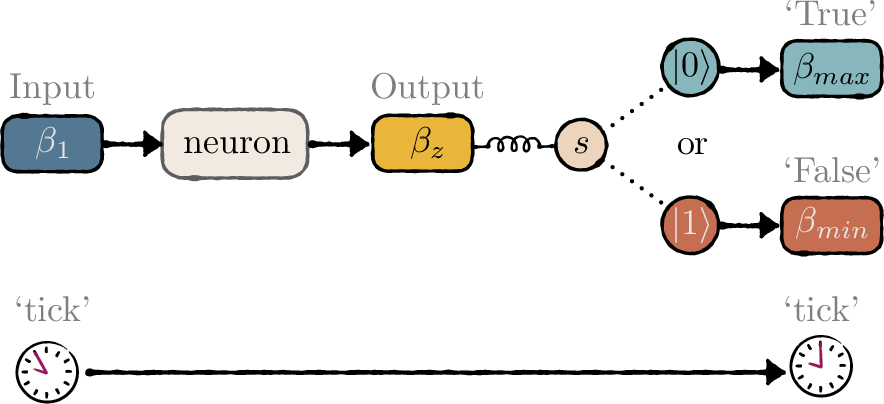
Figure 3: Signal qubit coupling enables autonomous propagation and readout in thermodynamic neuron networks.
Redundancy and Robust Evaluation
Error rates at the individual neuron level are non-negligible and highly biased towards missed excitations (i.e., false positives for logical True), a direct consequence of stochastic transitions. The architecture implements redundancy: multiple identical neurons operate in parallel, and the output is determined via a logical OR (first excitation event triggers False). This exponentially suppresses error rates for logical True output, providing statistically reliable computation even as network depth grows.
Rule-Based Evaluation Engine
The thermodynamic classifier implements the rule-evaluation stage of the Tsetlin machine in physical hardware. Each feature-literal pair is evaluated using a single-feature thermodynamic logic network, and outputs are aggregated via a cascade of thermodynamic AND gates. Rules are represented as conjunctions of included literals (features or their negations), and satisfaction is checked via multi-stage thermodynamic circuits. The logical structure enables direct mapping from Tsetlin rules to physical logic.
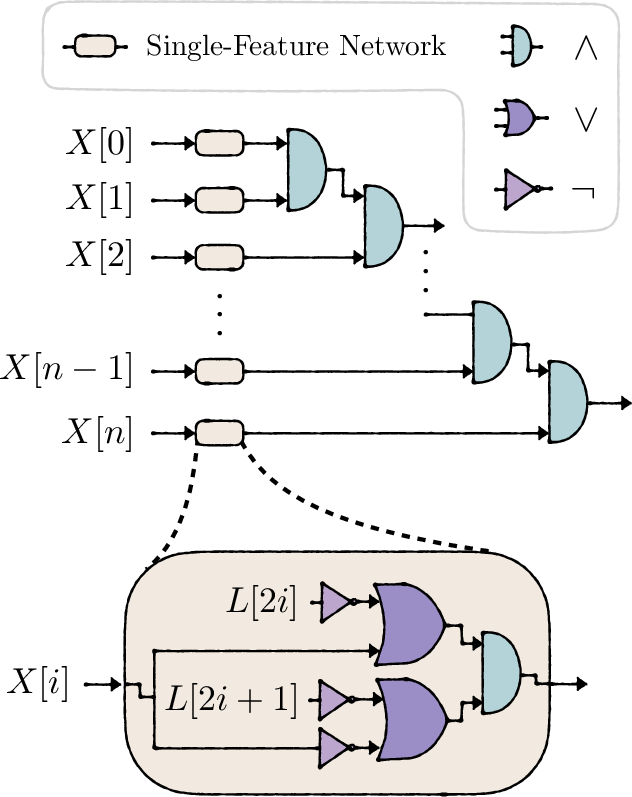
Figure 4: Thermodynamic rule-evaluation engine architecture, with single-feature networks and output aggregation via cascade of AND gates.
Gate Parameter Optimization and Physical Scaling
The quality of gate approximation to ideal Boolean logic is controlled by tunable energy parameters (e.g., α, ϵi); gate response sharpness increases with these energy scales, enhancing transition separation but at higher energetic cost. The virtual temperature formalism allows for affine mapping from Boolean input space to physical temperature, supporting universality for linearly separable Boolean functions.
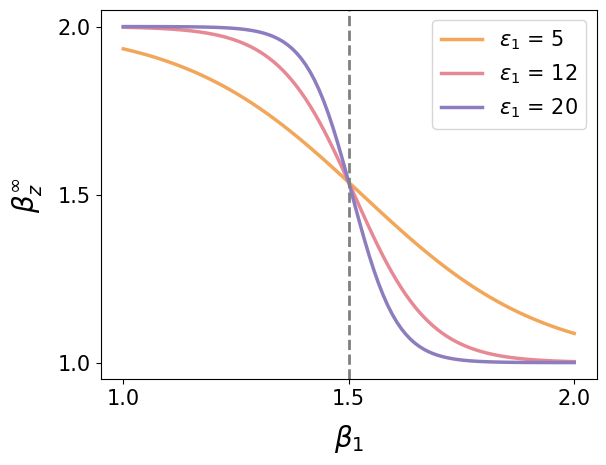
Figure 5: Steady-state output improvement for NOT gate as energy gap increases, illustrating sharper sigmoid approximation.
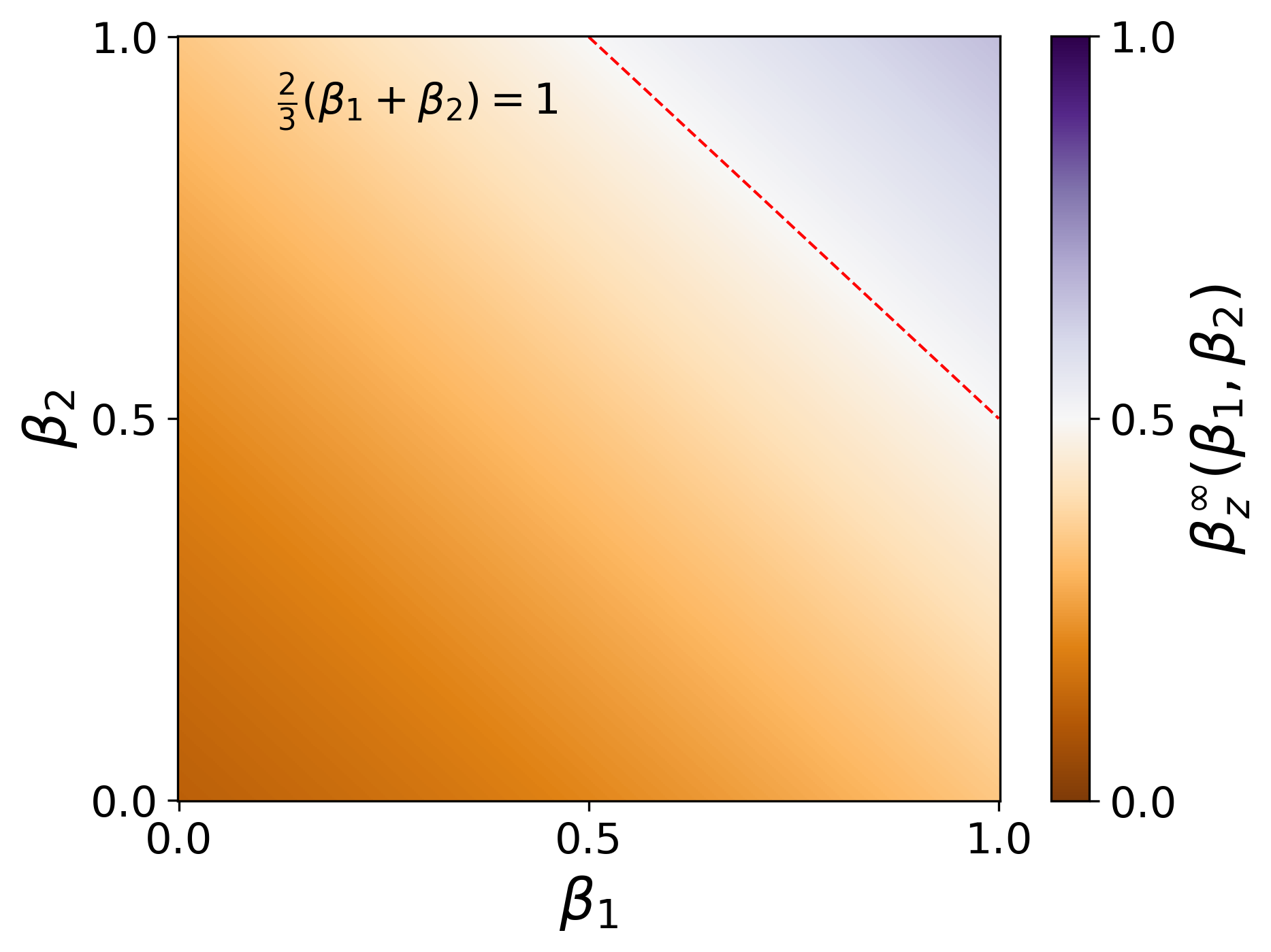
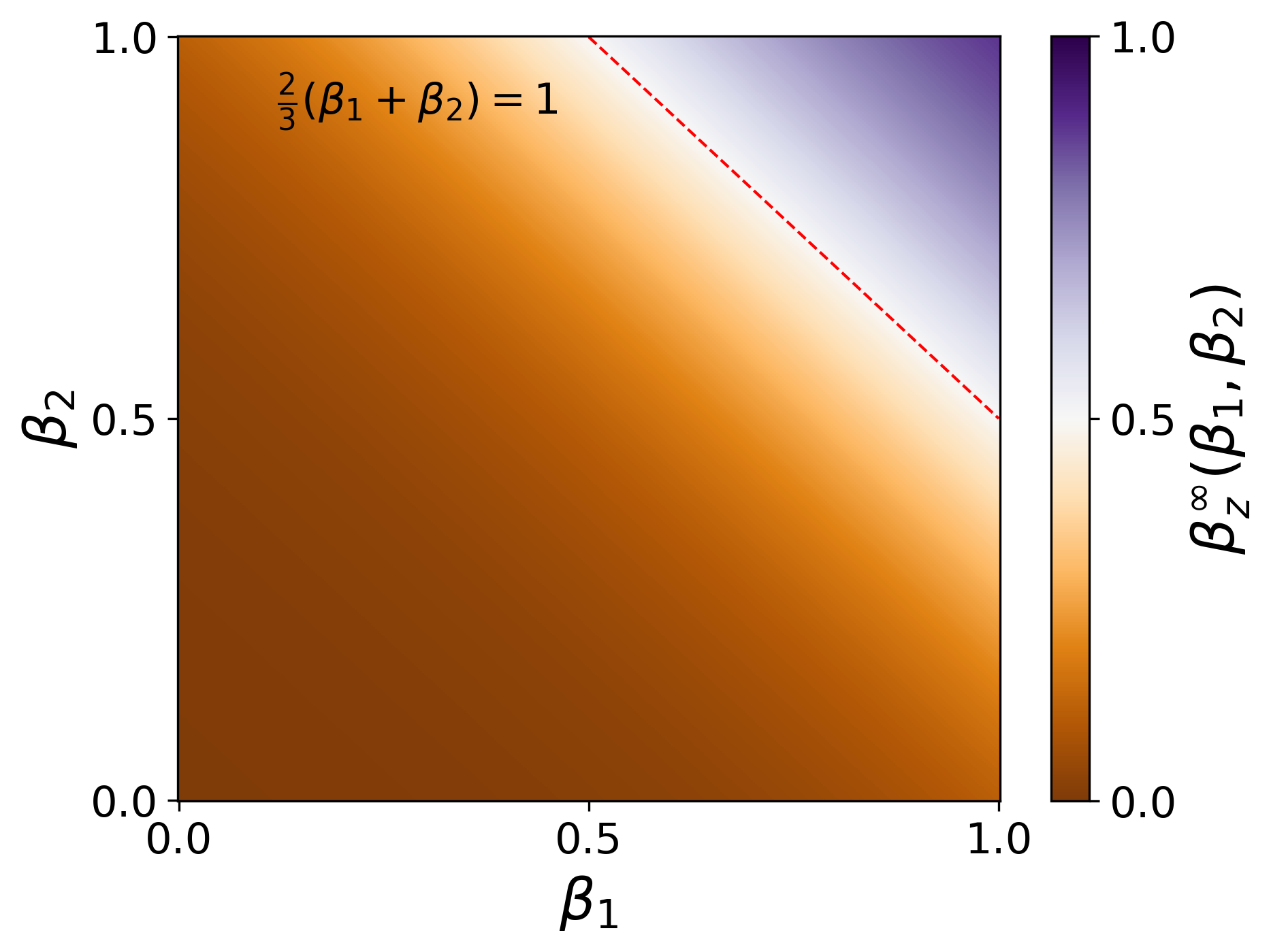
Figure 6: Response sharpening for AND gate as energy scale parameter β10 is increased.
The stochastic thermodynamic classifier was benchmarked against the standard deterministic Tsetlin machine on multiple datasets. When gates are non-redundant (β11), classification accuracy degrades substantially due to concatenated stochastic failures. Introducing redundancy (β12) rapidly restores accuracy, consistently matching or slightly exceeding classical software results within statistical uncertainty. For example, on the mushroom dataset, the thermodynamic implementation achieves β13 accuracy, comparable to the classical version, with standard deviation often reduced due to network-level averaging induced by redundancy.
Implications: Physical Computation and Future Directions
This work establishes that reliable learning does not require deterministic logic or externally timed control; accurate, interpretable classification can emerge from purely stochastic, dissipative dynamics when architectural principles such as redundancy and thresholding are properly engineered. The physical substrate governs computation via intrinsic nonequilibrium and irreversibility, and architectural corrections—rather than noise elimination—ensure reliability.
Key theoretical implications include:
- Reliable computation from noisy substrates: Accuracy is limited by learning architecture capacity, not physical noise, when redundancy and thresholding are incorporated.
- Thermodynamic universality: Linearly separable Boolean functions and rule-based evaluation are physically realizable, supporting interpretable ML in non-standard substrates.
- Physical resource scaling: Reliability-energy trade-off arises; sharper logic (and higher redundancy) increases energetic cost and system size.
- Potential for broader application: Any computation decomposable into linearly separable functions can be mapped to thermodynamic neuron networks, enabling physics-driven computing models and possibly catalyzing developments in neuromorphic, quantum, and reservoir computing.
Possible future developments:
- Stochastic feedback integration: Autonomous stochastic feedback for learning dynamics (beyond rule evaluation) could further enhance robustness and adaptivity, paralleling advances in asymmetric probabilistic Tsetlin machines.
- Energetic analysis: Explicit quantification of energetic cost per operation, including reset/detector costs and physical limits, can guide optimal substrate design.
- Quantum advantage investigation: Extensions incorporating quantum coherence and correlations may enable benefits surpassing classical stochastic architectures, contingent on suitable task mapping.
- Physical implementation: Modification of redundancy schemes (e.g., signal-qubit-only duplication) could minimize resource demands for scalable thermodynamic learning hardware.
Conclusion
The paper demonstrates that interpretable and accurate rule-based learning can be realized via autonomous thermodynamic networks governed by stochastic irreversible dynamics. Reliability, in the absence of deterministic logic, is attained through redundancy and architectural thresholding. This validates thermodynamic computation as a viable framework for physical machine learning and offers a concrete methodology for integrating physical principles into AI architecture design, laying the foundation for future advances in energy-efficient, interpretable, and physically universal computing substrates (2606.26220).