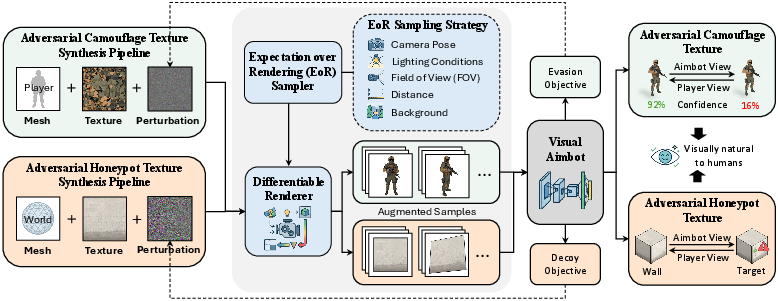
- The paper introduces AimTrap, a proactive defense that leverages adversarial camouflage and honeypot textures to disrupt visual aimbots without runtime overhead.
- It employs offline differentiable rendering and stochastic optimization to generate textures that reduce aimbot detection confidence by 46.3% and achieve 96.9% decoy success.
- AimTrap’s trajectory analysis and bidirectional LSTM model yield 98.05% accuracy with near-zero false positives, ensuring robust, scalable anti-cheat performance.
AimTrap: Proactive Texture-Based Defense and Detection of Visual Aimbots in FPS Games
Motivation and Threat Landscape
Visual aimbots, leveraging advances in object detection (e.g., YOLO, Faster R-CNN), have established themselves as a critical anti-cheat challenge in FPS games. By operating exclusively on rendered frames and abstaining from direct memory or system interaction, they circumvent all contemporary integrity-based anti-cheat systems. Prior countermeasures are bifurcated into post-hoc behavior analytics—which are increasingly undermined by human-mimetic aimbots—and online defenses, which disrupt render output but introduce prohibitive performance overhead or require invasive integration.
AimTrap addresses these core limitations by unifying runtime prevention and forensic detection via adversarial manipulation of 3D texture assets, thus sidestepping per-frame computational cost and eliminating the need for rendering pipeline interception. The fundamental strategic shift is the transition from passive behavioral anomaly detection to an active visual challenge-response paradigm: adversarial signals, imperceptible to legitimate players but maximally salient to vision-based cheats, become ground truth indicators for both online defense and post-game cheating attribution.
Core Mechanisms: Adversarial Textures for Camouflage and Honeypots
AimTrap is grounded in two complementary adversarial texture techniques:
- Adversarial Camouflage Textures (ACT): These perturbations are applied to player character meshes. Their optimization via Expectation over Renderings (EoR) ensures that, across diverse and dynamic viewpoints, lighting, and backgrounds, they consistently degrade vision model confidence. Texture updates are computed offline with a fully differentiable 3D rendering pipeline, with gradients propagated through UV mapping to the underlying texture parameterization.
- Adversarial Honeypot Textures (AHT): These are static, scene-bound distractors, visually innocuous to humans but explicitly engineered to elicit high-confidence, unambiguous detections from aimbots. Offending aimbots not only suffer performance degradation (by targeting non-player decoys) but also produce objective, repeatable interaction signals ideal for high-precision post-game forensic detection.
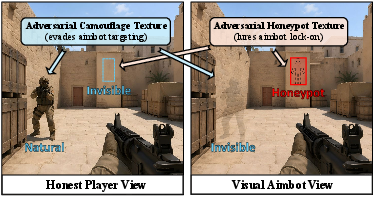
Figure 1: A high-level illustration of AimTrap’s principles, including camouflage on player models and honeypot decoys.
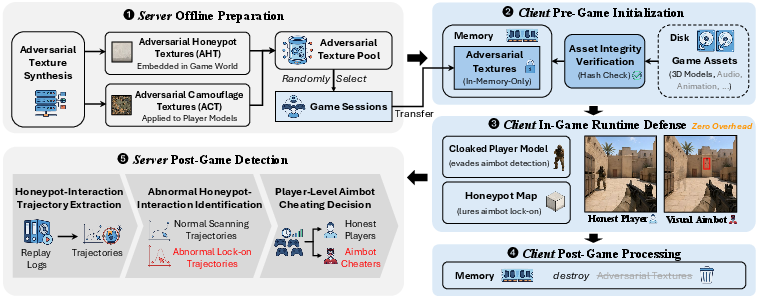
Figure 2: Overview of AimTrap showing the system architecture from offline synthesis to post-game detection.
Adversarial texture synthesis for both ACT and AHT adopts offline stochastic optimization against randomized rendering conditions, ensuring operational robustness without incurring client-side overhead. Secure and non-persistent deployment of session-specific textures thwarts reverse engineering and adaptive retraining attacks by cheat developers.
Interaction Attribution via Honeypot Trajectory Analysis
AimTrap’s detection architecture parses tick-level replay logs, which are standard in all major FPS engines. By projecting view rays and player state, AimTrap isolates interactions where player view and/or aim vector intersects the spatial region of a honeypot, filtering these sequences with geometric and temporal clustering. Trajectories are classified as aimbot-driven if they exhibit deliberate, high-concentration aim behaviors uncharacteristic of human play.
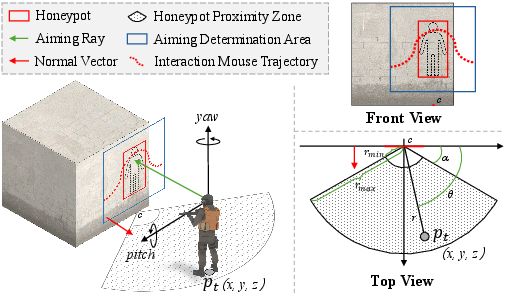
Figure 3: Adversarial honeypot for aimbot detection—interpreting spatial and temporal correlations between player input and honeypot positioning.
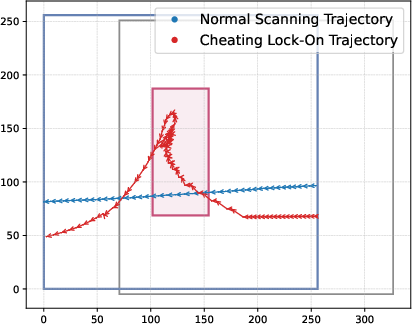
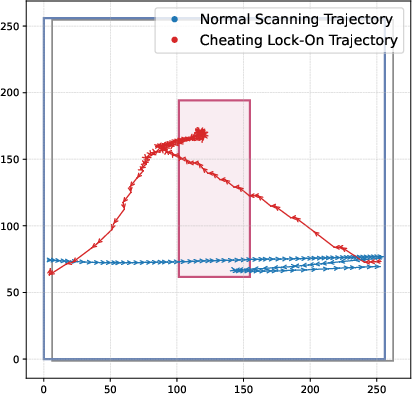
Figure 4: Typical mouse trajectories of aimbots and normal players on two distinct honeypots. Aimbot traces show intentional lock-ons; human traces pass through or avoid decoys naturally.
A bidirectional LSTM sequence model, operating on normalized trajectory encodings with honeypot context, achieves extremely high accuracy and AUROC. Threshold-based aggregation controls the trade-off between recall and precision at the player-level, attaining negligible false-positive rates suitable for large-scale deployment.
Quantitative Evaluation and Deployment Impact
AimTrap’s empirical evaluation utilizes real-world CS2 data, synthesizing adversarial textures for diverse in-game assets, and deploying a controlled aimbot based on open-source YOLOv5 implementations. The following metrics are highlighted:
User studies confirm ACT/AHT are visually indiscernible to typical players (Figures 7 and 8); perceptibility, naturalness, and gameplay engagement remain unimpaired even for highly experienced participants. Client-side deployment involves only pre-game memory installation—no modifications to the rendering or asset pipelines are needed, and textures are not written to disk, maximizing compatibility and security.
Comparison with State-of-the-Art Defenses
Unlike prior approaches relying on OS/system-level interventions or real-time display modifications—both prohibitively expensive and difficult to generalize—AimTrap relies exclusively on standard asset workflows and server-side replay logs. In head-to-head real-game benchmarks against an advanced behavioral detector (XGuardian), AimTrap alone achieves perfect recall and precision, while XGuardian is compromised by false negatives, false positives, and outright failures, especially against human-mimicking aimbots.
Theoretical and Practical Implications
AimTrap’s operational paradigm shift—injecting adversarial signals into static assets—creates a novel, orthogonal attack surface for anti-cheat: one that bypasses system internals and leverages the inevitable vulnerability of vision models to distribution shifts and adversarial examples. This model is inherently robust to both behavioral mimicry and system-level evasion, and can be deployed at scale without disrupting engine architectures or requiring privileged system integration.
Practical implications are immediate for the online FPS industry: AimTrap enables proactive match integrity, provides high-confidence forensic attribution, and fundamentally shifts the economics of cheat development. The offline synthesis and per-session randomization pipeline imposes a significant adaptation penalty on cheat authors, likely rendering widespread vision-based cheats unsustainable in practice.
Limitations and Prospective Research Directions
While cross-architecture transferability of adversarial textures is nontrivial—AHT decoy efficacy diminishes as detection models diverge from the optimization proxy—the current security margin is sufficient given the mono-culture of YOLO-based aimbots in the wild. However, development of adaptive or ensemble-based cheats may eventually mandate continual co-evolution or universal adversarial textures.
Potential future developments may include:
- Generalization to other genres and vision-based game cheats (e.g., wallhacks, ESP overlays)
- Integration of human-in-the-loop playtesting in the texture optimization process for further augmentation of indistinguishability
- Exploration of advanced asset randomization (geometry, shaders) to complement texture-based perturbations.
Conclusion
AimTrap represents a rigorously engineered, empirically validated framework for zero-runtime-overhead, texture-centric anti-visual-aimbot defense and detection in modern FPS games. By synthesizing adversarial camouflage and honeypot textures through EoR-driven differentiable rendering, AimTrap simultaneously thwarts in-game aimbot efficacy and provides conclusive, low-false-positive post-match attribution, with full compatibility for real-world deployment.