- The paper presents a cage-based geometric filtering pipeline that effectively suppresses texture artifacts by excluding non-cosmetic zones.
- It employs ray-projection and mesh segmentation, achieving real-time transfer with approximately 70ms latency and a 20MB memory footprint per asset.
- The approach reduces reliance on large neural models, offering a scalable solution for high-fidelity 3D graphics in constrained environments.
Cage-based Texture Transfer with Geometric Filtering: An Expert Analysis
Overview and Motivation
The paper "Cage-based Texture Transfer with Geometric Filtering" (2606.25220) introduces a novel approach to real-time, artifact-free texture transfer for 3D graphics applications. The method leverages an auxiliary cage mesh as a geometric filter, systematically identifying and suppressing Non-Cosmetic Zones (NCZs) during texture projection. This enables low-latency, high-fidelity texture transfer suitable for consumer-grade hardware and constrained environments, without reliance on large-scale neural models or hand-labeled datasets, marking a significant advancement in practical digital content creation workflows.
The core problem addressed is the artifact generation by classical texture transfer algorithms, which indiscriminately project UVs onto internal geometry or developer-excluded areas. Conventional solutions either require substantial manual effort (manual authoring, secondary UV sets) or employ computationally intensive vision-driven NCZ detection, both of which are suboptimal for scalability and real-time deployment.
Methodological Contributions
The proposed pipeline employs cage-based geometric filtering to efficiently resolve artifacts:
- Self-Intersection Filtering: For each target vertex, the algorithm projects a ray aligned with the normal of the closest cage triangle. Intersections with the target mesh identify internal geometry as NCZs, systematically excluding problematic areas from UV transfers.
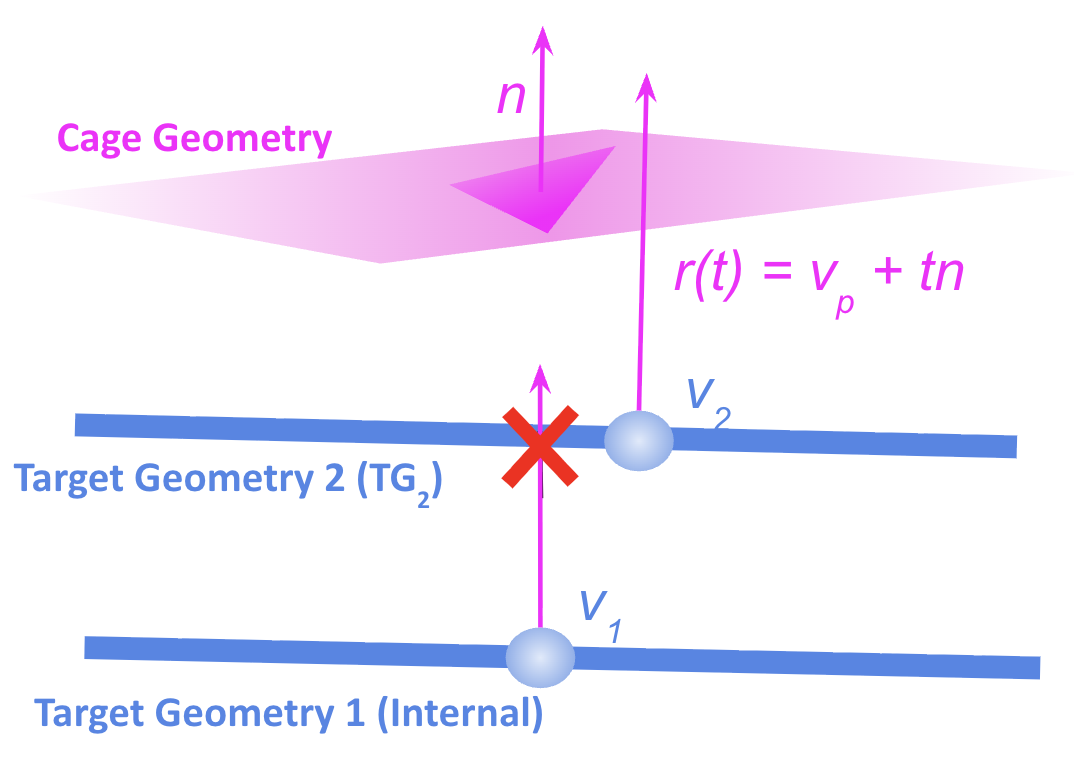
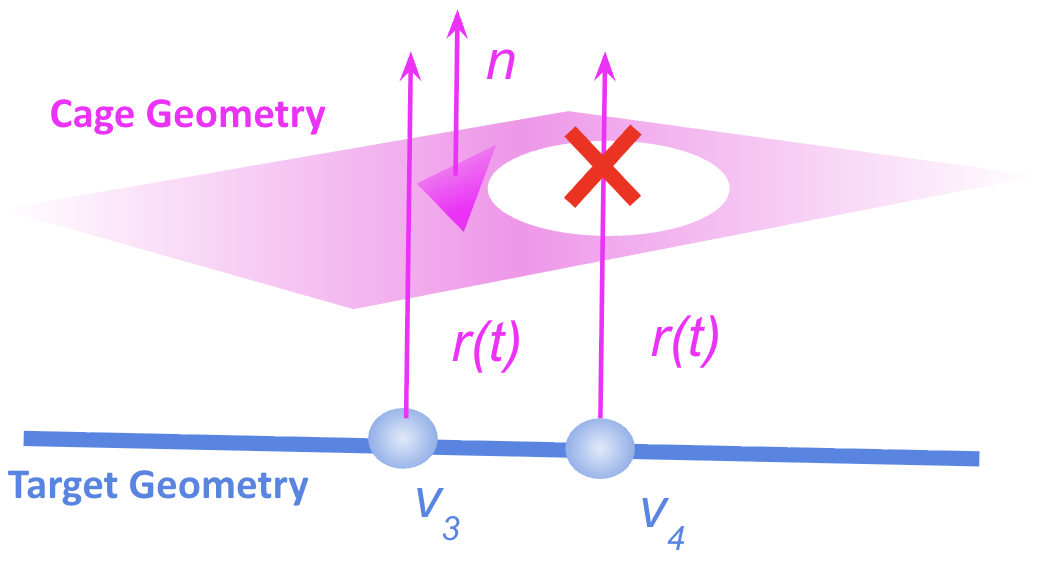
Figure 1: (Left) Vertex v1 is filtered as NCZ due to internal mesh intersection, while v2 passes as a valid candidate; (Right) Cage intersection distinguishes v3 (valid cosmetic area) and v4 (hole-induced NCZ).
- Cage Intersection Filtering: Coverage checks via cage intersection tests further identify developer-specified NCZs. This step is optimized by first filtering via self-intersection, minimizing redundant calculations.
- Mesh Segmentation: The target mesh is partitioned into topologically connected segments S={s1,…,sn}, facilitating efficient storage and segment-level filtering. Segmentation enables threshold-based elimination, wherein entire segments are marked as NCZ if the fraction of valid transfer area falls below a developer-specified threshold, accelerating artifact suppression and increasing precision.
- Computational Efficiency: Spatial queries are accelerated via KD-Trees, guaranteeing O(Vlog(N+M)) complexity for V vertices, N target triangles, and M cage triangles. Memory requirements scale linearly, with the reported test assets consuming approximately 20MB for meshes with ∼4.8k triangles, and runtime maintained at v2070ms on mobile hardware.
Empirical evaluation demonstrates superior artifact suppression relative to classical proximity-based transfer methods and manual authoring baselines. The pipeline achieves high fidelity with real-time latencies, supporting scalable deployment in resource-limited contexts. The visual ablation study illustrates clear improvements in preventing texture bleeding into NCZ zones—for example, eliminating unwanted projection onto character interiors or excluded areas.
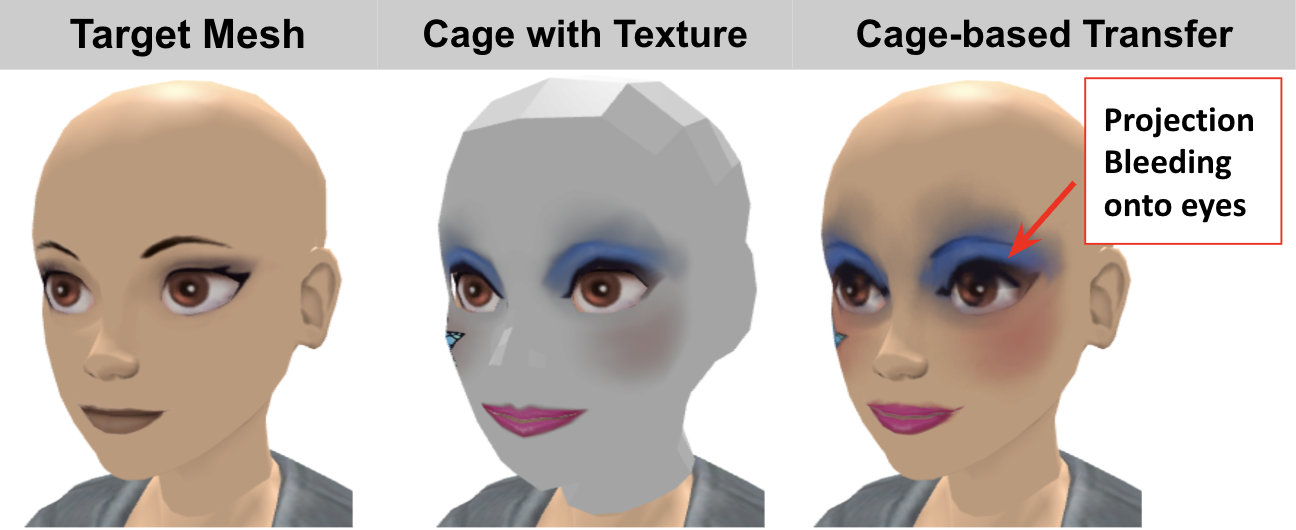
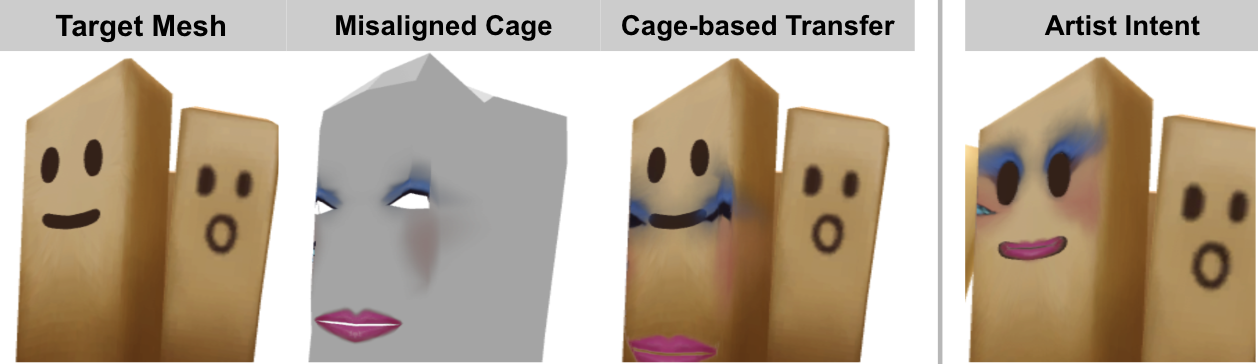
Figure 2: (Left) Absence of mesh segmentation causes artifact bleeding onto the eyes; (Right) Misaligned cage geometry fails to filter and preserve artist intent.
Strong numerical outcomes include:
- Latency: v2170ms on v22k triangle mesh (mobile device)
- Memory footprint: v2320MB per asset
- Artifact suppression: High, with minimal post-filtering required
Contradictory claims relative to neural model scaling laws highlight that high visual fidelity is achievable without extensive model size or memory overhead.
Limitations and Practical Considerations
The technique's efficacy is contingent upon the quality of cage mesh fitting and segment topology. Absence of accurate segmentation can result in artifact leakage (Figure 2, left), while poor cage construction yields nonsensical filtering (Figure 2, right). These dependencies are notable: automated mesh segmentation remains an open research challenge; current solutions rely heavily on manual cage creation or mesh preprocessing.
Additionally, the method assumes access to reliable cage geometry, which may not always be available or straightforward to generate for arbitrary assets. The authors speculate that integration with AI-driven segmentation and cage generation could further streamline the pipeline and enhance robustness.
Implications and Future Directions
Practically, this research enables artists and developers to conduct rapid, scalable, artifact-free texture transfer for a diversity of 3D asset types, lower barriers to creative expression, and facilitate real-time personalization in interactive media and gaming environments. Theoretically, it validates geometric filtering as a lightweight yet powerful alternative to vision-based segmentation, circumventing the memory and latency trade-offs intrinsic to modern neural architectures.
Anticipated future developments include:
- Automated cage generation, potentially leveraging AI-driven mesh analysis
- Fully automated mesh segmentation pipelines for robust NCZ identification
- Integration with radiance field rendering and real-time avatar generation frameworks, further enhancing fidelity and customization
Conclusion
The cage-based geometric filtering pipeline delivers efficient, precise, and scalable texture transfer for real-time 3D graphics. By bridging the gap between low-latency projection methods and artifact suppression, this approach establishes new benchmarks for fidelity and practicality in consumer-facing software. While limitations exist regarding cage craftsmanship and segmentation, ongoing advances in automated mesh analysis and cage creation are likely to further expand its utility and adoption in the field.

