- The paper proposes transforming static penalty hyperparameters into variational parameters to streamline constraint enforcement in QAOA.
- It introduces piecewise-ramp scheduling, which significantly improves feasibility and optimality with minimal added circuit depth.
- Empirical benchmarks on satellite mission planning and MIS demonstrate substantial performance gains in constrained quantum optimization.
Feasibility-driven QAOA with Penalty Scheduling: Advancements in Quantum Optimization for Constrained Problems
Introduction
Quantum approaches to combinatorial optimization focus on efficiently navigating complex solution landscapes where classical methods often exhibit exponential scaling. A persistent bottleneck in the application of quantum algorithms, especially on industrially relevant, constrained problems, lies in the effective enforcement of constraints within the quantum ansatz. Conventionally, the Quadratic Unconstrained Binary Optimization (QUBO) formulation incorporates constraints as penalty terms—a strategy that introduces a costly and non-trivial penalty weights calibration process. The methods laid out in "Feasibility-driven QAOA with penalty scheduling" (2606.25117) reparameterize QAOA by promoting penalty weights from static hyperparameters to variational parameters optimized within the quantum circuit, revolutionizing how constraints are balanced in large-scale and multi-constraint settings.
Problem Framework and QUBO Limitations
The study considers Earth-observation satellite mission planning as a canonical instance, effectively formulated as a budget-constrained Maximum Weight Independent Set (MWIS) problem. In this formulation, each observation target is defined as a node and incompatibilities between observations are encoded as edges in a conflict graph. The objective maximizes total priority under feasibility (independent set) and budget constraints.
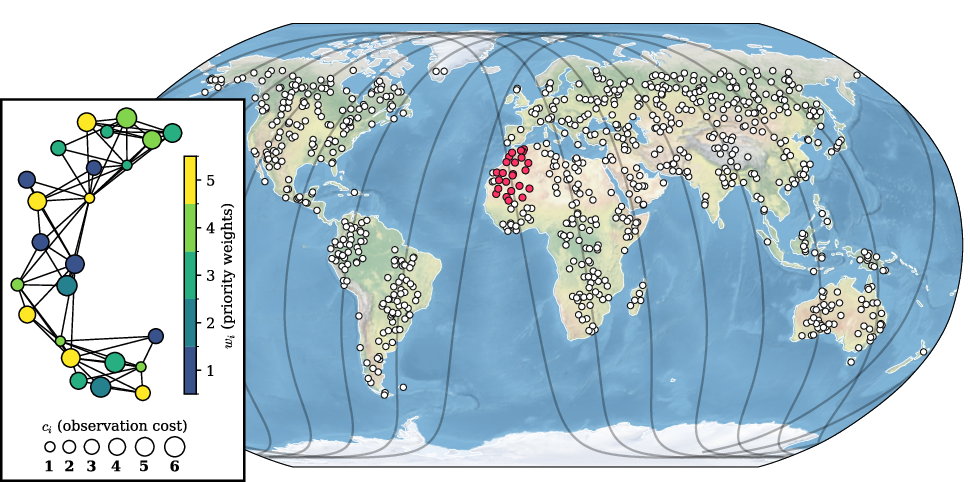
Figure 1: Satellite mission planning instance with budget-constrained MWIS formulation; red nodes indicate the active subgraph under study.
Encoding these constraints in a QUBO Hamiltonian results in the principal challenge of determining appropriate penalty coefficients. Infeasibility-induced optimal states can dominate when penalties are underweighted, while overly large penalties can obfuscate the objective landscape and degrade solution quality. Analytical determination of suitable penalty weights is generally intractable, particularly for multiple heterogeneous constraints.
Algorithmic Innovations
Λ-lr-QAOA: Variational Penalty Schedules
By independently assigning a variational schedule to each penalty term, the Λ-lr-QAOA approach eliminates the need for a costly outer loop hyperparameter grid search. The penalties are tuned within the single optimization run, jointly with standard QAOA parameters. The loss function is redefined to consider only feasible bitstrings, which ensures that the ansatz is explicitly steered toward feasible, high-quality solutions.
Piecewise-ramp QAOA
Going beyond linear ramps, piecewise-ramp QAOA replaces each schedule with a two-segment piecewise-linear interpolation. This enhancement introduces breakpoints as additional variational parameters—only a constant overhead irrespective of circuit depth p—and significantly increases the ability of the ansatz to model more expressive adiabatic trajectories. The method remains resource-efficient with a fixed parameter count per constraint and without incurring additional circuit depth.
MIS Benchmarking
Benchmarks on graph-based Maximum Independent Set (MIS) instances, both unweighted and with varying system sizes, highlight distinctly improved feasibility and optimality metrics for the proposed methods.
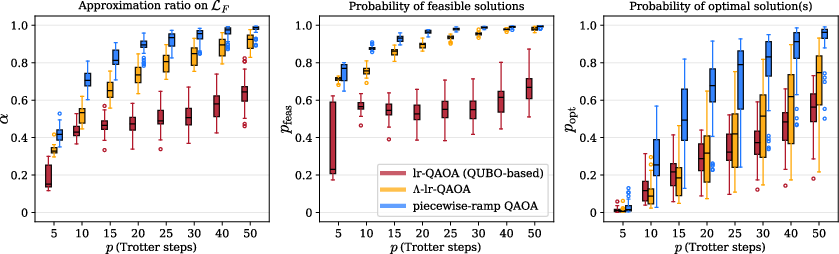
Figure 2: Comparative box plots for α, pfeas, and popt as a function of Trotter steps for MIS; blue denotes piecewise-ramp QAOA, red is QUBO-lr-QAOA, orange is Λ-lr-QAOA.
Across increasing circuit depths, piecewise-ramp QAOA demonstrates:
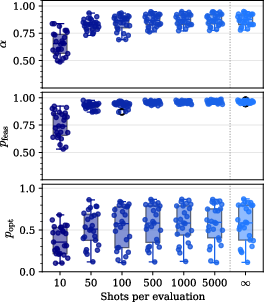
The results indicate robustness of the approach to sampling fluctuations, further supporting its suitability for NISQ-era hardware.
Satellite Mission Scheduling
In practical mission planning subgraphs (e.g., 24-target components), piecewise-ramp QAOA outperforms the best-case QUBO-based lr-QAOA models (after exhaustive penalty grid searches) across feasibility and optimality, and does so in a single optimization run—demonstrating both operational and computational efficiency.
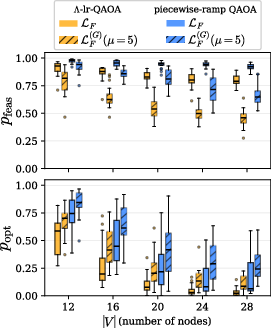
Figure 4: Distribution of Λ0 and Λ1 for piecewise-ramp QAOA and Λ2-lr-QAOA across problem sizes; hatched boxes denote filtered loss usage.
Feasibility-Optimality Trade-off and Loss Function Variants
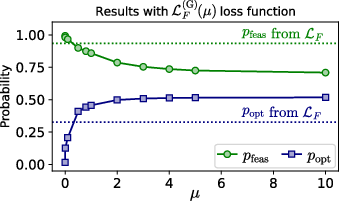
While high feasibility implies robust constraint enforcement, it can dilute optimality. Conversely, prioritizing objective value can reduce feasible sampling rates. To address this, a filtered Gibbs free energy-inspired loss function is introduced, parameterized by Λ3, which allows fine control over the balance:
The explicit tuning knob equips practitioners with precise handle over solution characteristics, accommodating industrial or operational requirements dynamically.
Probability Distributions and Solution Structure
Histograms of sampled bitstrings from the quantum output state reveal the impact of the filtered loss. As Λ8 increases, probability mass shifts toward the ground state of the objective Hamiltonian, while smaller Λ9 values accentuate general feasibility across the feasible subspace.
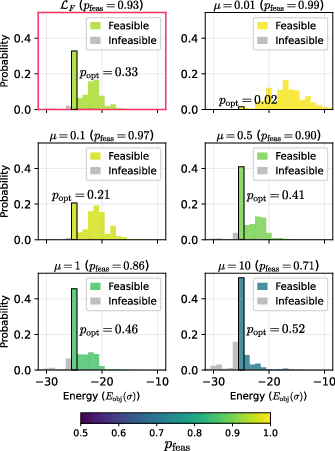
Figure 6: Distribution of bitstring probabilities conditional on energy for feasible (colored) and infeasible (gray) solutions as a function of p0.
Implications and Future Directions
The feasibility-driven and filtered-loss QAOA protocols present a comprehensive solution to the classical QUBO penalty calibration problem. By embedding constraint handling into the quantum variational landscape, the approach is algorithmically scalable and directly extensible to problems with high constraint heterogeneity and density.
Practical implications are immediate for industries requiring guaranteed feasibility—mission planning, logistics, and resource allocation—where near-optimal feasible solutions are as valuable as exact global optima. Theoretically, the piecewise schedule concept hints at further enhanced expressive power, which could be extended to richer, higher-order interpolation schemes or adaptive schedulings based on instance-specific spectral properties.
Testing on actual quantum devices, integration in hybrid quantum-classical pipelines, and generalization to further problem classes (e.g., general integer programs) constitute natural next steps.
Conclusion
The work rigorously demonstrates that treating penalty schedules variationally and introducing loss functions tailored for the feasibility-optimality trade-off fundamentally advances the applicability and reliability of QAOA for constrained combinatorial problems. Piecewise-ramp QAOA establishes new standards for practical quantum optimization under real-world constraints, and its extension with filtered losses provides a strategically important control lever for industrial deployment.