- The paper introduces a bright-state framework that precisely cancels spontaneous Raman scattering via counterdiabatic driving in STIRAP protocols.
- It compares two velocity-class control methods, demonstrating that standard frequency chirping remains robust against detuning limitations compared to two-quadrature nulling.
- A detailed mode-error budget is provided for LMT interferometry, guiding experimental designs for minimizing scattering losses in quantum atom optics.
Bright-State Source Cancellation in Dissipative Shortcut Raman Atom Optics
Overview
This paper introduces a rigorous framework for analyzing spontaneous Raman scattering in shortcut-assisted atom optics, specifically focusing on the dynamical source responsible for dissipation during Stimulated Raman Adiabatic Passage (STIRAP) and its shortcut variants. By formulating the loss channel in terms of the bright-state population, the authors clarify how counterdiabatic driving, particularly shortcut-to-adiabatic passage (STIRSAP), achieves exact source cancellation rather than merely modifying optical decay rates. The paper delineates the boundaries of velocity-selective protocols, demonstrating the equivalence and limitations of two-quadrature source nulling versus standard frequency chirping for addressing momentum classes, and concludes with a detailed mode-error budget for large-momentum-transfer (LMT) interferometry.
Dissipative Model and Primary-Scattering Channel
A three-level Λ system is utilized to model primary spontaneous emission in Raman atom optics. The system consists of long-lived ground states ∣g⟩ and ∣a⟩, both coupled to a lossy excited state ∣e⟩ via pump and Stokes fields at detuning Δ and time-dependent two-photon detuning δ(t). Counterdiabatic driving is implemented via a direct g↔a coupling field.
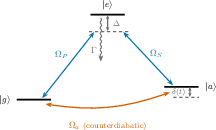
Figure 1: Three-level Λ system illustrating coherent Raman coupling and optical decay channels relevant to atom interferometry.
The Lindblad formalism provides an exact norm-loss identity, establishing spontaneous scattering as governed by the excited-state population. After adiabatic elimination, the excited-state amplitude follows the lower-manifold optical source S(t) nearly instantaneously, with primary loss controlled by ∣S∣2.
Bright-State Source Identity and Reduced Loss Functional
Transforming into the instantaneous dark--bright basis, the paper identifies the optical source feeding the dissipative channel as exclusively carried by the bright-state amplitude, expressed as ∣g⟩0, where ∣g⟩1 is the bright-state amplitude and ∣g⟩2 the total Raman Rabi frequency. The loss functional thus reduces to:
∣g⟩3
with ∣g⟩4 the effective bright-state decay coefficient. This formulation recovers STIRAP loss transparently and clarifies shortcut action. Numerical validation confirms the correspondence between full three-level dynamics, the reduced dark--bright propagation, and the closed-form estimate across parameters:
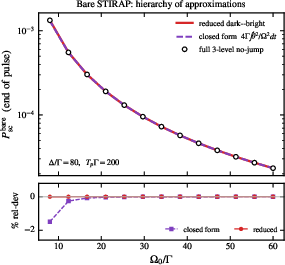
Figure 2: Validation of bare-STIRAP scattering in hierarchy of approximations, showing strong agreement between full model and reduced formalism as a function of Raman Rabi scale.
Counterdiabatic Cancellation: Exactness and Structure
The counterdiabatic Hamiltonian ensures exact cancellation of the bright-state source under the condition ∣g⟩5, where ∣g⟩6 is the mixing-angle rate. The residual source splits into orthogonal quadratures: real (shortcut mismatch) and imaginary (two-photon Doppler detuning). On resonance, the primary bright-state amplitude collapses to zero, with full-model confirmation demonstrating that both the excited-state population and accumulated scattering approach numerical precision limits as the counterdiabatic point is reached. The quadratic dependence on source mismatch is verified:
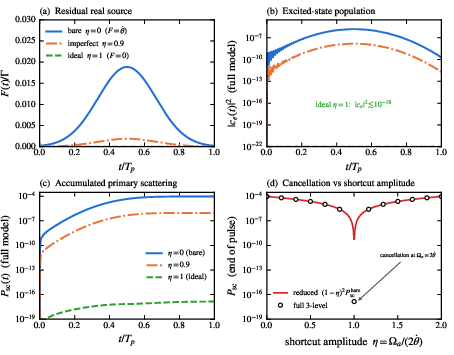
Figure 3: Full-model demonstration of bright-state source cancellation; primary scattering and excited-state population collapse at the counterdiabatic point, confirming exact dynamical suppression.
Velocity-Class Source Nulling versus Frequency Chirping
Addressing velocity classes via Doppler detuning splits the residual source into an imaginary quadrature. Two approaches are contrasted:
- Frequency Chirp: Standard protocol, where two-photon detuning is ramped to bring the desired momentum class onto resonance, yielding robust loss suppression for the targeted class and near neighbors.
- Two-Quadrature Source Nulling: Employs an auxiliary phase-shifted lower-state field to cancel both quadratures for a designated momentum class.
Both approaches are equivalent in the small-detuning regime (∣g⟩7), but the nulling protocol fails as the selected class approaches the bright-state gap ∣g⟩8. Nulling is only robust for ∣g⟩9; outside this regime, Hamiltonian perturbations degrade transfer efficiency irreparably.
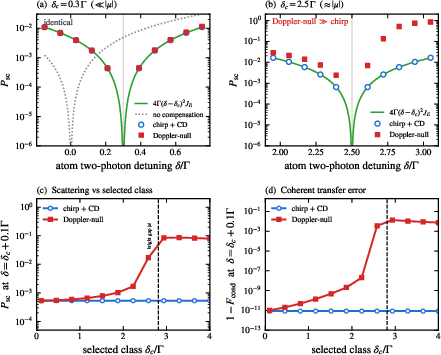
Figure 4: Comparative performance of velocity-class source nulling and chirping; equivalence at small detuning, but nulling fails as ∣a⟩0 approaches bright-state gap, demonstrating practical superiority of frequency chirping.
Implementation Cost and Mode-Error Budget for LMT Optics
Shortcut protocols require specific couplings. In LMT interferometry (where ∣a⟩1 and ∣a⟩2 carry momentum separation), direct counterdiabatic coupling must be optical, imposing auxiliary scattering costs. If the shortcut is encoded via reshaped Raman envelopes, the scattering channel is not auxiliary but captured by the primary functional. The single-pulse mode-error budget is cast as:
∣a⟩3
where each term is explicitly tied to the bright-state source. The break-even condition is quantified, guiding experimental design.
Implications and Future Directions
The paper establishes a clear separation between bright-state decay coefficients and the dynamical source. Exact source cancellation in shortcut protocols is validated both in reduced and full models. The orthogonal quadrature decomposition offers diagnostic clarity, but practical velocity-class control continues to favor frequency chirping due to its robustness across parameter regimes. The mode-error budget enables rigorous evaluation of protocol trade-offs for LMT atom optics. The bright-state source perspective is generalizable to other dissipative quantum control systems employing shortcut techniques, offering a foundational tool for minimizing loss.
Conclusion
The bright-state source-centric framework developed here rigorously elucidates spontaneous Raman scattering in dissipative shortcut atom optics. Exact source cancellation is achieved in shortcut-to-adiabatic passage protocols when implemented via counterdiabatic driving, as shown analytically and numerically. Velocity-class addressing via two-quadrature nulling is theoretically equivalent to chirping only under stringent conditions and fails as detuning increases, affirming chirping as the robust control method. The comprehensive mode-error budget delineates the practical boundaries for scattering minimization in LMT interferometry. The methods and organizational principles introduced may prove instrumental in designing future quantum optical protocols where dissipative channels are structurally minimized for high-fidelity coherent control.

