- The paper demonstrates that QD-RSPT reconciles various effective Hamiltonian methods by systematically incorporating detuning and asymmetric couplings in intense light-matter interactions.
- The methodology employs quasi-degenerate Rayleigh-Schrödinger perturbation theory to overcome limitations of traditional AMP approaches, yielding non-Hermitian corrections and enhanced predictive accuracy.
- Key results include quantitative validation with exact Floquet theory across model systems, highlighting its potential for advancing strong-field quantum optics and ultrafast phenomena.
Reconciliation of Effective Hamiltonians in Intense Light-Matter Interactions
Introduction
The modeling of intense light-matter interactions increasingly relies on essential-state reductions and effective Hamiltonians to distill complex many-body physics into tractable few-level descriptions. In quantum optics and attosecond science, effective Hamiltonians constructed via adiabatic elimination, the Markov approximation, or the pole approximation—collectively referred to as the AMP approach—have formed the backbone of theoretical predictions and experimental analysis. However, as experimental access now routinely crosses into regimes of high field intensities and multi-photon strong-coupling, the essential assumptions underlying AMP-based effective Hamiltonians are violated. The present work systematically analyzes the breakdown of these canonical approximations and demonstrates the reconciliation of diverse effective Hamiltonian methodologies via quasi-degenerate Rayleigh-Schrödinger perturbation theory (QD-RSPT). The results establish QD-RSPT as a unifying, systematically improvable framework, resolving debates on picture dependence, basis non-orthogonality, and accurate high-intensity modeling.
The AMP Hamiltonian is constructed by projecting the full light-matter Hamiltonian onto a subspace (“model space” or P) spanned by near-resonant (“essential”) states. The influence of “nonessential” states (Q) is incorporated via resolvent expansions or time-local approximations. The traditional adiabatic elimination assumes negligible coupling between essential and nonessential states or that the detuning is much greater than the coupling. This results in energy-independent, Hermitian effective Hamiltonians with orthogonal eigenstates.
These assumptions are routinely invalid at high intensities or significant detunings—for example, in multiphoton ionization, Autler-Townes splittings, or strong two-photon Rabi regimes—where the coupling to Q is non-negligible and the essential levels are generally non-degenerate. The existing literature has attempted to mitigate some of these limitations by ad-hoc choices of energy reference or “interaction picture”, but such treatments remain fundamentally ambiguous and unsystematic.
Quasi-Degenerate Rayleigh-Schrödinger Perturbation Theory
This paper demonstrates that QD-RSPT provides a natural and systematic refinement of effective Hamiltonians by explicitly accounting for quasi-degeneracy and asymmetric couplings within the model space. QD-RSPT formalizes the model space through projectors P and Q, constructs a reduced wave operator (the “correlation operator” χ), and derivatively expands the effective Hamiltonian as a (generally non-Hermitian) operator acting within P. Notably, the eigenstates of this effective Hamiltonian are generally non-orthogonal. The formalism naturally incorporates both non-degenerate essential states and asymmetric couplings to nonessential sectors, with the general structure
Heff=PH0P+PVP+k=1∑n−1PVχ[k]
where χ[k] are the k-th order correction terms incorporating iterative photon pathways involving Q0-space.
Key theoretical advances established here include:
- QD-RSPT clarifies the ambiguity of “interaction picture” or reference energy in AMP approaches by directly encoding detuning effects at the level of the perturbative expansion.
- The formalism predicts and explains non-orthogonality of effective eigenstates and non-Hermiticity of the effective Hamiltonian, connecting these to the physical reality of transient population in nonessential states and the asymmetric role of detuning and multi-photon paths.
- The convergence and computational feasibility of high-order QD-RSPT expansions are shown to be tractable using modern symbolic and numerical computing environments for realistic multi-level systems.
Demonstration: Model System and Numerical Results
The utility and necessity of QD-RSPT are demonstrated through a minimal model Hamiltonian and two realistic atomic scenarios.
Minimal Model and Non-Hermiticity
A three-level system with one ground state, one excited state, and a third “Rydberg” state is constructed to expose the consequences of nontrivial Q1-space coupling and non-orthogonality of eigenstates. The AMP Hamiltonian fails qualitatively, missing excited-state population dynamics and predicting incorrect Rabi oscillation frequencies. Inclusion of QD-RSPT corrections—in particular the off-diagonal asymmetric terms—systematically restores agreement with the exact full Hamiltonian dynamics.
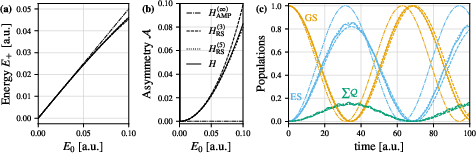
Figure 1: Properties of the minimal model Hamiltonian Q2 and comparison to various effective Hamiltonians, showcasing non-Hermitian corrections and excited-state population asymmetry.
Rubidium in the IR Regime
Rubidium driven in a strong Q3 nm IR field provides an example where the non-degeneracy of the essential states is non-negligible. A four-level model is constructed with Q4, Q5, Q6, and Q7 states near-resonant with the optical field. Here, both decay rates and quasi-energies calculated via QD-RSPT (7th order) show excellent agreement with exact Floquet theory; the AMP and quasi-degenerate AMP approaches deviate markedly at and beyond the first avoided level crossing.
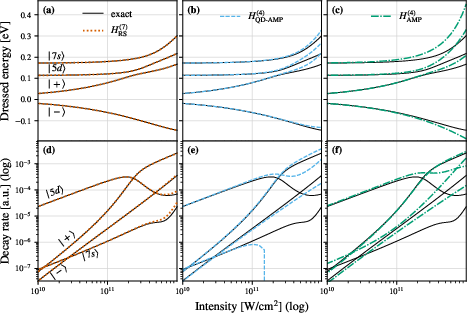
Figure 2: Quasi-energies Q8 of Rubidium in an IR field. QD-RSPT agrees quantitatively with Floquet theory at high order, while the AMP approximation fails at strong coupling/avoided crossing.
Helium in the XUV Regime
For XUV-driven processes, the Q9 transition in helium reveals the necessity of high-order perturbative treatment due to substantial coupling strength and large detunings. Here, QD-RSPT in 10th order closely tracks both real and imaginary parts of the quasi-energies, robustly outperforming AMP at high intensities. Furthermore, the predicted asymmetry (non-Hermiticity) of the effective Hamiltonian becomes large, corroborated by direct Floquet calculations.
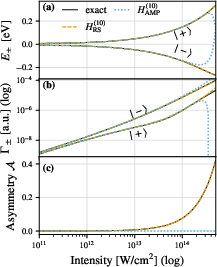
Figure 3: Quasi-energies Q0 of Helium in XUV, comparing QD-RSPT and AMP predictions against exact Floquet theory. Non-Hermitian asymmetry becomes sizeable at high field strengths.
Physical Interpretation and Implications
The explicit inclusion of detuning and asymmetric coupling effects in QD-RSPT is essential in accurately capturing the ab initio boundary between strong-field, few-level coherent control, and the onset of irreversible ionization and multi-level quantum chaos. The non-orthogonality of effective eigenstates has direct implications for the transient and cycle-averaged observables such as population transfer, photoelectron spectra, and time-resolved coherence.
Boldly, the work demonstrates that the dominant limitations of AMP—its insensitivity to detuning, enforced symmetry, and orthogonality—can be directly overcome by QD-RSPT, even for realistic multi-level atoms driven at experimentally accessible intensities. These conclusions are substantiated by strong numerical agreement with nonperturbative Floquet theory across physically disparate regimes.
Future Prospects
QD-RSPT's formalism, computational efficiency, and systematic improvability render it a highly attractive tool for computational quantum optics, strong-field photoionization, and quantum control. As experimental platforms advance toward routine access to pulsed, intense XUV/X-ray fields, and highly detuned schemes for quantum information processing, the systematic machinery presented here positions QD-RSPT as a standard for “effective” Hamiltonian computation—particularly in regimes where conventional few-level descriptions break down.
Extensions to explicitly time-dependent Hamiltonians, treatment of shaped pulses and chirped fields, and connection to effective operator approaches for observables (not only Hamiltonians) are warranted avenues for theoretical and computational development. The non-Hermitian structure invites further investigation in nonreciprocal and dissipative quantum dynamics, including applications in open quantum systems, quantum thermodynamics, and intense quantum optics.
Conclusion
This work provides a comprehensive reconciliation of effective Hamiltonian methodologies for intense light-matter interactions, grounding the approach in the rigorous and systematically improvable framework of QD-RSPT. The treatment resolves longstanding ambiguities regarding detuning, nondegeneracy, and eigenbasis structure, and demonstrates quantitative predictive power across a spectrum of realistic atomic systems. QD-RSPT is poised to become central in the theoretical toolbox for strong-field and ultrafast quantum science, supporting both fundamental investigations and emergent quantum technological applications.
(2606.04835)

