- The paper demonstrates that performance in neural operators is fundamentally driven by aligning spectral bases with the symmetry and phase of PDE solution operators.
- It compares Hartley Neural Operators (HNO) with Fourier Neural Operators (FNO), showing that HNO excels with real, symmetric Green’s functions in elliptic PDEs.
- Empirical evaluations reveal that reduced arithmetic complexity in HNO benefits self-adjoint problems while FNO remains essential for oscillatory, time-dependent issues.
Spectral Basis Selection in Neural Operators: Analysis of Hartley vs Fourier Representations
Introduction
The investigation centers on spectral basis selection for neural operators, specifically the comparison between complex-valued Fourier Neural Operators (FNO) and their real-valued Hartley counterparts (Hartley Neural Operator, HNO) for mapping function spaces governed by Partial Differential Equations (PDEs). The paper posits that the optimal choice of spectral basis is determined by the symmetry and phase characteristics of the solution operators themselves, not by superficial labels such as PDE class or dataset structure. The authors provide theoretical and empirical evidence that self-adjoint elliptic PDEs with real, symmetric Green's functions favor real-valued spectral representations, whereas time-dependent and transport-dominated PDEs—whose solution propagators carry phase—necessitate the flexibility of complex spectral weights.
HNO is formulated as a structurally parallel, iso-parametric real mirror to FNO. The Hartley transform replaces the FFT to avoid conjugate redundancy and complex arithmetic, retaining twice as many spectral modes but halving per-mode parameterization. For real-valued PDEs, this exploits the symmetry of input signals and reduces representational complexity. Both HNO and FNO are trained identically—including identical channel widths, learnable modes, optimizer configurations, and loss functions—to isolate spectral basis differences as the single variable influencing performance.
The architectural schema for HNO features input projection, repeated spectral convolution blocks (with residual and local 1×1 convolutions), and output projection; each spectral block multiplies Hartley coefficients per corner with a single real weight matrix, circumventing even/odd or k/−k decomposition. This mirrors FNO's complex per-mode scheme while maintaining iso-parametric parity.
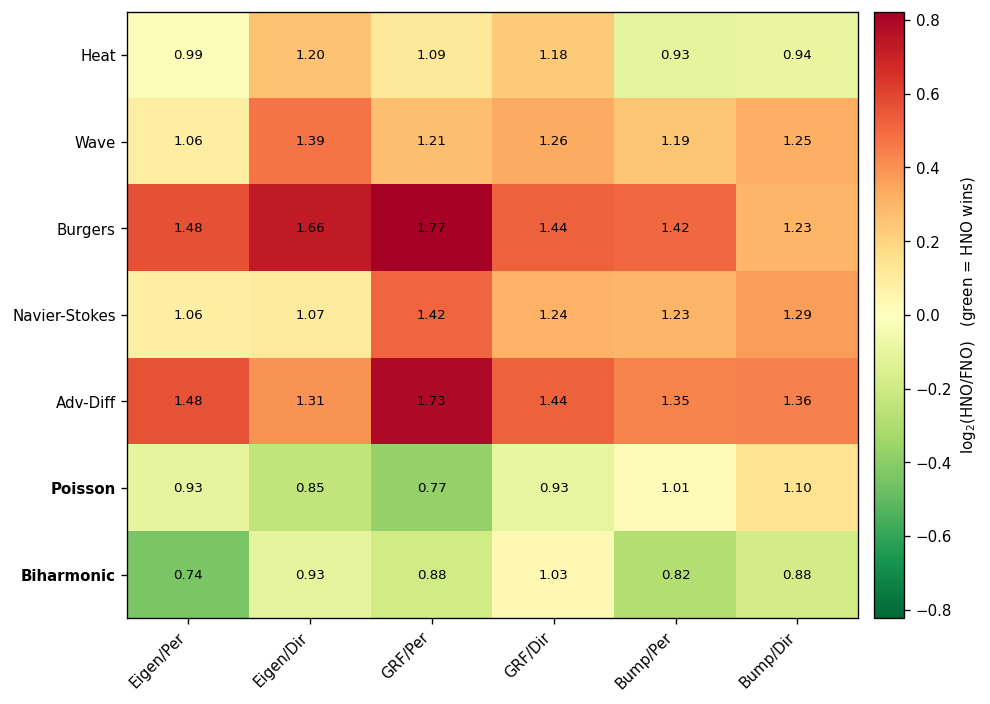
Figure 1: HNO/FNO relative-L2 error ratios show operator-based basis preference, with green cells favoring HNO (elliptic) and red favoring FNO (time-dependent and transport-dominated).
Theoretical Rationale: Green's Function Alignment and Phase Ordering
The authors formalize their claim via spectral analysis of Green’s functions. Elliptic, self-adjoint operators yield real, symmetric Green’s functions. The Hartley transform aligns perfectly: it diagonalizes these operators with a single real multiplier per mode, rendering HNO an exact realization (see Theorem~\ref{thm:elliptic_greens} in the appendix). In contrast, time-dependence introduces phase (oscillation, advection), requiring the expanded hypothesis class of complex spectral weights; the real basis is structurally incapable of representing phase-carrying solution operators.
The performance differentiation is monotonic in operator phase content: the biharmonic equation offers the most decisive HNO advantage, followed by Poisson, while heat (phaseless, but time-dependent) approaches parity. Wave, advection-diffusion, Burgers, and Navier-Stokes equations progressively favor FNO with increasing phase and transport content. The theoretical separation is reinforced by analysis of parameter space: HNO’s hypothesis class is strictly aligned with real symmetric kernels, offering a complexity reduction and optimization advantage (see Theorem~\ref{thm:complexity}).
Empirical Evaluation: PDE Benchmark Suite and Initial Condition Variability
Both operators are benchmarked across canonical PDEs with three distinct initial condition families (Gaussian random fields, eigenfunction expansions, and localized Gaussian bumps) under both periodic and Dirichlet boundary conditions, covering parabolic, hyperbolic, advective, nonlinear, and elliptic cases. Ground truth for each PDE is produced via standard solvers; time-dependent problems utilize finite difference methods, while elliptic problems exploit exact spectral solutions.
The empirical results are summarized in terms of relative-L2 error and spatial gradient error. HNO dominates on elliptic problems, with error distributions diffusely green across the domain, indicative of global basis alignment. In contrast, FNO prevails on time-dependent equations, with structured domain-dependent error patterns reflecting vortices and transport directionality.
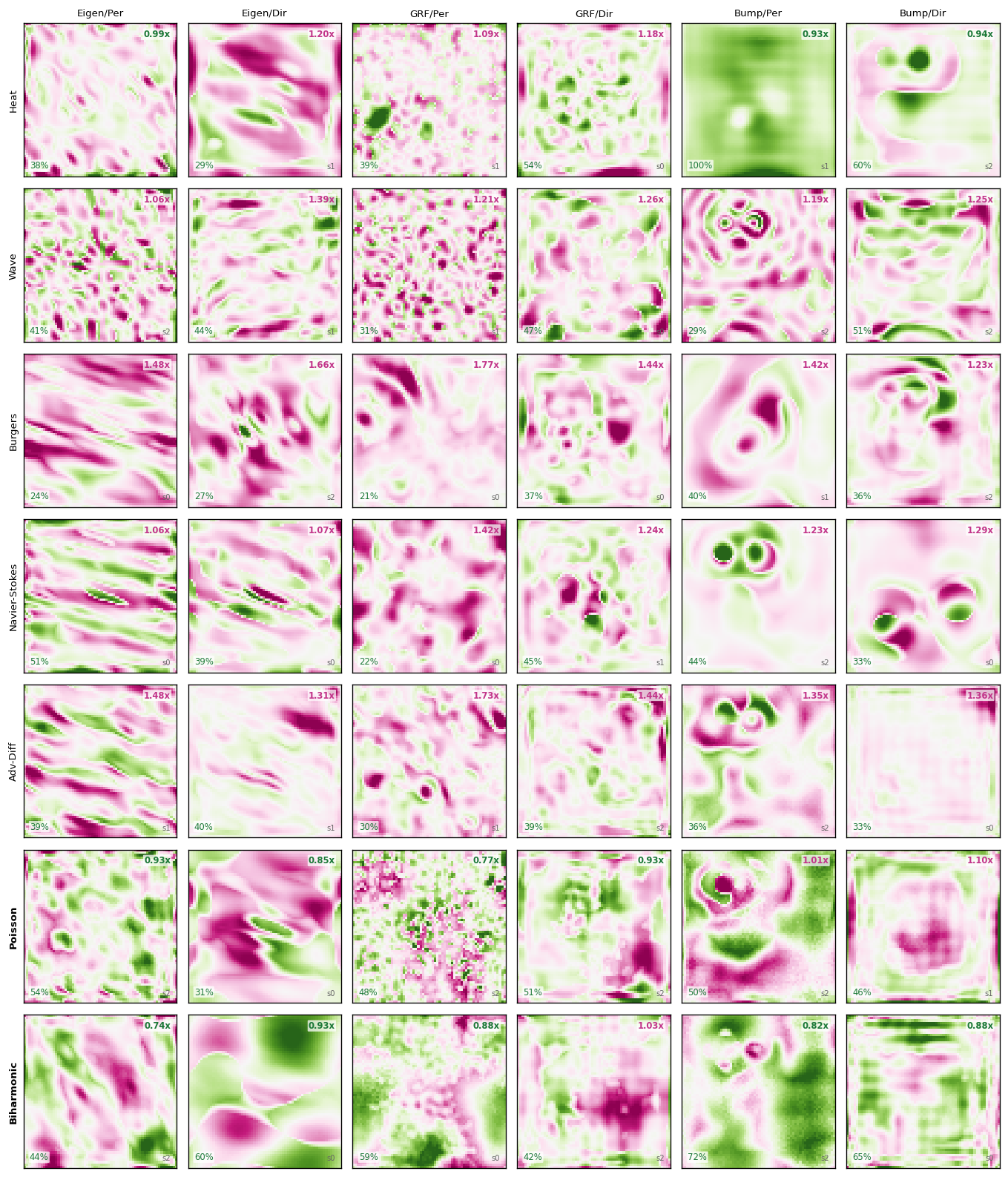
Figure 2: Spatial error map depicting domains where HNO (green) or FNO (pink) is closer to ground truth; elliptic cases exhibit uniform HNO advantage, while time-dependent cases show structured FNO gains.
The initial condition family modulates the magnitude—but not the sign—of performance differences, supporting the assertion that basis preference is operator-intrinsic rather than data-dependent. In broadband spectral content cases (GRF), both bases are stressed, maximizing the observed gap; smooth ICs (Gaussian bumps) yield more parity.
Computational and Practical Implications
A key advantage of HNO is the reduced arithmetic overhead per mode: real multiplication for each retained corner, compared to complex in FNO. However, practical implementation via torch.fft emulates the Hartley transform atop complex FFTs, introducing minimal overhead. Radix-4 Fast Hartley Transform benchmarks indicate substantial speedup potential if dedicated FHT kernels are implemented, especially for 3D domains.
These insights underpin practical guidance for neural operator design: for real, self-adjoint, phaseless PDE solution operators (elliptic, diffusion), HNO is superior; for oscillatory and transport-dominated cases (wave, advection, turbulence), FNO’s complex diagonal is unavoidable.
Connections, Limitations, and Speculative Extensions
The work connects to ongoing exploration of real-basis neural operators, including Walsh-Hadamard and convolutional operator variants, as well as resolution-robust Hartley-based approaches in medical image segmentation. The paper’s limitation lies in dataset scale (up to 64×64 domains), absence of true shock formation (for nonlinear problems), and reliance on emulated rather than native Hartley transform kernels.
Future directions include implementation of native fast Hartley transforms for efficiency, adaptive basis selection integrated into operator architectures, and comparative evaluation against non-spectral baselines (DeepONet, convolutional neural operators). The findings establish a clear paradigm: spectral basis selection must be matched to operator symmetry, not to data or universal defaults.
Conclusion
The paper rigorously demonstrates that spectral basis selection in neural operators is fundamentally determined by the symmetry and phase of the solution operator. HNO, as the real-valued mirror of FNO, is optimal for self-adjoint, phaseless elliptic operators, while FNO remains indispensable for phase-carrying time-dependent and transport-dominated operators. This basis–operator alignment principle provides actionable rules for neural operator design and opens avenues for adaptive, physics-informed architectures in operator learning.

