Can Scale Save Us From Plasticity Loss in Large Language Models?
Abstract: The loss of plasticity - the ability of a network to learn new information after having already learned older information - is a fundamental challenge in creating artificial neural networks capable of continual learning. Although this phenomenon has been known for decades, it has mostly been studied in older, relatively small architectures and rarely in natural-language domains. To determine whether loss of plasticity remains a problem in the modern transformer-based LLM paradigm, we study plasticity loss in GPT-style Transformer models trained on a multilingual continual learning problem. Consistent with prior work, we find evidence of plasticity loss across models ranging from 5M to 314M non-embedding parameters, as measured by deterioration on a held-out Vietnamese probing task. We further find that the onset of plasticity loss follows a predictable scaling law, growing sublinearly with model size. These results suggest that larger models may delay the measurable effects of plasticity loss, but that increasing parameter count alone is likely to be insufficient to completely prevent it. We also find evidence of plasticity loss under stationary multilingual training, challenging the view that the phenomenon is exclusive to continual learning with abrupt task changes. Overall, our results suggest that even large Transformer LLMs trained on natural-language will eventually lose the ability to efficiently adapt to new data after sufficiently long training, in both continual and stationary settings.
Paper Prompts
Sign up for free to create and run prompts on this paper using GPT-5.
Top Community Prompts
Explain it Like I'm 14
What this paper is about
This paper looks at a problem called “loss of plasticity” in LLMs. Plasticity is a model’s ability to keep learning new things over time. Loss of plasticity means the model gets worse at learning new information after being trained for a long time. The authors ask: do modern GPT-style Transformer models still suffer from loss of plasticity, does making them bigger help, and does this happen only when the training data changes over time or also when it stays the same?
The main questions the paper asks
- Do large, modern LLMs lose their ability to learn new information if they are trained for a long time?
- Does making models bigger delay or solve this problem?
- Does loss of plasticity happen only in “continual learning” (where tasks change over time) or also in “stationary” training (where the data mix stays the same)?
- What changes inside the model are linked to losing plasticity?
How the researchers tested this
To make this understandable, here’s the setup in everyday terms:
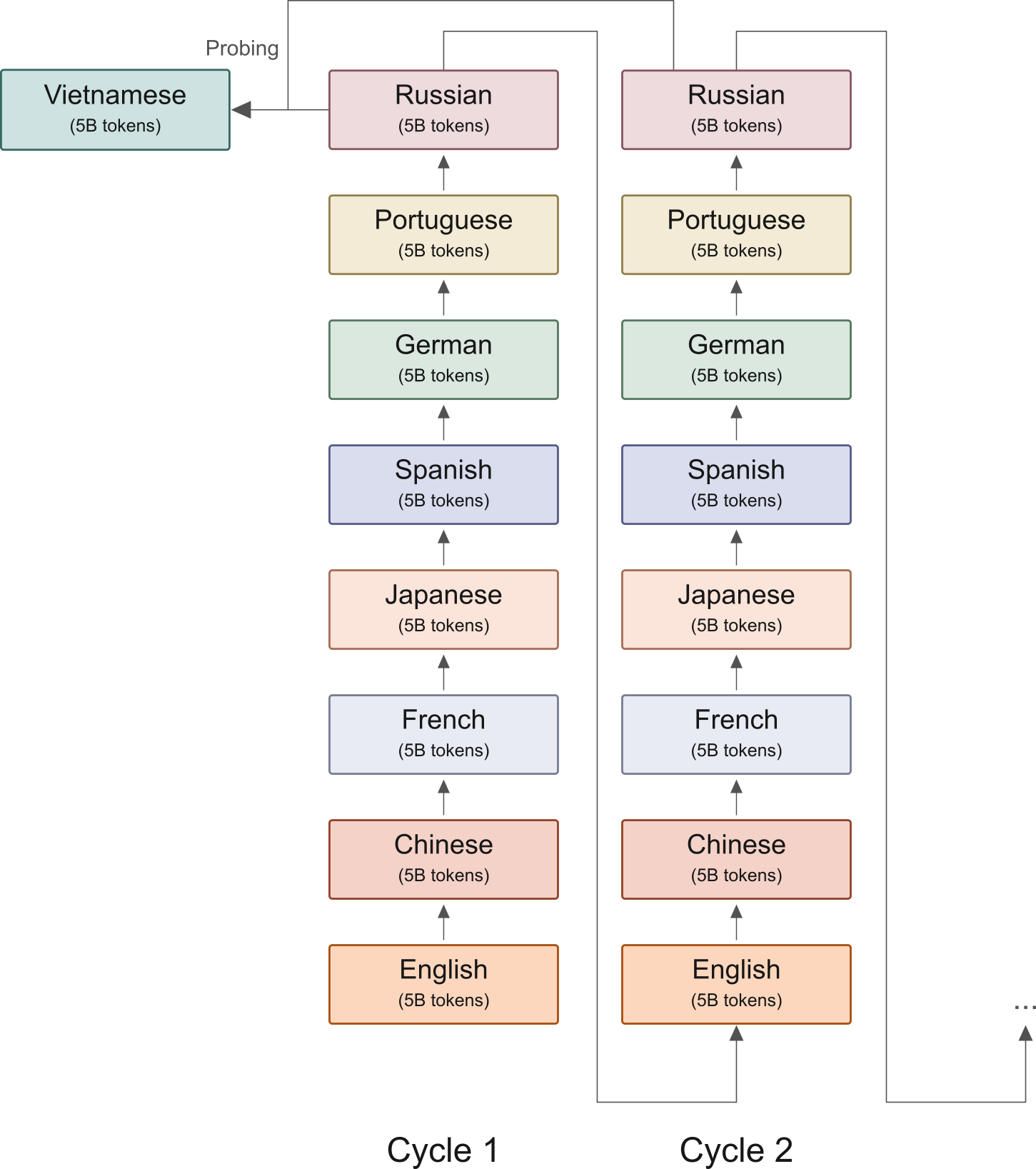
- Imagine teaching a student many languages one after another (English, Chinese, French, Japanese, Spanish, German, Portuguese, Russian). You repeat this cycle many times.
- After each cycle, you see how quickly the student can start learning Vietnamese (a language the student didn’t study during the cycles). If they learn Vietnamese more slowly later on than they did at the beginning, that suggests they’ve lost plasticity.
Here’s what they did:
- Models: They trained GPT-style Transformer models of different sizes, from small (about 5 million parameters) to bigger (about 314 million parameters). Think of “parameters” as the model’s “brain cells.”
- Continual learning: They trained the models on eight languages, one at a time, each for a fixed number of tokens (tokens are pieces of text the model reads). One full pass through all eight languages is a “cycle.” They did many cycles.
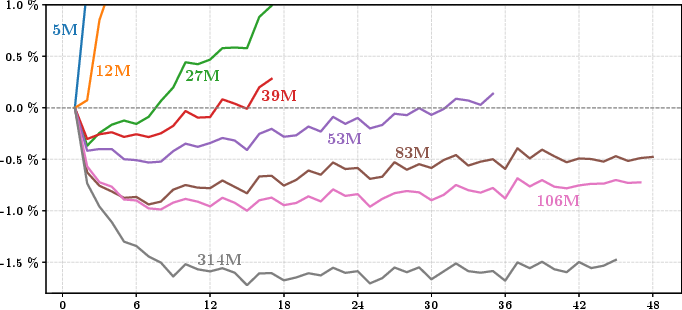
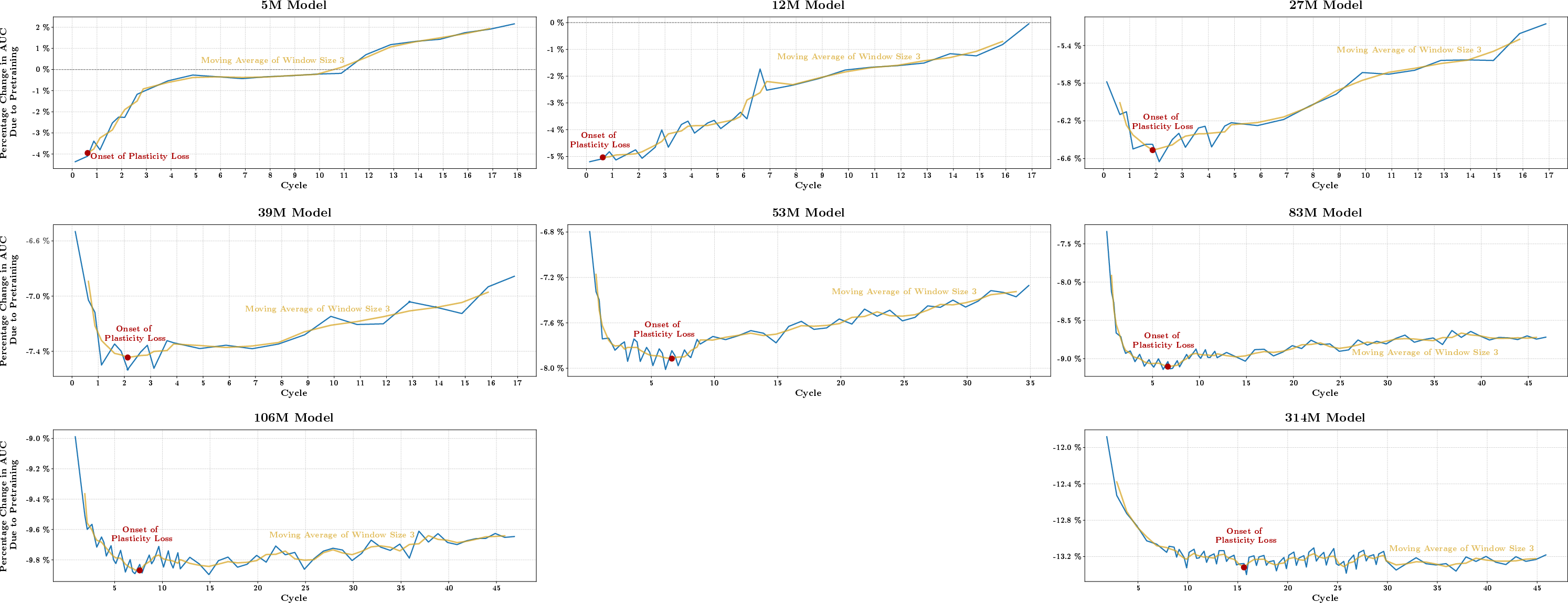
- Probing with Vietnamese: At the end of each cycle, they tested how well the model could start learning Vietnamese by training it briefly on Vietnamese and measuring how fast its validation loss dropped. Validation loss is a score that shows how well the model predicts the next word on data it hasn’t seen; lower is better. They summarized learning speed using the “area under the curve” (AUC) of validation loss over training steps: smaller AUC means the model improved faster.
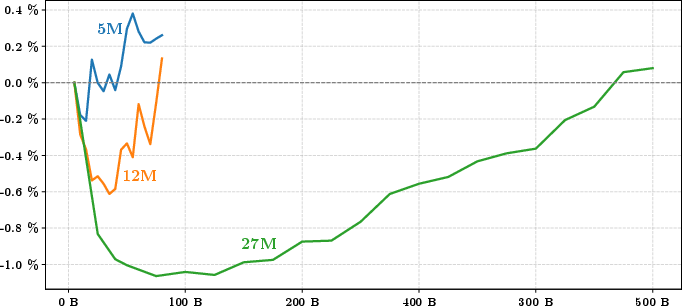
- Stationary training: They also tried mixing all eight languages together and training without switching tasks (like a blended class), then probed with Vietnamese in the same way.
- Simple idea to remember: If AUC goes up over time, the model is getting worse at learning new things (loss of plasticity). If AUC goes down, it’s learning new things more easily (positive transfer).
What they found and why it matters
Here are the key results:
- Loss of plasticity happens in all tested models: Every model, from 5M to 314M parameters, eventually showed signs of getting worse at learning Vietnamese after long training.
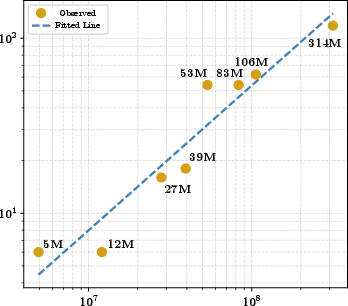
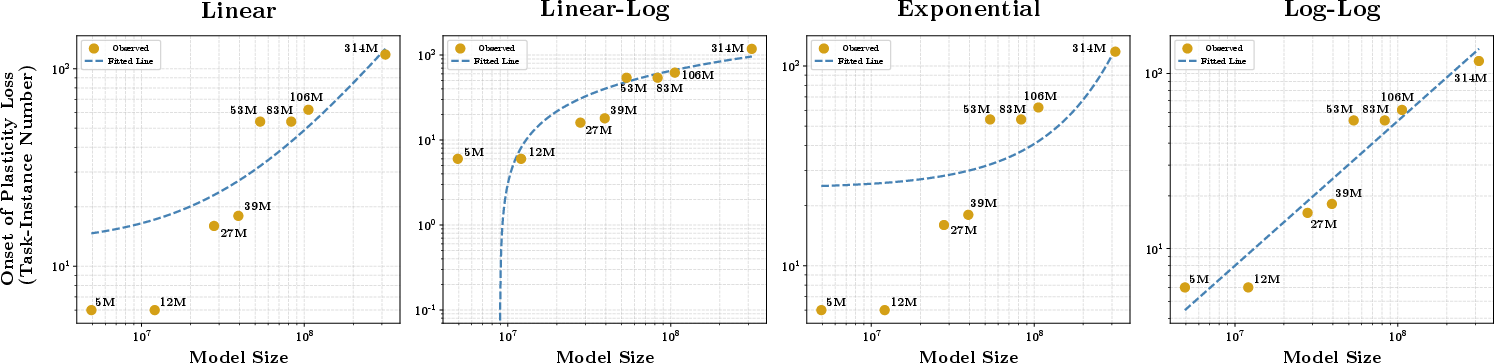
- Bigger models help but don’t solve it: Larger models delayed when the problem showed up, but didn’t prevent it. The “onset” (when plasticity loss starts being noticeable) follows a power-law scaling with model size:
- Here, is the number of task instances (how far into training you are), and is the number of non-embedding parameters (the model’s size).
- “Sublinear” means doubling the model size does not double how long it can avoid plasticity loss; you get diminishing returns from making the model bigger.
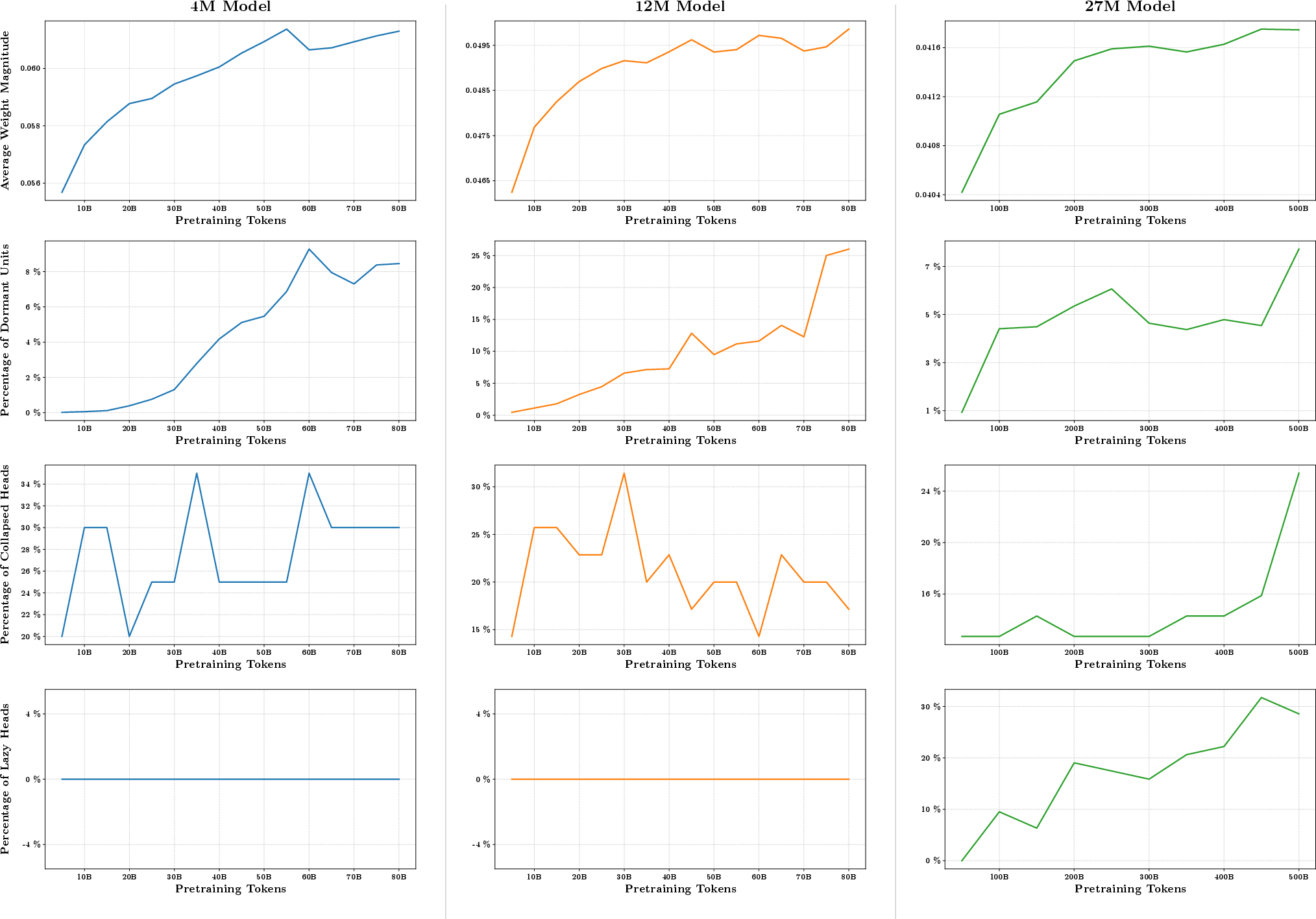
- It’s not just about task switching: Even when the training data was stationary (the same mix of languages), the models still eventually lost plasticity. So abrupt task changes aren’t required for this problem to appear.
- Transfer helps at first, then hurts: Early on, going through cycles improved the model’s ability to learn Vietnamese (beneficial transfer). But after enough training, the ability to adapt declined (loss of plasticity).
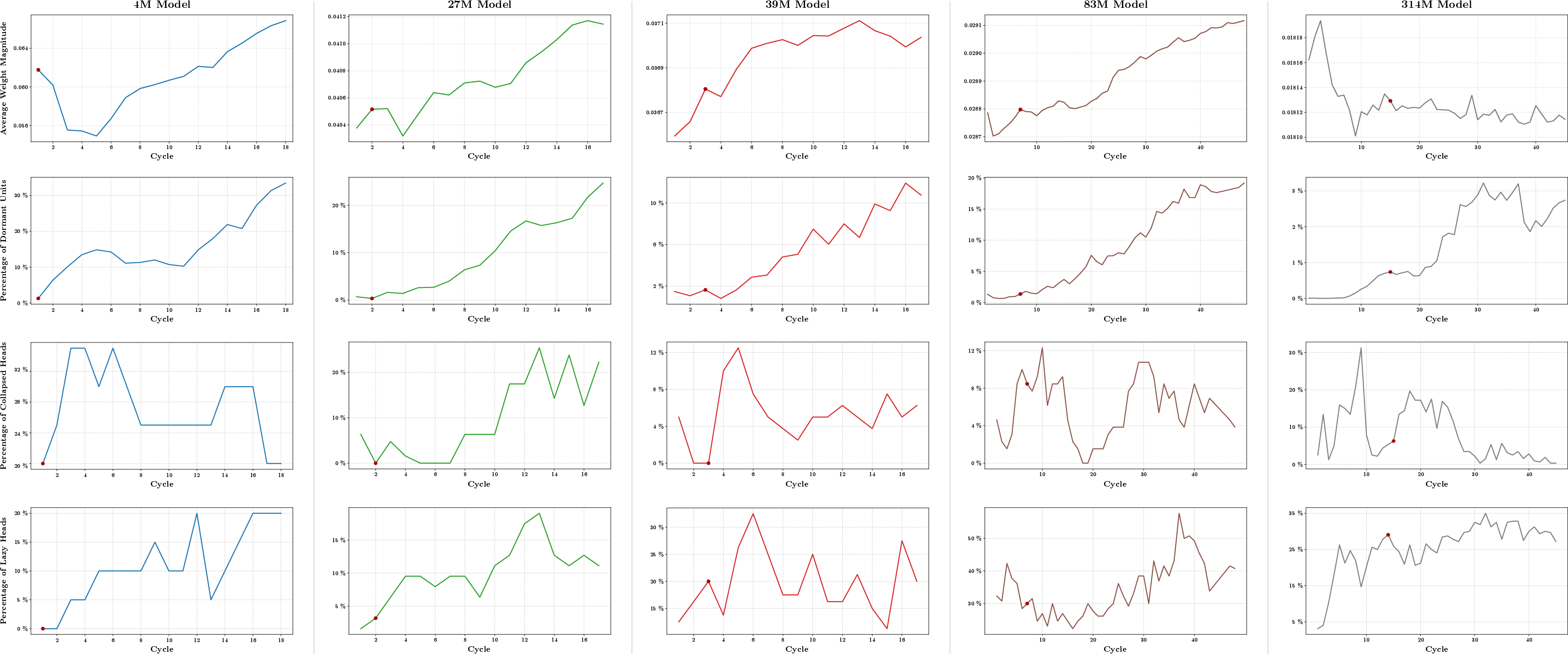
- Inside the model, certain warning signs showed up:
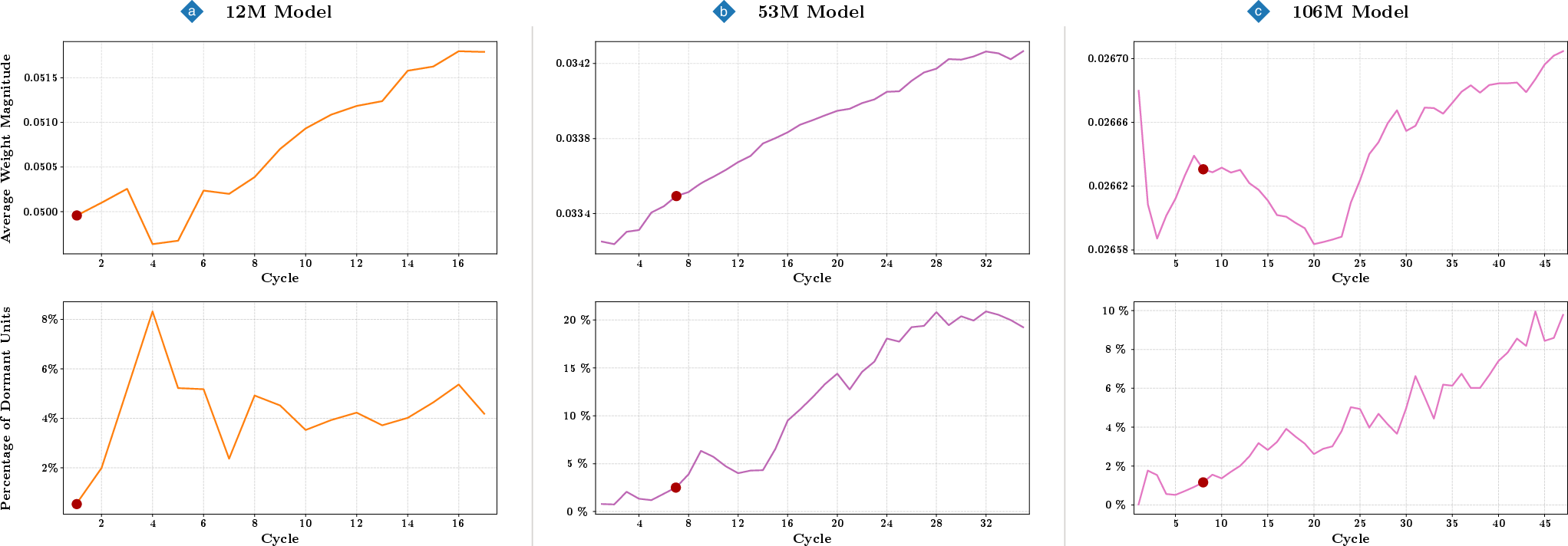
- Average parameter values tended to grow over long training (like weights getting “stiff”), which can slow learning.
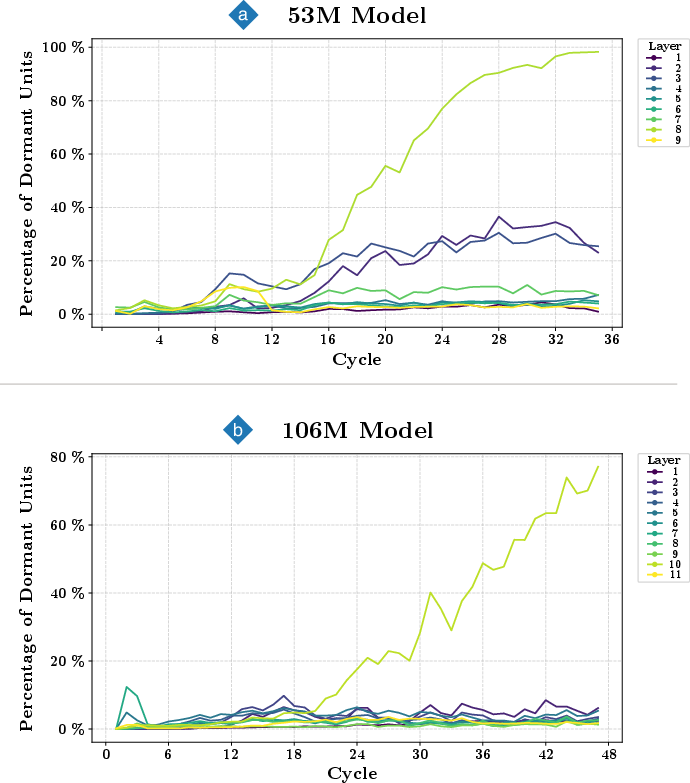
- “Dormant units” increased in some layers (neurons with very low activity compared to others), suggesting parts of the network contribute less over time.
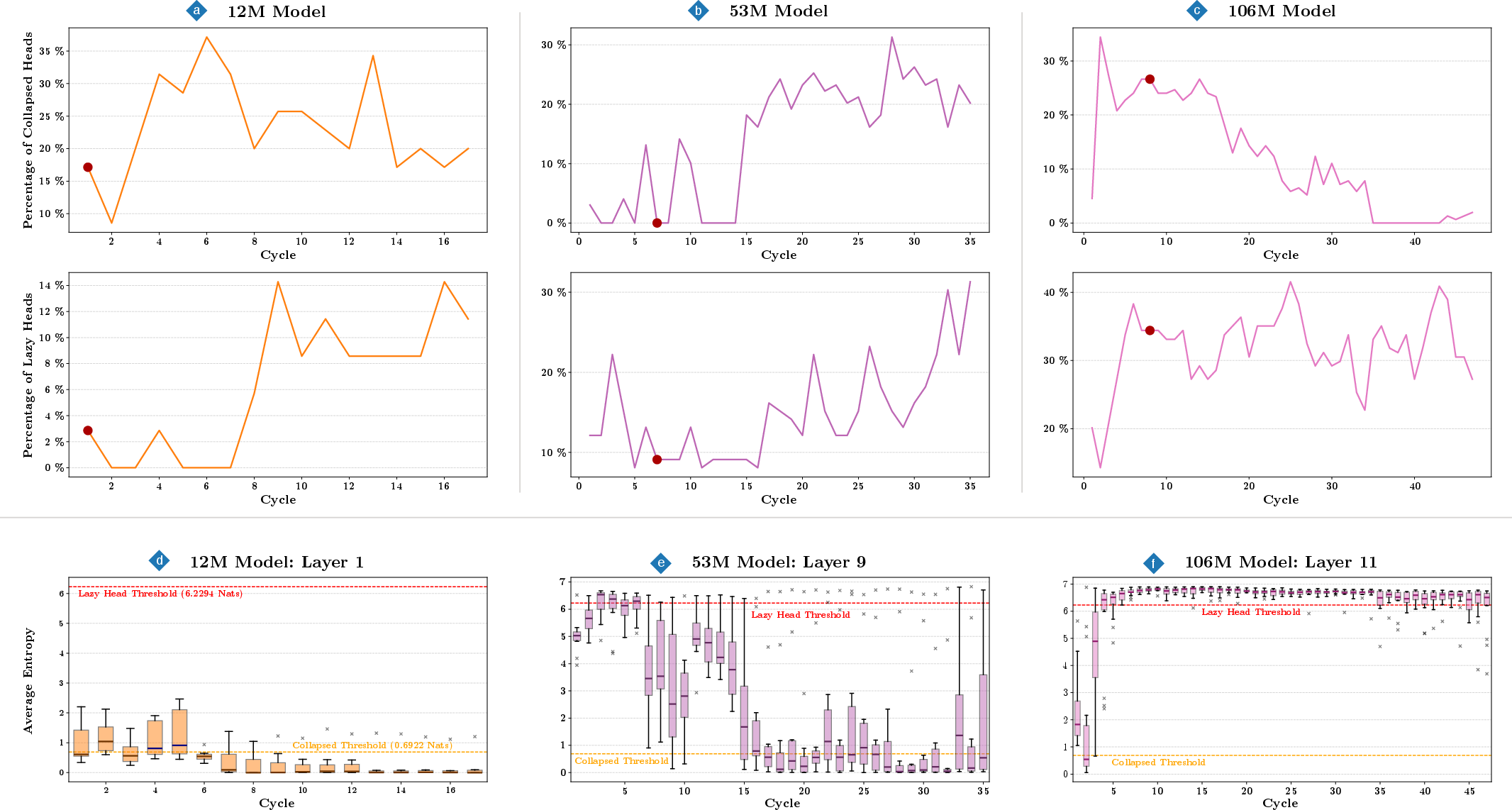
- Attention heads sometimes became “lazy” (spreading attention too uniformly) or “collapsed” (focusing extremely narrowly), both of which can reduce useful signal. Entire layers could drift into these patterns.
These internal changes didn’t perfectly explain plasticity loss on their own, but together they paint a picture of the model becoming less flexible and less responsive to new information.
What this means going forward
- Scale alone isn’t enough: Just making models bigger can delay the problem, but won’t eliminate it. This matters for building LLMs that keep up with new facts, codebases, or domains over time.
- We need plasticity-preserving methods: The authors suggest ideas that might help, such as stronger weight decay to limit parameter growth, resetting or reinitializing low-activity units, adding small perturbations to weights, or techniques to manage attention patterns. There’s no single proven fix yet, but these are promising directions.
- Real-world impact: If LLMs lose plasticity with long training, they may become slower to learn updates or adapt to new users and tasks. Better training methods could make future models more “lifelong learners,” reducing reliance on long prompts or frequent full retraining.
In short, the paper shows that modern GPT-style models do lose some ability to learn new things after enough training, bigger models delay it but don’t stop it, and this happens even without switching tasks. Understanding and addressing this will be important for building AI systems that can keep learning effectively over time.
Knowledge Gaps
Unresolved gaps, limitations, and open questions
The paper advances evidence for plasticity loss in GPT-style LLMs, but several concrete gaps remain for future work to address:
- Scale and generality of findings
- Verify whether the sublinear scaling of plasticity-loss onset holds for larger models (≥1B–10B+ parameters) trained for trillions of tokens, rather than relying on extrapolations from ≤314M.
- Test robustness across architectures (e.g., post-norm vs pre-norm, RMSNorm, different MLP expansions, rotary vs absolute positional embeddings, varying head dimensions, different width/depth ratios) to assess architectural dependence of plasticity loss and the scaling law.
- Assess tokenizer dependence by repeating experiments with alternative multilingual tokenizers (e.g., SentencePiece, BPE variants) and measuring how segmentation granularity affects transfer and plasticity.
- Extend beyond natural-language text to other domains (code, math, multimodal) to evaluate whether observed trends generalize across modalities and token distributions.
- Probing methodology and measurement
- Evaluate plasticity via multiple probing tasks/languages with varying similarity to the training mixture, not solely Vietnamese, to disentangle transfer effects from plasticity loss and assess sensitivity to task-choice.
- Report additional adaptation metrics (e.g., initial improvement rate, time-to-X% loss reduction, final post-probe loss) and vary the probe budget (e.g., 100M, 1B, 10B tokens) to characterize plasticity across timescales.
- Quantify uncertainty: repeat probes with multiple random seeds and provide confidence intervals for AUC trends and onset estimates.
- Analyze sensitivity to probe-evaluation design choices (e.g., entropy thresholds for “lazy/collapsed” heads, number of sequences used for entropy estimation, moving-average window size for smoothing).
- Estimating the “onset” of plasticity loss
- Reduce ambiguity in onset detection by probing at higher cadence throughout cycles, testing alternative onset definitions (e.g., change-point detection), and providing error bars on onset estimates.
- Test whether the inferred power-law exponent and prefactor are stable under different smoothing windows, probe language choices, and alternative curve-fitting models.
- Examine how the scaling law varies with per-task token budget (5B in this work), batch size, and context length.
- Training regimen and hyperparameter sensitivity
- Systematically ablate optimizer and schedule choices (e.g., momentum carryover vs optimizer reset, constant vs cosine decays, different warm-up schemes) to determine their causal impact on plasticity loss.
- Explore the roles of weight decay magnitude, gradient clipping, dropout, label smoothing, and other regularizers in modulating plasticity loss and the growth of parameter magnitudes.
- Assess whether resetting LR warm-up at every task boundary accelerates plasticity loss compared to smoother inter-task transitions or mixed curricula.
- Investigate sensitivity to batch size and gradient noise scale, which may materially affect effective plasticity and adaptation speed.
- Continual-learning design and data
- Test alternative task orderings, curriculum strategies, and smoother transitions (e.g., gradually varying language mixtures) to determine whether abrupt shifts are a primary driver of plasticity loss.
- Clarify and control token reuse: quantify how many cycles reuse earlier samples once the 100B-per-language pool is exhausted, and measure the effect of data repetition on plasticity loss.
- Examine the impact of language mixture weights and stationarity details (e.g., balanced vs natural-frequency mixes) on the rate and onset of plasticity loss.
- Evaluate data quality and preprocessing (e.g., deduplication levels, script/orthography normalization) to determine whether corpus artifacts accelerate plasticity loss.
- Mechanistic understanding and diagnostics
- Establish causal links between measured correlates (parameter magnitude growth, dormant units, lazy/collapsed heads) and plasticity loss via targeted interventions (e.g., unit/weight reinitializations, regularizers, noise injections) and ablation studies.
- Track additional internal signals over training (e.g., per-layer gradient norms, curvature/Hessian spectra, Fisher information, layernorm statistics, effective rank of weight matrices) to identify early-warning indicators and mechanisms.
- Localize plasticity degradation across layers and components (embeddings, attention, MLPs) using fine-grained per-layer adaptation tests and interventions.
- Investigate whether attention “collapse” reflects attention sinks or other mechanisms (e.g., BOS attraction, positional biases) and whether mitigation (e.g., learned sink tokens, attention-mass constraints) restores plasticity.
- Interplay with forgetting and transfer
- Jointly measure catastrophic forgetting and plasticity loss to understand their interaction and trade-offs under the same training conditions.
- Quantify how language/task similarity modulates both transfer and the rate of plasticity loss, using controlled similarity gradients or synthetic mixtures.
- Stationary vs non-stationary settings
- Extend stationary-mixture experiments beyond small models (5M–27M) to larger scales and longer horizons to test whether conclusions about stationary plasticity loss hold universally.
- Systematically compare rates of plasticity loss under stationary, slowly drifting, and abruptly switching regimes to isolate the role of distribution shift dynamics.
- Mitigation evaluation
- Empirically test candidate mitigations discussed in the paper (e.g., higher weight decay, unit/weight resets such as ReDo, Continual Backprop, Self-Normalized Resets, shrink-and-perturb, utility-based perturbations) within the same multilingual setup.
- Measure whether mitigating dormant units and lazy/collapsed heads causally improves adaptation speed and delays the scaling-law onset.
- External validity and reproducibility
- Provide multiple-run replications across seeds for each model size and report variability to strengthen claims about trends and scaling.
- Release task sequences, probes, and code to enable independent validation and to test alternative design choices (tokenizers, languages, schedules).
- Additional factors to probe
- Test longer context lengths and different positional encoding schemes (e.g., RoPE) to assess context-length effects on plasticity.
- Evaluate the role of embedding parameters (e.g., freezing embeddings, partial freezing) in plasticity dynamics, especially in multilingual settings.
- Examine whether tokenization rates (tokens per character/word) across languages bias perceived adaptation speed and plasticity outcomes.
Practical Applications
Immediate Applications
The following applications can be deployed now by leveraging the paper’s methods (multilingual continual/stationary training with periodic probing), findings (sublinear scaling law for the onset of plasticity loss, emergence under both stationary and continual regimes), and diagnostics (AUC-based probing efficiency, parameter magnitude growth, dormant MLP units, lazy/collapsed attention heads).
- Plasticity monitoring and early-stopping in LLM pretraining
- What: Integrate periodic “held-out domain” probing (AUC of validation loss during short fine-tunes) to detect declining learning efficiency; stop or alter training when plasticity loss trends appear.
- Sectors: Software/AI platforms, MLOps, foundation model labs.
- Tools/products/workflows: “Plasticity Monitor” module that schedules probes (e.g., on a low-transfer domain or language), computes AUC, tracks trends, and triggers early-stopping or checkpoint selection.
- Dependencies/assumptions: Probing domain must be sufficiently out-of-distribution (e.g., Vietnamese-like choice) to reflect genuine adaptivity; adds compute overhead; assumes metric thresholds calibrated per model/data.
- Training-budget planning using the scaling law
- What: Use the paper’s empirical scaling law T ≈ 1.3e−5 * P0.8269 (non-embedding parameters P; task instances T) to estimate when plasticity loss may onset and to plan token budgets, checkpointing, and model refresh cadence.
- Sectors: Industry model providers, academia (benchmark planning), finance/healthcare teams managing regulated training budgets.
- Tools/products/workflows: “Plasticity-aware scheduler” that projects safe training horizon and recommends model size vs token budget trade-offs.
- Dependencies/assumptions: Law inferred from GPT-style, pre-norm, multilingual next-token training with specific hyperparameters and 5B-token tasks; extrapolation to other setups requires caution.
- LLM training dashboards for internal diagnostics
- What: Track and alert on (a) average parameter magnitude, (b) dormant-unit fraction, (c) attention-head entropy (lazy/collapsed head rates) alongside probing AUC to detect emerging pathologies.
- Sectors: Software/AI infrastructure, LLMOps vendors.
- Tools/products/workflows: “Attention Health Checker” and “Dormancy Scanner” integrated with training telemetry (e.g., Weights & Biases, Grafana).
- Dependencies/assumptions: Requires instrumentation to compute activations/attentions on validation data; thresholds (e.g., entropy cutoffs) need calibration; metrics are correlational, not definitive causes.
- Safer continual fine-tuning for enterprise/domain models
- What: For orgs continually adapting models to evolving corpora (codebases, internal docs), schedule small, frequent held-out probes to ensure adaptivity hasn’t degraded; if it has, switch to fresher checkpoints or apply mitigations (e.g., higher weight decay, warm restarts).
- Sectors: Enterprise software, coding assistants, knowledge management, customer support bots.
- Tools/products/workflows: Continual fine-tuning pipelines with probe gates and automated rollback/refresh policies.
- Dependencies/assumptions: Access to a neutral “new-domain” probe set; compute/time for periodic probes; alignment with data governance policies.
- Multilingual/data-mixture design and checkpoint selection
- What: Use probing to select checkpoints that maximize downstream adaptability rather than only pretraining loss; design multilingual mixtures acknowledging uneven transfer (e.g., English vs Japanese to Vietnamese).
- Sectors: Localization/translation, global product support, education tech.
- Tools/products/workflows: “Adaptability-first” checkpoint selection; mixture rebalancing experiments guided by probe AUC.
- Dependencies/assumptions: Transfer effects depend on language similarity and tokenizer coverage; may trade off SLT (single-language) perplexity vs cross-domain adaptability.
- Guidance for small-model practitioners and edge deployments
- What: Because smaller models lose plasticity earlier, adopt stronger weight decay, more frequent probing, and periodic resets or partial reinitialization to maintain adaptivity on-device.
- Sectors: Mobile/edge AI, robotics, embedded systems, hobbyist communities.
- Tools/products/workflows: Lightweight “probe-and-refresh” loops; on-device reinit of low-activity neurons; scheduled optimizer resets.
- Dependencies/assumptions: Limited compute requires careful probe sizing; reinitialization policies must avoid destabilizing performance.
- Responsible model cards and training transparency
- What: Include plasticity-relevant disclosures (parameter counts excluding embeddings, tokens seen, probe AUC trends, diagnostics) to set user expectations on continued adaptability and fine-tuning responsiveness.
- Sectors: Policy/compliance, procurement, enterprise AI buyers.
- Tools/products/workflows: “Plasticity risk” section in model cards and vendor documentation.
- Dependencies/assumptions: Organizations must log token counts, probes, and metrics during training; may expose competitive details.
- Academic benchmark adoption
- What: Adopt the paper’s multilingual continual/stationary tasks and probing protocol as a standard benchmark to evaluate plasticity-preserving methods, ablations, and scaling trends.
- Sectors: Academia, open-source research.
- Tools/products/workflows: Public benchmark suites, leaderboards for continual learning in LLMs.
- Dependencies/assumptions: Access to CulturaX-like datasets; reproducible training setups; community agreement on probe design.
Long-Term Applications
These applications require additional research, scaling, or robust engineering based on the paper’s insights and suggested mitigations.
- Plasticity-preserving training algorithms integrated into LLM stacks
- What: Production-ready implementations of neuron/weight reinitialization (e.g., Continual Backprop, ReDo, Self-Normalized Resets, GraMa), shrink-and-perturb, selective weight reinit, or adaptive weight decay schedules that maintain adaptability over trillions of tokens.
- Sectors: Foundation model providers, open-source frameworks.
- Tools/products/workflows: “Plasticity Toolkit” for PyTorch/JAX training loops with safe deploy defaults.
- Dependencies/assumptions: Need to quantify trade-offs vs pretraining loss and downstream utility; stability and safety guarantees; compatibility with distributed training.
- Attention pathology mitigation
- What: Methods to prevent lazy/collapsed attention layers (e.g., entropy-aware regularizers, attention-sink tokens tuned for language modeling, head-level perturbations/rejuvenation).
- Sectors: Core AI research, large-scale training platforms.
- Tools/products/workflows: Head-level diagnostics and interventions that auto-correct attention regimes during training.
- Dependencies/assumptions: Must avoid harming genuine inductive behaviors (e.g., pointer-like heads); overhead should be minimal at scale.
- Architecture and activation innovations for sustained plasticity
- What: Design activations and normalization schemes less prone to dormancy, and architectures (e.g., MoE with rotation/rejuvenation of experts) that keep “fresh” capacity for new data.
- Sectors: Software/AI research, model architecture design.
- Tools/products/workflows: New transformer variants, layerwise plasticity controllers.
- Dependencies/assumptions: Requires extensive ablations across tasks and scales; potential inference cost changes.
- Automated orchestration optimizing size–tokens–adaptability
- What: Systems that combine the scaling law with online probe signals to dynamically allocate compute across model size, token budgets, and interventions, optimizing for long-term adaptability and cost.
- Sectors: Cloud AI providers, AutoML platforms.
- Tools/products/workflows: “Adaptivity-aware trainer” that plans curricula, refreshes, and model growth.
- Dependencies/assumptions: Scaling law generalization to new domains/architectures; reliable online signals; policy constraints on data usage.
- Continual learning standards and compliance tests
- What: Industry standards for plasticity evaluation (probe suites, thresholds, reporting) and certification for models deployed in dynamic domains (e.g., new regulations, evolving medical knowledge).
- Sectors: Policy/regulation, healthcare, finance, critical infrastructure.
- Tools/products/workflows: Third-party audits including plasticity tests and degradation curves.
- Dependencies/assumptions: Consensus on metrics and acceptable thresholds; accessible, representative probe datasets.
- Sector-specific resilient adaptation pipelines
- Healthcare: Lifelong literature-updating clinical assistants with plasticity guards to prevent stagnation after long pretraining.
- Finance: Models that adapt to regime shifts and new rules without losing learnability; ensemble refresh or checkpoint rotation guided by probes.
- Robotics: Continual adaptation of language-conditioned planners with periodic rejuvenation to maintain on-device learning capacity.
- Education: Multilingual tutoring systems that stay adaptable to new curricula and languages as content evolves.
- Tools/products/workflows: Domain-tailored probe libraries; automated refresh schedules; safe reinit policies.
- Dependencies/assumptions: High-stakes validation; domain-specific robustness requirements; data governance.
- Hardware/runtime support for plasticity workflows
- What: Accelerator/runtime features for low-overhead periodic probing, activation/attention telemetry, and fast partial reinitialization during training.
- Sectors: AI hardware, systems software.
- Tools/products/workflows: Runtime hooks for “probe epochs,” activation sampling buffers, weight-reinit primitives.
- Dependencies/assumptions: Close co-design with training frameworks; minimal throughput impact.
- Model lifecycle governance and risk management
- What: Organizational policies that cap training tokens relative to model size, mandate plasticity probes, and define refresh criteria; included in ML risk frameworks and SLAs.
- Sectors: Enterprise AI governance, auditors, insurers.
- Tools/products/workflows: Plasticity KPIs in governance dashboards; incident playbooks for adaptivity degradation.
- Dependencies/assumptions: Organizational maturity; alignment with privacy/compliance; reliable monitoring infra.
Glossary
- Absolute positional embeddings: Fixed position encodings added to tokens to provide order information in sequences. "absolute positional embeddings"
- AdamW: An adaptive gradient-based optimizer that decouples weight decay from the gradient update. "AdamW"
- AUC (area under the validation-loss curve): A scalar summary of learning efficiency computed by integrating validation loss over training steps. "the area under the validation-loss curve (AUC)"
- Aspect ratio (of a Transformer): The ratio between hidden size and number of layers used to keep depth/width proportions constant across scales. "aspect ratio of all models"
- Attention heads: Parallel attention mechanisms within a multi-head attention layer that learn different relational patterns. "collapsed and lazy attention heads"
- Attention-head dimension: The per-head feature width in multi-head attention. "we kept the attention-head dimension fixed at 64"
- Attention sinks: Tokens or positions that disproportionately attract attention mass, potentially degrading specificity. "the emergence of attention sinks"
- Batch size: The number of tokens (or examples) processed together for a single optimization step. "a batch size of 0.5M tokens"
- BOS token: A special Begin-Of-Sequence symbol often used by LLMs. "such as the BOS token"
- Causal self-attention: Attention where each position can attend only to previous positions to preserve autoregressive causality. "causal self-attention"
- Catastrophic forgetting: A loss of performance on previously learned tasks when learning new tasks overwrites earlier knowledge. "catastrophic forgetting in neural networks"
- Collapsed heads: Attention heads whose entropy is abnormally low, focusing too narrowly on few positions. "collapsed and lazy attention heads"
- Continual learning: A training paradigm where tasks arrive over time and the model must keep learning without losing adaptability. "continual learning"
- Continual pretraining: Ongoing pretraining over a sequence of tasks or data distributions before downstream evaluation or finetuning. "continual pretraining"
- Decoder-only Transformer: A Transformer architecture consisting solely of decoder blocks for autoregressive modeling. "decoder-only Transformer models"
- Dormant units: Neurons with persistently low relative activity that contribute little to representations. "dormant units"
- Entropy (of attention heads): A measure of how diffuse or concentrated an attention distribution is across positions. "entropy of attention heads"
- Entropy collapse: A failure mode where attention distributions become overly concentrated with very low entropy. "entropy collapse"
- GeLU: Gaussian Error Linear Unit; a smooth activation function commonly used in Transformer MLPs. "GeLU activations"
- Held-out probing task: An evaluation task not seen during the main training sequence, used to assess plasticity. "held-out probing task"
- Lazy attention heads: Heads with near-uniform, high-entropy attention that contribute little query-specific information. "collapsed and lazy attention heads"
- Layer normalization: A normalization technique applied across features to stabilize and speed up training. "in the presence of layer normalization"
- Leave-one-out cross-validation: A model selection/evaluation procedure that withholds one data point (or case) at a time. "leave-one-out cross-validation"
- Learning rate schedule: A predefined plan for changing the learning rate during training. "learning rate schedule"
- Linear warm-up: A period where the learning rate increases linearly from zero to its target value at the start of training. "linear warm-up"
- Log-log model: A regression model fitted in logarithmic space for both predictors and response, often revealing power laws. "log-log model"
- Loss of plasticity: The degradation of a model’s ability to learn new information after extended training. "loss of plasticity"
- MLP expansion factor: The ratio by which the hidden size is expanded inside the Transformer’s feedforward (MLP) layers. "MLP expansion factor of 4"
- Multilingual Continual Learning Problem: The paper’s non-stationary training setup cycling through multiple languages for long-horizon evaluation. "Multilingual Continual Learning Problem"
- Multilingual Stationary Learning Problem: The paper’s stationary training setup using a fixed mixture of multiple languages. "Multilingual Stationary Learning Problem"
- Next-token prediction: Autoregressive language modeling objective predicting the next token given previous context. "next-token prediction problem"
- Non-embedding parameters: Model parameters excluding token embedding tables, used here as a capacity proxy for the Transformer stack. "non-embedding parameters"
- Optimizer reset: Reinitializing optimizer states (e.g., moments) to avoid carryover effects across tasks. "The optimizer was reset at the start of each task"
- Parameter magnitude: The scale (e.g., average absolute value) of learned parameters, often linked to plasticity. "average parameter magnitude"
- Power law: A functional relationship where one quantity varies as a power of another, often identified via log-log fits. "power law"
- Pre-layer normalization: Applying layer normalization before the sublayer (attention/MLP) operations in each Transformer block. "pre-layer normalization"
- Probing task: A controlled adaptation/evaluation task used periodically to assess learning efficiency over time. "probing task"
- Scaling law: A predictable performance or behavior trend as a function of model size or data, often power-law-like. "scaling law"
- Sequence length: The number of tokens in each input sequence processed by the model. "sequence length of 2,048"
- Stability-plasticity dilemma: The tension between retaining old knowledge (stability) and learning new information (plasticity). "stability-plasticity dilemma"
- Stationary multilingual training: Training on a fixed mixture distribution of languages without abrupt task changes. "stationary multilingual training"
- Tied input and output embeddings: Sharing the same embedding matrix for input token embeddings and output softmax weights. "tied input and output embeddings"
- Validation loss: The loss measured on held-out validation data to monitor generalization or adaptation progress. "validation loss"
- Vietnamese probing task: The specific held-out adaptation task used to measure plasticity in this study. "held-out Vietnamese probing task"
- Weight decay: L2-style regularization applied to weights to control parameter growth during optimization. "weight decay of 0.1"
Collections
Sign up for free to add this paper to one or more collections.

