- The paper develops phase-space synchronization residuals using Husimi-Q angular moments to quantify phase localization and collective dynamics in finite-dimensional spin networks.
- It demonstrates through two-qubit cavity models that bipartite synchronization residuals follow a subadditivity-like structure, sensitive to microscopic parameters.
- Extending to a three-qubit triangular network, the study identifies negative tripartite residuals, indicating genuine multipartite phase locking beyond pairwise correlations.
Multipartite Synchronization Residuals in Driven-Dissipative Spin Networks
Introduction
This paper ("Multipartite synchronization residuals in driven-dissipative spin networks" (2606.24360)) establishes a rigorous phase-space framework for quantifying quantum synchronization in finite-dimensional spin systems. The authors develop synchronization residuals—subadditivity- and strong subadditivity-inspired measures grounded in the angular moments of Husimi-Q distributions—that are sensitive to collective phase localization in bipartite and tripartite spin networks. By comparing these phase-sensitive residuals to entropic correlation measures, the paper demonstrates their distinctiveness and probes the deeper structure of nonequilibrium quantum correlations in driven-dissipative settings.
Phase-Space Synchronization Measures and Residuals
The paper constructs phase synchronization measures from the first angular moments of phase distributions extracted via marginalization of Husimi-Q quasiprobability functions. The synchronization residuals, ΔR(2) and ΔR(3), are formulated analogously to subadditivity and strong subadditivity relations for von Neumann entropy, but are grounded in phase statistics rather than information-theoretic quantities. Specifically,
- ΔR(2)=R1+R2−R12 compares single-qubit and pairwise phase localization.
- ΔR(3)=R12+R23−R2−R123 quantifies the gap between pairwise and genuine tripartite phase locking.
These residuals vanish for uniform angular distributions and become non-zero when phase correlations and synchronization arise. Unlike entropic residuals, their sign is not inherently constrained by quantum information inequalities.
Two-Qubit Cavity Network: Bipartite Synchronization
The authors analyze a cavity-mediated two-qubit system in the dispersive adiabatic regime, where effective qubit-qubit interaction emerges via photon hopping and Jaynes–Cummings coupling. Synchronization is probed by solving the Lindblad master equation and extracting Husimi-Q phase distributions for both single-qubit and joint states.
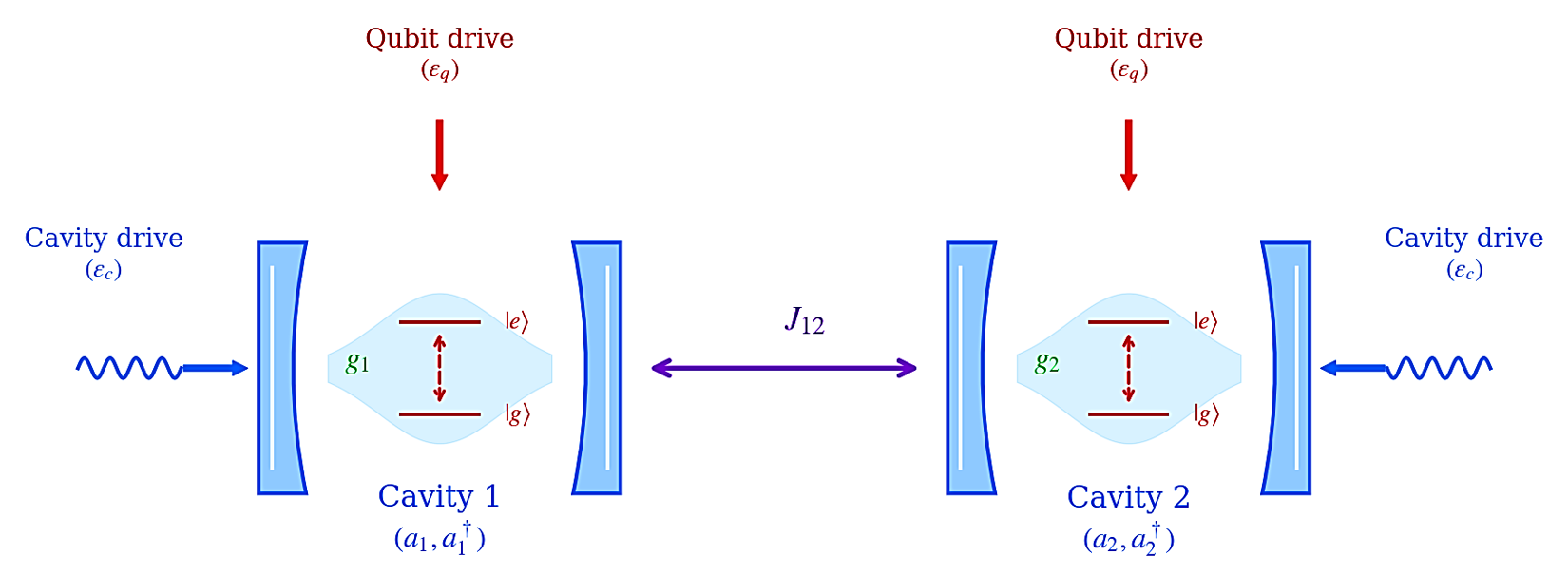
Figure 1: Schematic representation of two qubits inside a coupled-cavity system.
The steady-state Husimi-Q density plots reveal enhanced azimuthal localization in the joint distribution compared to individual qubits, indicating the emergence of collective phase locking in the system.
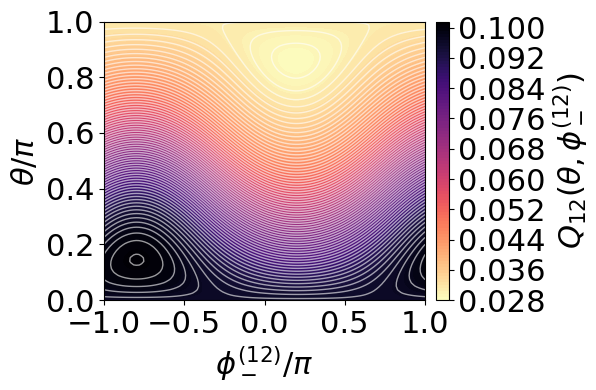
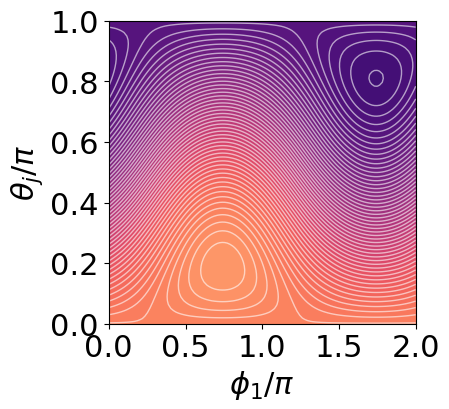
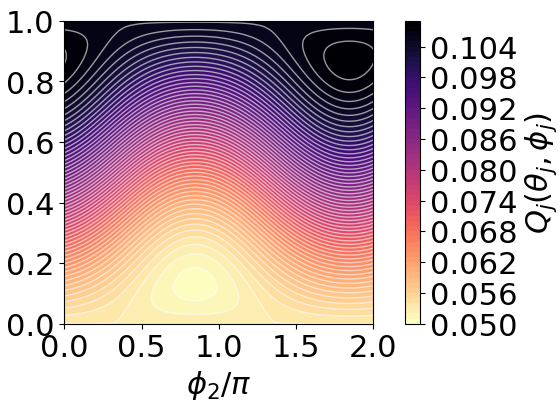
Figure 2: Density plots of steady-state Husimi-Q distributions for the bipartite (Q12) and single-qubit (Q1, Q2) phase spaces.
Temporal evolution of the bipartite synchronization residual ΔR(2)(t) shows non-negative behavior, consistent with a subadditivity-like structure. Notably, the entropy-based correlation measure ΔS(2)(t) remains strictly non-negative and converges to a small steady-state value.
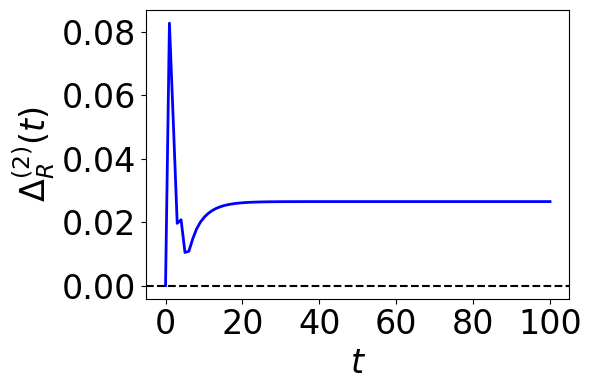
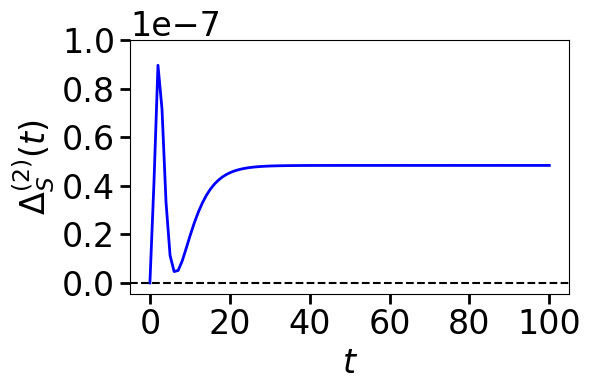
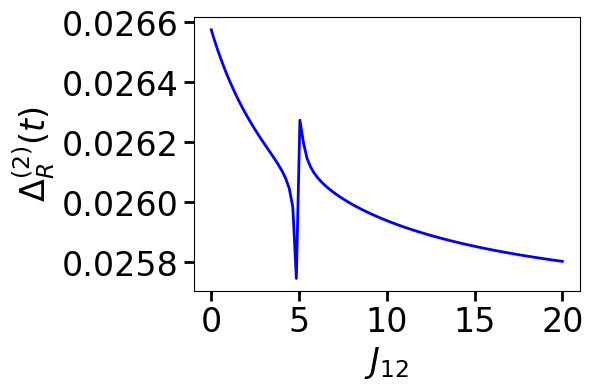
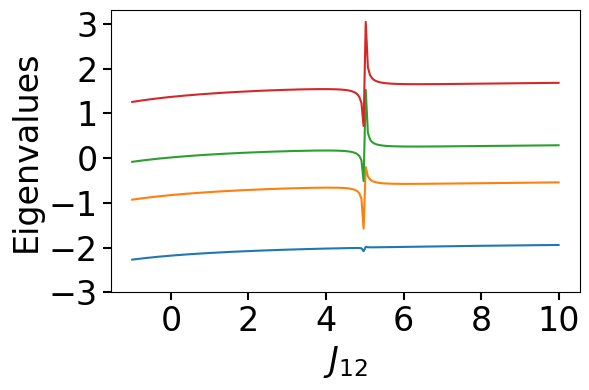
Figure 3: Time evolution of the bipartite synchronization residual ΔR(2)(t) and entropic residual ΔR(3)0, alongside parametric dependence and energy spectrum.
The dependence of ΔR(3)1 on photon hopping reveals singular behavior at the adiabatic breakdown threshold (ΔR(3)2), emphasizing the sensitivity of phase synchronization to microscopic parameters in the dispersive regime.
Three-Qubit Triangular Network: Tripartite Synchronization
The study extends the analysis to a triangular three-qubit network, where cavities are mutually coupled, generating genuine multipartite interaction. After cavity elimination and solving for the tripartite density matrix dynamics, the Husimi-Q phase distributions show a pronounced collective localization in the three-qubit state.
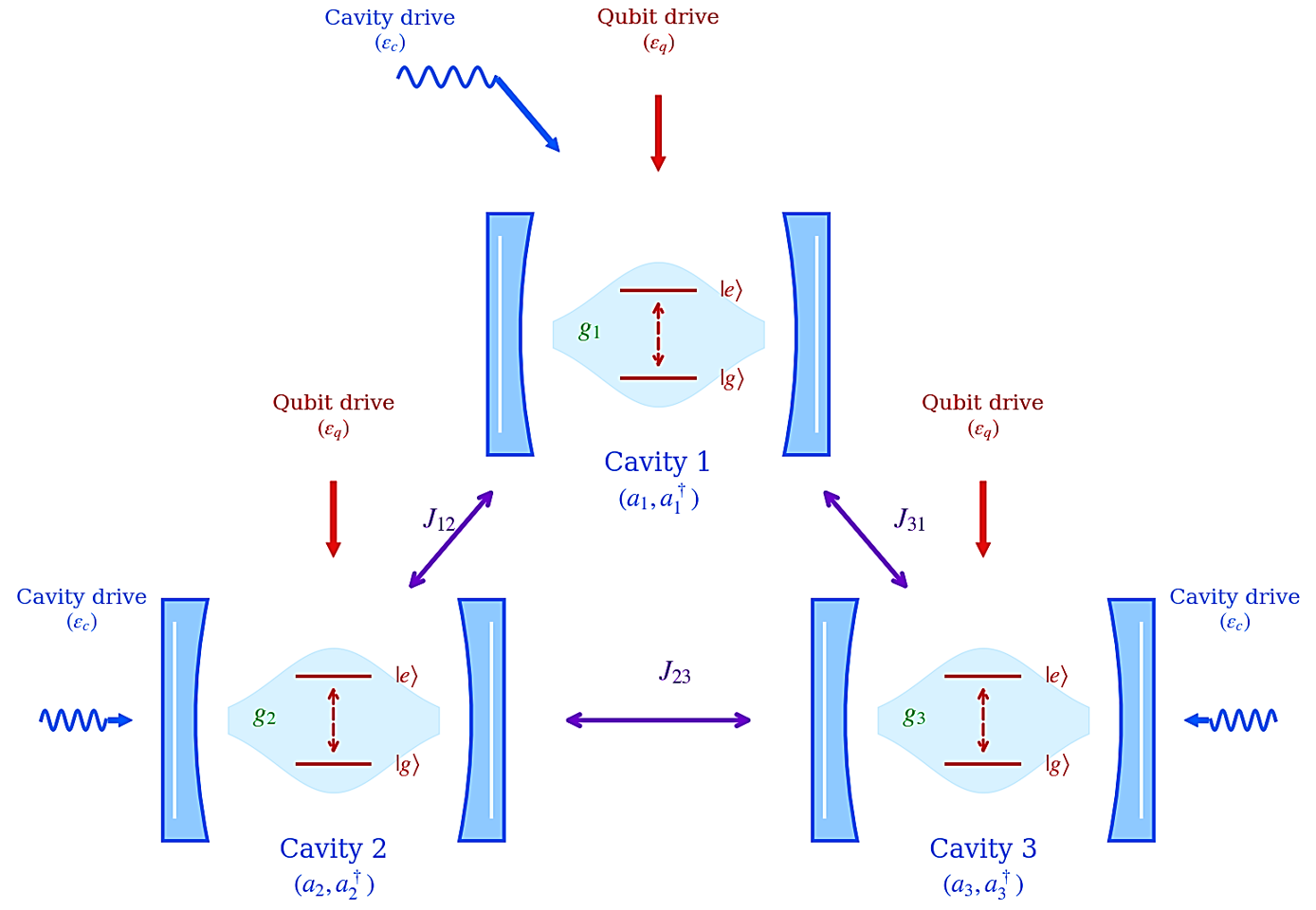
Figure 4: Schematic representation of three qubits inside a triangular cavity coupled system.
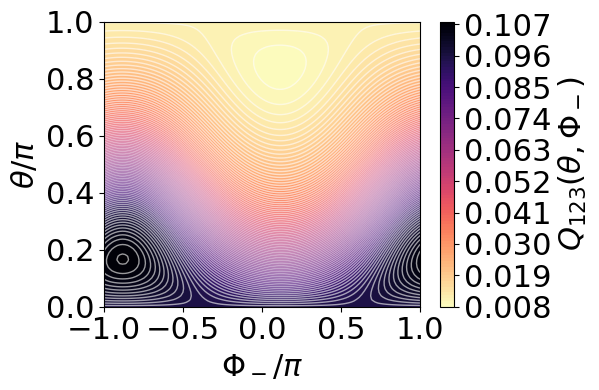
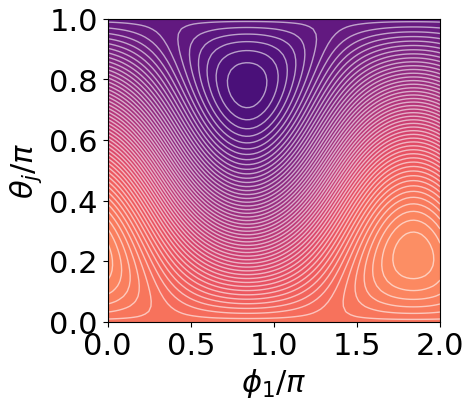
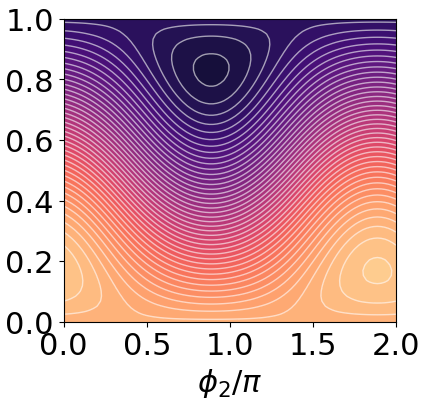
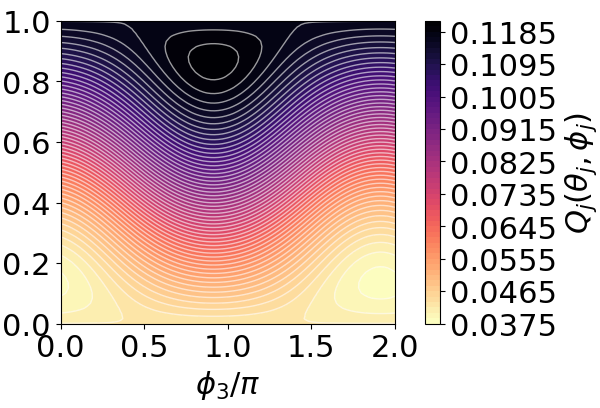
Figure 5: Density plots of Husimi-Q distributions for the tripartite (ΔR(3)3) and single-qubit (ΔR(3)4, ΔR(3)5, ΔR(3)6) phase spaces.
Critically, the tripartite synchronization residual ΔR(3)7 evolves to a negative steady-state value, explicitly violating the SSA-like inequality in phase localization. This strongly indicates the presence of collective phase-locking phenomena not reducible to pairwise correlations. The corresponding entropic residual ΔR(3)8 strictly satisfies SSA and remains positive throughout.
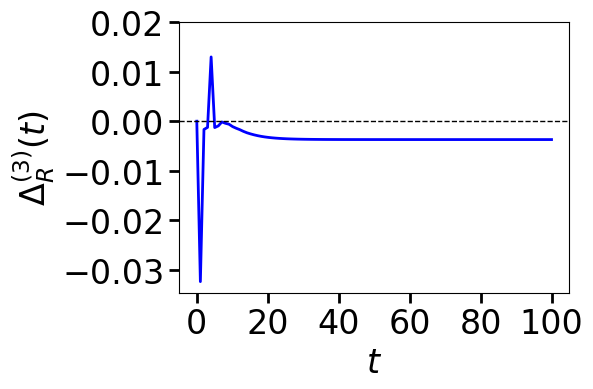
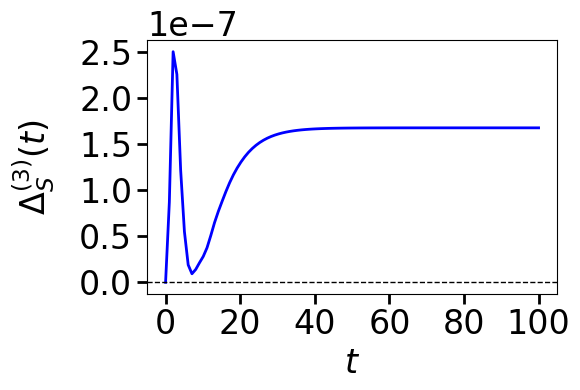
Figure 6: Time evolution of the tripartite synchronization residual ΔR(3)9 and entropic residual ΔR(2)=R1+R2−R120 for the three-qubit network.
Implications and Outlook
The results demonstrate that phase-space synchronization residuals can detect multipartite quantum correlations fundamentally distinct from those captured by information-theoretic entropic measures. The existence of negative tripartite residuals signifies collective phase locking that transcends bipartite decomposition, akin to genuine multipartite entanglement but rooted in phase statistics rather than entropy.
This distinction is crucial for the theoretical foundation of quantum synchronization—a phenomenon relevant for quantum technology applications in precision metrology, quantum information transfer, and robust operation of distributed quantum networks. The Husimi-Q-based phase localization framework provides operational diagnostics applicable to experimental platforms ranging from cavity and circuit QED to spin chains, trapped ions, and NMR systems. The formalism can scale to larger networks and may pave the way for quantifying synchronization-induced many-body correlations and benchmarking quantum simulators for dynamical collective phenomena.
Future research should investigate the interplay between phase synchronization, entanglement, and information propagation in networks with more complex topologies, time-dependent driving, and non-Markovian environments. Algorithmic and analytical extension to higher moments and alternative phase-space quasiprobabilities may further discriminate correlation classes and aid in exploring quantum synchronization’s role in non-equilibrium quantum thermodynamics.
Conclusion
This work introduces a new class of phase-space synchronization residuals for coupled spin networks, establishing their relevance and operational distinction from traditional entropic correlation measures. The numerical and theoretical results confirm that multipartite synchronization embodies correlation structures invisible to pairwise analysis, and may violate additive constraints otherwise obeyed by quantum entropy. The Husimi-Q quasiprobability methodology is demonstrated to be an effective tool for probing these collective dynamics, with substantial implications for many-body quantum systems, information processing, and dynamical quantum control.