- The paper presents a dual-branch neural architecture that jointly estimates time-frequency noise masks and adaptive white noise gain for robust MVDR beamforming.
- It leverages a differentiable MVDR layer to integrate learned covariance estimation with frequency-dependent robustness, outperforming fixed-threshold baselines.
- Experimental results on simulated array mismatches show significant improvements in SNR, SDR, and speech intelligibility compared to conventional methods.
Introduction
The minimum variance distortionless response (MVDR) beamformer is a canonical approach for noise-robust multichannel speech enhancement, balancing signal preservation in a specified look direction with spatial filtering for noise and interference suppression. However, practical deployment is often challenged by array imperfections and microphone self-noise, necessitating explicit robustness constraints, frequently formulated through the white noise gain (WNG). Conventional remedies employ empirically chosen, fixed WNG thresholds or diagonal loading, which are ill-suited to dynamically changing or mismatched arrays. The paper "Joint Learning of Covariance Estimation and White Noise Gain for Robust MVDR Beamforming" (2606.24137) systematically addresses this deficiency via a data-driven paradigm: a neural architecture that learns both the noise covariance and an adaptive, frequency-dependent WNG constraint in an end-to-end framework. This essay provides a detailed analysis and contextualization of the proposed method, including architectural choices, optimization strategies, empirical results, and broader implications.
The MVDR beamformer maximizes output SNR subject to a distortionless constraint in the look direction. In environments with array mismatches (e.g., microphone gain/phase errors, positional inaccuracies), its performance is highly susceptible to white noise amplification, quantifiable by the WNG metric. Empirical studies have established that overly aggressive directivity (high MVDR gain) can yield negative WNGs, amplifying sensor self-noise and diminishing robustness. Traditionally, robust variant designs employ diagonal loading or a fixed WNG constraint; optimal settings for these hyperparameters are scene- and array-dependent and thus ad hoc in practice. Prior work has focused predominantly on spatial covariance estimation, often via time–frequency (T–F) masking with deep learning, while leaving robustness control decoupled from the end-to-end optimization.
Data-Driven Adaptive Robustness Control
Dual-Branch Neural Architecture
To resolve the joint estimation problem, the authors introduce a dual-branch deep neural network that operates on multi-channel STFT inputs. The architecture is designed to output:
- T–F Noise Mask: A branch dedicated to predicting complex-valued T–F masks, enabling accurate estimation of the noise spatial covariance matrix.
- Frequency-Dependent WNG Constraint: A parallel branch that infers per-frequency WNG thresholds, allowing adaptive robustness tuning specific to the observed acoustic scenario and array conditions.
This is accomplished via a fusion strategy inspired by established multi-clue neural backbones, incorporating modules for frequency, narrowband temporal, subband, and fullband features. The feature extractor leverages Bi-LSTM and LSTM layers followed by fully connected units to capture both spectral and temporal dependencies and aggregate global context information.
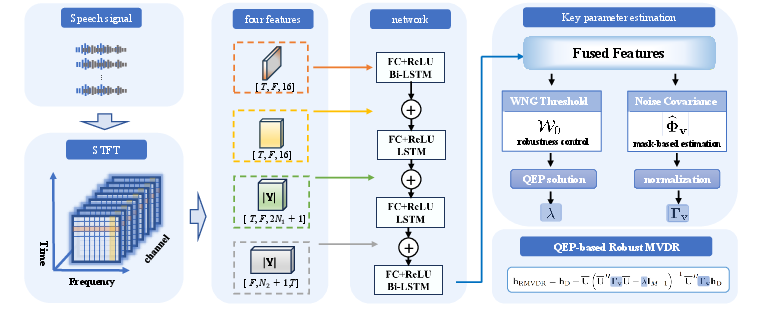
Figure 1: Overview of the dual-branch architecture for joint T–F mask estimation and data-driven WNG prediction.
The predicted mask branch passes its output to a spatial covariance estimator, aggregating over frames to yield Hermitian PSD matrices. The WNG constraint branch provides thresholds fed into a differentiable robust MVDR layer, which solves the beamformer weights using quadratic eigenvalue problem formulations. The end-to-end pipeline is trained via mean absolute error to reference early-arrival beamformed signals, enforcing implicit supervision on both mask and WNG branches via the final beamformed output.
Differentiable Robust MVDR Layer
The differentiable MVDR layer operationalizes robust beamforming via the QEP-based closed-form solution, directly incorporating the predicted frequency-dependent WNG into the beamformer optimization. This ensures that robustness control and covariance estimation are not independently tuned, but are instead co-adapted by backpropagation to maximize enhancement quality and stability.
Experimental Setup
Speech signals from the VCTK corpus, re-recorded with simulated eight-microphone uniform linear arrays under varying reverberation times, noise fields (spatially diffuse, white Gaussian), and random array mismatches, are employed. Performance is measured using SNR gain, SDR, STOI, and PESQ across both seen and unseen array conditions.
Results
The system is compared against a FullSubNet-based T–F mask estimator and conventional MVDR beamformers with fixed WNG or diagonal loading, with hyperparameters tuned for best-case baseline performance. For the fixed-setting baseline, the optimal WNG is found empirically at –6 dB; for the proposed method, both fixed (–8 dB) and adaptively learned WNG strategies are evaluated.
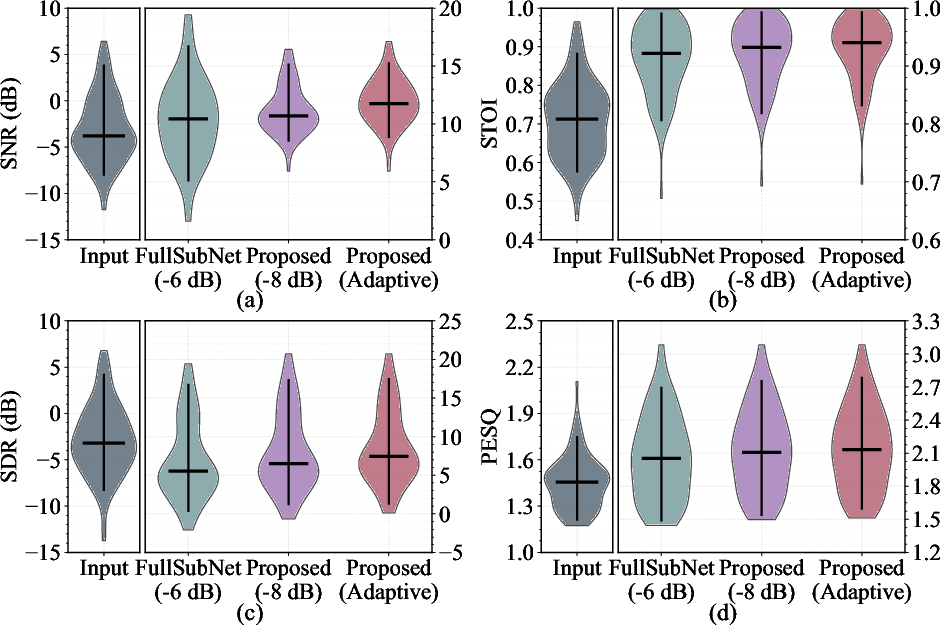
Figure 2: Distribution of utterance-level metrics (SNR, STOI, SDR, PESQ) for input, conventional FullSubNet-MVDR, and the proposed fixed/adaptive WNG methods.
The proposed adaptive WNG approach consistently delivers higher mean and median scores across all objective metrics. Notably, under array mismatch conditions (inter-microphone spacing deviations of ±0.1 cm, as well as unseen spacings of 1.0 and 3.0 cm), the adaptive approach demonstrates improved generalization and robustness:
- Seen array (2.0 cm): SNR gain = 11.94 dB (proposed) vs. 10.1–10.5 dB (baselines)
- Unseen arrays (1.0/3.0 cm): SNR gain = 10.2–11.6 dB (proposed) vs. 8.7–9.9 dB (baselines).
This performance delta is mirrored in ΔSDR metrics, confirming superior speech enhancement even when the array configuration deviates from training distributions. Thus, the claim that joint, data-driven WNG estimation yields more reliable and interpretable robustness–directivity tradeoffs than fixed or empirically tuned baselines is empirically substantiated.
Implications and Future Directions
The presented framework establishes clear evidence that WNG, traditionally treated as an external hyperparameter, can be successfully recast as a latent control variable within a learned optimization landscape. The integration of a differentiable robust MVDR layer enables true end-to-end adaptation of both spatial statistics estimation and robustness. This capacity is particularly impactful in consumer or embedded scenarios, where microphone hardware variation and environment dynamics are the norm and fixed robustness tradeoffs are fundamentally inadequate.
The methodology can be generalized beyond MVDR to related filter families with controllable robustness parameters or postfiltering stages. Moreover, the demonstrated utility in array-mismatched conditions directly addresses pressing practical limitations in field-deployed speech devices. Extensions to larger or more diverse array geometries, integration with additional cue sources (e.g., motion, video), or multi-task learning objectives such as joint ASR enhancement are promising directions. The overall approach motivates more systematic representation and control of latent physical constraints within deep audio signal processing pipelines.
In the broader AI context, this work exemplifies a trend toward hybrid physical–data-driven system modeling, where learned models parameterize hard constraints derived from physical robustness theory rather than treating such quantities as static or exogenous.
Conclusion
This research demonstrates the efficacy of joint, data-driven control of covariance estimation and per-frequency robustness in MVDR beamforming (2606.24137). The dual-branch neural architecture introduces interpretable and adaptive WNG estimation as an integral part of the beamforming pipeline, surpassed fixed-threshold baselines in both matched and mismatched array conditions, and provides a template for future research in data-driven array signal processing. The robust integration of learned representations of physical array constraints into end-to-end optimization constitutes a significant methodological advance with direct applicability to the design of robust, generalizable speech enhancement systems.

