Spacetime torsion fixes the mass and spin of gravitationally produced dark matter
Published 22 Jun 2026 in gr-qc and hep-th | (2606.23418v1)
Abstract: The gravitational production of dark matter from stochastic gravitational waves requires the produced fermion to acquire a mass by unspecified late-time physics. We show that this mass is supplied by spacetime torsion alone -- no Higgs sector and no free mass parameter. In the Quadratic Spinor Lagrangian formulation of general relativity, extended to Einstein--Cartan, a cosmological spinor condensate generates a vectorial trace torsion $K\propto\dotχ/χ$; an explicit Clifford reduction confers on the produced spin-1/2 fermion a pure Dirac mass $M_{\rm eff}=(1/\sqrt6)\,|\dotχ/χ|$, with no pseudoscalar or cross terms, locked to the Hubble rate at production, $M_{\rm eff}\simeq(c_χ/\sqrt6)H_$. The relic abundance is then a one-parameter prediction, $Ωh2\propto H_{5/2}$, and the spin is fixed: the same framework admits no propagating spin-3/2 mode, so the composite spin-1/2 Dirac fermion is its unique dark-matter candidate.
The paper demonstrates that spacetime torsion from the Quadratic Spinor Lagrangian uniquely generates a pure Dirac mass for spin-1/2 dark matter without a Higgs sector.
It shows that mass locking ties dark matter mass to the Hubble scale, reducing free parameters and predicting relic abundance scaling as H_*^(5/2).
The framework excludes spin-3/2 modes through geometric and symmetry constraints, ensuring causal propagation and distinct high-frequency gravitational wave signatures.
Spacetime Torsion as the Origin of Mass and Spin in Gravitationally Produced Dark Matter
Formalism and Key Proposition
The paper "Spacetime torsion fixes the mass and spin of gravitationally produced dark matter" (2606.23418) introduces a geometric mechanism whereby spacetime torsion, emerging in the Einstein–Cartan extension of general relativity via the Quadratic Spinor Lagrangian (QSL), uniquely endows gravitationally produced dark matter (DM) with both mass and spin. The core assertion is that the geometric field content—specifically the vectorial trace torsion arising from cosmological spinor condensates—supplies a pure Dirac mass to spin-$1/2$ fermions produced by stochastic gravitational waves, eliminating the necessity for a Higgs sector or free mass parameters.
This framework operates through the QSL: a 4-form Lagrangian constructed from Clifford-algebra-valued spinor fields, distinct from the Einstein–Hilbert action only by boundary terms. The metric emerges as a spinor bilinear, and upon extension to the Einstein–Cartan theory, torsion is algebraically fixed by the spinor condensate. For spatially homogeneous fields, torsion reduces to a vector aligned with cosmic time, K∝χ˙/χ, setting the stage for mass generation.
Geometric Mass Generation and Spin Selection
The paper demonstrates that the mass term arises through quadratic contributions in contorsion:
Meff2=61(χχ˙)2
with the condensate evolution directly tied to the Hubble rate, H∗. Importantly, the explicit Clifford reduction confirms that the resulting mass is a pure Dirac term (ψˉψ), with all vector, axial, pseudoscalar, and tensor channels identically vanishing—this is enforced by the cosmological symmetry (SO(3) scalar). The composite nature of the Dirac-vector, constructed from a single spinor, ensures that only the spin-$1/2$ mode is propagating, with spin-$3/2$ components identically nullified. This geometric construction precludes propagating spin-$3/2$ states, excluding associated pathologies such as Velo–Zwanziger inconsistencies and catastrophic production.
Mass Locking and Predictive Relic Abundance
A pivotal consequence is the locking of mass to the Hubble scale at the time of production:
Meff=6cχH∗
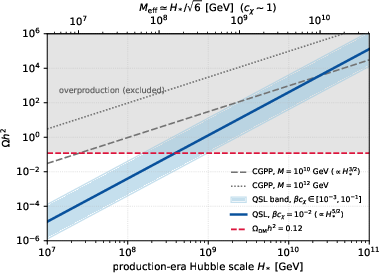
This relation eliminates the usual freedom to scan mass independently of the cosmological setting. For gravitational freeze-in production, the relic abundance is expressed as:
K∝χ˙/χ0
which marks a deviation from conventional scaling (K∝χ˙/χ1), directly imprinted by mass locking. The predictive power of this framework collapses the parameter space to a single variable, K∝χ˙/χ2, as illustrated by the matching of observed DM abundance to a uniquely specified Hubble scale and mass.
Figure 1: Relic abundance vs. production scale K∝χ˙/χ3. Mass locking reduces the K∝χ˙/χ4 parameter space to a single curve, enforcing a precise relationship between DM mass and cosmological production scale.
Causal Structure and Spin-K∝χ˙/χ5 No-Go
The theory ensures that the propagating mode—a composite spin-K∝χ˙/χ6 Dirac field—obeys a second-order metric d'Alembertian equation, preserving causal propagation on the metric cone. Promotion to a spin-K∝χ˙/χ7 field yields no massive propagating mode due to the structure of the QSL action, which restricts quadratic fluctuations to the metric and scalar components. The spin-K∝χ˙/χ8 mode thus stands as the unique candidate for gravitationally produced DM in this geometric setting.
Phenomenological Implications and Connections
The mass locking implies a stochastic gravitational wave (GW) counterpart: the same K∝χ˙/χ9 fixes both Meff2=61(χχ˙)20 and the redshifted GW frequency, Meff2=61(χχ˙)21. These GW signatures would appear in the MHz band, targeting ultra-high-frequency detectors, with distinctive spectral components arising from condensate relaxation. Importantly, all predicted signals lie below current Meff2=61(χχ˙)22 constraints but remain accessible to future instrumentation.
The theoretical construction connects to supersymmetric DM paradigms, identifying the propagating spin-Meff2=61(χχ˙)23 Goldstino as analogous to the light gravitino of Pagels–Primack, but realized in a composite, geometric context. The framework embeds the trace anomaly as the driver of scale breaking in asymptotically free scalar-field cosmology, further grounding the mass generation mechanism in quantum gravitational effects.
Conclusion
The QSL approach, with spacetime torsion as the sole supplier of DM mass and spin, offers a geometric, parameter-minimal solution to mass generation in gravitational DM production scenarios. The resulting Dirac mass is uniquely locked to the Hubble scale, transforming the relic abundance into a one-parameter theory and eliminating the requirement for a Higgs or free mass parameter. Spin-Meff2=61(χχ˙)24 modes are robustly excluded, singling out the composite spin-Meff2=61(χχ˙)25 Dirac fermion as the exclusive DM candidate within this framework. The implications reach both phenomenological and foundational aspects of dark matter, tying together cosmological production, causal propagation, and geometric mass generation in a unified theory.
“Emergent Mind helps me see which AI papers have caught fire online.”
Philip
Creator, AI Explained on YouTube
Sign up for free to explore the frontiers of research
Discover trending papers, chat with arXiv, and track the latest research shaping the future of science and technology.Discover trending papers, chat with arXiv, and more.