- The paper establishes that the QSL framework uniquely propagates a composite spin-1/2 Dirac fermion as the dark matter candidate, effectively excluding a massive spin-3/2 field.
- It employs rigorous kinematic and dynamic analyses, showing that torsional mass terms and vanishing kinetic contributions prevent the activation of spin-3/2 propagation.
- The study links the surviving Goldstino-like spin-1/2 mode to supersymmetry breaking and cosmological mass generation tied to the Hubble parameter.
Spin-3/2 No-go and Uniqueness of Spin-1/2 Dark Matter in the Quadratic Spinor Lagrangian
Introduction and Context
This paper rigorously analyzes the dark-matter phenomenology stemming from the Quadratic Spinor Lagrangian (QSL) formalism for general relativity. The QSL action LQSL=2DΨγ5DΨ employs a Clifford-algebra-valued 1-form Ψ=ϑaγaψ, where ψ is a Dirac spinor and ϑa is a tetrad. Previous work ("Dark matter from the quadratic spinor Lagrangian. I" [TungCQG2026]) established that the composite QSL propagates a spin-21 Dirac fermion whose mass is geometrically induced by cosmological trace torsion. This paper confronts the natural question: can the QSL, when its spinor 1-form Ψμ is promoted to an independent Dirac-vector field, also propagate a genuine massive spin-23 field and thus provide a higher-spin dark-matter candidate?
Lorentz Structure of Vector-Spinor Fields
The vector-spinor Ψμ carries reducible Lorentz content:
[(21,0)⊕(0,21)]⊗(21,21)=(21,0)⊕(0,21)⊕(1,21)⊕(21,1),
decomposing cleanly into spin-21 and spin-Ψ=ϑaγaψ0 sectors. The composite QSL restricts to Ψ=ϑaγaψ1, for which the gamma-traceless spin-Ψ=ϑaγaψ2 part vanishes identically. This kinematic restriction evokes the question of whether an independent Ψ=ϑaγaψ3 could activate the spin-Ψ=ϑaγaψ4 sector.
The torsional mass term in the QSL arises from the Einstein--Cartan trace torsion Ψ=ϑaγaψ5, with contorsion Ψ=ϑaγaψ6 (Appendix A). The mass-like term is Ψ=ϑaγaψ7. For the composite field, this yields a pure scalar Dirac mass:
Ψ=ϑaγaψ8
locked to the Hubble rate Ψ=ϑaγaψ9 at production. For the independent vector-spinor, the mass term is frame-aligned, coupling only the time-component (i.e., ψ0), not the spatial or diagonal components, and the spin-ψ1 sector ψ2 receives zero mass (Appendix A).
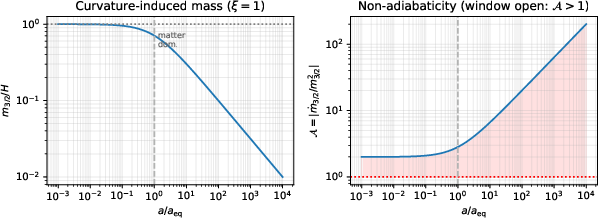
Figure 1: Curvature-induced transverse mass ψ3 and non-adiabaticity parameter ψ4 versus scale factor; the mass drops below ψ5 during matter domination, but auxiliary nature prevents relic production.
Pillar II: Absence of a Spin-3/2 Kinetic Term
The component expression of the QSL action,
ψ6
does not provide a bulk kinetic term for the independent field. The kinetic part and the cross term vanish identically; only the pure torsional mass survives (Appendix B). This follows from the underlying spinor-curvature identity, which renders the kinetic term a boundary operator rather than a bulk dynamic term.
Pillar III: Second Variation Factorization and No Propagation
Dynamical content resides only in the curvature side, via the action:
ψ7
with both metric and scalar constructed as composites of ψ8. The second variation factors through linearized metric ψ9 and scalar ϑa0, both massless:
ϑa1
No massive spin-ϑa2 mode is found, the kinetic structure supporting only graviton and scalar propagations. This dynamical completion corresponds to a constrained system with only auxiliary (non-propagating) gamma-traceless vector-spinor components.
Constraint Sector and Degree-of-Freedom Counting
Hamiltonian analysis via Dirac–Bergmann confirms the absence of spin-ϑa3 propagation: the time component acts as a Lagrange multiplier, enforcing primary and secondary constraints that remove all would-be lower-spin excitations. The remaining degrees of freedom match those of the graviton and a scalar.
Spin-1/2 Uniqueness and Dark Matter Implications
Combining kinematic and dynamic arguments, the QSL framework is shown to propagate uniquely the composite spin-ϑa4 Dirac fermion. This mode inherits geometric mass tied to the Hubble parameter, justifying its identification as the sole dark-matter candidate. Contrast is drawn with Rarita–Schwinger and supergravity paradigms wherein independent spin-ϑa5 fields propagate (with potential pathologies); the QSL evades such pathologies by structural exclusion rather than by constraint engineering.
Curved Backgrounds and Mass-Induced Activation
The analysis is robust against background curvature. Cosmological corrections induce only algebraic mass-like couplings (proportional to pressure ϑa6) for the transverse spin-ϑa7 components:
ϑa8
No kinetic term emerges, so even at points where ϑa9 (e.g., matter domination), the auxiliary nature of the mode persists and no healthy propagation nor relic production occurs. The mode acts as a redundant parametrization of graviton data.
Supergravity Connection and Goldstino Interpretation
Via the super-210 structure, the surviving spin-211 mode is interpreted as the Goldstino of spontaneously broken local supersymmetry, as the metric condensate breaks the super-Lorentz symmetry. The supercurrent is sourced by the gamma-trace spin-212 mode, not the transverse spin-213.
Numerical Results and Null Space Structure
The null space of the inverse propagator 214 remains invariant across spacelike and timelike 215, jumping only at 216, corroborating analytically derived results and confirming the absence of timelike (massive) poles. Detailed computations sample several backgrounds and directions; the characteristic cone is strictly luminal.
Implications and Outlook
The QSL framework structurally precludes propagating massive spin-217 excitations, uniquely selecting a spin-218 composite fermion as the dark-matter candidate. It represents a maximally economic model, containing only graviton and Goldstino-like excitations derived from the same field. Higher-spin generalizations would require operators external to the QSL family.
The theoretical implications include a sharpened perspective on spinor and higher-spin dynamics in gravitational backgrounds, providing a powerful no-go theorem. Practically, the model offers a parameter-less prediction for dark-matter mass and abundance tied to early-universe Hubble scale, potentially constraining observational explorations and model-building in cosmological and gravitational dark matter.
Conclusion
This paper provides an authoritative no-go theorem for propagating spin-219 dark matter in the Quadratic Spinor Lagrangian context, rooted in both kinematic and dynamical analyses. The unique propagating matter is the composite spin-Ψμ0 Dirac fermion, whose geometric mass and cosmological relic abundance are protected against potential higher-spin generalizations. No modification within the QSL structure itself admits massive spin-Ψμ1 modes, reinforcing the distinction between QSL and supergravity frameworks. The Goldstino interpretation links the findings to established supersymmetry breaking mechanisms, while the luminosity of the characteristic cone ensures robust absence of pathologies typically afflicting higher-spin fields.
Figure 1: Curvature-induced transverse mass Ψμ2 and non-adiabaticity parameter Ψμ3 versus scale factor, indicating persistent auxiliary nature and the absence of relic production across cosmological evolution.

