- The paper introduces a novel mechanism where persistent vector modes from primordial magnetic fields during a stiff (kination) era amplify second-order curvature perturbations for PBH formation.
- Using a Ratra-type magnetogenesis model, the authors obtain a power spectrum scaling of k⁻⁵ with induced perturbations reaching O(10⁻²) near the infrared cutoff.
- The study confirms that the resulting PBH mass function meets observational constraints, potentially offering a significant dark matter candidate.
Vector-Induced Curvature Perturbations from Primordial Magnetic Fields and their Role in Primordial Black Hole Production
Overview and Motivation
The paper "Primordial Black Holes from Vector-Induced Curvature Perturbations Sourced by Primordial Magnetic Fields" (2606.23307) investigates a novel mechanism for the amplification of primordial curvature perturbations, leading to the formation of primordial black holes (PBHs) as a dark matter candidate. Unlike conventional PBH formation scenarios, which rely on scalar perturbations sourced at first order during inflation, this work focuses on vector metric perturbations induced by the electromagnetic stress-energy tensor of primordial magnetic fields (PMFs) during a stiff (kination) post-inflationary epoch. These persistent vector modes subsequently act as nonlinear sources for second-order scalar (curvature) perturbations, resulting in a characteristic power enhancement on relevant scales.
Mechanism: Vector-Induced Scalar Amplification During Kination
The study begins by formalizing the dynamics of first-order vector modes sourced by the vector component of the electromagnetic stress-energy tensor of PMFs. In standard cosmological epochs (radiation or matter domination), such vector modes decay due to expansion. However, during a stiff epoch where the equation of state w=1 (kination), these modes remain constant in amplitude. The key technical insight is that these persistent vector modes become an efficient source for second-order scalar perturbations, particularly the curvature potential Φ in the conformal Newtonian gauge.
The nonlinear coupling from vector to scalar produces a source term in the second-order Einstein equations, whereby the induced curvature perturbation spectrum is maximally amplified toward the infrared cutoff of the kination band. The resulting scaling of the power spectrum is found to be PR(k)∝k−5, a robust result derived analytically using the Green-function formalism and confirmed numerically.
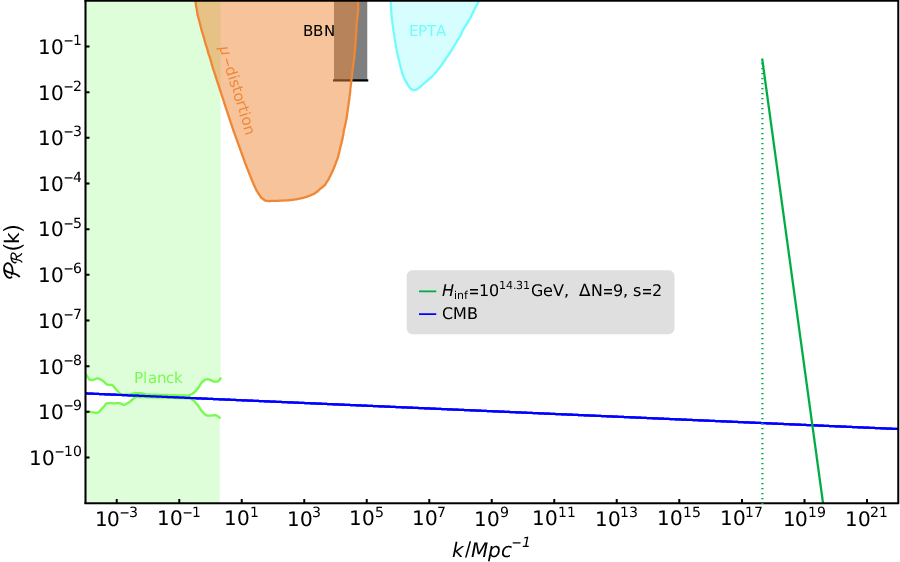
Figure 1: The vector-induced curvature power spectrum PR(k) sourced by PMFs during kination, demonstrating significant amplification at the infrared cutoff and a spectral index of −5.
This amplification provides the necessary overdensities for gravitational collapse into PBHs upon horizon re-entry.
Magnetogenesis Model and Parameter Realization
To concretely demonstrate the mechanism, the authors adopt a Ratra-type inflationary magnetogenesis scenario, characterized by a power-law magnetic spectrum parameterized by (Hinf,ΔNkin,s). The resulting PMF spectrum is restricted to a finite comoving band between ultraviolet (kUV) and infrared (kIR) cutoffs, set by post-inflationary evolution and horizon exit/re-entry considerations. The spectral index and amplitude, determined by the model's coupling parameter s, yield a representative magnetic amplitude Brms∼102 nG, commensurate with BBN and PTA constraints for the considered small scales but not violating CMB or large-scale bounds.
Numerically, with Φ0, the induced curvature power spectrum achieves values of Φ1 near the infrared cutoff, more than sufficient for PBH seeding.
PBH Mass Function and Observational Constraints
Utilizing the Press-Schechter formalism for a first estimate, the induced curvature perturbations produce a PBH mass function Φ2 compatible with current bounds from extragalactic Φ3-ray background, microlensing, INTEGRAL, and CMB constraints. The resulting PBH abundance may constitute a substantial fraction of the dark matter, for carefully selected parameter values.
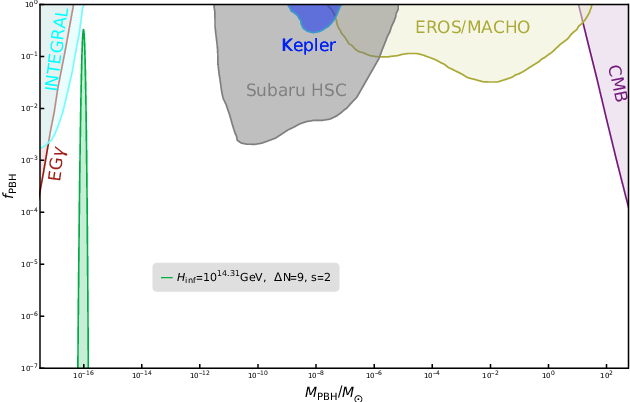
Figure 2: Present-day PBH mass function Φ4 with chosen magnetogenesis parameters, demonstrating compatibility with major observational constraints and potential for significant dark matter contribution.
Implications and Future Directions
The main theoretical implication is the existence of a distinct vector-induced channel for PBH formation, with a characteristic scalar power spectrum scaling Φ5 that is insensitive to the underlying PMF details and offers a discriminant signature. The mechanism circumvents limitations of conventional inflationary scalar enhancement scenarios, offering a post-inflationary, nonlinear route reliant on PMFs.
From a practical and observational perspective, this scenario relaxes constraints by localizing the amplification on small scales, evading CMB and large-scale bounds on PMF amplitudes. The PBH mass function generated is consistent with all current observational constraints relevant for PBH dark matter.
Outstanding questions remain regarding nonstandard subhorizon evolution, magnetic pressure effects on collapse thresholds, intrinsic non-Gaussianity of quadratic vector-induced sources, and the associated stochastic gravitational-wave backgrounds—topics ripe for further detailed investigation.
Conclusion
This paper establishes and elucidates a new post-inflationary mechanism for PBH formation, predicated on second-order scalar perturbations induced by vector modes sourced by PMFs during kination. The resulting power spectrum enhancement, universal Φ6 scaling, and compatibility with observational constraints position this scenario as a viable and theoretically distinct candidate for PBH dark matter. Future developments may include improved estimates of non-Gaussian statistics, refinements beyond the Press-Schechter approximation, and cross-correlation with gravitational-wave signals.