- The paper presents a novel PBH formation mechanism via the collapse of primordial voids, showing how a central rebound triggers effective overdensities.
- It employs numerical relativity with precise initial conditions and compaction thresholds, comparing positive and negative curvature scenarios.
- Results demonstrate similar mass scaling laws for void-induced PBHs and standard overdensities, influencing abundance estimates and gravitational wave predictions.
Primordial Black Holes from Primordial Voids: A Technical Summary
Introduction and Motivation
This paper investigates a novel channel for primordial black hole (PBH) formation, focusing on the collapse of large negative curvature perturbations—termed Primordial Voids (PVs)—in the early universe. Traditionally, PBH formation has been attributed to the collapse of large positive curvature (overdensity) fluctuations during the radiation-dominated (RD) era. The authors employ numerical relativity to demonstrate that sufficiently deep PVs can undergo a nonlinear central rebound, generating an effective overdensity that collapses into a PBH. This mechanism is shown to obey a critical threshold and mass scaling relation analogous to the standard overdensity scenario, but with distinct geometric and dynamical features.
Theoretical Framework
Curvature Fluctuations and Geometric Classification
The initial conditions for PBH formation are modeled as spherically symmetric curvature perturbations with a sinc profile:
ζ(r)=μsinc(k⋆r)
where μ is the central amplitude and k⋆ sets the characteristic scale. The sign and magnitude of μ determine the nature of the fluctuation: positive μ yields overdensities, while negative μ produces underdensities (voids).
The geometric classification of these fluctuations is based on the behavior of the areal radius R(r) and the three-Ricci scalar (3)R(r). Type-I profiles have monotonic R(r), while Type-II profiles exhibit non-monotonicity, leading to "belly" and "neck" structures. Notably, negative amplitude fluctuations (μ<−1) admit Type-II configurations, which are essential for PV-induced PBH formation.
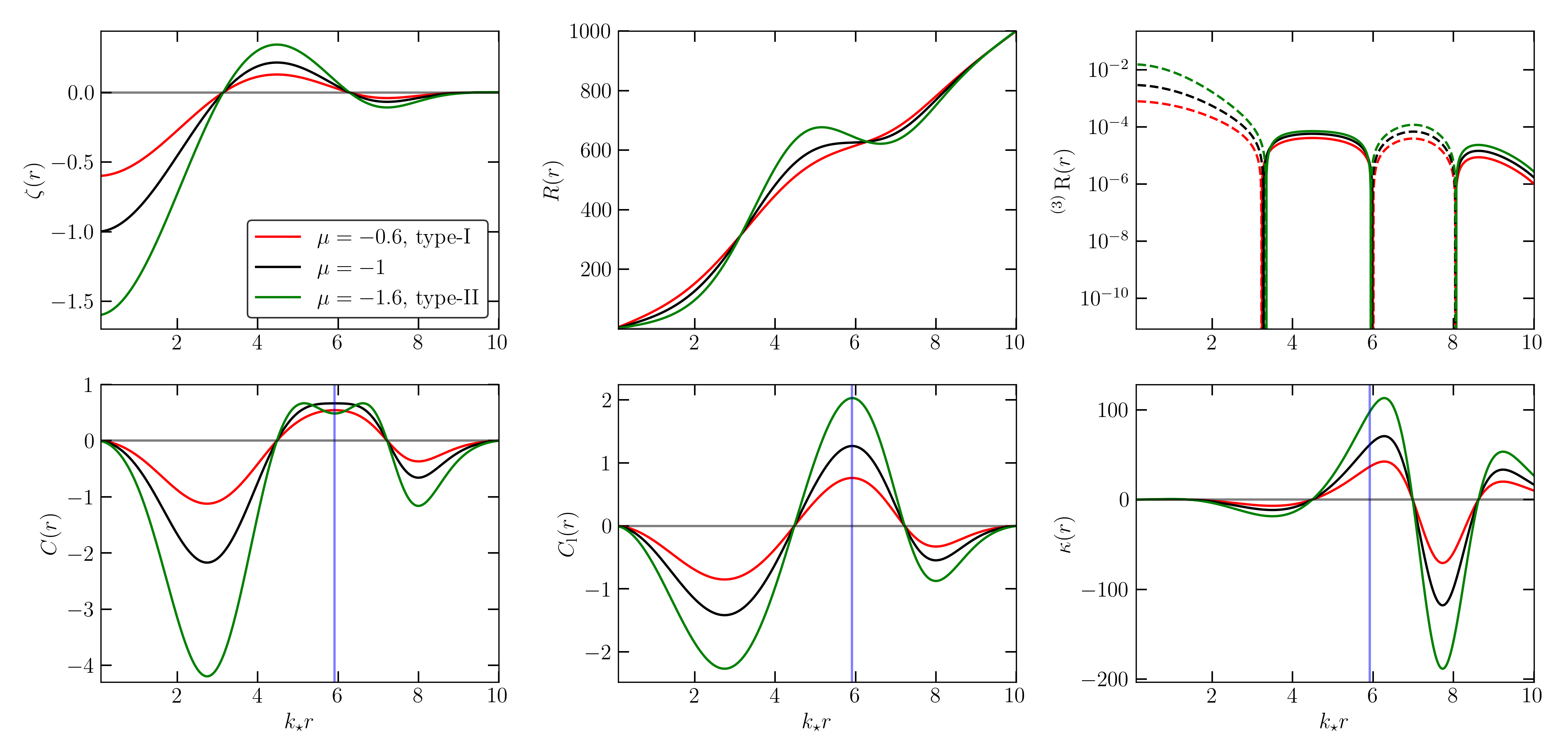
Figure 1: Initial configuration for three representative negative curvature fluctuations, illustrating the transition from Type-I to Type-II geometry as μ decreases.
Dynamical Collapse and Trapped Surfaces
The collapse process is characterized by the formation of trapped surfaces, identified via the Misner–Sharp mass and the compaction function:
C(r)=R(r)2[MMS(r)−Mbkg(r)]
A trapped surface forms when C(r)≳1. The critical threshold for collapse is determined by the peak value of the linear compaction function Cℓ(r) and its curvature κ(r), with the criterion:
Cm>δc(Cm,κm)
where δc is a non-linear function calibrated against numerical relativity results.
Numerical Relativity Simulations
Methodology
The authors solve the Einstein field equations using the BSSN formalism in spherical symmetry, coupled to a perfect fluid with a barotropic equation of state p=ωρ. The initial data are constructed to satisfy the Hamiltonian and momentum constraints exactly, ensuring accurate evolution of both geometry and matter.
Collapse Dynamics
Simulations reveal that positive μ perturbations (overdensities) collapse directly upon Hubble re-entry if the amplitude exceeds a critical value. In contrast, negative μ perturbations (voids) develop a central underdensity surrounded by an overdense shell. Upon Hubble re-entry, the shell contracts, driving a central rebound. If the rebound is sufficiently strong (i.e., μ<μc(−)), a PBH forms; otherwise, the void dissipates into sound waves.
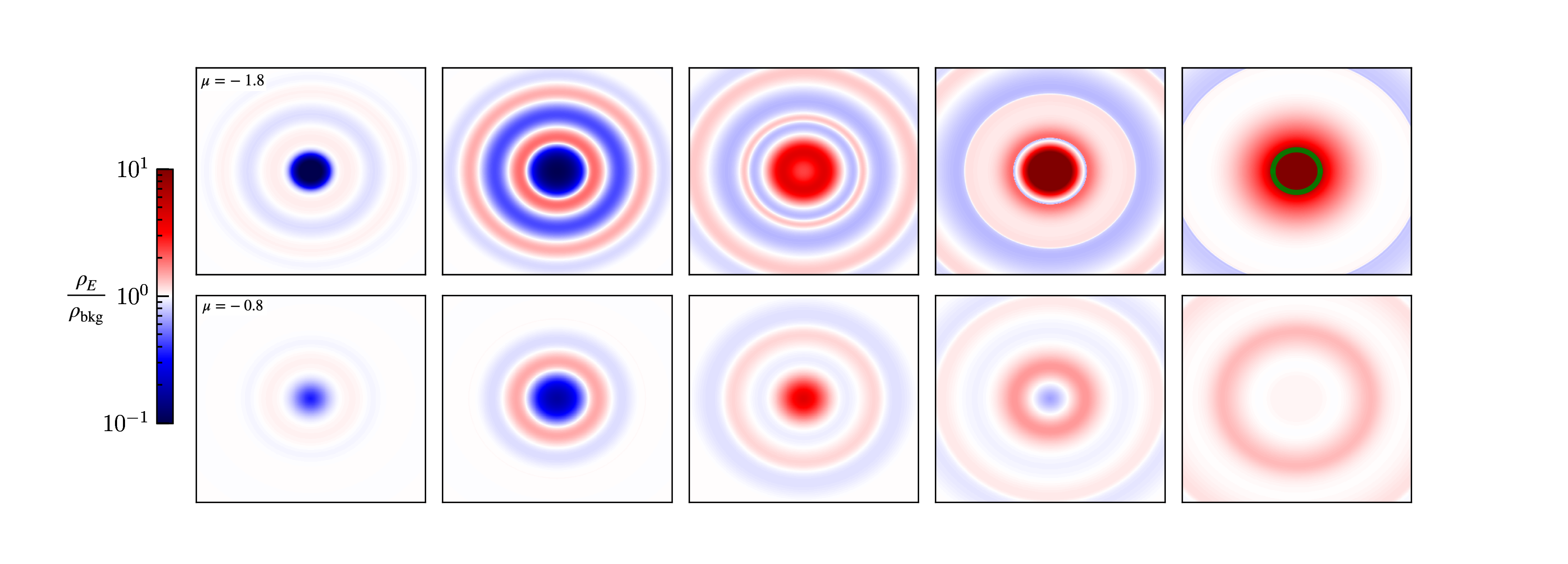
Figure 2: Evolution of the density contrast for negative curvature fluctuations, showing the formation and collapse of a PV into a PBH (top) versus dissipation (bottom).
Critical Thresholds and Equation of State Dependence
The critical amplitude thresholds for PBH formation are computed for a range of equations of state (ω). The thresholds for PVs are consistently higher than those for overdensities, reflecting the need to overcome the expanding geometry of the void. For positive μ, the threshold increases monotonically with ω, while for negative μ, the threshold exhibits non-monotonic behavior, peaking near ω≃1/3 (RD).
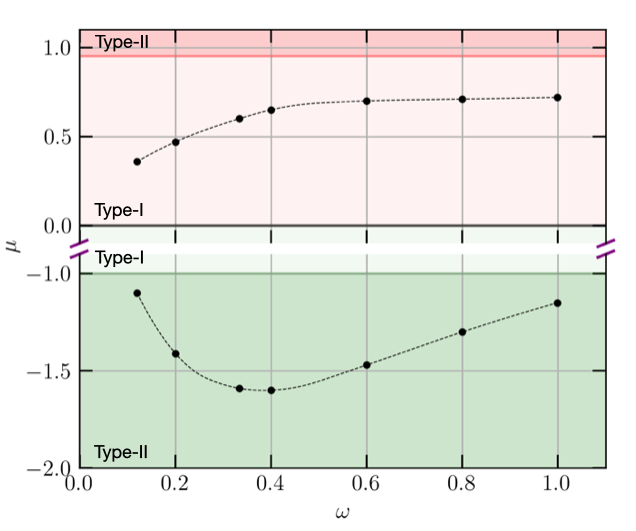
Figure 3: Amplitude thresholds for PBH formation across different equations of state, with distinct regions for positive and negative curvature fluctuations.
Mass Scaling Relations
Near the critical threshold, the PBH mass follows a scaling law:
MPBH=K∣μ−μc∣γM×
where M× is the Hubble mass at horizon crossing, K is a fitted constant, and γ is the critical exponent. The scaling index γ is found to be similar for both positive and negative curvature fluctuations at fixed ω, with γ≈0.36 for RD.
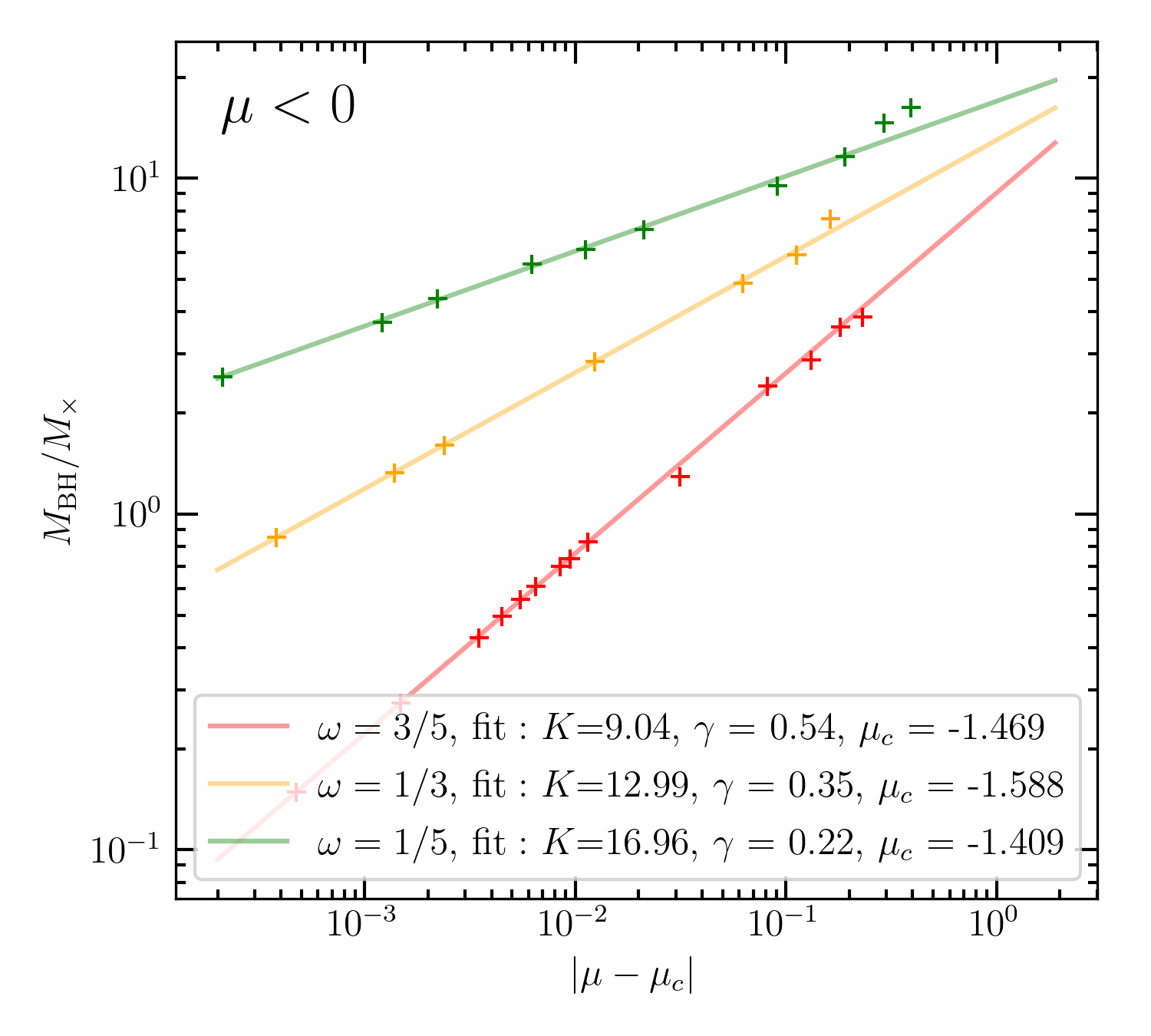
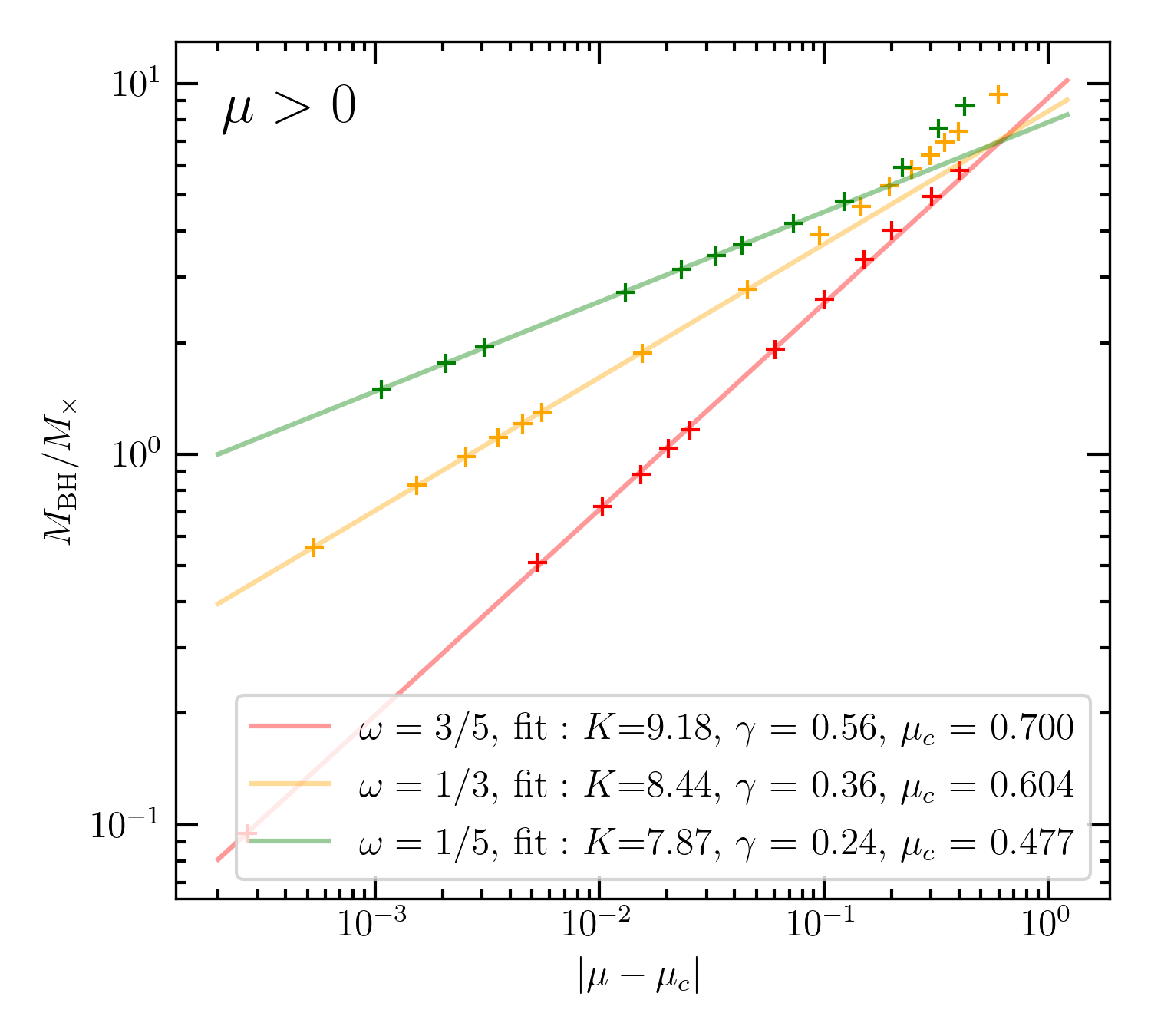
Figure 4: Mass scaling of PBH formation for negative (left) and positive (right) curvature fluctuations, confirming similar critical exponents.
Implications and Future Directions
The identification of PVs as a viable channel for PBH formation has several implications:
- PBH Abundance Calculations: Models that enhance the scalar power spectrum must account for both overdensities and underdensities, as PVs can contribute non-negligibly to PBH abundance.
- Non-Gaussianity Effects: The abundance and profile of PVs are sensitive to the skewness of the curvature perturbation PDF. Negative skewness enhances PV formation, potentially altering cosmological signatures.
- Gravitational Wave Signatures: The dynamics of PV collapse and associated sound waves may produce distinctive gravitational wave backgrounds, relevant for PTA and LISA observations.
- Matter-Dominated Epochs and Baryogenesis: PV-induced PBHs could play a role in reheating scenarios and baryogenesis, especially in non-standard cosmologies.
Theoretical extensions include the study of type-B PBHs (separate universe mechanism) from PVs, the impact of non-Gaussian initial conditions, and the generalization to scalar-field-dominated backgrounds.
Conclusion
This work establishes primordial voids as a novel and physically distinct channel for PBH formation, characterized by higher collapse thresholds and similar mass scaling behavior compared to the standard overdensity scenario. The results underscore the necessity of including PVs in PBH phenomenology and motivate further investigation into their cosmological consequences, especially in models with enhanced small-scale power or significant non-Gaussianity. Future research should address the role of PVs in non-standard cosmologies, their gravitational wave signatures, and their potential impact on early universe processes such as reheating and baryogenesis.