- The paper establishes a criterion for radiative Mpemba effects by linking phase-change hysteresis and latent heat to anomalous thermal relaxation.
- The paper employs analytic formulations and numerical simulations to map thermal trajectories and reveal enhanced near-field coupling in VO2-SiC systems.
- The paper demonstrates ordinary, inverse, and novel passive Mpemba effects, offering insights into nanoscale thermal management via structural memory.
Hysteresis-Driven Radiative Mpemba Effect in Phase-Change Nanostructures
Introduction
The Mpemba effect, characterized by the faster relaxation of a hotter system compared to a colder one, has been extensively studied in convective, conductive, Brownian, granular, and quantum domains. However, its manifestation in radiative thermal transport remained unaddressed. This paper presents an analytic and numerical exploration of the Mpemba effect in the context of radiative heat transfer mediated by phase-change hysteresis, particularly in a VO2 nanoparticle near a SiC substrate. The study delineates the influence of latent heat, radiative coupling, and external memory mechanisms on anomalous thermal relaxation, providing insight into both ordinary and inverse Mpemba effects as well as a novel passive variant.
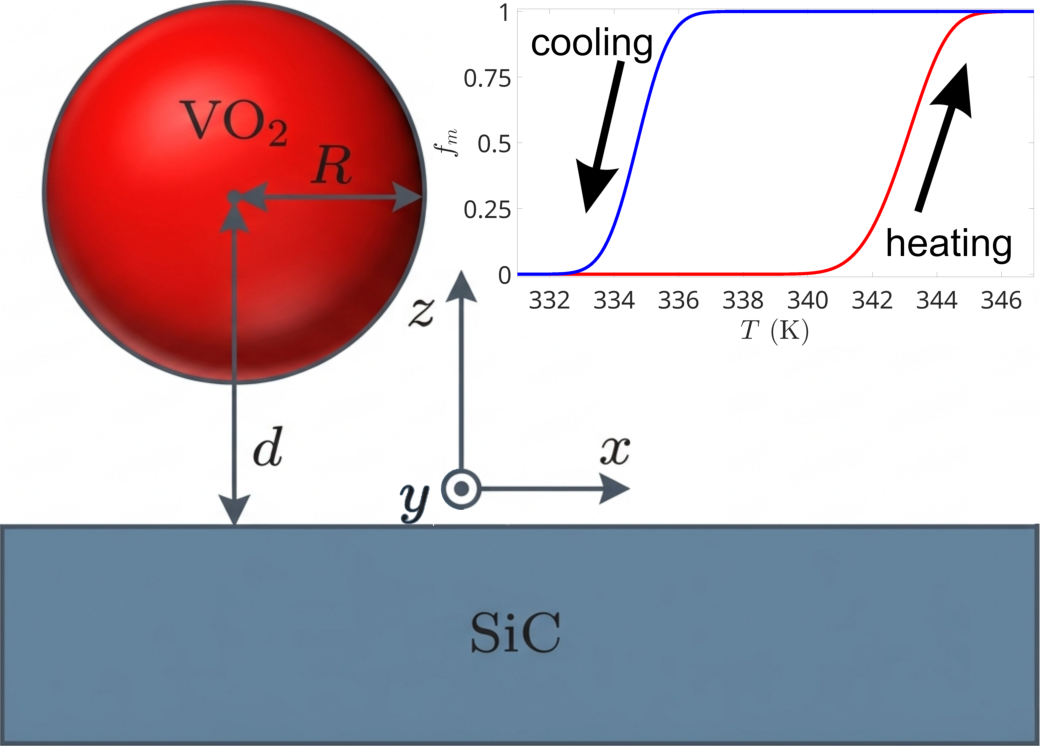
Figure 1: Schematic system with a VO2 nanoparticle above a SiC substrate; inset shows hysteresis in metallic volume fraction fm.
The central system comprises a VO2 nanoparticle of radius R at center-to-surface distance d from a SiC substrate maintained at fixed temperature. The local temperature evolution is governed by the heat exchange power and the specific heat capacity, accounting for phase-change hysteresis via the metallic volume fraction f. The analysis establishes a general criterion for the radiative Mpemba effect, showing that a persistent memory mismatch Δf=0 is necessary for two thermal relaxation trajectories to intersect nontrivially (i.e., the hotter system overtakes the colder one), even when their temperatures equalize at the intersection time.
The derived condition highlights the importance of derivative terms in both exchanged power and specific heat capacity with respect to f. The framework extends readily to other internal variables, such as strain or rate-dependent optical properties, revealing the potential for broad anomalous relaxation phenomena in non-Markovian systems characterized by structural memory.
Numerical Mapping and Mechanism
Simulation of the thermal relaxation for VO2 nanoparticles reveals that the latent heat associated with the phase transition serves as a strong caloric buffer, predominantly determining the occurrence and characteristics of the Mpemba effect. Near-field coupling via surface phonon polaritons amplifies radiative heat transfer in the dielectric phase, further modifying relaxation timescales. The mapped "Mpemba phase space" demonstrates regions where initially hotter particles exhibit accelerated cooling relative to colder counterparts, with plateaued temperature profiles arising due to kinetic delays in domain reorganization and first-order reversal effects.
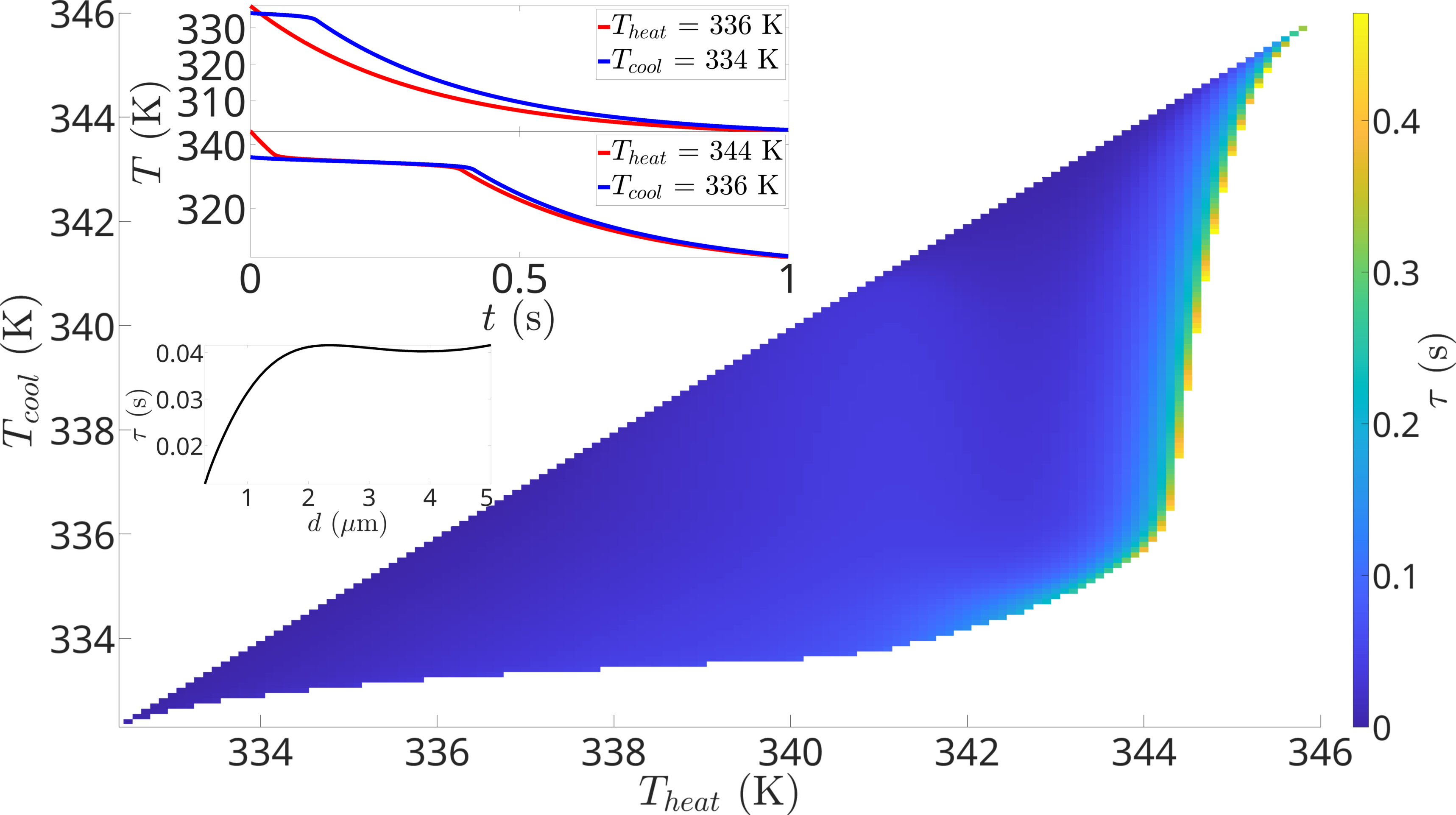
Figure 2: Heatmap of intersection time 20 for temperature trajectories on heating/cooling branches; inset: exemplary trajectories and distance-dependence of 21.
Variation of particle-substrate distance establishes the dominance of near-field effects at submicron separations, where the thermal relaxation is rapid and strongly modulated by evanescent electromagnetic coupling. In the far-field regime, propagating waves in the LDOS induce oscillatory behavior, effectively making the Mpemba boundaries distance-invariant, but altering intersection timescales.
Inverse and Passive Mpemba Effect
Heating scenarios (i.e., with elevated substrate temperature) reproduce the inverse Mpemba effect, where initially colder systems heat up more rapidly than hotter ones. The phase space topology mirrors the ordinary effect, but latent heat absorption shifts the regions and timescales of intersection.
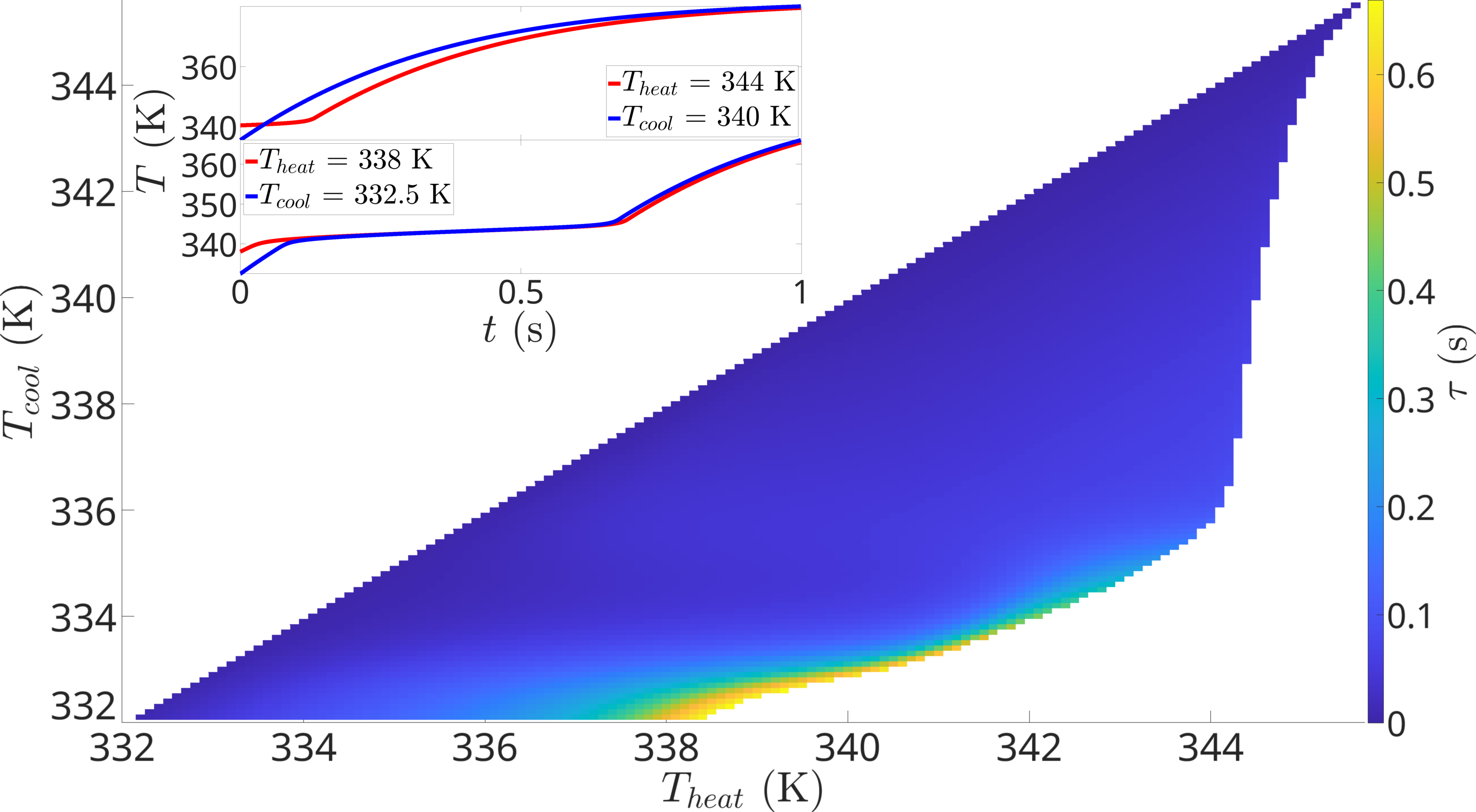
Figure 3: Heatmap for inverse Mpemba effect with substrate heating; inset: trajectory examples with intersection dynamics.
The study further introduces the passive Mpemba effect, realized by exchanging particle and substrate materials (SiC particle above VO22 substrate). Here, internal memory is transferred to the substrate reflection, such that the relaxing particle’s heat capacity is memory-independent. Strong radiative contrast and near-field coupling enable anomalous relaxation exclusively in the near field.
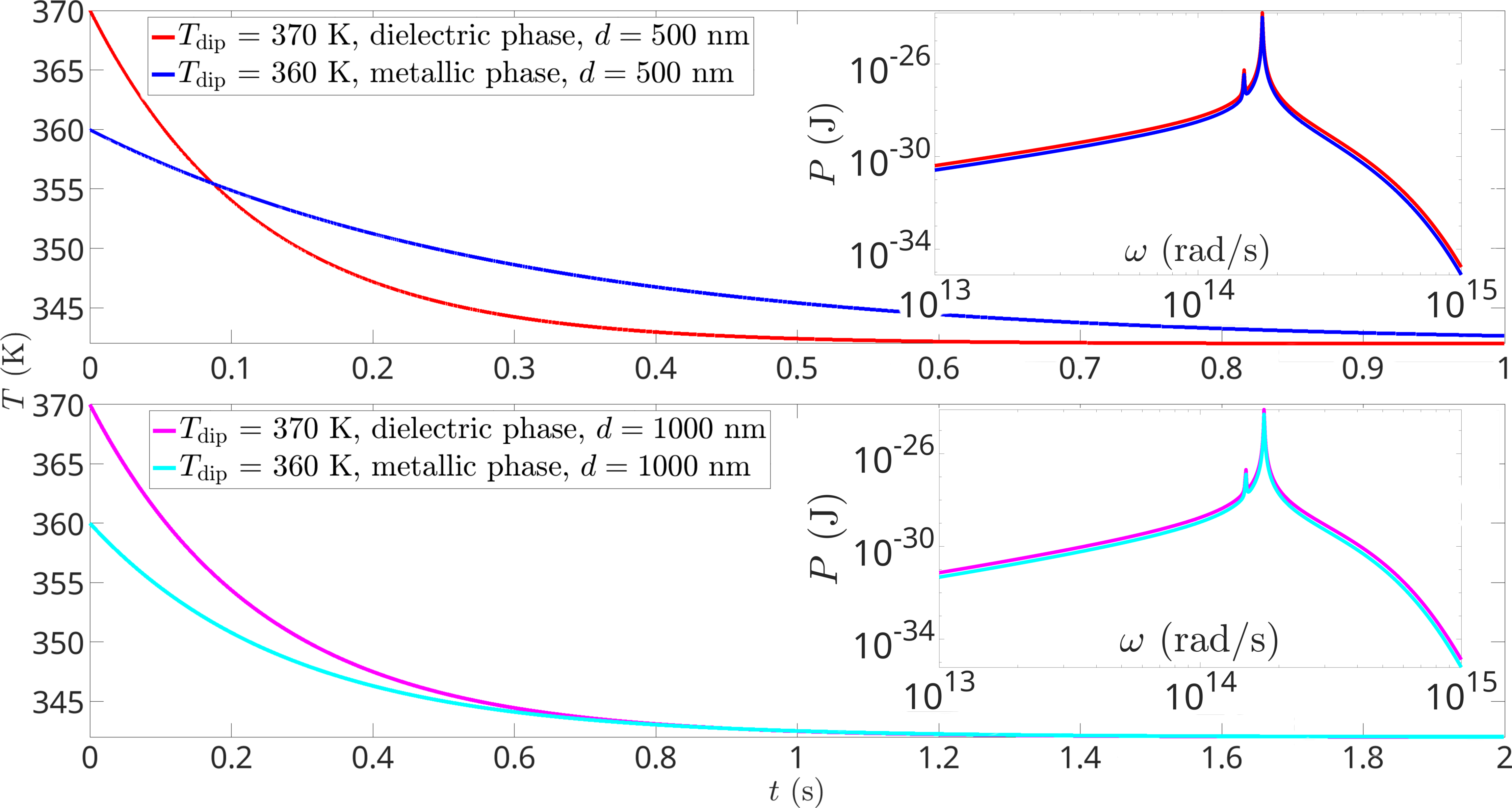
Figure 4: Passive Mpemba effect—temperature evolution for SiC particles above VO23 prepared in different phases; inset: exchanged power contrasts.
Implications and Future Prospects
The demonstration of a hysteresis-driven radiative Mpemba effect expands the landscape of anomalous thermal phenomena to nanoscale optical systems. Practical implementation in pump-probe microscopy setups is enabled by the accessible system geometry and material choices. The effect magnitude may be optimized via symmetric phase-change configurations (VO24-VO25) or tailored hysteresis loops, as achievable through doping and material engineering, unlocking new avenues in dynamic thermal management and thermotronic device design.
The theoretical formulation presented could catalyze investigation into the broader class of non-Markovian and memory-driven relaxation phenomena, with possible extensions to systems evolving under strain, structural aging, or coupled quantum optical environments. The passive Mpemba effect gives rise to new concepts of external memory in radiative transfer, suggesting future research on geometric and material tunability for nanoscale heat control.
Conclusion
This study provides a comprehensive analytic condition for hysteresis-driven radiative Mpemba effects and substantiates it numerically in phase-change nanostructures. The key finding is that phase-change memory and latent heat act as essential modulators of relaxation dynamics, producing ordinary, inverse, and passive Mpemba effects in radiative settings. The results facilitate practical approaches to nanoscale thermal control, establishing groundwork for exploiting material history and structural memory in dynamic heat management applications.