- The paper demonstrates that RG improvements in asymptotically safe, shift-symmetric scalar-tensor theory yield a Starobinsky-like inflationary model.
- It derives an improved action with R² and R³ corrections that constrain the gravity-matter coupling D0 using observational data.
- The two-field Einstein frame analysis provides predictions for the spectral index and tensor-to-scalar ratio consistent with Planck results, guiding UV completion viability.
Starobinsky Inflation in Asymptotically Safe Shift-Symmetric Scalar-Tensor Theory
Introduction and Theoretical Motivation
The paper "Starobinsky-inflation in asymptotically safe shift-symmetric scalar-tensor theory" (2606.22408) systematically addresses the interplay between scalaron-driven inflation and asymptotically safe scalar-tensor models endowed with shift symmetry. The analysis begins with Horndeski-type scalar-tensor actions, which extend the gravitational sector by a scalar field without introducing higher-order equations of motion, preserving second-order dynamics. The central focus is on renormalization group (RG) improvement methods applied to these models to investigate which inflationary scenarios are allowed under asymptotic safety constraints.
The asymptotic safety paradigm in quantum gravity posits that a non-Gaussian fixed point (NGFP) exists for the RG flow of gravitational couplings, ensuring ultraviolet (UV) completeness. When matter and gravity are coupled, the RG trajectories interpolate between an NGFP in the UV and a Gaussian fixed point (GFP) in the infrared (IR). The shift symmetry of the scalar sector severely constrains the allowed interactions, excluding scalar potentials generated radiatively and tightly structuring the non-minimal gravity-matter couplings.
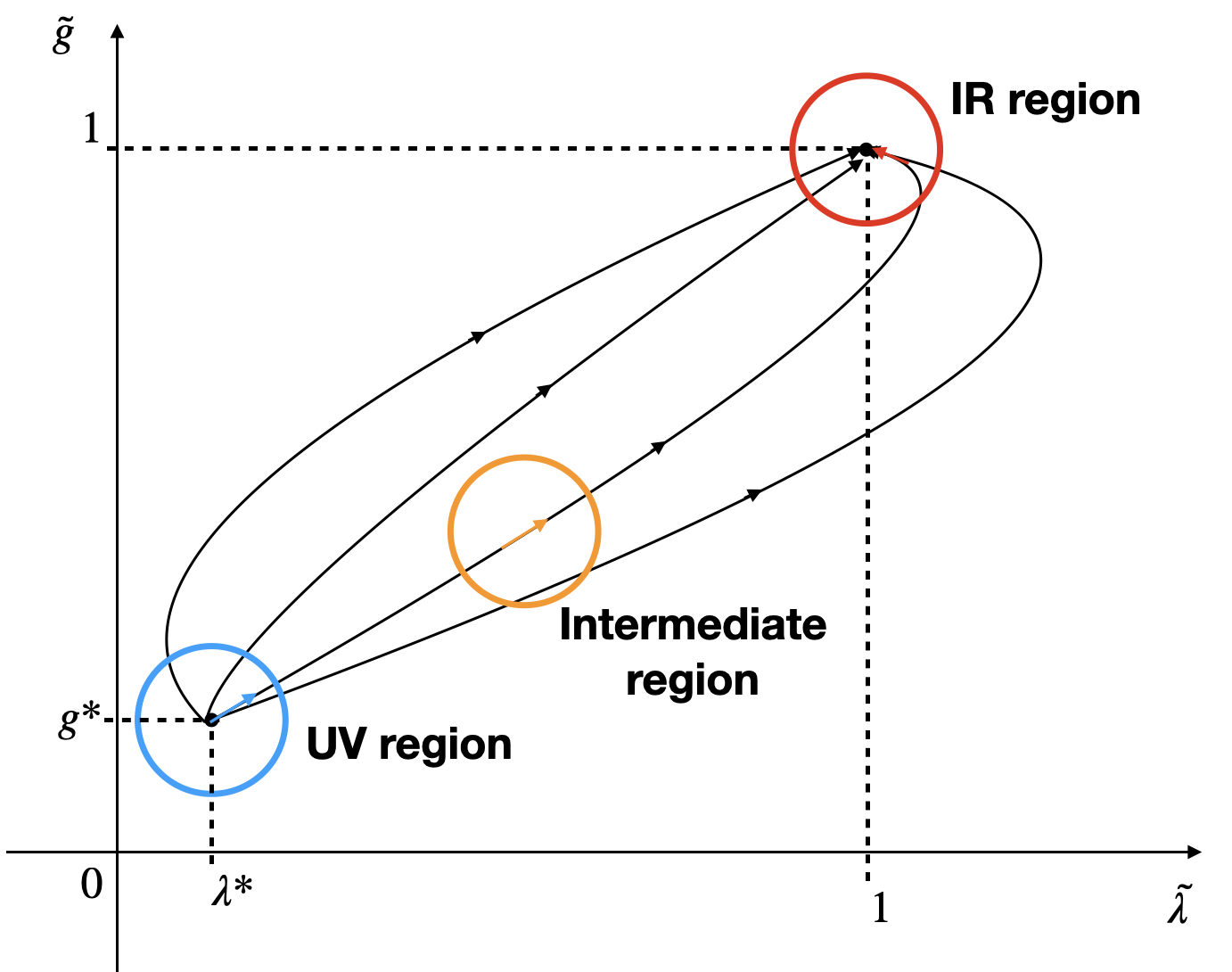
Figure 1: Schematic RG flow for the couplings g~k and λ~k showing interpolation from a NGFP in the UV (blue circle) to a GFP in the IR (red circle); inflationary energy scales reside in the intermediate region (orange circle).
Renormalization Group Improvement and Action Construction
The RG improvement procedure is pivotal to quantifying quantum corrections without requiring explicit computation of all effective couplings. Two expansion strategies are contrasted: the traditional top-down approach expanding at the NGFP and a novel bottom-up approach expanding at the GFP, justified by the inflationary scale residing well below the Planck mass.
The improved action derived via the IR expansion exhibits only integer powers in curvature invariants, primarily R2 and R3, with non-minimal RX couplings. The RG-improved Lagrangian in this regime is:
LRGIR=2κ21(R−2Λ0+6m21R2+3m4λR3)−X(21+D0R−αR2)
where D0 encodes the gravity-matter coupling determined by RG trajectory initial conditions rather than arbitrary IR tuning. The shift symmetry ensures technical naturalness, preventing destabilization of D0 via radiative corrections.
Einstein Frame and Inflationary Dynamics
By employing a conformal transformation to the Einstein frame, the F(R,ϕ) theory is recast as a two-field system with a canonical scalaron ρ and an additional shift-symmetric scalar λ~k0. The scalaron potential governs inflation, and λ~k1 remains a flat direction, protected by symmetry. The resulting inflaton potential reproduces the Starobinsky form when higher-order terms are negligible:
λ~k2
With the λ~k3 correction, the plateau of the potential attains finite extension, enabling stringent constraints on λ~k4.
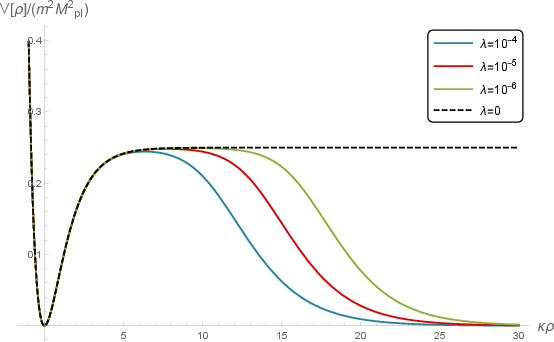
Figure 2: Potential λ~k5 as a function of λ~k6 for varying λ~k7, showing plateau shrinkage as higher-order corrections become significant.
The dynamics adhere to a covariant two-field formalism, but inflation predominantly follows the λ~k8 direction. Slow-roll parameters λ~k9 and R20 are derived analytically in terms of the number of e-folds R21, the plateau parameter R22, and underlying couplings. Their explicit expressions enable computation of the spectral index R23 and tensor-to-scalar ratio R24, directly connecting theoretical predictions with CMB observations:
R25
The model yields R26 and R27 predictions in excellent agreement with Planck 2018 results for suitable R28 and R29 values, confirming the viability of Starobinsky-type inflation with subleading R30 corrections.

Figure 3: Predictions for the spectral index (R31) and tensor-to-scalar ratio (R32) in the two-field model for R33, overlaid with Planck 2018 confidence contours.
Constraints on Gravity-Matter Coupling and Implications
The observational requirement of a sufficiently flat inflationary plateau translates into a non-trivial constraint on R34. Explicitly,
R35
for plateau parameters in the regime R36. This tight constraint acts as a selection criterion for RG trajectories in the UV-complete theory and is preserved by shift symmetry, guaranteeing its radiative stability. The model’s predictions for R37—R38—fall well within current Planck limits and are testable by upcoming missions (e.g., LiteBIRD), offering a direct probe of quantum gravitational effects in cosmology.
Further, the analysis enables falsification or selection of UV completions among NGFPs. Specifically, two of three NGFPs are excluded due to their critical exponent structure failing to support RG trajectories passing through phenomenologically viable R39 values, with only NGFPRX0 accommodating observational constraints.
Theoretical and Phenomenological Outlook
The approach establishes a direct bridge between UV quantum gravity physics and inflationary cosmology, utilizing the asymptotic safety paradigm and shift symmetry. It identifies RX1 as a phenomenologically relevant parameter encoding quantum gravitational signatures, with forthcoming data poised to further constrain its magnitude.
The formalism is scalable to scenarios involving generation of non-trivial scalar potentials (via inclusion of Yukawa couplings or kinetial terms), at which point multi-field effects become important. Current reduction to a single-field inflation is a consequence of the fixed-point structure, not an ad hoc assumption, and may evolve as the matter sector is extended.
Conclusion
This paper develops a rigorous connection between Starobinsky-type inflation and the landscape of asymptotically safe scalar-tensor gravity with shift symmetry (2606.22408). By leveraging RG improvements anchored at the Gaussian fixed point, the analysis constrains the non-minimal gravity-matter coupling RX2 through inflationary observables. The approach excludes certain UV completions and delineates viable RG trajectories, yielding model predictions compatible with Planck constraints and amenable to future experimental falsification. The results emphasize the pivotal role of technical naturalness and symmetry protection in retaining phenomenological consistency, and establish a template for integrating quantum gravitational corrections into inflationary cosmology.

