Robustness of Starobinsky inflation in a minimal two-field scalar-tensor completion
Published 17 Apr 2026 in gr-qc and hep-th | (2604.15931v2)
Abstract: We study a minimal two-field scalar-tensor completion of Starobinsky inflation motivated by the one-loop effective action of scalar-tensor gravity. The model admits an exact Starobinsky branch, but the relevant question is whether nearby trajectories generate observable multifield effects. We show that a non-trivial class of initial conditions relaxes to an attractor-connected slow-roll branch continuously connected to the Starobinsky solution. We then solve the coupled adiabatic and entropy perturbation equations numerically. On the branch studied here, the entropy mode remains sufficiently suppressed that its sourcing of the curvature perturbation is negligible, while the tensor sector is unchanged. The inflationary observables therefore remain effectively Starobinsky-like, providing a robustness test of Starobinsky inflation against a minimal radiative scalar-tensor deformation.
The paper demonstrates that the two-field scalar-tensor completion preserves the Starobinsky attractor under quantum corrections.
It employs conformal transformation and phase space analysis to reveal exponential suppression of multifield effects during slow-roll inflation.
Numerical and analytic results confirm a near scale-invariant scalar spectrum with stable adiabatic perturbations consistent with CMB observations.
Robustness of Starobinsky Inflation in a Minimal Two-Field Scalar-Tensor Completion
Introduction and Motivation
The Starobinsky model, featuring R2 gravity, sets a benchmark for single-field inflationary cosmology due to its consistency with CMB data, notably predicting a nearly scale-invariant scalar spectrum and a small tensor-to-scalar ratio. Recent observational preferences for a slightly higher spectral index ns than the canonical Starobinsky value have motivated re-examination of the model’s robustness under quantum corrections. This study systematically investigates the impact of the minimal gravitationally-induced scalar-tensor radiative completion on the inflationary phenomenology, restricting attention to operators unambiguously generated by one-loop gravity effects in a minimally coupled scalar-tensor theory.
Model Construction and Effective Action
The starting point is general relativity minimally coupled to a single massive scalar field χ, with the action (neglecting self-interactions and non-gravitational couplings). The one-loop effective action for this system introduces an R2 term and a unique Horndeski-type nonminimal kinetic coupling, both unambiguously selected by the microscopic content and quantum structures:
The potential V(χ) is determined via the one-loop computation and is smooth and regularized at the origin. Notably, terms like Rχ2 are absent unless the microscopic content is extended.
The diagonalization of the action proceeds via a conformal transformation and field redefinition, explicitly extracting the canonical scalaron ϕ associated with R2 and recasting the action into a bi-scalar-tensor theory with suppressed nonminimal derivative couplings on the slow-roll branch. Crucially, both kinetic and potential contributions of χ are weighted by exponential factors in ns0, leading to significant suppression in the region relevant for inflation.
Phase Space Analysis and Attractor Structure
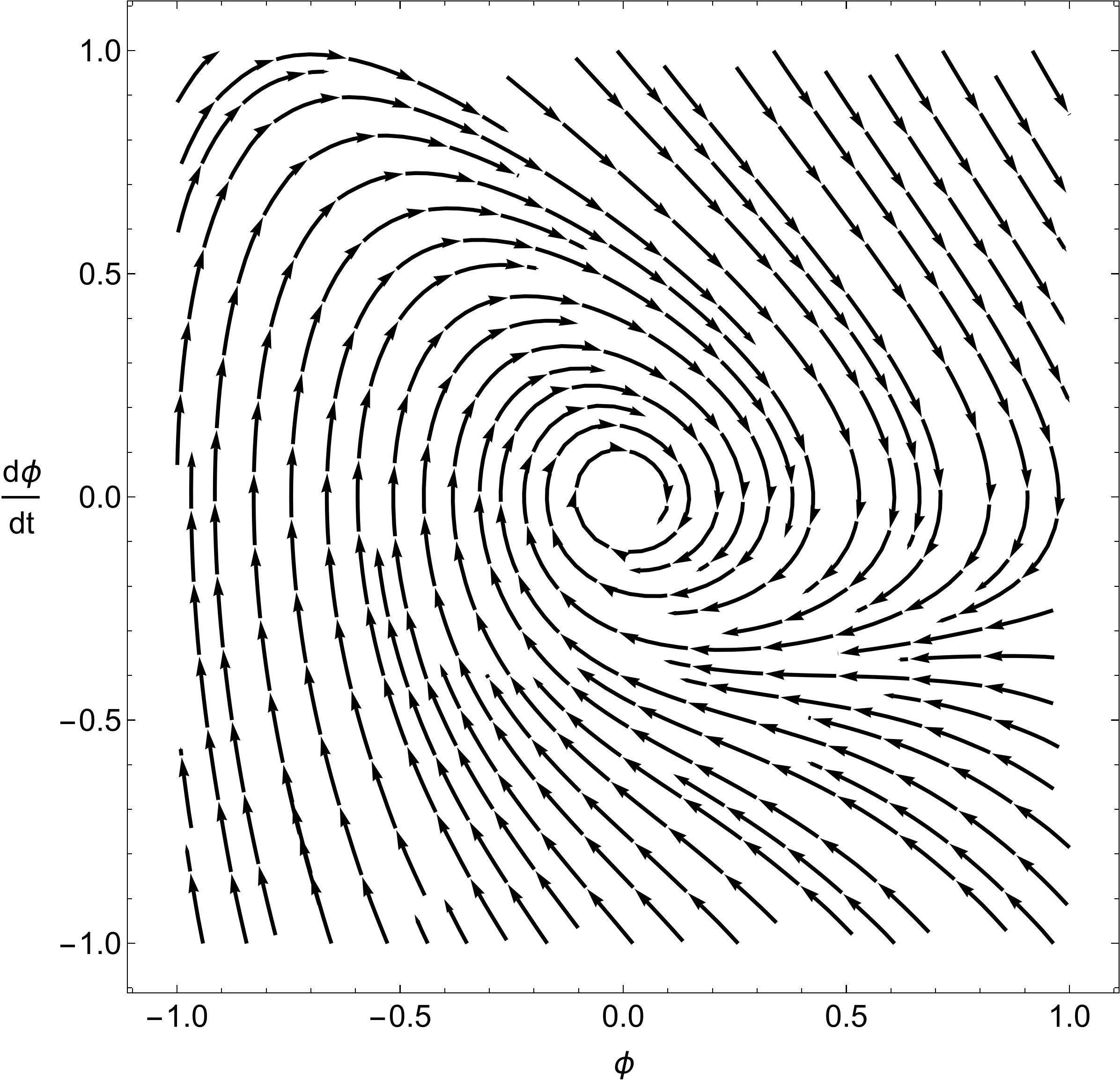
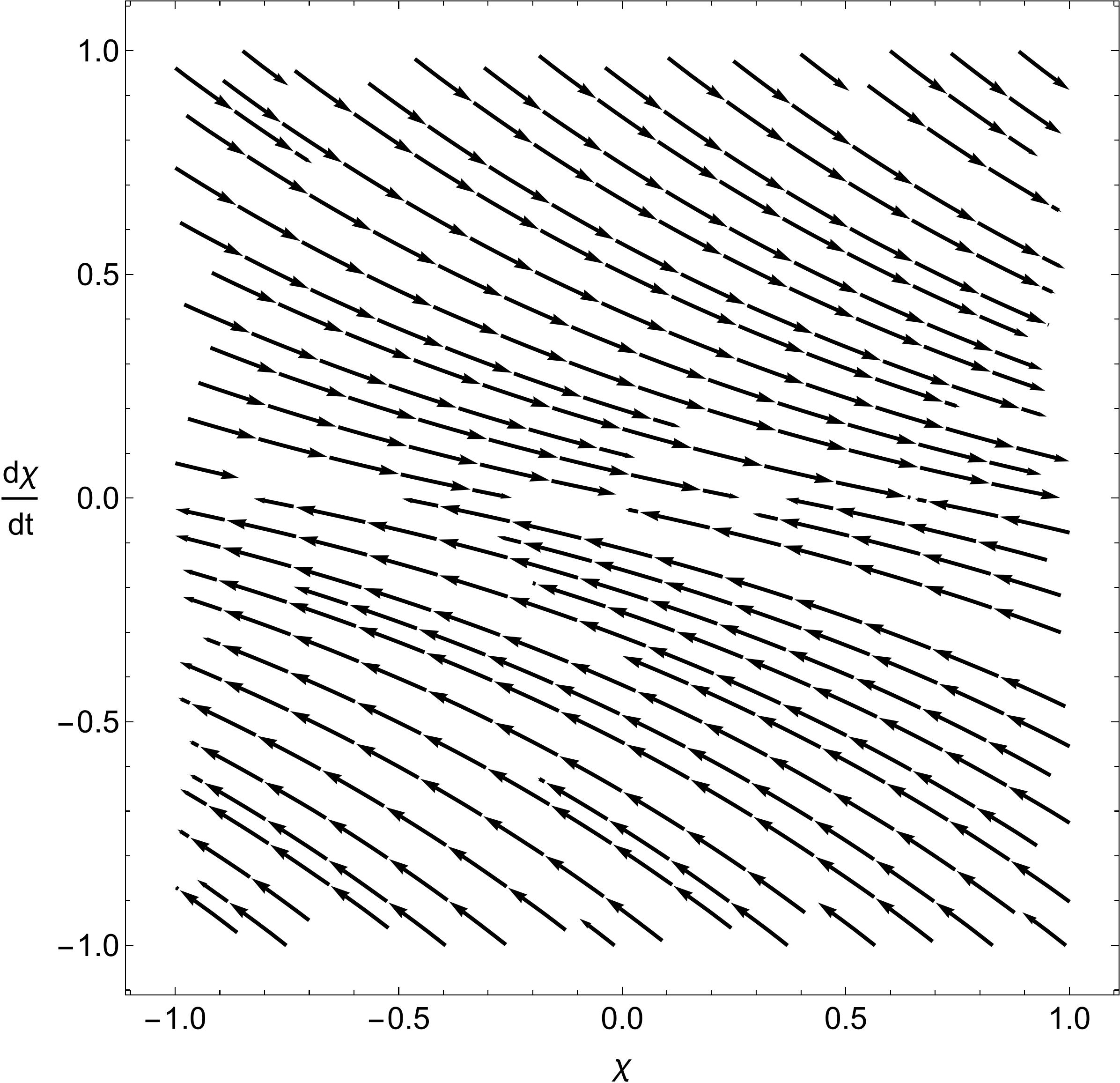
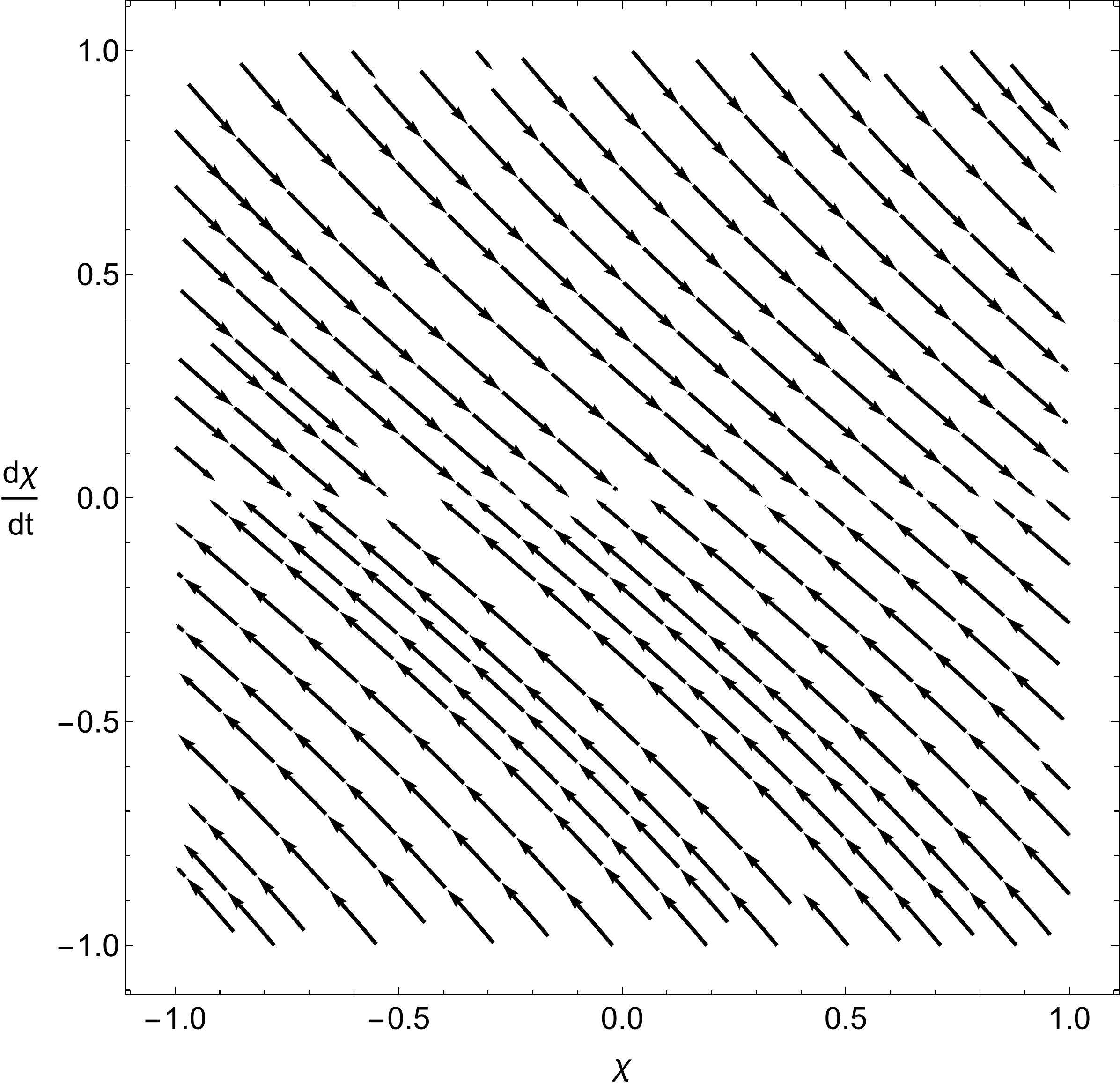
A main result is the existence and stability of a Starobinsky-like attractor in the full two-field phase space. For initial data near the single-field inflation trajectory (ns1), the system dynamically approaches a slow-roll solution continuously connected to the Starobinsky model.
Figure 1: Phase portrait of the Starobinsky phase space exhibiting a dominant attractor structure.
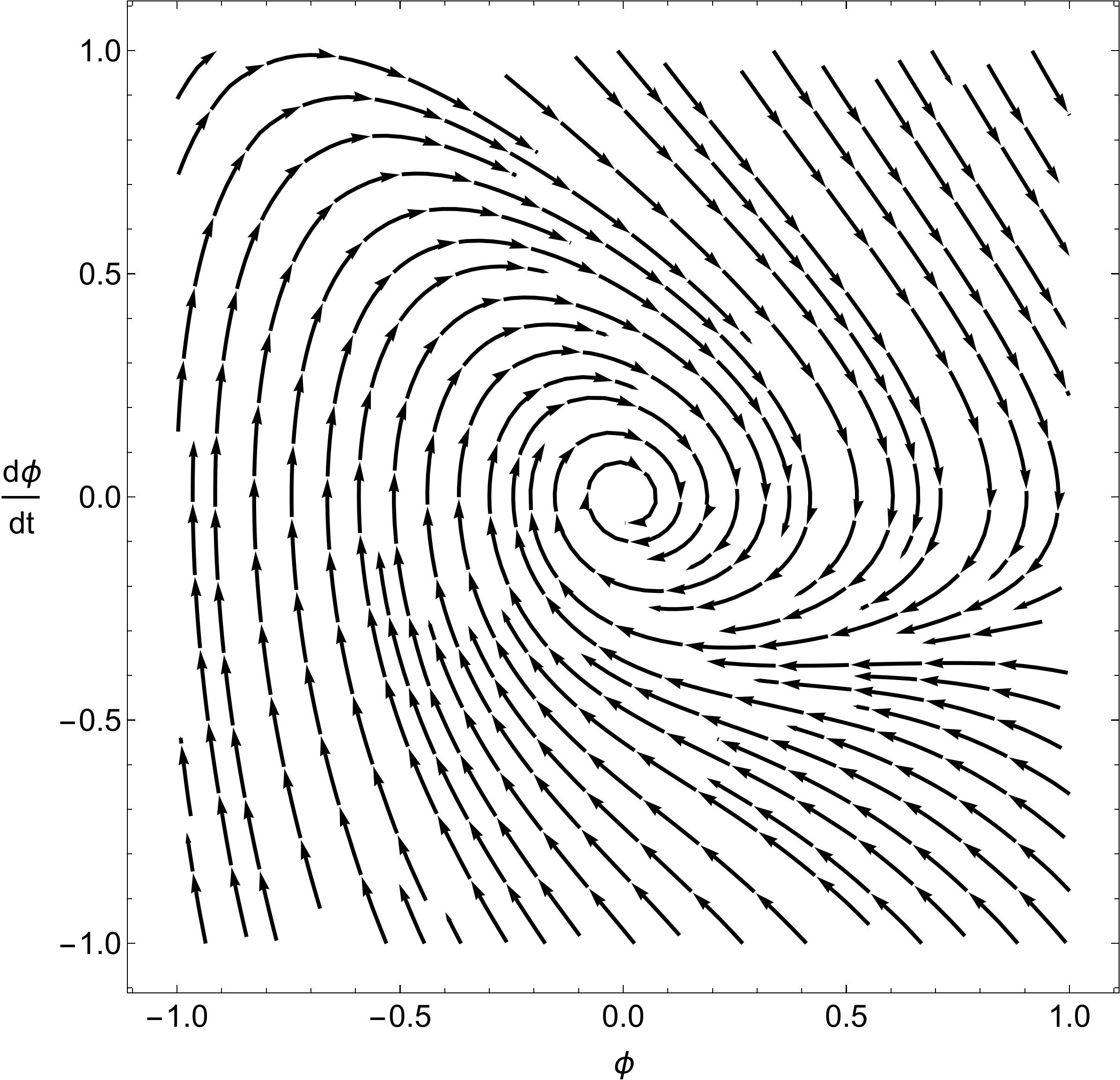
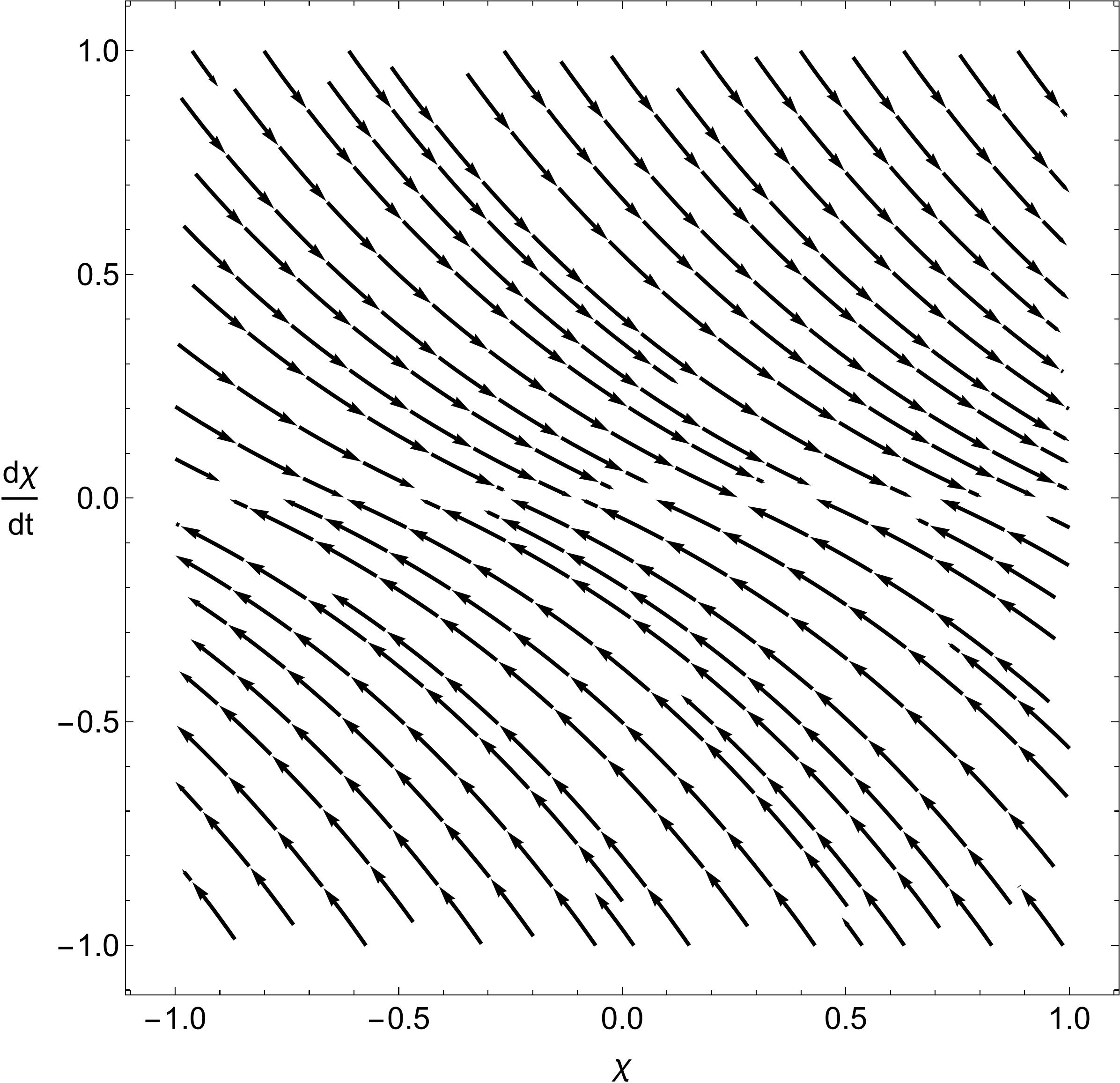
These attractor properties are retained in the extended two-field system. Phase portraits for both ns2 and ns3 confirm that moderate deviations in the initial conditions of ns4 do not destabilize the inflationary attractor. Furthermore, analytic estimates show that, for parameter choices relevant to inflation, both kinetic and potential terms of ns5 are suppressed by factors of ns6 and ns7, respectively.
Figure 2: Phase portrait in the ns8 plane for varying initial conditions, showing strong attraction toward the inflationary trajectory.
Figure 3: Phase portrait in the ns9 plane highlighting rapid relaxation of the field χ0 toward the slow-roll regime regardless of initial value.
Perturbation Analysis: Scalar and Tensor Sectors
The full perturbation analysis is performed in the adiabatic-entropy formalism. The perturbation equations—expressed in the coupled Mukhanov–Sasaki system and rotated into adiabatic (curvature) and entropy bases—demonstrate that, in the attractor regime, entropy production is negligible: the mass of entropy modes and exponential suppression due to the background evolution prevent their significant sourcing of curvature perturbations.
Tensor perturbations are described by the canonical quadratic action with χ1 and standard normalization, unmodified by the two-field structure on the Starobinsky branch. Hence, tensor-to-scalar predictions remain those of the original Starobinsky model.
Numerical solution of the coupled perturbation system confirms that the scalar power spectrum
remains nearly scale-invariant, with χ2 and χ3, for a wide range of initial χ4 values. The amplitude of entropy perturbations is suppressed by about five orders of magnitude relative to curvature, ensuring adiabaticity.
Strong result: For all explored attractor-adjacent initial data, multifield effects are unobservable in both scalar and tensor sectors.
Implications and Outlook
These findings indicate that Starobinsky inflation is robust against the minimal scalar-tensor, radiatively induced completion: the specific set of operators and their coefficients fixed by gravitational one-loop corrections are insufficient to induce observable multifield signatures in the slow-roll regime. The attractor dynamics and exponential suppression mechanisms enforce effective single-field behavior over the relevant period of inflation.
The only avenues for significant deviation would require:
Large initial kinetic energies in χ5, pushing the system away from the attractor and possibly out of the slow-roll regime.
Modification of the microscopic interactions to introduce new operators (e.g., χ6, χ7).
Regimes with dominant nonminimal kinetic coupling, as in χ8- or χ9-inflation scenarios, which are not realized for generic initial conditions in the minimal completion.
Future Directions
Several theoretically and observationally motivated lines of research remain:
Exploring inflationary dynamics and power spectra in regimes far from the Starobinsky attractor to characterize possible viable non-attractor solutions.
Systematic investigation of scenarios with dominant kinetic couplings, e.g., kinetic-driven inflation, where suppression arguments may fail.
Extending the microscopic model by incorporating direct couplings or additional fields, or allowing for matter/radiation-driven quantum effects.
Conclusion
The Starobinsky model exhibits strong rigidity against the class of gravitationally generated, minimal scalar-tensor quantum corrections addressed here. Within the attractor-connected, slow-roll regime, adiabaticity prevails and observational signatures remain essentially indistinguishable from the single-field scenario. Departures from this conclusion demand either extended operator content or highly nonstandard initial conditions. This underscores the unique status of Starobinsky inflation as an endpoint of gravitational EFT deformations with purely minimal universal content.
“Emergent Mind helps me see which AI papers have caught fire online.”
Philip
Creator, AI Explained on YouTube
Sign up for free to explore the frontiers of research
Discover trending papers, chat with arXiv, and track the latest research shaping the future of science and technology.Discover trending papers, chat with arXiv, and more.