Three Quantum-Geometric Contributions to Cubic Orbital Magnetization
Published 26 May 2026 in cond-mat.mes-hall | (2605.27277v1)
Abstract: In noncentrosymmetric metals such as $C_{3v}$ topological-insulator surfaces, moiré heterobilayers, and zincblende crystals, point-group symmetry can forbid the linear and quadratic electric-field-induced orbital magnetization, leaving the cubic response as the leading signal. Using a Ward-complete finite-momentum cubic Kubo kernel with an antisymmetric linear-in-$q$ projection, we show that the dc response separates into three quantum-geometric channels. These are a mixed electric-magnetic positional-shift quadrupole, a quantum-metric drift term, and an orbital-moment octupole. The three contributions share the same point-group symmetry but differ in their lifetime, frequency, and gate fingerprints. For a warped $C_{3v}$ surface the metric channel obeys the cutoff-independent law $\barχ_G \propto μ{-2}$. We propose third-harmonic magneto-optical Kerr spectroscopy as an experimental route.
The paper presents a decomposition of cubic orbital magnetization into three independent quantum-geometric channels—mixed quadrupole, metric drift, and transport octupole.
It employs a gauge-invariant Kubo formalism and an antisymmetric q-linear projection to separate magnetic responses from transport currents.
Experimental implications include distinct lifetime and frequency scaling, with THG-MOKE and gating proposed for isolating these nonlinear magnetic effects.
Quantum-Geometric Mechanisms in Cubic Orbital Magnetization
Motivation and Background
The paper "Three Quantum-Geometric Contributions to Cubic Orbital Magnetization" (2605.27277) delivers a rigorous theoretical framework for cubic-order nonlinear orbital magnetization in noncentrosymmetric metals where point-group symmetry can suppress linear and quadratic magnetoelectric responses. In these systems—e.g., C3v topological-insulator surfaces, moiré heterobilayers, and zincblende-type crystals—the leading nonzero contribution arises at cubic order in the electric field. This context places the work in direct analogy to nonlinear transport phenomena (e.g., Berry curvature dipole-driven nonlinear Hall effects), but the orbital magnetization has intricate, previously underexplored multipole hierarchy and decomposition.
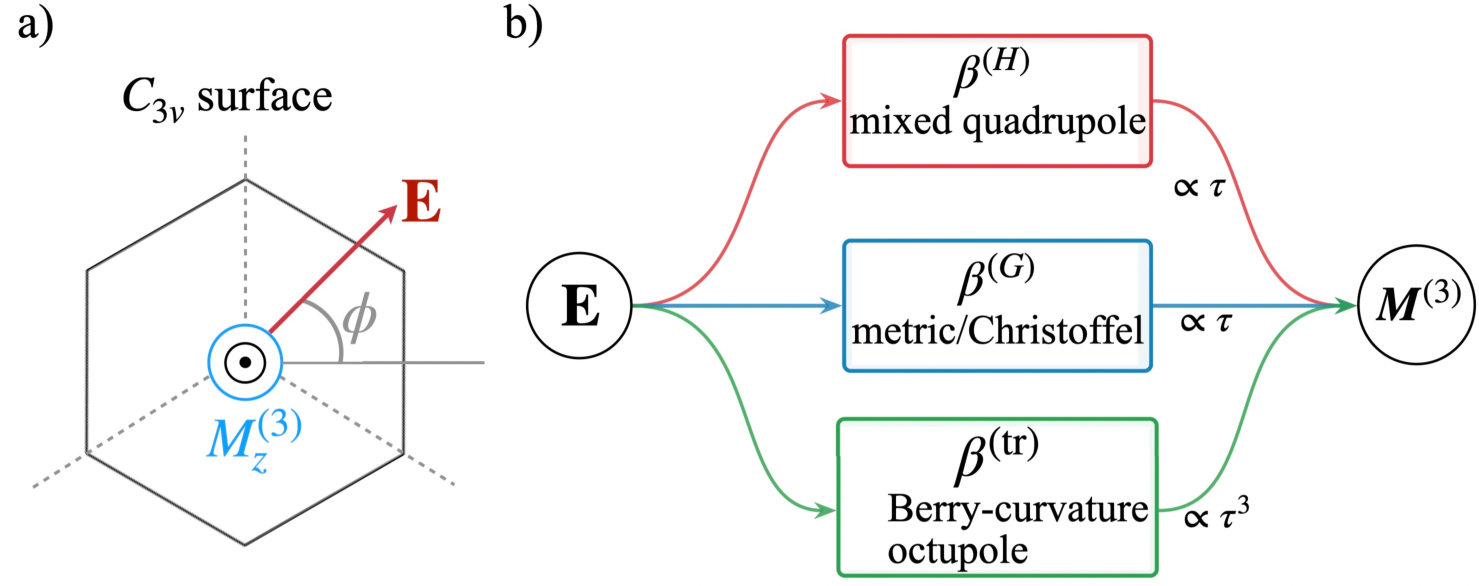
Figure 1: Symmetry filtering in C3v systems and decomposition of the cubic orbital magnetization into three quantum-geometric channels.
The paper addresses the gauge-invariant Kubo formalism at finite momentum q and, via an antisymmetric linear-in-qprojection, elucidates three independent quantum-geometric channels contributing to cubic magnetization. Notably, these include a mixed electric-magnetic positional-shift quadrupole (β(H)), a quantum-metric drift term (β(G)), and an orbital-moment octupole (β(tr)), each manifesting distinct dynamical fingerprints, symmetry relations, and experimental observables.
Formalism: Cubic Kubo Kernel and Quantum-Geometric Decomposition
The orbital magnetization response is extracted from the magnetization-current component of the cubic Kubo kernel, utilizing a Ward-complete gauge-invariant construction. The magnetic response separates from the transport current via an antisymmetric q-linear projection in momentum space, aligning with the modern theory of orbital magnetization [shi2007orbital, xiao2010berry].
The essential structure is
Mc=βcjklEjEkEl,
where β is the cubic magnetization kernel obtained from the C3v0-linear antisymmetric part of the cubic current response tensor. Three independent terms arise in the static, single-relaxation-time regime:
C3v1
where:
C3v2 (mixed quadrupole): Occupied-state dipole of a mixed electric-magnetic quadrupolar correction to the local orbital moment. No quadratic counterpart exists; constructed via simultaneous electric and magnetic interband mixing.
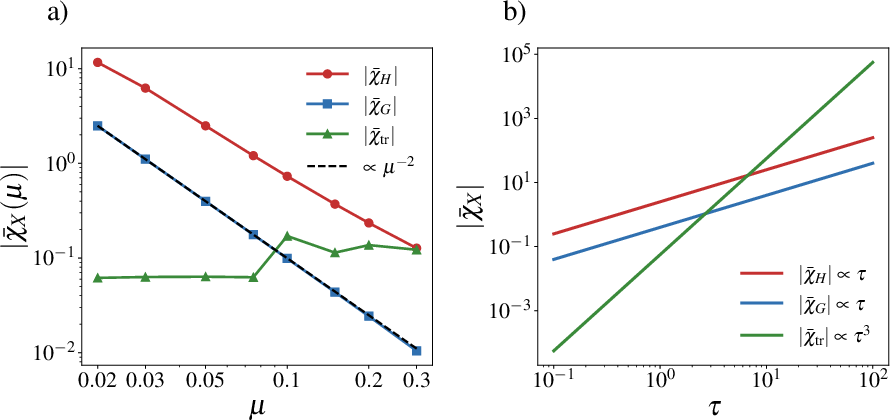
C3v3 (metric drift): Fermi-surface metric drift, the cubic analogue of the quadratic Christoffel mechanism, explicitly cutoff-independent and with closed-form prediction in continuum models.
C3v4 (orbital-moment octupole): Transport contribution, reducible to a gap-weighted Berry-curvature octupole in two-band models.
These contributions are operator-distinct but symmetry-equivalent in C3v5 and related point groups.
Symmetry Constraints and Experimental Diagnostics
The C3v6 point-group dictates that the out-of-plane magnetization C3v7 and in-plane electric field C3v8 transform as axial C3v9 and polar q0 representations, respectively. The cubic expansion is required, yielding an angular dependence q1 or q2 depending on crystal axes.
Figure 2: Contribution-resolved plots for cubic magnetization in the q3 model, showing gate-tunable q4 law and relaxation-time scaling distinguishing geometric versus transport channels.
Lifetime and frequency diagnostics are crucial:
Lifetime scaling: Geometric (q5) versus transport (q6) scaling enables separation by disorder or temperature.
Frequency rolloff: Mixed quadrupole relaxes at the last input frequency; metric drift at the total output; transport at all input sums.
Gate dependence: Metric contribution q7 provides a cutoff-independent prediction accessible via gating.
Minimal Model and Lattice Completion
The Hamiltonian for hexagonally warped q8 topological-insulator surfaces is analyzed:
q9
where q0 sets the cubic warping magnitude. The metric contribution is unambiguously predicted as q1; transport and mixed-quadrupole terms require lattice completion or explicit magnetic coupling for model-independent quantification.
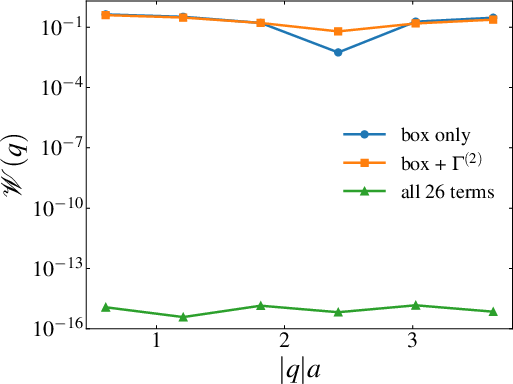
Figure 3: Output-leg Ward-identity check for the cubic current kernel, confirming the necessity of contact terms and exact gauge invariance.
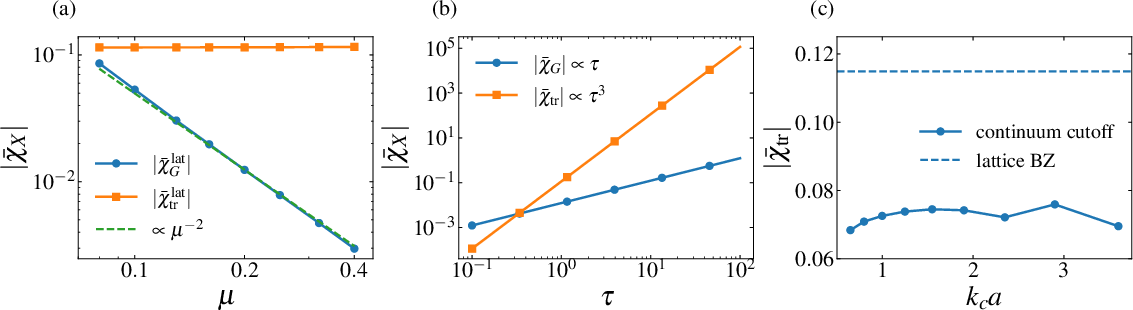
Figure 4: Triangular-lattice regularization validating the universality and cutoff independence of the metric contribution in a lattice-completed toy model.
Experimental Implications and Kerr Spectroscopy
Third-harmonic magneto-optical Kerr effect (THG-MOKE) is proposed for direct detection. Under strong THz driving fields, the predicted cubic magnetization yields Kerr rotations scaling as q2 and following the symmetry-filtered angular harmonic. Separation of channels is best achieved through disorder scans, gating, and frequency variations, with the metric channel serving as the unambiguous reference.
Notably:
Finite for linear polarization but vanishes in ordinary inverse-Faraday backgrounds.
Weak-warping case provides clean electrostatic gate control.
Coexisting quadratic channels in other point groups necessitate frequency-mixing and lifetime diagnostics.
Broader Impacts, Extensions, and Theoretical Outlook
The formalism is not restricted to q3 and extends to any noncentrosymmetric system where appropriate symmetry selection rules apply. Extensions to magnetic crystals, incorporation of side-jump/skew-scattering, and interacting Green-function generalizations are possible.
Practical implications include:
Fundamental diagnostics for current-induced orbitronics phenomena.
Material design strategies targeting enhancement of the quantum metric and orbital moments.
Potential for spectroscopic resolution of geometric multipoles in nonlinear magnetic responses.
Future theoretical work could investigate interaction effects, higher-order multipole hierarchies, and explicit computation in correlated and topologically nontrivial systems.
Conclusion
This paper provides a comprehensive, gauge-invariant decomposition of cubic orbital magnetization into three quantum-geometric channels—mixed quadrupole, metric drift, and transport octupole—demonstrating symmetry-filtered leading-order nonlinear magnetization in noncentrosymmetric metals. The metric channel’s universal gate dependence q4 stands out for experimental testability, and the THG-MOKE protocol offers a promising platform for extracting cubic magnetization signatures in topological insulator surface states, moiré heterostructures, and zincblende-type semiconductors. The theoretical tools developed open avenues for probing Bloch-state geometry beyond the Berry curvature dipole paradigm and for advancing the understanding of nonlinear magnetoelectric effects.
“Emergent Mind helps me see which AI papers have caught fire online.”
Philip
Creator, AI Explained on YouTube
Sign up for free to explore the frontiers of research
Discover trending papers, chat with arXiv, and track the latest research shaping the future of science and technology.Discover trending papers, chat with arXiv, and more.