- The paper demonstrates that nonmetricity corrections in f(Q) gravity, especially the logarithmic model, can reconcile discrepancies between local and early-Universe H₀ measurements.
- The study employs Bayesian MCMC with diverse datasets—including cosmic chronometers, Type Ia supernovae, and BAO—to robustly constrain model parameters and assess performance.
- The findings imply that logarithmic f(Q) models offer a geometrically driven alternative to dark energy, reducing model-selection penalties compared to ΛCDM.
Non-Metricity Corrections Approach to Alleviate H0 Tension: The Logarithmic and Nonlinear f(Q) Models
Context and Motivation
The persistent discrepancy between early- and late-Universe measurements of the Hubble constant (H0), currently in excess of 5σ, presents a robust challenge to the standard ΛCDM framework. Measurements calibrated via local distance ladders (e.g., SH0ES, JWST) consistently yield H0>73 km s−1 Mpc−1, whereas large-scale structure and BAO analyses (e.g., DESI DR2) favor H0≈68.5 km s−1 Mpcf(Q)0. Traditional attempts to account for this discrepancy by invoking dynamical dark energy, or modifying the expansion history at low f(Q)1, have encountered model-selection penalties or required exotic new fields. An alternative paradigm is to modify the gravitational sector itself while retaining geometric consistency at early times.
Symmetric teleparallel gravity, constructed via a nonmetricity scalar f(Q)2 and generalized to f(Q)3 gravity, is a promising candidate. Within this framework, the gravitational action is a function of f(Q)4 (distinct from curvature and torsion), introducing new geometric degrees of freedom. These can alter late-time expansion without impacting the high-f(Q)5 regime, offering controlled mechanisms to address f(Q)6 tension.
f(Q)7 Gravity: Theoretical Structure
The action for f(Q)8 gravity is
f(Q)9
with field equations derived via metric and affine connection variation. Under FLRW dynamics and the coincident gauge, H00 and the modified Friedmann equations are
H01
With H02, geometric corrections H03 act as alternatives to dark energy, impacting late-time expansion.
Observational Dataset and Inference
The models are constrained by a comprehensive set of late-time cosmological probes:
- Cosmic Chronometers (CC): 31 direct H04 measurements using passively evolving galaxies.
- Type Ia Supernovae: Pantheon, Pantheon+SH0ES, and DES SN5YR compilations spanning extensive H05 precision and robust host distance calibration.
- BAO: Measurements from SDSS and DESI DR2, with careful treatment of degeneracies between H06 and H07.
Parameter estimation relies on Bayesian MCMC, with explicit chi-square construction and priors over H08, as appropriate. Model comparison is performed via AIC and BIC, penalizing unnecessary parameter proliferation.
Logarithmic and Nonlinear H09 Models
Model I: Logarithmic Correction
Functional form:
5σ0
with normalization 5σ1 fixed by present Friedmann constraints.
The normalized Hubble parameter, 5σ2, satisfies a nonlinear equation accommodating geometric deviations at low 5σ3. Model reduces to 5σ4CDM in the limit 5σ5.
Confidence parameter contours and posterior distributions for Model I, across dataset combinations, consistently yield intermediate 5σ6 values between Planck and SH0ES benchmarks, with improved precision as BAO data shift from SDSS to DESI.
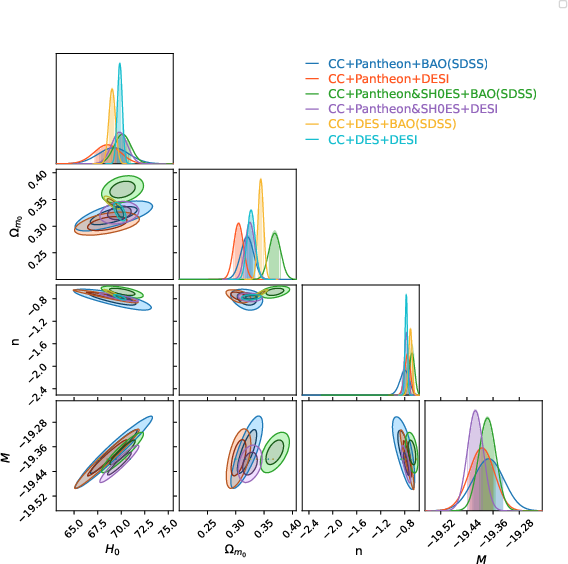
Figure 1: Contour plot for the combined dataset for CC, Pantheon, Pantheon+SHOES, BAO(SDSS), DESI for Model-I.
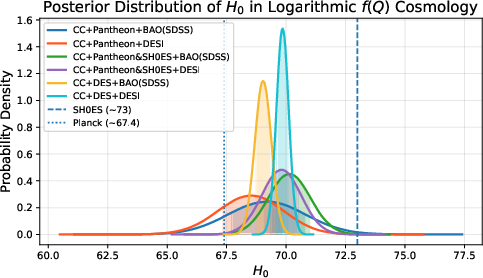
Figure 2: Posterior probability distributions of 5σ7 for Model I from all major dataset combinations, showing intermediate values and reduced uncertainty with DESI and DES SN5YR.
Key numerical results:
- 5σ8 (CC+PN+SDSS); 5σ9 (CC+PN+DESI)
- Λ0 (CC+PN(SH0ES)+SDSS); Λ1 (CC+PN(SH0ES)+DESI)
- DES SN5YR combinations further tighten Λ2 uncertainties to sub-percent levels.
Model II: Nonlinear Saturation
Functional form:
Λ3
with normalization and evolution equations ensuring gradual transition and stability at all epochs.
Contour plots and Λ4 posteriors show Model II can accommodate Λ5 for Pantheon-based datasets, but—upon inclusion of DES SN5YR and DESI—converges toward Planck Λ6 values.
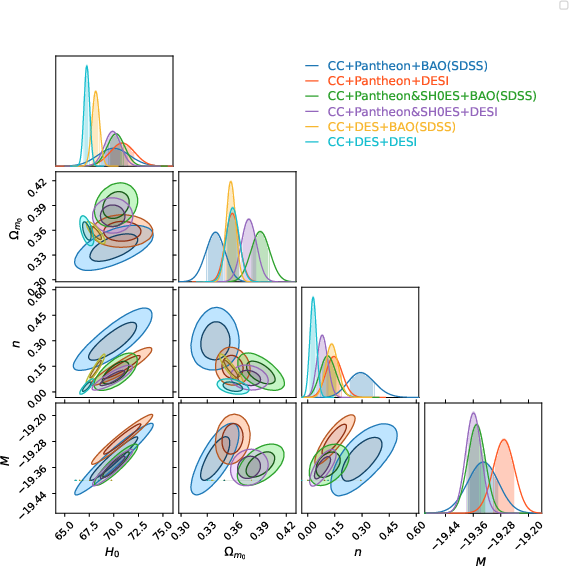
Figure 3: Contour plot for the combined dataset for CC, Pantheon, Pantheon+SHOES, BAO(SDSS), DESI for Model-II.
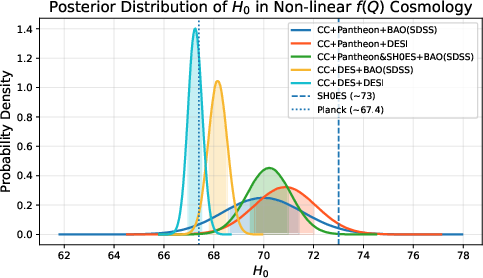
Figure 4: Posterior probability distributions of Λ7 for Model II across all dataset combinations.
Numerically:
- Λ8 (CC+PN+SDSS); Λ9 (CC+PN+DESI)
- H0>730 (CC+DES+SDSS); H0>731 (CC+DES+DESI), closely matching Planck CMB values.
Comparative Assessment
Radar plots of H0>732 and information criterion deltas (AIC/BIC) show:
- Model I (logarithmic) delivers intermediate H0>733 values, statistically competitive with H0>734CDM, with lowest H0>735AIC/H0>736BIC for most dataset combinations.
- Model II (saturation) yields tighter clustering near Planck H0>737, with variability depending on dataset, occasionally outstripping Model I in H0>738AIC for DES-based combinations.
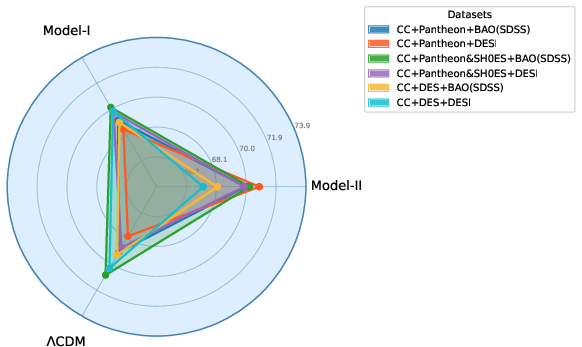
Figure 5: Inferred H0>739 values for Model I, Model II, and −10CDM across six datasets, illustrating model/data sensitivity.

Figure 6: Variation of −11AIC and −12BIC for Model I and Model II versus −13CDM across dataset combinations.
Tables of best-fit parameters emphasize that Model I maintains negative −14 (deviating from −15CDM) and balances −16 tension with statistical support, while Model II's −17 approaches zero when high-precision data are included.
−18CDM Reference
Analysis of −19CDM itself across identical datasets confirms −10's sensitivity to adopted probes:
- −11--−12 km s−13 Mpc−14 for Pantheon/BAO;
- −15 km s−16 Mpc−17 for Pantheon+SH0ES/SDSS;
- DESI datasets provide narrower confidence intervals.
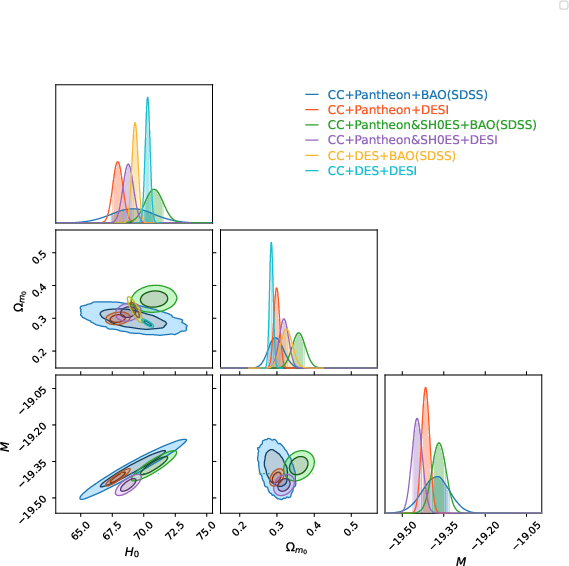
Figure 7: Contour plot for the combined dataset for CC, Pantheon, Pantheon+SH0ES, BAO(SDSS), DESI for −18CDM.
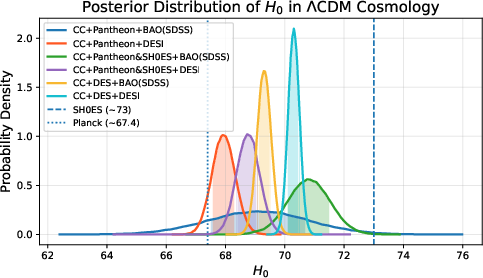
Figure 8: Posterior probability distributions of −19 for H0≈68.50CDM from all dataset combinations.
Implications and Future Directions
The findings establish modified gravity via nonmetricity, particularly the logarithmic H0≈68.51 model, as a viable framework for alleviating H0≈68.52 tension. This approach maintains statistical parity with H0≈68.53CDM under AIC/BIC while predicting H0≈68.54 values favoring reconciliation between local and early-Universe determinations, provided dataset combinations are carefully chosen.
Practically, the logarithmic H0≈68.55 correction offers a geometric mechanism for mimicking dynamical dark energy behavior, without explicit dark energy components or distorting early universe physics. The nonlinear saturation model is effective at restoring H0≈68.56CDM-like predictions as dataset precision increases, implying a robustness to observational constraints but less flexibility for tension mitigation.
Upcoming high-precision cosmological surveys (BAO, SN Ia, CC) will be critical for distinguishing between these model classes, and for testing the relevance of geometric corrections. Further theoretical work could address the microphysical interpretation of the H0≈68.57 degrees of freedom and their implications for structure formation and gravitational wave propagation.
Conclusion
The nonmetricity-based H0≈68.58 gravity models provide compelling alternatives to H0≈68.59CDM for explaining cosmic acceleration and mitigating −10 tension. The logarithmic model, in particular, delivers intermediate and robust −11 values across diverse dataset combinations and minimal information criterion penalties, marking it as a preferred candidate for partial tension resolution. Model selection under more extensive and precise datasets will determine whether purely geometric corrections suffice for cosmological concordance or necessitate new physics beyond GR and the standard cosmological model.

