Quantifying and Probing Multipartite Entanglement via Minimum Entanglement Drop
Published 20 Jun 2026 in quant-ph | (2606.21950v1)
Abstract: Quantifying genuine multipartite entanglement remains a significant challenge. We propose a multipartite entanglement monotone defined by the minimum entanglement drop -- the reduction in global one-to-group entanglement upon tracing out a single particle. We formulate a computationally efficient variant using tangle and negativity to ensure non-vanishing values for W-class states, and rigorously prove it is a valid monotone under local operations and classical communication. In the tripartite regime, the minimum tangle drop is physically equivalent to the minimum pairwise concurrence. We establish an operational framework where the entanglement drop acts as a structural probe: by assessing sensitivity to qubit loss, it identifies inseparable clusters, extracting connectivity fingerprints that uniquely differentiate graph topologies within the same local Clifford equivalence class. Integrating this mapping with classical shadows enables efficient experimental estimation and dynamic tracking of entanglement network evolution. We derive exact analytical solutions for n-qubit W states under environmental noise, revealing robust scaling behaviors. Finally, we acknowledge limitations, noting that diagnostic sensitivity strictly vanishes for highly robust states such as the 5-qubit error-correcting code.
The paper presents the minimum entanglement drop (MED) as a robust monotone that quantifies genuine multipartite entanglement by analyzing entanglement loss upon single-qubit exclusion.
It leverages tangle and negativity measures to offer computational efficiency and precise cluster mapping, distinguishing between inseparable subgroups even in high-dimensional systems.
The MED approach, validated against traditional measures like CKW monogamy, provides experimental advantages when combined with classical shadows for scalable entanglement estimation.
Minimum Entanglement Drop as an Efficient Multipartite Entanglement Probe
Introduction
The quantification and characterization of genuine multipartite entanglement (GME) pose significant challenges due to the exponential complexity of quantum systems. Previous entanglement measures relying on convex roof constructions and monogamy-based frameworks exhibit fundamental limitations, particularly for high-dimensional systems. Notably, such approaches fail to detect certain classes of GME states—among them the W class—highlighting the inadequacy of traditional residual entanglement schemes. This paper introduces a robust multipartite entanglement monotone based on the minimum entanglement drop (MED) induced by tracing out a constituent particle. The central theoretical tool leverages both tangle and negativity to maintain computational efficiency and sensitivity, rigorously proving monotonicity under LOCC and establishing physical equivalence with minimum pairwise concurrence (MPC) for tripartite systems. A novel structural probe emerges, capable of revealing inseparable clusters and connectivity fingerprints, further enhanced when integrated with classical shadows for efficient experimental estimation.
Deficiency of Standard Monogamy-Based Measures
Multipartite entanglement measures rooted in the Coffman-Kundu-Wootters (CKW) monogamy framework—for instance, the three-tangle and its generalized residual counterparts—are analytically tractable but fail critical requirements for GME quantification. These measures vanish for W states, contradicting their known genuine entanglement, and produce false positives for biseparable states such as tensor products of GHZ states. High-dimensional generalizations suffer from invalid monogamy inequalities, as demonstrated with explicit counterexamples, e.g., 4-qubit biseparable Bell pairs. The failure arises from the conflation of multi-qubit focus blocks and the inability of pairwise sums to enforce vanishing for biseparability.
Minimum Entanglement Drop: Tangle and Negativity Variants
The MED is defined by the reduction in global one-to-group entanglement (via tangle or negativity) when a single particle is traced out, with minimization over all choices of the removed particle. For n-qubit pure states, the minimum tangle drop Dq1 is formulated as:
Dq1=i=q1minτq1(rest)−τq1(rest∖qi),
and its negativity analogue:
DN,q1=i=q1min(Nq1∣rest−Nq1∣rest∖qi).
These quantities satisfy monotonicity, LU invariance, and convexity, and strictly vanish for biseparable states. Notably, in the tripartite regime, MED aligns with MPC and thus acts as a faithful GME measure. The negativity variant (MED-N) offers computational advantages, sidestepping convex roof evaluations by relying exclusively on the trace norm of partial transpose, equipping the approach for scalable implementation.
Detection of Inseparable Structural Clusters
The minimum negativity drop provides a rigorous structural diagnosis: a positive entanglement drop upon tracing out particle x from the group associated with focus q1 unambiguously signals mutual inseparability. This enables cluster identification in multipartite systems, transitioning GME verification from exponential bipartition enumeration to localization and separation of macroscopic blocks. Operationally, the approach scales as O(n2) for cluster mapping, with O(2k) for final separability checks across k identified clusters, rendering it efficient for modular or highly symmetric states.
Structural Fingerprint and Local Clifford (LC) Orbit Differentiation
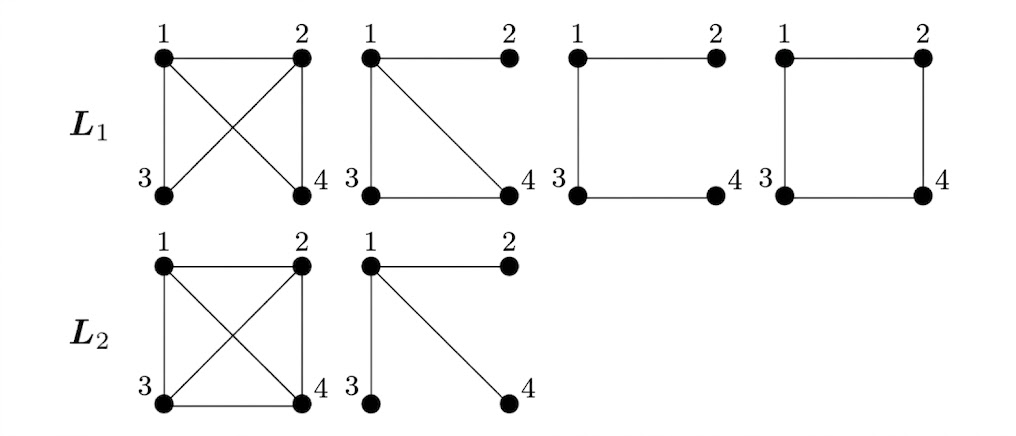
The MED framework extracts cluster fingerprints that differentiate between graph state topologies even within the same LC equivalence classes.
Figure 1: The two LC orbits for 4-qubit connected graph states; cluster probes yield distinct structure fingerprints for states within the same orbit.
For 4-qubit systems, connected graph states organize into two LC orbits: L1 (fragmented into two inseparable pairs) and Dq10 (fully inseparable four-node clusters). Cluster identification under MED distinctly separates these orbits, further resolving sensitivity to edge and non-adjacency configurations. However, the clusters are not LC-invariant, reflecting probe sensitivity to explicit graph topology and local connectivity.
Computational and Experimental Advantages
Unlike GMC and GGM—requiring global optimization over exponentially many bipartitions—the MED-based approach efficiently maps local structural clusters. For generic pure states lacking algebraic shortcuts, global measures are intractable; MED, when combined with classical shadows and randomized measurements, drastically reduces both quantum measurement and classical post-processing costs. Specifically, purity checks can certify cluster inseparability, and entanglement between clusters can be efficiently validated by PT moment inequalities (Dq11), scalable on NISQ devices.
Dynamical Probing of Entanglement Network Evolution
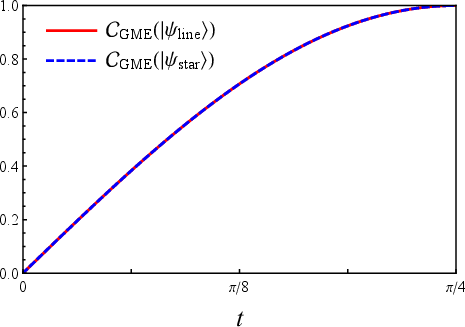
MED offers granular tracking of correlation dynamics, dramatically outperforming scalar measures like GMC. For instance, Ising-interaction driven evolution of 4-qubit graph states (line vs. star topology) yields virtually indistinguishable GMC trajectories.
Figure 2: GMC dynamics for the 4-qubit Line and Star graph states; global measures fail to differentiate topologies.
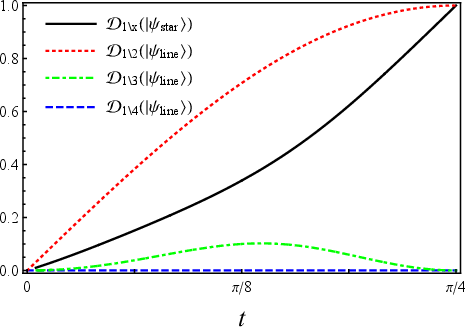
MED however uncovers spatiotemporal connectivity evolution, capturing distinct nearest-neighbor, next-nearest, and peripheral node dependencies, and reveals transient correlation waves otherwise invisible to global metrics.
Figure 3: Dynamic structural fingerprint from individual negativity drops, tracing the spatial impact of qubit removal on entanglement evolution in Line and Star topologies.
Analytical Solutions and Robustness for W States
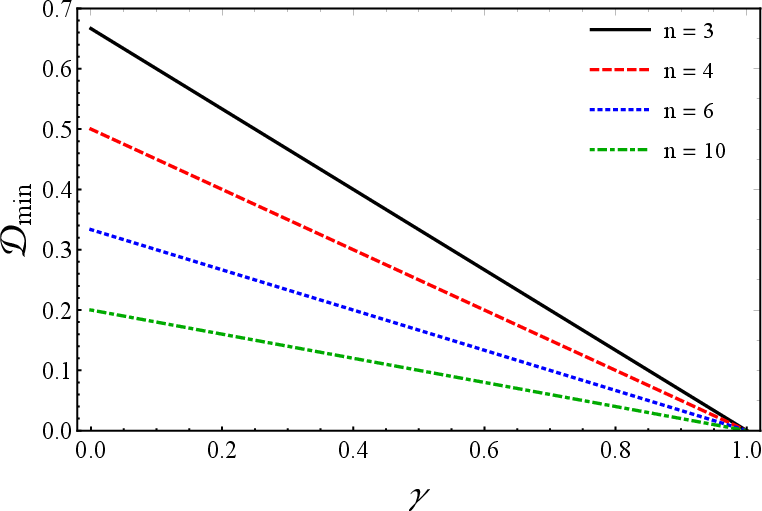
For the Dq12-qubit W state, the minimum tangle drop is analytically Dq13. The drop decreases monotonically with Dq14, reflecting growing robustness to single-particle loss. Under admixture with the vacuum (Dq15), MED maintains linear dependence on noise parameter Dq16, confirming predictable scaling and experimental utility.
Figure 4: Minimum tangle drop Dq17 as a function of particle number Dq18 and noise parameter Dq19; entanglement robustness increases with system size.
Limitations
MED-based probes fail for highly robust, symmetrically correlated states where all reduced subsystems are maximally mixed, e.g., five-qubit error-correcting code state; in such cases, pairwise removals yield vanishing drops, and separability cannot be inferred. Thus, the structural probe is primarily a heuristic diagnostic for modular or locally-structured multipartite systems.
Conclusion
The minimum entanglement drop, particularly in its negativity variant, constitutes an efficient multipartite entanglement monotone, rigorously satisfying key requirements and operationally enabling structural probing of quantum systems. By reorienting detection from global optimization to local connectivity mapping and cluster extraction, the MED framework offers enhanced scalability, experimental viability, and dynamical insight. Its applicability spans modularly structured and nontrivially connected systems, outperforming traditional scalar GME quantifiers in revealing the topology and evolution of quantum entanglement networks. However, its diagnostic sensitivity strictly vanishes for symmetrically correlated states with maximally mixed reductions, delineating clear boundaries for practical deployment.