Quantification of Entanglement in Three-Qubit Systems
Published 3 Jun 2026 in quant-ph | (2606.04721v1)
Abstract: This study presents an analytical investigation of entanglement quantification in three-qubit pure states through the Acín canonical representation, which serves as a generalization of the two-qubit Schmidt decomposition. Driven by the intricacies of multipartite entanglement and the shortcomings of current measures, we employ a global concurrence measure derived from the generalized concurrence of various bipartitions within the system. The characteristics of this measure are explored both analytically and numerically across a range of SLOCC entanglement classes, such as product, biseparable, GHZ-type, and W-type states. When compared to the three-tangle and tripartite negativity, our findings indicate that this measure yields complementary insights into multipartite correlations. The outcomes underscore the significance of this measure in elucidating the structure and distribution of entanglement within three-qubit quantum systems.
The paper presents a global concurrence measure derived via the Acín canonical form, enabling analytical quantification of three-qubit entanglement.
It employs determinants of subsystem density matrices to capture both bipartite and tripartite correlations under SLOCC classifications.
The measure is compared with three-tangle and tripartite negativity, highlighting enhanced sensitivity in detecting entanglement redistributions.
Analytical Quantification of Entanglement in Three-Qubit Systems via Acín Parametrization
Introduction
The quantification of entanglement in multipartite quantum systems presents persistent theoretical and practical challenges central to quantum information science. While bipartite entanglement is efficiently characterized through the Schmidt decomposition and quantifiers like concurrence, three-qubit systems display a nontrivial entanglement structure that resists summary by a single scalar invariant due to the inequivalence of classes under SLOCC transformations. This work implements the Acín canonical representation to express and analyze three-qubit pure states, leveraging the reduction of parameter redundancies to facilitate analytical and computational tractability. Building on prior generalizations of concurrence for multipartite systems, a global concurrence measure is constructed from the determinants of reduced subsystem density matrices. The manuscript delivers thorough analysis of this measure across the entire SLOCC classification, with explicit comparison to the canonical three-tangle and tripartite negativity. The study yields substantial insights into the distributions and nature of entanglement in three-qubit systems, highlighting both the qualitative and quantitative performance of the global concurrence measure.
Bipartite and Multipartite Entanglement: Acín Canonical Form
For bipartite pure states, the Schmidt decomposition offers a full characterization, enabling entanglement quantification with direct relation to subsystems' mixedness. In contrast, for three qubits, the absence of an analogous canonical decomposition mandates alternative approaches. The Acín canonical representation achieves parametrization up to local unitary equivalence, representing an arbitrary state as
with real, non-negative λi subject to normalization and a single physically relevant phase ϕ. This representation dramatically simplifies the examination of multipartite entanglement phenomena and forms the basis for analytical expressions of entanglement measures.
Construction of the Global Concurrence Measure
Entanglement within multipartite systems is distributed asymmetrically among possible bipartitions. The measure adopted,
E=2(det(ρA)+det(ρB)+det(ρC)),
sums contributions from all one-versus-rest bipartitions, where ρX denotes the reduced density matrix of subsystem X. Within the Acín parametrization, explicit expressions for det(ρA), det(ρB), and det(ρC) are derived in algebraic relation to the canonical parameters, encompassing the state space while respecting normalization and the range of ϕ.
The measure exhibits essential properties for multipartite entanglement quantification:
Vanishing for fully separable states (all reduced density matrices pure),
Non-negativity and upper-boundedness,
Sensitivity to the distribution of entanglement among bipartitions.
Analytical and Numerical Behavior Across SLOCC Classes
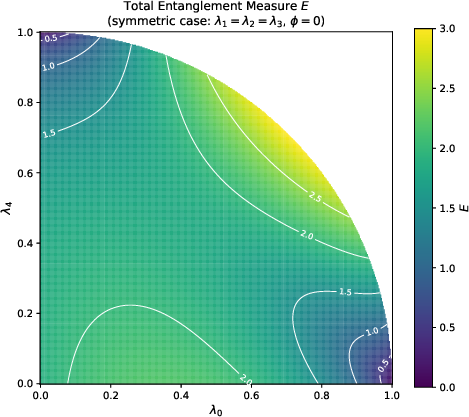
Figure 1: Contour plot showing the variation of the global concurrence λi0 for the symmetric Acín case (λi1, λi2). The circumference points correspond to GHZ-type states; maximal entanglement arises at λi3.
Analysis of the measure across the parameter space reveals that the global concurrence λi4 continuously interpolates between zero (product states) and its maximum at the GHZ point. Each entanglement class under Acín's SLOCC classification displays distinct behavior:
Type 1 (Product States): λi5 (all subsystems pure/detached).
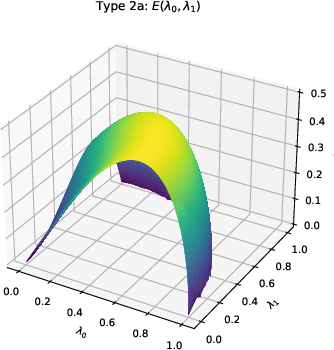
Type 2(a) (Biseparable States): λi6 in the interior, vanishing on product-state boundaries, reflecting bipartite entanglement only.
Figure 2: Behavior of λi7 for Type 2(a) biseparable states. The measure is non-zero in the interior, vanishing as parameters approach product state boundaries.
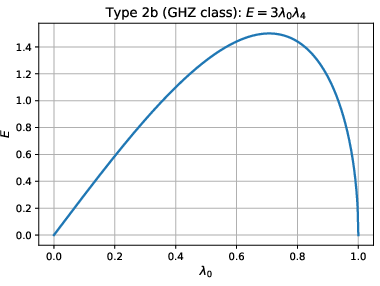
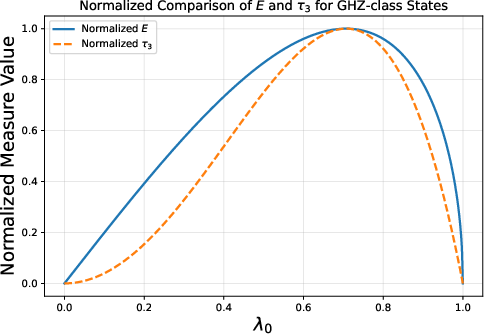
Type 2(b) (GHZ States): λi8; peaks at λi9 for the canonical GHZ state.
Figure 3: Variation of ϕ0 for GHZ-type states as a function of ϕ1; maximal entanglement at ϕ2.
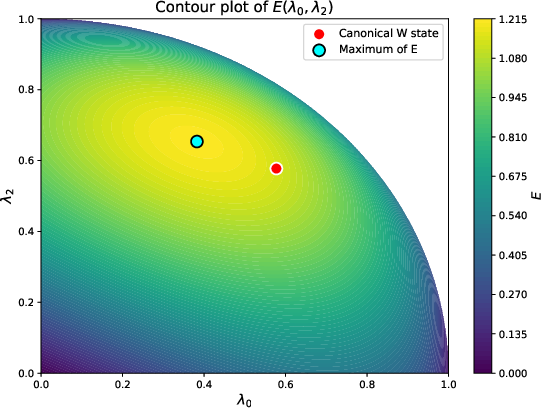
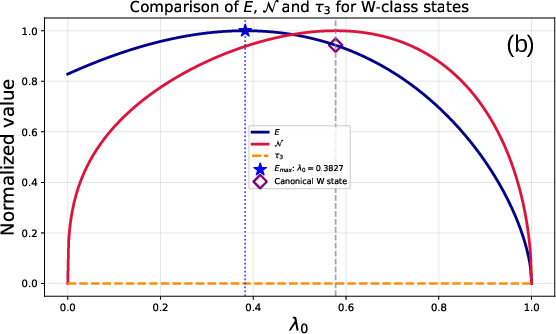
Type 3(a) (W-Type States): ϕ3 does not vanish within the class, reflecting nontrivial bipartite correlations undetected by three-tangle.
Figure 4: Variation of ϕ4 for W-type states as a function of ϕ5 and ϕ6. The canonical W state (red point) does not achieve maximal ϕ7.
Comparative Assessment with Three-Tangle and Tripartite Negativity
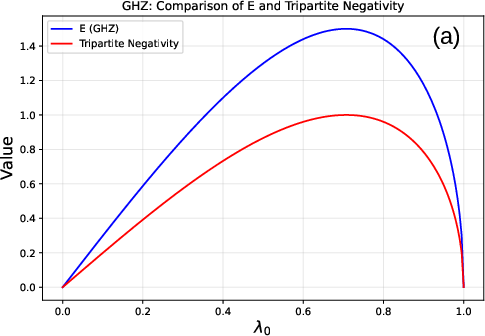
The three-tangle, a degree-4 polynomial invariant, precisely tracks genuine tripartite correlations (nonzero only for the GHZ class), while global concurrence ϕ8 also senses bipartite contributions present in other classes. For GHZ states, both measures present qualitative alignment but exhibit different normalization and sensitivity; for W states, the three-tangle identically vanishes, whereas ϕ9 remains strictly positive.
Figure 5: Comparison of E=2(det(ρA)+det(ρB)+det(ρC)),0 with three-tangle E=2(det(ρA)+det(ρB)+det(ρC)),1 for the GHZ class; both measures show similar qualitative behaviors, distinct in normalization and slope.
Tripartite negativity, aggregating bipartition-based negativities, is broadened to detect both W and GHZ entanglement. The alignment of E=2(det(ρA)+det(ρB)+det(ρC)),2 and tripartite negativity over GHZ regions is strong, although E=2(det(ρA)+det(ρB)+det(ρC)),3 displays enhanced sensitivity near the entanglement maxima. Importantly, for W-type states, E=2(det(ρA)+det(ρB)+det(ρC)),4 and negativity attain their maxima at different parameter locations. The distinct functional shape often results in E=2(det(ρA)+det(ρB)+det(ρC)),5 capturing richer redistribution of entanglement that negativity alone would miss.
Figure 6: Comparison of E=2(det(ρA)+det(ρB)+det(ρC)),6 with tripartite negativity for (a) GHZ and (b) W type states. For GHZ, both track each other up to scale; for W, E=2(det(ρA)+det(ρB)+det(ρC)),7 reveals broader bipartite entanglement redistribution.
Theoretical and Practical Implications
These results emphasize that any single invariant, including the three-tangle, fails to capture the full structure of multipartite entanglement. The global concurrence measure E=2(det(ρA)+det(ρB)+det(ρC)),8 constructed here produces an analytically tractable, computationally efficient quantification of entanglement across the Acín parameter space, allowing for detailed diagnosis of both tripartite and bipartite quantum correlations. Practically, the measure enables efficient classification, tracking, and optimization of entanglement resources in quantum information protocols where genuine and hybrid entanglement types are simultaneously present. The explicit connection to the canonical state parameters facilitates use in variational quantum circuit design and benchmarking of quantum computation primitives.
Theoretically, E=2(det(ρA)+det(ρB)+det(ρC)),9 provides a tool for mapping out phase diagrams and transitions among entanglement classes arising under decoherence, noise, or dissipative dynamics. The measure’s sensitivity to both the structure and redistribution of multipartite entanglement prompts examination in higher-dimensional multipartite systems, including ρX0-qubit states and qudit architectures. Extensions to mixed-state analysis and entanglement evolution under non-unitary operations constitute promising avenues for continued development.
Conclusion
The global concurrence measure derived via the Acín canonical form provides an analytically concise and physically meaningful quantifier for entanglement in three-qubit pure states. It is capable of distinguishing between all SLOCC classes, capturing both genuine tripartite and bipartite contributions. The explicit analysis and visual mapping of this measure clarify its relation to established quantifiers and underscore its complementary role for multipartite entanglement classification and resource analysis. This framework is poised to inform both theoretical investigations and practical implementations in quantum information science, serving as a foundation for future entanglement quantification methodologies in systems of increasing complexity.
Reference: "Quantification of Entanglement in Three-Qubit Systems" (2606.04721)