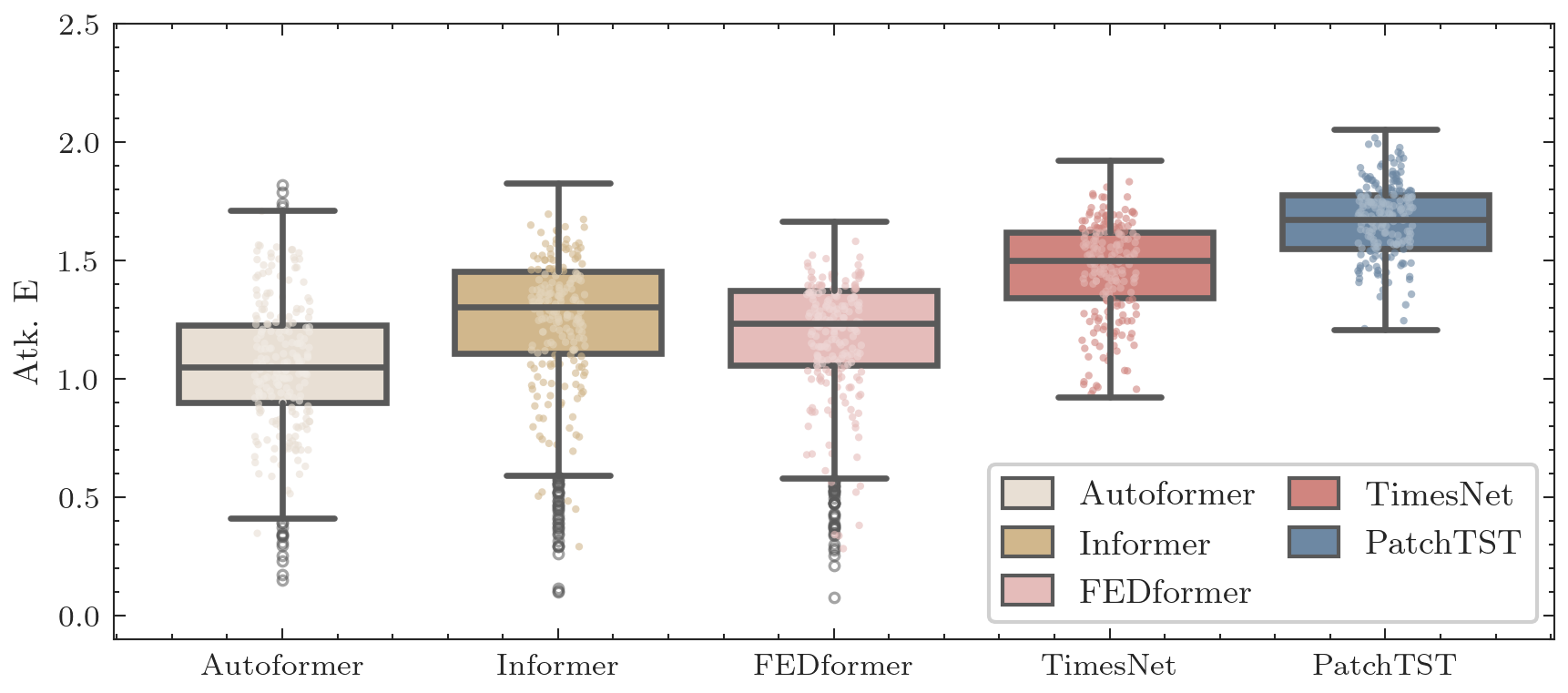
- The paper presents GridTroj, a novel task-aware backdoor framework that aligns poisoning strategies with the attacker’s operational intent.
- It integrates an Intention Planner and Backdoor Realizer to optimize trigger timing, sample selection, and loss functions for covert forecast manipulation.
- Experimental results across distribution network tasks reveal that GridTroj achieves higher attack efficiency and stealth compared to traditional methods.
Task-Aware Backdoor Attacks in Forecast-Driven Distribution Network Operations: An Analysis of GridTroj
Introduction and Motivation
Backdoor attacks have emerged as a nuanced threat in the landscape of machine learning security, diverging from conventional adversarial paradigms due to their persistent, controllable, and highly covert impact characteristics. While adversarial attacks on power system forecasting models—primarily false data injection—have been well studied, the risk posed by backdoor attacks remains under-explored. The distribution network, a complex cyber-physical system intensely reliant on distributed energy resource (DER) forecasts for optimal operation, is particularly vulnerable. The paper “Mind the Intention: Task-Aware Backdoor Attacks for Forecast-Driven Distribution Network Operations” (2606.21846) introduces GridTroj, a task-aware backdoor framework explicitly optimized for operational disruption in such power systems.
A pivotal insight of this work is that standard forecasting backdoor attacks, designed solely to minimize prediction errors relative to an arbitrary target, often fail to maximize operational detriment post-optimization. GridTroj systematically addresses this shortcoming, shifting the attack paradigm from error-centric to intention-centric, establishing a direct connection between the attacker's operational intent and the poisoning strategy.
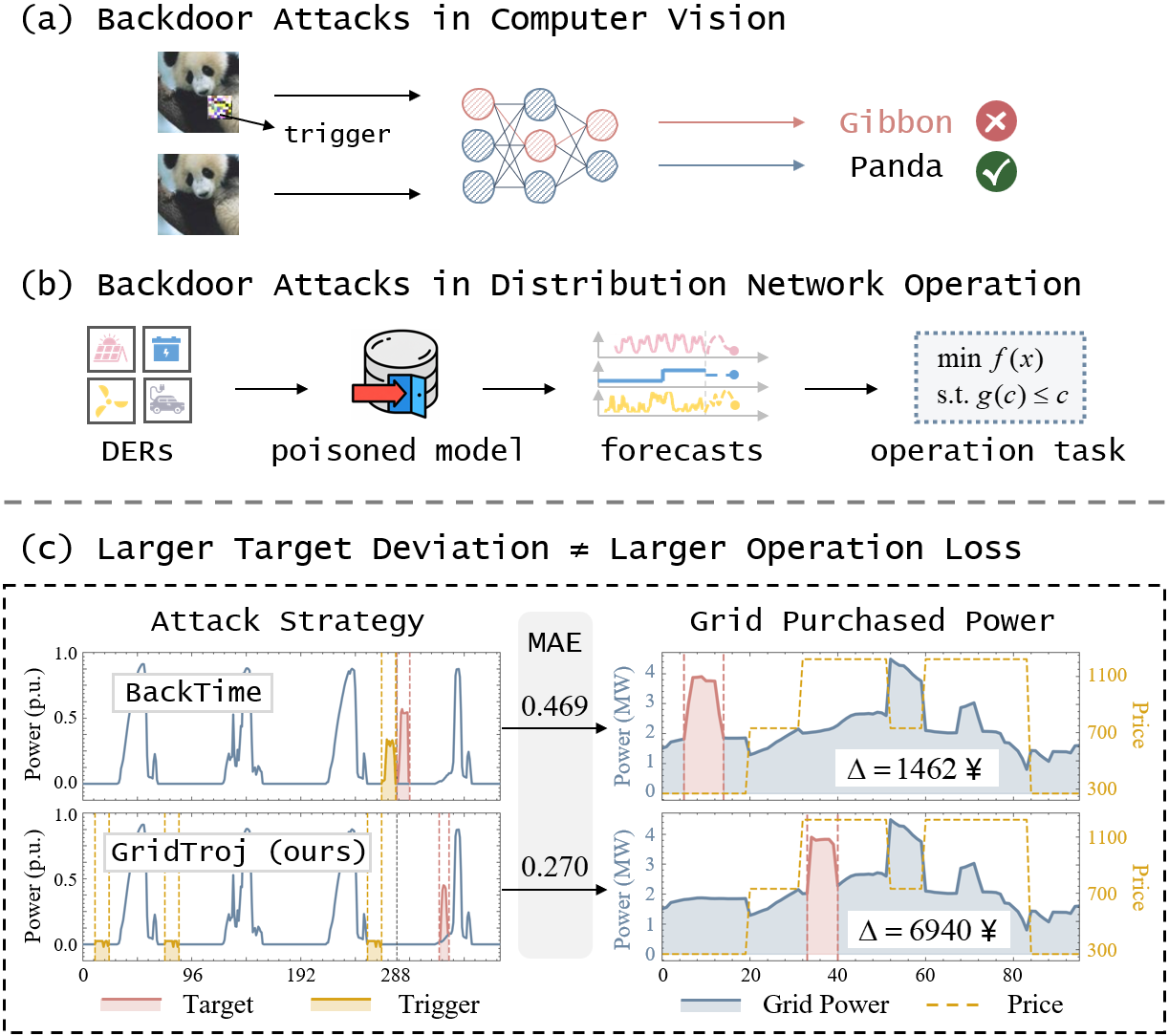
Figure 1: (a) Illustrates backdoor attacks in image classification; (b) extension to forecast-based grid operation; (c) GridTroj induces smaller forecast error but higher operational loss compared to BackTime.
The GridTroj Framework
GridTroj is a unified framework that integrates two core modules: the Intention Planner and the Backdoor Realizer, orchestrating a principled poisoning strategy for maximum downstream operational impact.
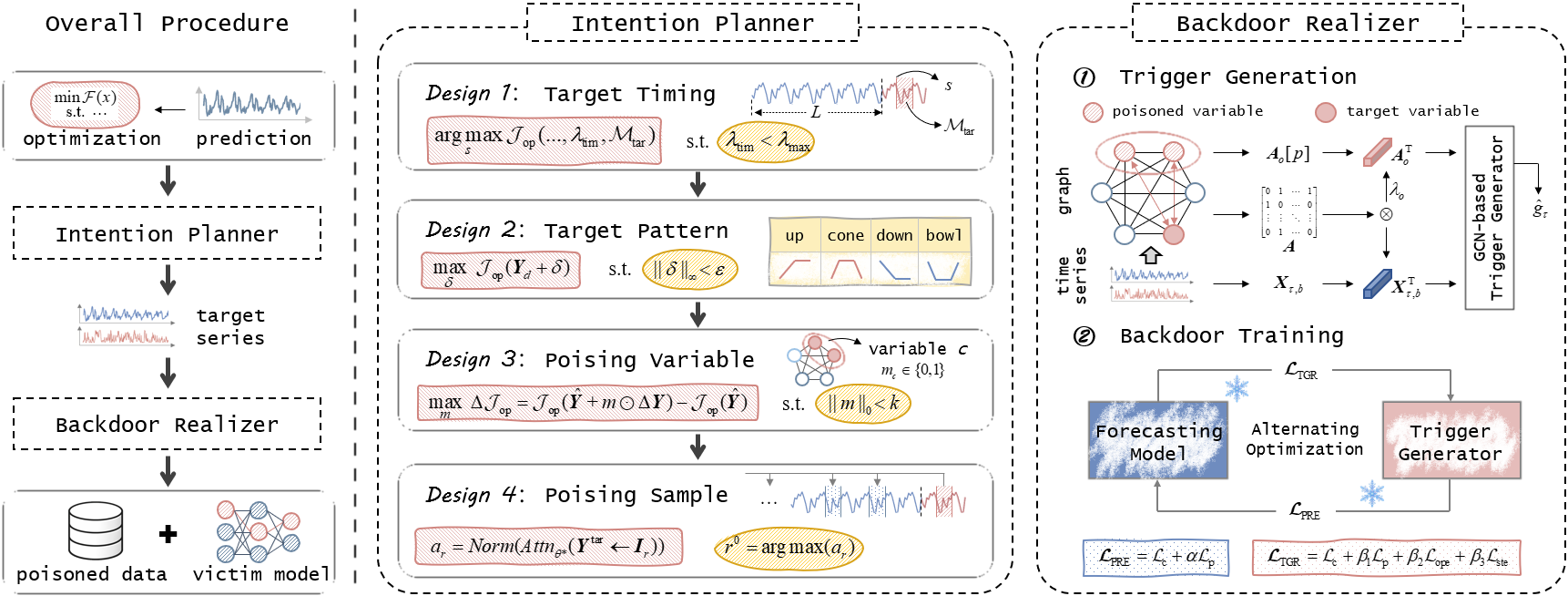
Figure 2: The overall architecture of GridTroj, bridging forecast-based data injection and operational loss.
Intention Planner
The Intention Planner performs operation-aware analysis to construct backdoor attack targets aligned with the attacker's objectives. It differs from naive trigger-target association by leveraging the sensitivity of downstream control and optimization tasks to forecast perturbations. Key components include:
- Target Timing and Pattern: Instead of static or naive target placement, GridTroj analyzes the sensitivity of future intervals and variable selection to the operational objective, guiding trigger injection where it yields maximal disruption.
- Sample and Variable Selection: A principled procedure identifies which DER channels and samples to poison, optimizing operational impact while ensuring stealth through physically plausible patterns.
Backdoor Realizer
To translate intention-aware design into a functioning backdoored model, the Backdoor Realizer extends canonical time series backdoor paradigms with crucial modifications:
- Decoupled Trigger-Target Realization: Architectural extensions allow for triggers and their associated operationally damaging targets to be temporally separated, an essential adaptation for time series applications involved in control pipelines.
- Alternated Training Strategy: The forecasting model and the trigger generator are updated in an alternating fashion, and a boosting-style reweighting further amplifies focus on difficult-to-trigger samples.
- Operation-Aware Loss Functions: Beyond standard regression metrics, the loss functions explicitly capture operational loss gradients, using a lightweight surrogate network to predict downstream cost changes due to forecast deviations, coupled with distributional discrepancy penalties.
Experimental Evidence and Ablation
Experiments encompass three canonical power system tasks (Volt-Var Control, Economic Dispatch, and Coordinated Active/Reactive Optimization) on several IEEE test feeders, using current state-of-the-art forecasting backbones (notably PatchTST), and compare GridTroj to existing time series backdoor and adversarial/poisoning baselines.
GridTroj demonstrates:
Notably, ablation analyses confirm that removing any major GridTroj design component significantly degrades operational disruption. Omission of the Intention Planner shifts attack behavior towards generic error maximization, reducing both operational gap and attack efficiency.
Case Analysis: Forecast-Driven Operational Disruption
The case study on coordinated active/reactive optimization exposes the mechanism by which GridTroj subverts grid operation. In the event of a poisoned forecast, optimal control actions—such as energy storage system (ESS) and electric vehicle (EV) charging—are systematically misled to produce costly or even infeasible system behaviors, e.g., evening supply deficits and excessive grid power imports under peak tariffs.
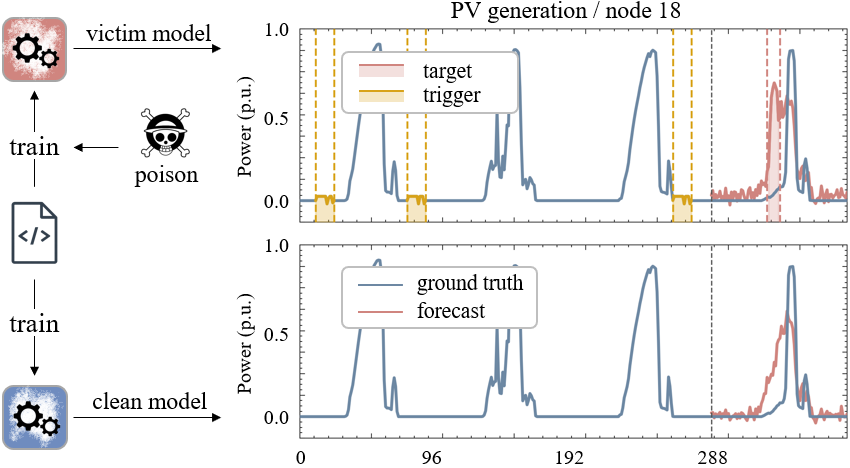
Figure 4: Comparison between attacked and clean forecasts for critical DER signals at the trigger window.
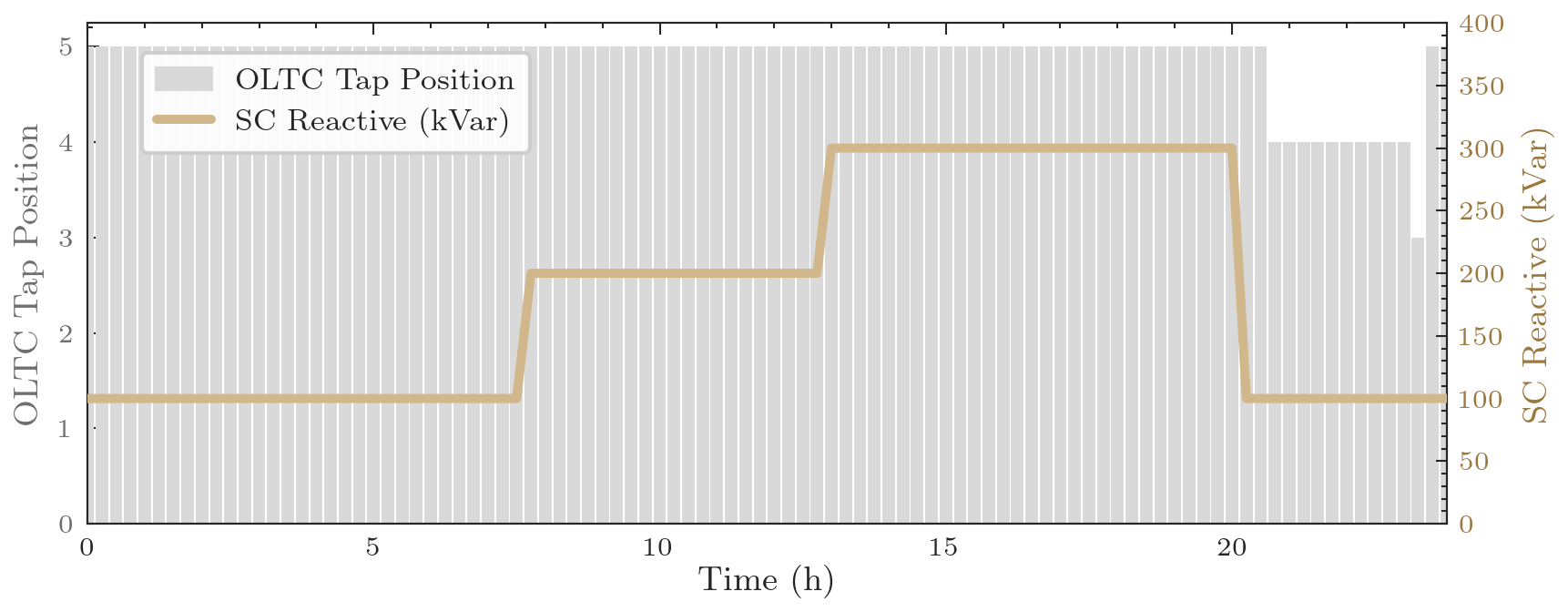
Figure 5: Operational control variables (OLTC tap, SC power) under both normal and attacked forecasting—reflecting discrete control in the VVC task.
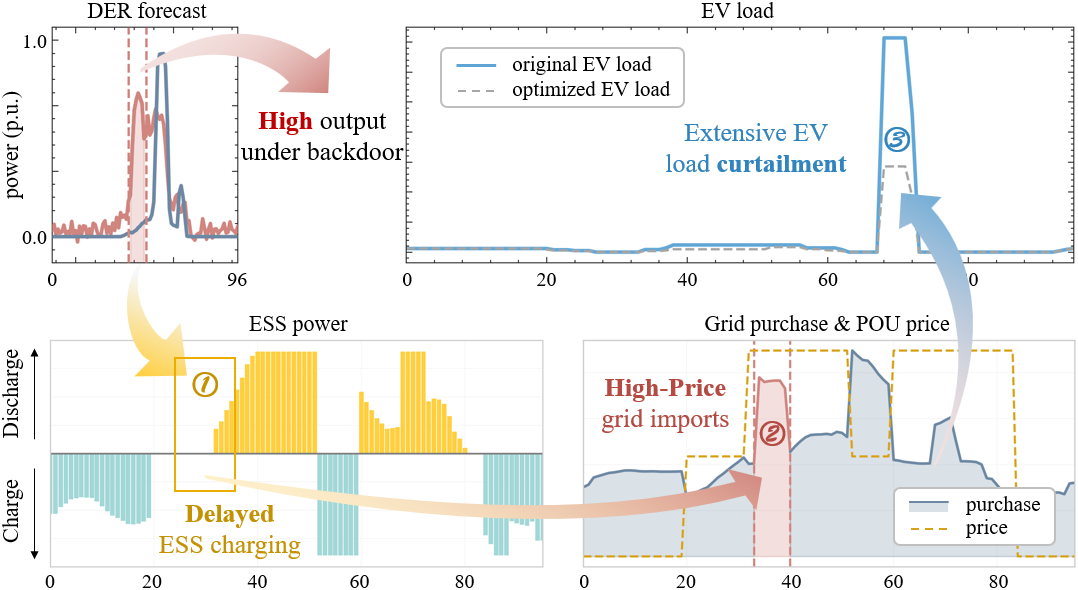
Figure 6: Impact on ESS dispatch, EV load profiles, and grid power purchases due to triggered adversarial forecasts.
This operational pathway from data poisoning to system-level harm, despite comparable forecast errors, underscores the inadequacy of loss function-based security measures, reinforcing the necessity for task-aware evaluation.
Design Sensitivities and Hyperparameter Analysis
GridTroj’s efficacy is founded on optimal hyperparameter selection (e.g., poison variable count, scaling factors, poison sample ratios). Experiments support the utility of greedy variable selection and multi-trigger strategies, particularly for periodic or multi-day input windows. Tuning the poison sample ratio is critical for balancing the model’s capacity to fit the trigger-to-target mapping.
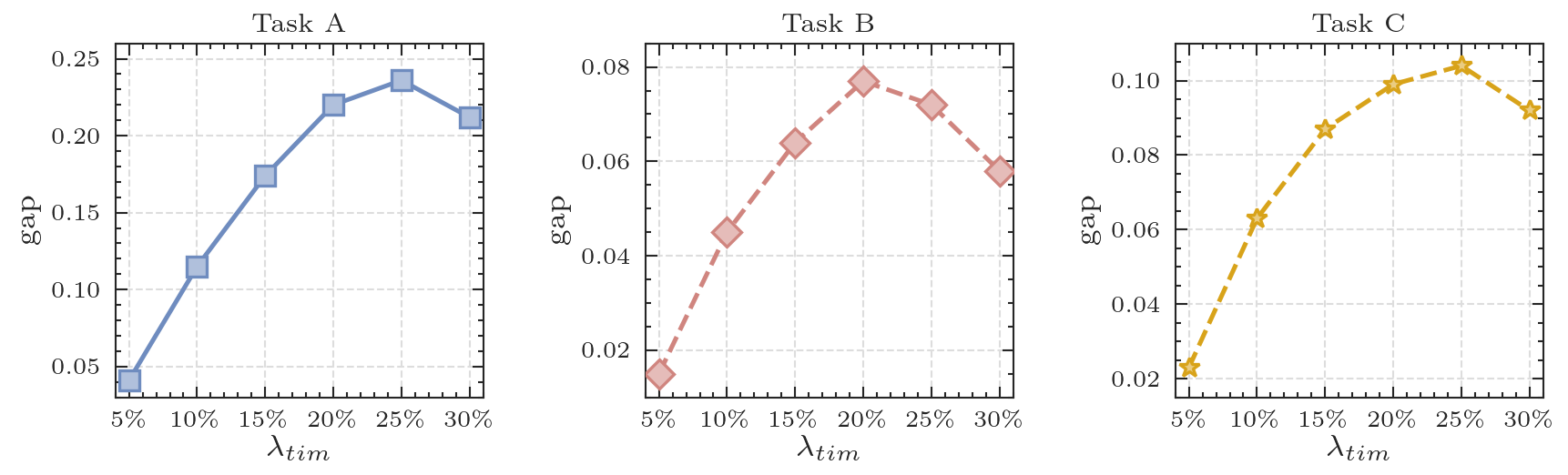
Figure 7: Analysis of attack cost scaling factor λ—attack gap saturates with increased amplification.
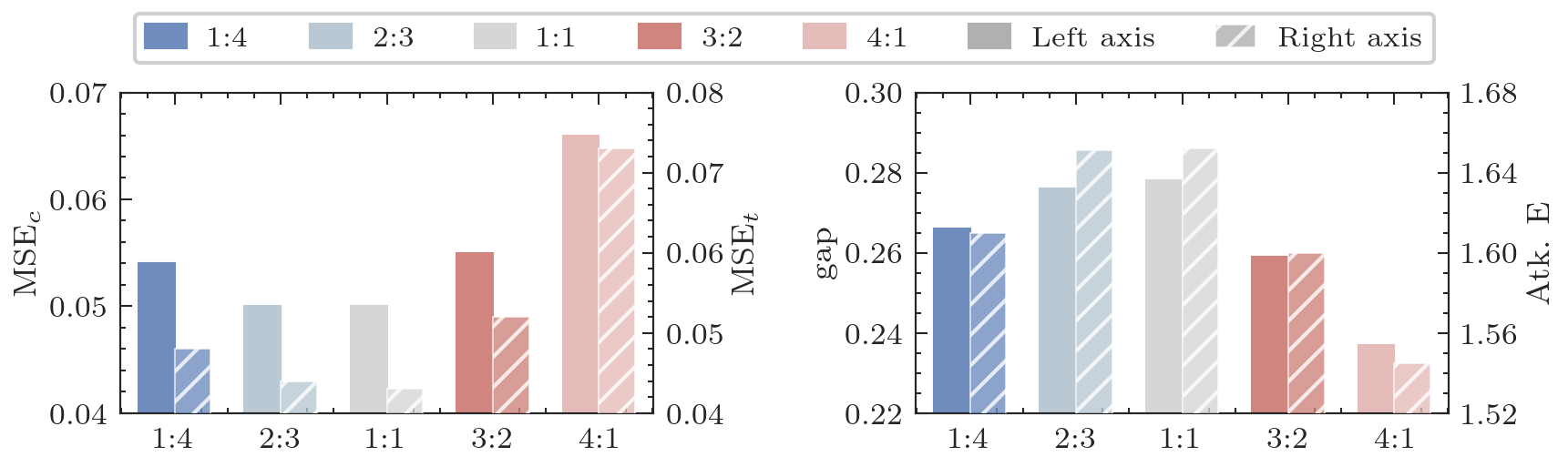
Figure 8: Poisoned sample ratio impacts target fitting error and attack effectiveness.
Implications and Future Directions
GridTroj elevates the sophistication of time series backdoor attacks by integrating end-task operational objectives into its attack pipeline. This work demonstrates that downstream system-level impact can be orders-of-magnitude higher than conventional backdoor or adversarial approaches for the same forecast error. Its generality and modularity enable application to a wide spectrum of forecast-driven control tasks beyond distribution networks.
From a security perspective, the results demand re-evaluation of machine learning robustness in cyber-physical applications, particularly for supervisory and closed-loop control. Standard anomaly detection and physical constraint checking provide insufficient guarantees. The explicit operational focus of GridTroj points towards the requirement for system-aware defensive strategies and more expressive anomaly modeling—potentially leveraging integrated digital twin and process-invariant checks.
Future research should explore collaborative or game-theoretic backdoor attacks among independent DER vendors, extensions to multimodal/LLM-based forecasting architectures, and scalable, certifiable defenses across the supply chain of machine-learned control systems.
Conclusion
GridTroj establishes a new standard for attacking forecast-driven cyber-physical systems by aligning backdoor trigger-target mechanisms with task-level operational disruption. Its intention-aware adversarial framework surpasses prior models in attack efficiency, stealthiness, and transferability, underscoring the urgent need for operation-aware defense mechanisms in safety-critical time series applications.
(2606.21846)