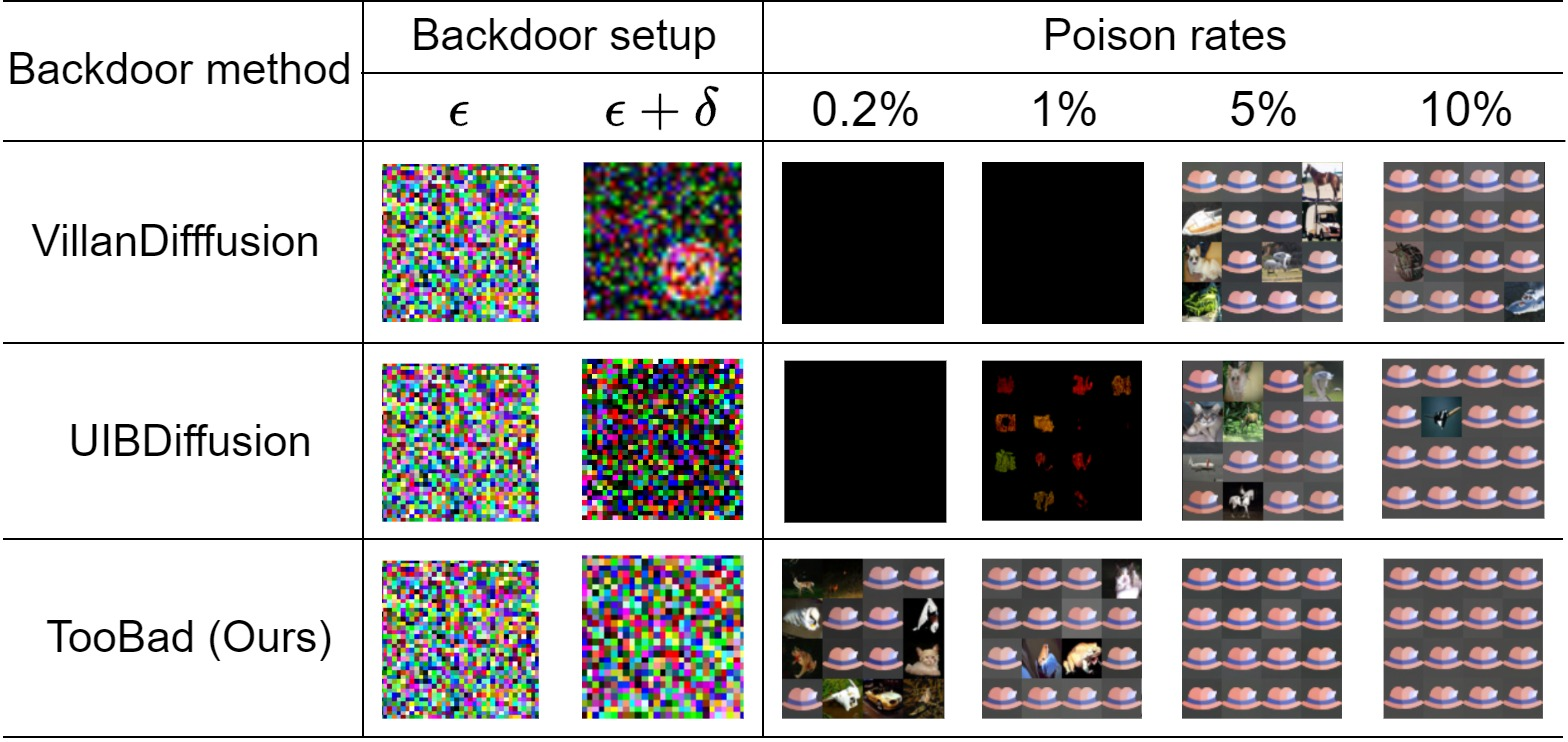
- The paper introduces an optimized trigger in the noise space of diffusion models, achieving backdoor attacks at ultra-low poison rates (0.2–1%) with imperceptible triggers.
- It employs a novel optimization framework that minimizes the generative gap between triggered noise and noised targets, ensuring rapid convergence and high attack success rates.
- Empirical results confirm that TooBad evades state-of-the-art defenses while generalizing across architectures and high-res datasets, exposing critical security vulnerabilities.
TooBad: Backdoor Diffusion Models with Ultra-Low Poison Rate and Imperceptible Trigger
Introduction and Motivation
The proliferation of diffusion models (DMs) has established them as the core generative paradigm across domains such as vision, audio, bioinformatics, and NLP, outperforming adversarial counterparts and variational approaches in fidelity and sample diversity. However, the security landscape of DMs remains insufficiently explored, especially regarding backdoor attacks that can insidiously compromise generative outputs with imperceptible triggers and ultra-low poisoning. Existing research reports critical limitations: SOTA attacks require high poison rates (10–30%), suffer from poor stealthiness, induce significant computational overhead, and are prone to detection by advanced backdoor defenses. These limitations are formalized as the backdoor "quadrilemma"—the provable inability of current attacks to achieve high attack performance, stealth, efficiency, and low resource utilization simultaneously.
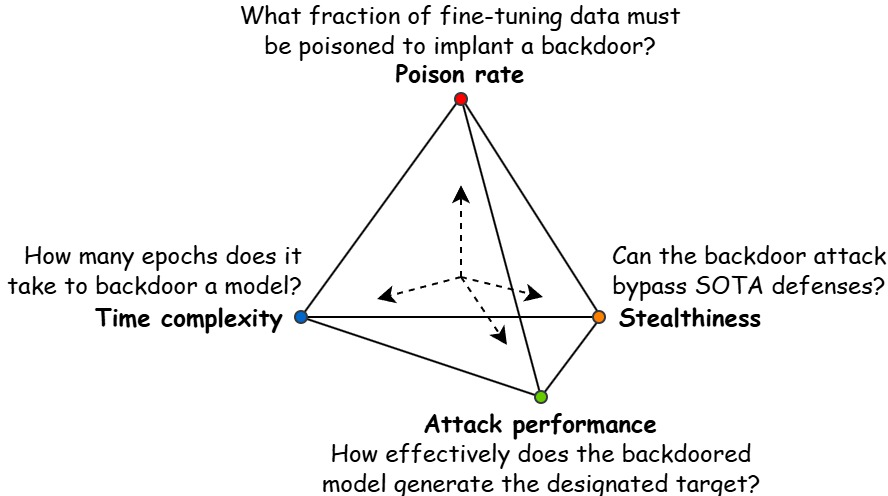
Figure 1: The quadrilemma illustrating the inability of SOTA attacks to meet all backdoor criteria simultaneously.
Threat Model and Attack Mechanism
The threat model assumes an attacker with the capability to poison a minuscule fraction of training samples or fine-tuning steps but without control over the main training pipeline. The malicious goal is to implant a precise mapping between an invisible (imperceptible and sparse) trigger stamped into the model’s sampling process and an attacker-chosen backdoor output. The clean generative fidelity must be preserved, all poisoned manipulations indistinguishable to SOTA detectors, and the attack must be practical—implemented with minimal compute and data disturbance.
Prior methods, such as VillanDiffusion and UIBDiffusion, either rely on visually salient triggers, fail at low poison rates, or require extended learning time. TooBad is the first to introduce a DM-tailored trigger optimization framework, explicitly formulating and directly minimizing the generative gap between a triggered noise and a noised backdoor target under strong imperceptibility constraints. The procedure is as follows:
- Optimize a sparse, low-norm trigger δ in noise space, specific to a chosen backdoor target, such that the forward process xtforward of the target matches the reverse denoising of the triggered noise xtbackward (before backdoor injection).
- Fine-tune the generative model with an injected trigger-target mapping at an extremely low poison rate, leveraging the fact that the optimized trigger already partially "aligns" the model’s generative distribution towards the target.
- Enforce invisibility and sparsity via PGD and l0/l∞ constraints during trigger optimization—ensuring SOTA detection methods are ineffective.
Trigger Optimization: Methodology
Trigger optimization is performed by solving a continuous minimization problem in the DMs’ noise embedding space. The attacker samples random noise and, at each iteration, tweaks the trigger δ such that the discrepancy (MSE) between the denoising output starting from triggered noise and the multi-step noising of the target is minimized. Imperceptibility is enforced via:
- l∞-norm clipping to a small threshold ε
- Hard thresholding to the k largest entries to induce sparsity
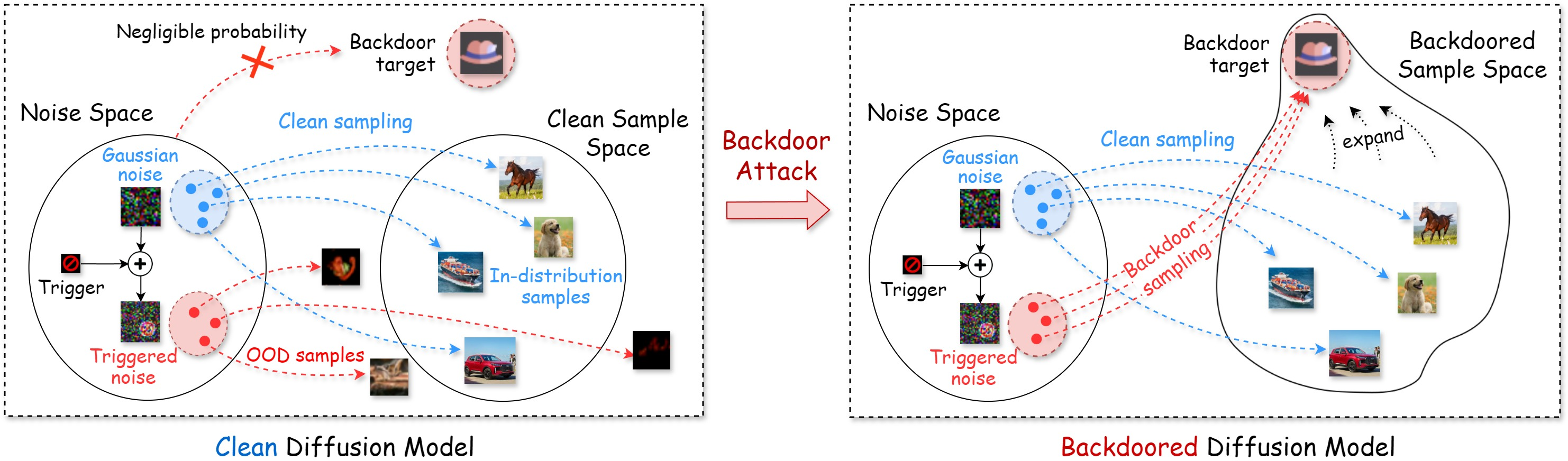
Figure 2: An illustration of backdoor attacks on DMs. Pre-attack, the backdoor target is unreachable from the sample space; post-backdoor, the target is consistently generated from triggered noise.
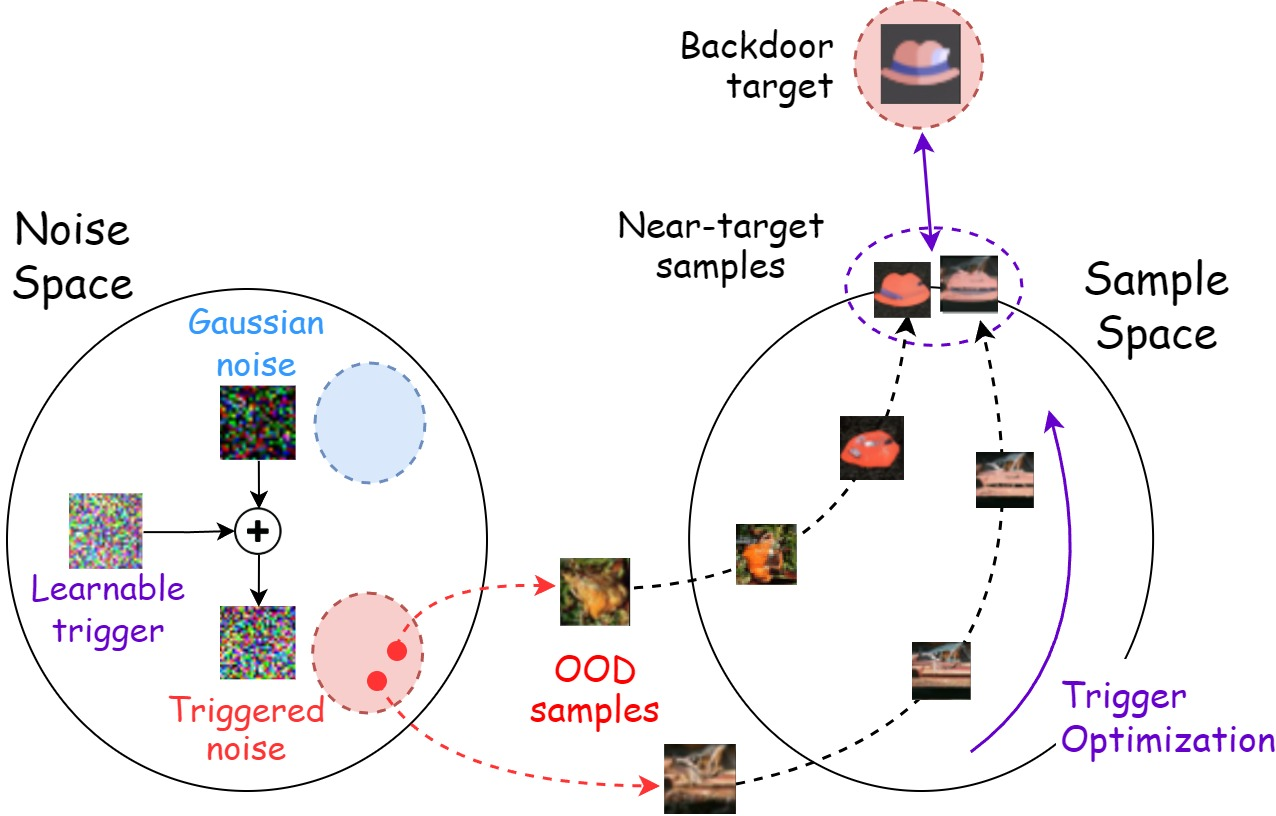
Figure 3: TooBad's trigger optimization: the trigger is directly optimized in noise space to collapse the generative distribution towards the backdoor target before injection.
This framework contrasts with prior art, which leverages arbitrary or classifier-based triggers not coupled to the DM’s generative mechanics. TooBad's optimization is model-aware and operates in the exact space actuated during generation, sidestepping the inefficiency of patch-based or image-space triggers.
Empirical Results
The TooBad framework yields multiple salient results:
Quantitative metrics show a consistent advantage: at a 1% poison rate, TooBad reaches 93% ASR, 0.01 MSE, and 0.91 SSIM—figures unattainable by previous work at any comparable regime.
Analysis of Properties and Ablations
The authors present comprehensive ablations on:
- Alternative Targets: Attack efficacy generalizes to varied backdoor targets, making the method equally viable for harmful or arbitrary semantically-rich objectives.
- Architectural Generality: TooBad works not only for DDPMs and LDMs but also in more challenging Score-based NCSNs, achieving high ASR at half the poison rate required by previous attacks.
- Scalability: Experiments extended to high-res datasets (CelebA-HQ) demonstrate robustness and generalization to different data regimes and model scales.
The crucial insight is the explicit consideration of the generative mapping between triggered and target distributions—resulting in an attack that is robust to reductions in available poisoned data, imperceptible to advanced inversion and detection, and agnostic to architectural details.
Theoretical and Practical Implications
TooBad exposes a substantial shortcoming in the security assumptions of generative modeling: the diffusion process itself, and not just auxiliary encoders or classifiers, is amenable to highly efficient, undetectable backdoor manipulations. This shifts the defensive focus from "patching" encoders to fundamentally rethinking noise propagation and the construction of robust denoising mappings. The success at sub-1% poison rate also raises concerns about the practicality of supply chain attacks and the feasibility of detecting or sanitizing compromised generative models in open-source and cloud training environments. Future work should investigate dynamic defense mechanisms that examine generative sample space expansions, distribution drift under rare triggers, and process-level anomaly detection—not just input/output alignment.
Conclusion
TooBad marks a new standard in backdoor attacks against diffusion models by achieving all facets of the quadrilemma: efficiency, stealth, attack performance, and minimal resource use. The approach is grounded in sound optimization of the DM’s own generative structure, setting a benchmark for both attackers and defenders. The results emphasize the urgency of devising new, generative-model-specific defenses capable of identifying and mitigating such highly stealthy and effective threats in practical settings.