- The paper demonstrates that time delays in excitatory coupling induce abrupt transitions from asynchronous or anti-phase to in-phase synchrony in excitable networks.
- Using a Watts-Strogatz network of FitzHugh-Nagumo neurons, the study shows that longer delays lower the synchronization threshold and foster multistability.
- Numerical and theoretical analyses reveal that delay-induced explosive synchronization is robust across variations in noise, heterogeneity, and network topology.
Abrupt Transitions in Excitable Networks Induced by Delayed Synchronization
Introduction
The paper "Delay coordinates synchronization and induces abrupt transition in excitable networks" (2606.21703) presents a comprehensive investigation into how time delays in excitatory coupling reorganize collective dynamics in excitable neuronal networks. The study is motivated by the ubiquity of communication delays in biological and artificial neural systems, rooted in finite signal propagation and synaptic transmission times. By analyzing FitzHugh-Nagumo networks and leveraging both numerical and theoretical perspectives, the authors highlight that delays serve as a general mechanism for organizing synchronization—leading to abrupt, explosive transitions between anti-phase and in-phase regimes.
Mechanistic Insights and Network Model
The core of the analysis is a Watts-Strogatz network of N=100 FitzHugh-Nagumo neurons, with heterogeneity and stochastic drive inducing irregular spiking. The coupling is excitatory, modeled by time-delayed synaptic inputs. The time delay τ is introduced as a control parameter, and the collective dynamics are characterized via temporal averages of phase order parameters R(1) (in-phase) and R(2) (anti-phase).
The principal claim is that sufficiently large transmission delays radically amplify irregular spiking, driving qualitative changes in collective behavior. As the coupling strength ε increases, the network transitions from asynchronous firing to anti-phase synchronization, and, above a critical threshold, displays an abrupt transition to in-phase synchrony.
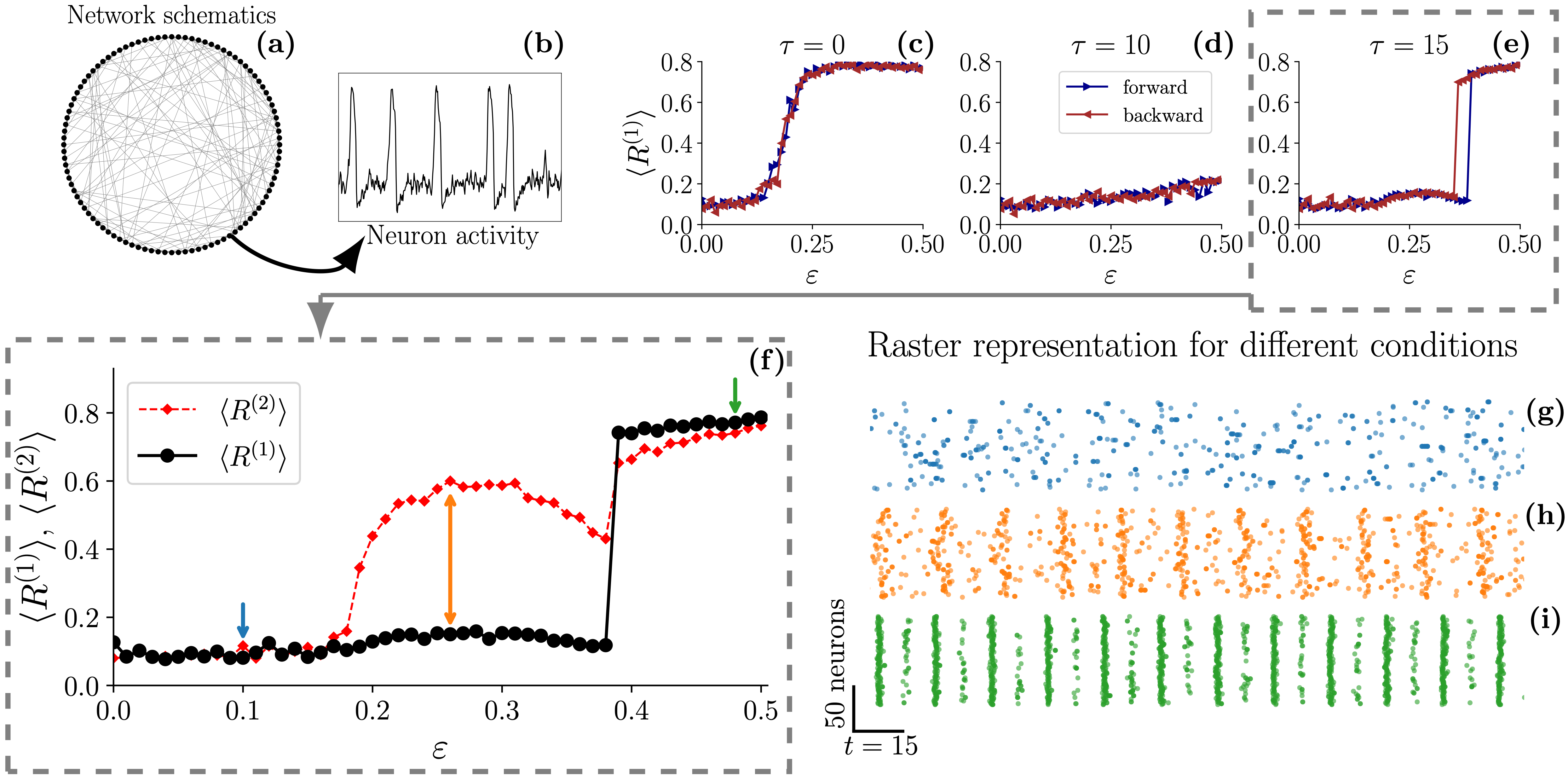
Figure 1: Watts-Strogatz network dynamics and abrupt transition to phase synchronization, with order parameters and raster plot evolution illustrating asynchronous, anti-phase, and synchronous regimes.
Delay-Induced Synchronization Patterns
A detailed sweep over the delay parameter τ reveals a non-monotonic dependence of the collective state on delay length. For small delays (τ≤7), the network exhibits a smooth transition to phase synchronization as ε increases. Intermediate delays (7<τ≤13) suppress synchrony, favoring anti-phase clusters. Critically, for long delays (τ>13), explosive synchronization emerges, with abrupt, hysteresis-laden transitions between incoherence and synchrony as coupling varies. Notably, increased delay reduces the threshold τ0 for synchronization onset.
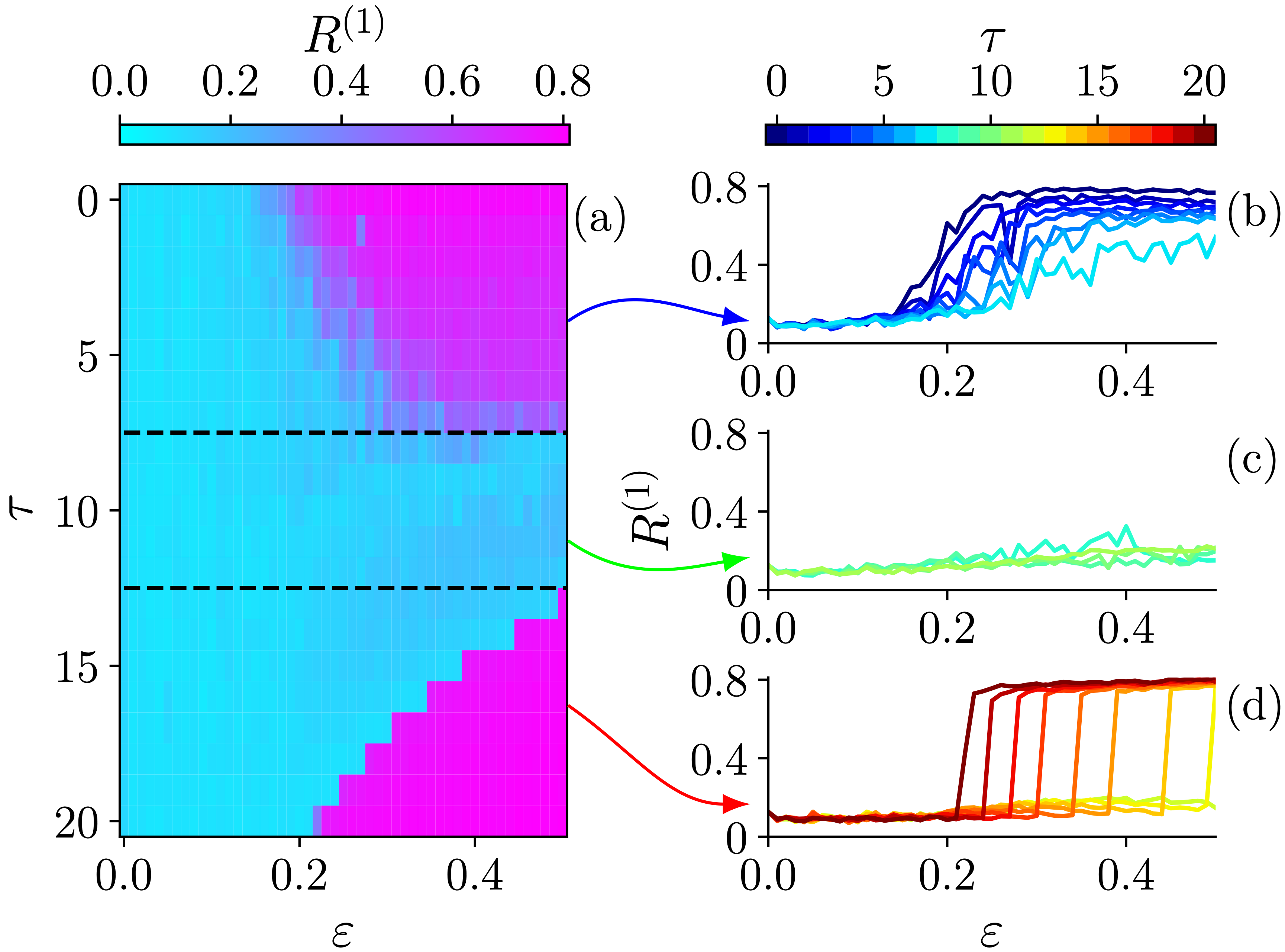
Figure 2: Delay-coupling parameter space revealing regimes of smooth to abrupt transitions, with critical thresholds dependent on both τ1 and τ2.
Minimal Mechanistic Illustration
The authors dissect the attractor dynamics with a simplified two-neuron model under fixed coupling. Three regimes are shown: irregular spiking for low delay (τ3), self-sustained anti-phase for intermediate delay (τ4), and stable in-phase for long delay (τ5). When stochastic drive is removed, only sufficiently delayed networks sustain deterministic oscillations—highlighting delay as a requisite for self-sustained synchrony.
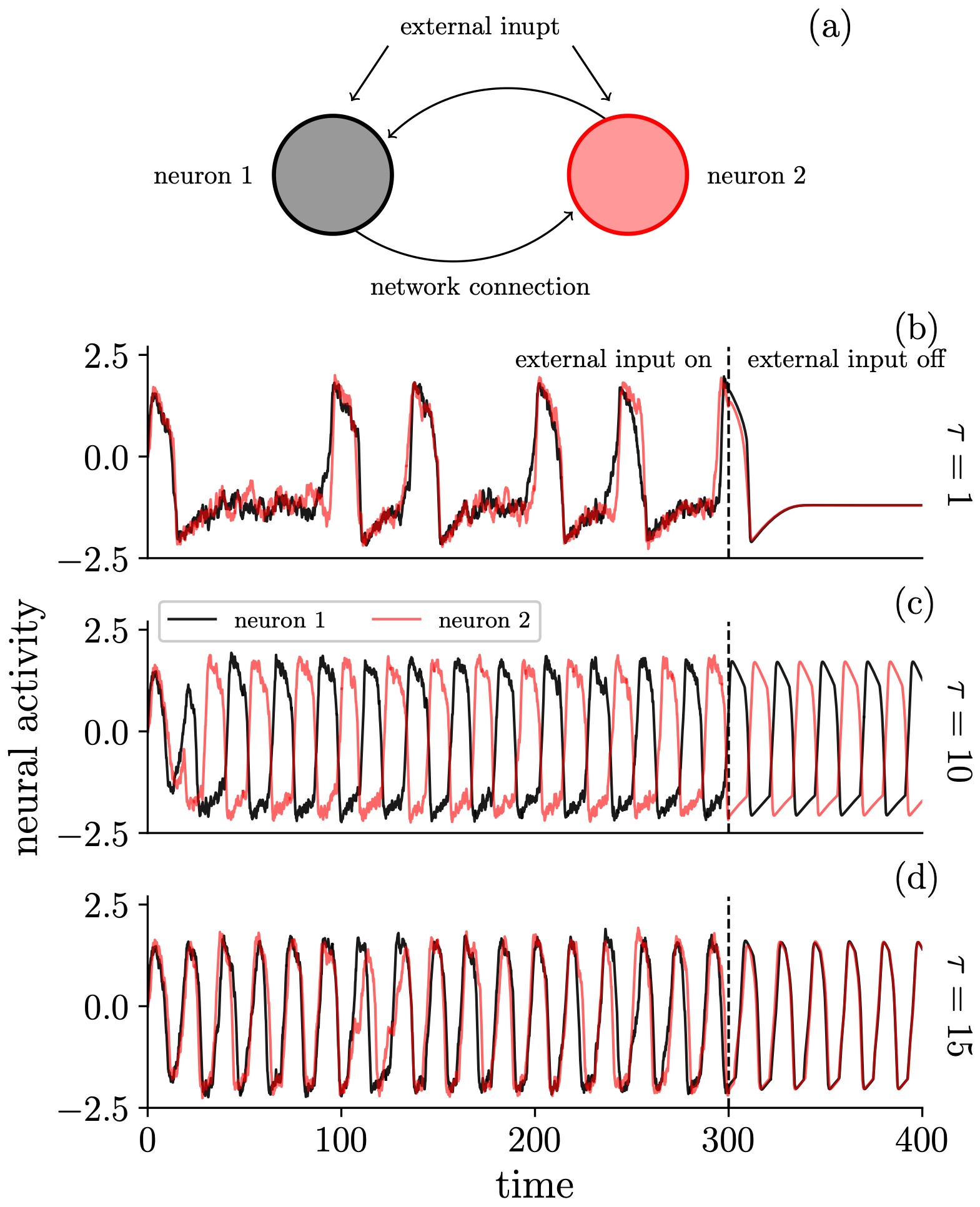
Figure 3: Two-neuron delay-coupling system demonstrates self-sustained anti-phase and in-phase oscillations dependent on delay magnitude.
Robustness and Generality
The underlying synchronization mechanism only requires (i) irregular spiking (from heterogeneity, noise, or chaos), (ii) excitatory coupling, and (iii) sufficiently large delays. This leads to delay-driven multistability and abrupt transitions robust to network topology, initial conditions, neuronal models, and noise—as shown in supplementary figures and extensive numerical trials. This coordination mechanism is independent of specific architectural constraints and applies broadly to excitable systems.
Theoretical Context and Implications
The phenomenon aligns with prior studies on explosive synchronization in oscillator and spiking networks, extending the mechanistic repertoire to include delayed excitatory interactions as a critical coordinating factor. Time delays are shown not simply as disruptive, but as structural organizers capable of modulating network multistability, cluster formation, and abrupt transitions. The paper's findings are strongly supported by numerical evidence, including clear regime boundaries and hysteresis phenomena in parameter sweeps. The theoretical implications are significant, providing a framework to interpret temporal latencies as dynamical control dimensions for network computation and synchronization transitions.
Practically, the results inform the design and modeling of neural circuits, both biological and artificial. Delays can be leveraged in SNNs and reservoir computing to enhance computational capacity, generate spatiotemporal structure, and control synchronization. The mechanism is particularly relevant for processing in distributed neural architectures, where coordination across heterogeneous delays is commonplace. The paper suggests that further exploration into distance-dependent, heterogeneous delays could reveal richer spatial-temporal dynamics, such as wave propagation and selective cluster synchrony.
Speculation on Future Directions in AI
The identification of delay-driven explosive synchronization opens routes for exploiting temporal coordination in neuromorphic engineering, adaptive SNN training, and reservoir design. Incorporating controlled delays may enable abrupt transitions, multistability, and synchronization modulation for tasks requiring flexible temporal information processing. Future theoretical investigations could deeply characterize the interplay between delay, excitation, and collective dynamics in more complex architectures, including hierarchical and modular arrangements.
Conclusion
This study delivers a rigorous framework for understanding how delayed excitatory coupling organizes and sustains synchronization in excitable networks. The robust, abrupt transition phenomenon governed by delay and coupling offers new perspectives on the controllability of collective dynamics, with broad applicability to neuroscience and artificial intelligence. The results underscore the critical role of temporal latencies as organizing principles in networked excitable systems, and provide foundational directions for translational research in both biological and computational paradigms.

