- The paper extends classical operator inequalities, like Golden–Thompson, to a tensor setting via a generalized φ-product framework.
- It quantifies transform sensitivity by linking defect magnitudes in inequalities to the commutator energy of spectral-domain slices.
- It formulates transform selection as an optimization problem over the unitary group, demonstrating adaptive schemes that reduce defect significantly.
Introduction
The paper "Operator Inequalities in Φ-Product Tensor Algebras: Invariance and Transform Sensitivity" (2606.21667) addresses foundational properties of operator inequalities in generalized tensor algebras, specifically the Φ-product framework for third-order tensors. The focus is on how classical matrix operator inequalities—such as Golden–Thompson, Jensen, Klein, and Lieb—extend to this tensor setting, while revealing nontrivial sensitivity in the slack (defect) of these inequalities to the choice of spectral basis Φ.
The Φ-product framework generalizes the t-product by substituting the discrete Fourier transform—with an arbitrary unitary transform Φ—facilitating matrix-like algebraic operations on tensors but inducing variable commutative structures. This work provides rigorous extensions of operator inequalities and a technical characterization of defect phenomena, culminating in strong separation results for transform sensitivity and a formal optimization theory for adaptive transform selection.
Algebraic Foundations: Φ-Product and Spectral Representation
The Φ-product is defined by block-diagonalizing the tensor after tube-wise unitary transformation. Algebraic operations (product, trace, exponentiation) are lifted from matrices to tensors in the transform domain, and Φ-Hermitian tensors are characterized via the Hermiticity of these block-diagonal slices.
This algebra isomorphic structure allows for direct transfer of matrix operator inequalities to the tensor setting. The spectral mapping lemma underpins this, showing analytic matrix functions apply blockwise under the Φ0-product, preserving the eigenstructure of the slices.
Invariance of Operator Inequalities
The main theoretical result is that classical operator inequalities remain valid in the Φ1-product algebra with identical constants to the matrix case. Explicit proofs for Golden–Thompson, Jensen, Klein, and Lieb-type inequalities follow from the algebraic isomorphism to block-diagonal matrices, yielding algebraic invariance for the tensor analogs. This confirms that, from an algebraic perspective, the choice of Φ2 does not affect validity or constants—however, it is agnostic to quantitative behavior.
The crux of the paper is the introduction and analysis of the defect
Φ3
which quantifies the slack in the Golden–Thompson inequality. The defect is characterized as a sum of slice-wise classical defects:
Φ4
where Φ5 and Φ6 are the Φ7-domain frontal slices.
A central theorem establishes that Φ8 is quadratically equivalent (up to universal constants) to the aggregate transform-domain commutator energy,
Φ9
highlighting that commutativity in the transform domain directly governs the defect magnitude.
Demonstrative constructions show that for specific tensor pairs, the defect can vanish under one transform (e.g., DFT), yet grow linearly with tensor depth under another (e.g., DCT), establishing strong Φ0 separation. This shatters the misconception that the transform is a benign change of basis—quantitative inequality tightness depends intrinsically on the spectral basis.
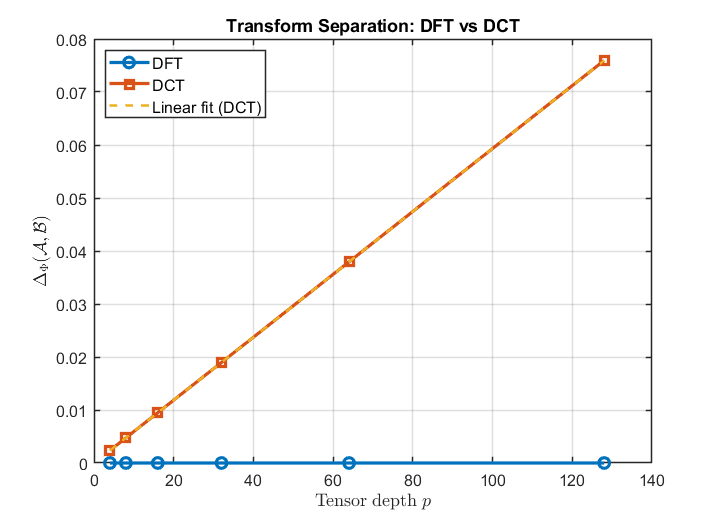
Figure 1: Transform separation under different spectral bases. The Golden–Thompson defect Φ1 grows linearly with Φ2 for DCT but is negligible with DFT, confirming strong transform sensitivity.
Non-Universality and Data-Dependent Optimality
The paper gives a rigorous non-universality theorem: no fixed transform minimizes Φ3 for all tensor pairs. For any pair of transforms, there exist tensors for which each is strictly superior in defect minimization. Underpinning this is the recognition that transform selection induces a geometry of commutator energy, and optimal choices are inherently data-dependent.
From the established equivalence, optimal transform selection becomes an optimization problem over the unitary group Φ4, minimizing
Φ5
This is directly connected to approximate joint diagonalization. The paper presents a Riemannian gradient flow scheme for this minimization, leveraging polar retraction for unitary constraint and gradient projection onto the tangent space. Numerical experiments show adaptive transform selection can yield defect reductions by an order of magnitude relative to standard DFT or DCT choices.
Practical and Theoretical Implications
The separation of algebraic invariance from quantitative behavior advances tensor algebra theory and informs practical applications where spectral operator compatibility matters (e.g., robust PCA, tensor completion). Transform selection, rather than being trivial, is a principled optimization accounting for operator commutativity, with implications for spectral stability, numerical conditioning, and representational efficiency.
Speculative extensions include higher-order tensors, non-unitary transforms, data-driven transform learning, and connections to infinite-dimensional operators. The paper's results underline the necessity of adaptive transform selection, paralleling "no free lunch" principles: no single basis simultaneously optimizes commutativity for all operators.
Conclusion
This paper rigorously establishes that while classical operator inequalities remain algebraically invariant under the Φ6-product framework, the defect measuring their tightness exhibits strong sensitivity to the choice of spectral basis. The characterization of defect in terms of transform-domain commutativity, the demonstration of strict separation phenomena, and the formulation of transform selection as a group optimization provide both fundamental and practical insights. Optimal transform selection emerges as a central, data-dependent task for enhancing spectral compatibility in tensor algebraic analysis.