- The paper’s main contribution is isolating context drift as a key factor in LLM hallucinations, quantified by the Context Divergence Score (CDS).
- It introduces the Shared State Verification Protocol (SSVP) which uses selective synchronization to resolve state inconsistencies and reduce API calls by 58%.
- Empirical evaluations show that targeted synchronization reduces hallucination rates compared to full-broadcast methods, especially in multi-domain planning scenarios.
Hallucination as Context Drift: Synchronization Protocols for Multi-Agent LLM Systems
Context Drift and Its Formalization in Multi-Agent LLMs
Multi-agent LLM systems exhibit persistent hallucination phenomena that cannot be fully explained by deficiencies intrinsic to individual LLMs. This paper isolates an alternative underlying mechanism: context drift, defined as the divergence in internal knowledge states among concurrently operating agents. Context drift manifests along spatial, temporal, and task axes, yielding systemic contradictions even when local agent reasoning remains sound. The authors formally introduce the Context Divergence Score (CDS), a scalar metric derived from cosine distance between agent context embeddings that operationalizes semantic drift without full state exchange or dependency on model internals. CDS facilitates real-time alignment detection, enabling threshold-based interventions that are computationally efficient and scalable for small teams.
Shared State Verification Protocol: Design and Rationale
Building on CDS, the paper proposes the Shared State Verification Protocol (SSVP), a selective synchronization mechanism wherein agents exchange context summaries only when system-level CDS exceeds a calibrated threshold (τ=0.25). SSVP involves two principal operations: (1) generation and exchange of compressed state summaries; (2) conflict adjudication via ContextMerge, where contradictions are surfaced and resolved by explicit reasoning steps utilizing timestamped task histories and authoritative source attribution. This methodology prevents the propagation of erroneous beliefs across agents, reducing unnecessary communication overhead (58% fewer API calls than naive full-broadcast) and avoiding indiscriminate contamination.
Empirical Evaluation and Contamination Effect
The authors conduct controlled evaluations across two domains—multi-agent travel planning and software project planning—using Claude Haiku as the LLM backend. In the travel domain, injected context mismatches (e.g., incorrect destination, stale weather, truncated schedule) lead to substantial divergence and contradictions when left unsynchronized. Metrics include Hallucination Rate (HR), Task Coherence Score (TCS), Recovery Steps, and system-level CDSsys. The critical empirical result is the identification of a contamination effect: naive full-broadcast synchronization, as opposed to selective SSVP, increases HR by 34% relative to no synchronization (HR: 0.658 vs. 0.492, p=0.0022, d=1.18), with SSVP showing modest but consistent directional reduction (−5.9%, d=0.30) and significant separation from full-broadcast (HR: 0.463, p=0.0005, d=1.47).
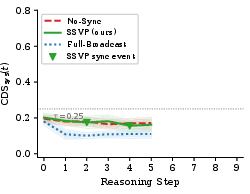
Figure 1: System-level CDSsys dynamics across reasoning steps, marking SSVP-triggered synchronization events and contamination-induced convergence under full broadcast.
Full-broadcast drives agents to consensus, but on erroneous state, resulting in low CDS concurrent with high HR—convergence that is informationally invalid. SSVP, by gating synchronization, ensures early surfacing and resolution of inconsistencies via explicit conflict prompts, thereby preventing silent propagation of hallucinated beliefs.
Domain-Specific Findings and Cross-Domain Generalization
Cross-domain analysis reveals that contamination risk is not universal. In the software project planning domain, errors are more orthogonal; full-broadcast does not replicate the contamination effect and HR is low across all protocols (<0.2). The paper concludes that contamination manifests where shared beliefs cascade across multiple evaluation dimensions (e.g., destination propagating to airport, weather, recommendations), whereas task domains with decoupled agent contexts are robust to naive synchronization.
Implications for Multi-Agent LLM System Design
The results compel a re-examination of communicative strategies in multi-agent LLM architectures. Indiscriminate information exchange increases the probability of systemic failures due to context contamination. The paper advocates context synchronization as a first-class primitive, recommending threshold-gated protocols like SSVP as the default for high-stakes deployments, especially in applications such as travel, healthcare, legal, and finance where erroneous actions can have material impact. The findings frame hallucination mitigation as analogous to distributed systems consistency, suggesting future work in hierarchical CDS computation and integration with retrieval-augmented memory frameworks for scaling to larger agent teams.
Limitations and Future Directions
Limitations include potential loss of fidelity when compressing complex state into single context vectors and error-prone conflict resolution when authority among agents is ambiguous. The experiments, limited to small agent teams and structured planning, may not generalize to dynamic or fully unstructured multi-agent tasks. Future investigations are warranted into hierarchical dissemination protocols, source confidence scoring, and the interplay between proactive synchronization (SSVP) and reactive mechanisms (multi-agent debate, inspector/challenger architectures).
Conclusion
This paper reconceptualizes hallucination in collaborative LLM systems as a distributed context drift problem, providing rigorous formalism and practical protocols for detection and mitigation. CDS and SSVP together deliver reduced hallucination rates, efficient resource utilization, and robust conflict resolution. Indiscriminate synchronization substantially degrades system reliability in certain domains, and selective synchronization emerges as a domain-general strategy for maintaining epistemic alignment among agents. The theoretical and empirical contributions establish context synchronization as a foundational element in the design and operation of multi-agent LLM systems (2606.21666).