- The paper establishes that nonsmooth max-type payoffs in reflected stochastic control require a measure-valued obstacle approach to properly capture singularities.
- The authors leverage a killed-resolvent representation to ensure correct free-boundary determination, validated by numerical simulations and Monte Carlo experiments.
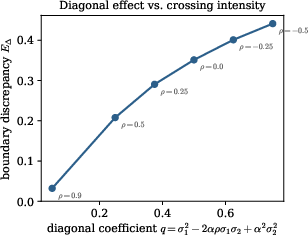
- The study demonstrates parameter sensitivity effects, showing that excluding the diagonal singular measure introduces significant boundary errors.
Problem Context and Formulation
The paper "Nonsmooth Obstacles and Killed Resolvents in Reflected Stochastic Control" (2606.21575) presents a rigorous analysis of an infinite-horizon optimal stopping problem driven by a two-dimensional, normally reflected diffusion in the positive quadrant R+2. The objective is to maximize expected discounted rewards given by a nonsmooth, convex max-type payoff G(x1,x2)=x1∨αx2, subject to a running cost c and discount rate r. The dynamic is governed by the reflected SDE:
dXt=b(Xt)dt+σ(Xt)dWt+dLt,
where Lt enforces normal reflection at the boundary. The primary analytic peculiarity arises from the nonsmoothness of G, whose kink at the diagonal Δ={x1=αx2} induces singular behavior in associated variational and potential-theoretic representations.
Measure-Valued Obstacle and Stopping Gain
The value function for the optimal stopping problem is characterized as the solution to a reflected variational inequality:
max{LV−rV−c,G−V}=0
with normal reflection on {xi=0} for G(x1,x2)=x1∨αx20, where G(x1,x2)=x1∨αx21 is the generator for the diffusion. The nonsmooth nature of G(x1,x2)=x1∨αx22 prohibits standard G(x1,x2)=x1∨αx23 analytic techniques; crucially, the obstacle's singularity on G(x1,x2)=x1∨αx24 forces the stopping gain G(x1,x2)=x1∨αx25 to be interpreted as a signed Radon measure. The singular component localized at G(x1,x2)=x1∨αx26 is explicitly computed via distributional calculus, yielding:
G(x1,x2)=x1∨αx27
where G(x1,x2)=x1∨αx28 and G(x1,x2)=x1∨αx29 denotes surface measure on c0. This term provides the measure-valued analogue of the local time accumulated by c1 at zero, essential for precise modeling near the kink.
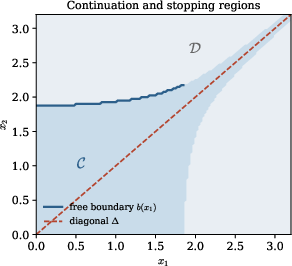
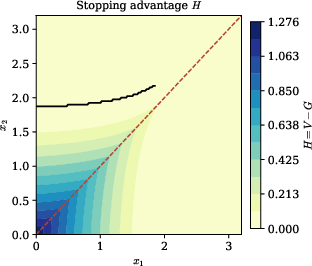
Figure 1: Baseline model; left, continuation region c2 (shaded), stopping region c3, free boundary c4, and diagonal c5; right, stopping advantage c6.
Killed Resolvent Representation
A major conceptual and practical advance is the killed-resolvent representation:
c7
where c8 denotes the resolvent operator for the reflected diffusion, killed upon entry to the stopping set c9. This formula corrects the usual unrestricted-resolvent identity, which erroneously includes post-stopping occupation—an error that results in both analytic inconsistency and incorrect boundary determination. The representation employs the full measure-valued stopping gain, including both absolutely continuous and singular components, and is validated via both deterministic PDE solvers and path-space Monte Carlo estimators.
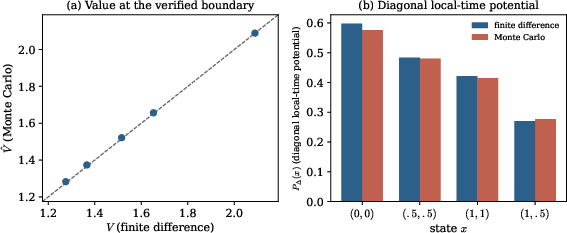
Figure 2: (a) Monte Carlo value r0 at the free boundary against FD value r1; (b) Diagonal local-time potential r2 via deterministic and MC local-time estimators.
Free-Boundary Characterization and Verification
Under explicit monotonicity assumptions—vertical monotonicity of the stopping advantage and nonemptiness of vertical stopping sections—the stopping set admits an epigraph representation:
r3
with r4 constituting the free boundary. The boundary is characterized not via classical smooth fit but by a killed-resolvent trace condition:
r5
The paper formalizes this as a verification theorem: if a candidate boundary r6 yields r7 satisfying domination, contact, strict continuation, normalized reflection, admissible growth, and measure-superharmonicity, then r8 coincides with the true value and the corresponding stopping time is optimal. This framework provides a rigorous certification protocol for free-boundary candidates.
Numerical Implementation and Diagnostic Experiments
The theoretical formulation is substantiated with detailed numerical analysis, combining deterministic solvers for the variational inequality and MC simulations for killed resolvent potentials. The key computational findings are:
- Effect of the diagonal singular measure: Omitting r9 incurs substantial boundary error (dXt=b(Xt)dt+σ(Xt)dWt+dLt,0 in baseline tests), falsifies domination (dXt=b(Xt)dt+σ(Xt)dWt+dLt,1 is violated), and collapses the continuation region near dXt=b(Xt)dt+σ(Xt)dWt+dLt,2.
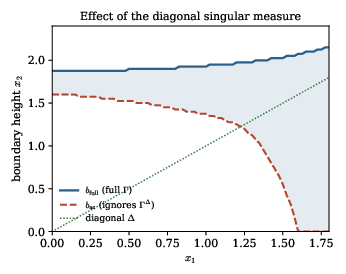
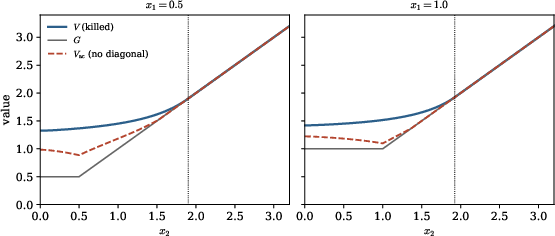
Figure 3: Effect of the diagonal singular measure; left, true boundary dXt=b(Xt)dt+σ(Xt)dWt+dLt,3 vs dXt=b(Xt)dt+σ(Xt)dWt+dLt,4; right, vertical sections dXt=b(Xt)dt+σ(Xt)dWt+dLt,5 at dXt=b(Xt)dt+σ(Xt)dWt+dLt,6.
Practical and Theoretical Implications
The measure-valued obstacle formulation establishes that nonsmooth payoffs require precise treatment of singularities in reflected stochastic control. The killed-resolvent trace condition provides a robust approach for free-boundary determination and verification, avoiding pitfalls inherent in scalar, pointwise generator calculations or unrestricted resolvent approximations. Computationally, successful implementation demands explicit inclusion of pathwise local time and careful handling of singular measures.
The theoretical framework can readily support further generalizations, including oblique reflection in polyhedral domains, higher-dimensional max-type payoffs (yielding singular measures on multiple interfaces), and relaxation of monotonicity assumptions via advanced PDE techniques.
Conclusion
The paper rigorously demonstrates that reflected optimal stopping with nonsmooth max-type payoff is governed by a measure-valued obstacle problem. The interplay between reflection, nonsmooth obstacles, and singular stopping gains induces nonlocal, killed-resolvent free-boundary equations. Both analytic and computational evidence confirms that ignoring the measure-valued structure—whether via classical generator methods or unrestricted resolvent formulas—results in invalid value representations and boundaries. The verification theorem, coupled with explicit diagnostic experiments, establishes a principled pathway for optimal boundary certification in multidimensional reflected diffusion settings with nonsmooth rewards.