- The paper presents an analytical construction of constrained instantons that enable bounce solutions in φ⁴ models with unstable quartic potentials.
- It develops asymptotic methods in three regimes—small instanton expansion, thin-wall approximation, and large-κ scaling—yielding precise corrections corroborated by numerical data.
- The study bridges analytical and numerical techniques for computing vacuum decay rates, offering practical tools for semiclassical treatments in field theory.
Asymptotic Limits and Analytical Construction of Constrained Instantons
Overview and Motivation
The paper "Asymptotic limits of constrained instantons" (2606.21561) addresses false vacuum decay in field theory, specifically for a real massive scalar ϕ4 model with an unstable quartic potential. Standard instanton techniques fail to yield bounce solutions in such models with a negative quartic term, despite the model's quantum instability at ϕ=0. The authors employ the method of constrained instantons, introducing explicit constraints in the path integral via Lagrange multipliers, thereby enabling stationary solutions ("constrained instantons") that contribute to false vacuum decay rates.
Analytical approaches are developed across three asymptotic regimes: small instanton limit (mρ≪1), large instanton limit for ϕ6 constraints (thin-wall approximation), and the large-κ limit for ϕ3 constraints. The necessity for asymptotic approximations arises due to the computational intensity of numerical methods for extreme values of the constraint parameters. The work rectifies prior omissions in the analytical treatment, particularly in the Affleck small-instanton expansion, providing new corrections and verifying them by comparison to numerical data.
Scalar Field Model and Constraints
The model under study is defined by the Euclidean action for a scalar field:
V(ϕ)=21m2ϕ2−4!λϕ4
whose potential supports a false vacuum at ϕ=0. Standard instantons do not exist when m is non-zero, as shown by scaling arguments demonstrating that the Euclidean action admits only the trivial configuration. Constrained instantons circumvent this by augmenting the action:
S~κ=∫d4x(21(∂ϕ)2+V(ϕ)+κO(ϕ))
with monomial constraints, ϕ=00 (cubic) and ϕ=01 (hexic).
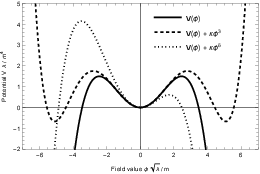
Figure 1: Diagram of the scalar potential ϕ=02 and representative modified potentials under cubic and hexic constraints.
Small-Instanton Expansion: Analytical Corrections and Results
In the ϕ=03 regime, the constrained solution approaches the Fubini instanton profile for the massless theory, allowing analytical expansion. The paper revisits Affleck's perturbative treatment, carefully retaining terms previously omitted. By dividing the solution into "core" and "tail" regions and matching their asymptotics, the leading corrections to the action are computed:
ϕ=04
This result demonstrates a factor-of-two difference relative to prior literature at leading order in ϕ=05, substantiated by comparison to numerical instanton action.
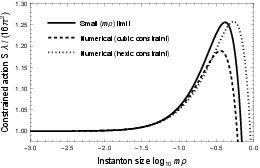
Figure 2: Comparison between the analytical small-instanton action formula and numerical results for both cubic and hexic constraints, affirming excellent agreement for ϕ=06.
Action vs. constraint values are further computed, leveraging the Fubini profile to evaluate integrals, yielding:
ϕ=07
These analytic predictions are again corroborated numerically.
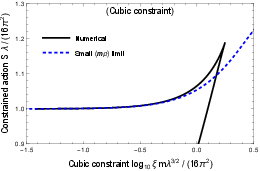
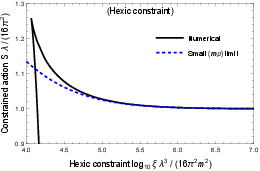
Figure 3: Action versus constraint for both constraint types, demonstrating consistency between analytic and numerical treatments in the small-instanton regime.
Large Instanton Limit: Thin-Wall Approximation for Hexic Constraint
For the ϕ=08 constraint, as ϕ=09, the modified potential possesses nearly degenerate vacua, enabling the classic thin-wall instanton approach. Neglecting the drag term in the equation of motion contiguous to the wall, the authors derive the field and action profile, justifying the analytical scaling:
mρ≪10
where the dominant contribution is controlled by mρ≪11. The constraint integral is similarly tractable, showing mρ≪12. The action-constraint relationship in this regime is characterized by the singular scaling as mρ≪13.
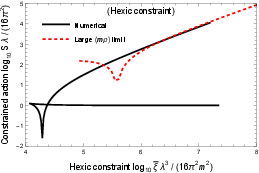
Figure 4: Comparison of the thin-wall approximation with numerical results in the large-instanton regime, showing the agreement for the upper (large-radius) branch.
Large-mρ≪14 Limit: Cubic Constraint and Scaling Solution
The mρ≪15 (cubic) constraint does not admit a thin-wall limit, as the modified potential lacks degenerate minima. Instead, the authors exploit a dimensional rescaling for large mρ≪16, showing the quartic interaction becomes negligible. The resulting action and constraint satisfy:
mρ≪17
and are computed numerically for the reduced system. There is no sharply-defined instanton size; field profiles remain broad and featureless, unlike the thin-wall scenario. Validation against numerical data demonstrates this scaling holds for large mρ≪18.
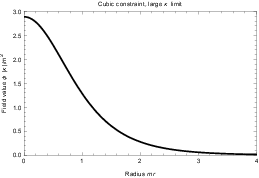
Figure 5: Field profile for a constrained solution in the large-mρ≪19 cubic regime, displaying the broad, scale-invariant nature of the solution.
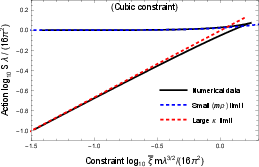
Figure 6: Comparison of asymptotic analytic results and numerical calculations for cubic constraints across small- and large-ϕ60 regimes.
Implications and Future Directions
This analytical investigation precisely characterizes constrained instantons across three disparate asymptotic regimes for two monomial constraints. Corrections in the small-instanton expansion are quantitatively established relative to classical results, impacting theoretical calculations of vacuum decay for models where standard instantons are absent. The approaches unify analytic and numerical techniques, enabling rapid estimation of instanton actions and constraints without direct full numerical integration, especially in the extremal parameter ranges. The methodology also highlights cases where instanton size loses its physical meaning, underpinning the nuanced nature of constrained solutions.
Practically, these results extend the toolkit for semiclassical descriptions of vacuum decay, relevant in cosmological and QFT settings with effective potentials not amenable to traditional instanton analysis. More broadly, constrained instanton formalism could be applied to models with exotic potentials or novel constraint operators, motivating further computational and analytical studies. Future research should address the precise calculation of prefactors and negative mode analyses, as these determine the actual tunneling rate contributions of constrained solutions.
Conclusion
The paper delineates analytic constructions for constrained instantons in scalar field theory with an unstable quartic potential under cubic and hexic constraints. Three asymptotic regimes (small-instanton, thin-wall, and large-ϕ61 cubic) are systematically developed, with analytical expressions validated against numerical computations. The corrections and scaling properties elucidated here refine theoretical predictions for false vacuum decay rates in models lacking conventional instanton solutions, and stimulate further exploration into the full path integral contributions of constrained solutions.