- The paper demonstrates that constrained instanton methods achieve consistent inner-outer matching at LO and NLO, overcoming previous concerns raised by Nielsen and Nielsen.
- It employs matched asymptotic expansions in both massive φ⁴ and Yang–Mills–Higgs models, with numerical simulations validating analytic predictions.
- Results support the use of gauge-invariant constraints for exploring nonperturbative phenomena such as baryon/lepton violation and axion dynamics in broken phases.
Revisiting Constrained Instantons: Asymptotic Structures and Matching in Broken Phases
Introduction and Context
The study addresses core conceptual and technical issues in the semiclassical treatment of quantum field theories with spontaneously broken gauge symmetries, focusing on instanton-induced nonperturbative phenomena. Instantons are classical solutions to the Euclidean equations of motion with finite action, essential for characterizing tunneling processes between distinct vacua (notably in QCD and Yang–Mills theories). In symmetric phases, well-defined instanton solutions exist. Upon introducing explicit symmetry breaking (e.g., via mass terms or Higgs mechanisms), finite-size instantons cease to be stationary points of the Euclidean action. Nonperturbative dynamics in this context rely on constrained instanton methods, which employ Lagrange-multiplier constraints to fix the instanton size and recover semiclassical features necessary for path integral calculations.
This work critically re-evaluates previous concerns, notably those by Nielsen and Nielsen (N&N), regarding the viability of conventional gauge-invariant constraints. N&N contended that systematic matching of inner (core) and outer (tail) asymptotics failed at next-to-leading order (NLO), raising doubts about theoretical consistency. This paper refutes the purported obstruction, providing a rigorous analytic and numerical treatment in both massive ϕ4 theory and spontaneously broken Yang–Mills–Higgs (YMH) systems.
Analytic Framework for Constrained Instantons
ϕ4 Theory as Prototype
The initial analysis considers a massive ϕ4 scalar model in four-dimensional Euclidean space. The Lagrangian contains a mass term and attractive quartic self-interaction. In the massless theory, exact instanton solutions of size ρ exist, furnishing scale-invariant action contributions. When m=0, the exact solution disappears—no finite-action trajectory connects boundary conditions at r=0 and r→∞ in the inverted quartic potential. The instanton configuration can be salvaged by introducing a constraint functional (e.g., ∫ϕ6) via the Lagrange-multiplier method, enforced at the level of the path integral.
The solution is constructed by matched asymptotic expansions: deriving inner (r≪m−1, core) and outer (r≫ρ, tail) solutions, then systematically matching in the overlap (ϕ40). The key is a double expansion in powers of ϕ41 and inverse powers of ϕ42. N&N’s obstruction is shown to arise from improper truncation of the outer solution, neglecting higher-order terms essential for smooth matching.
The analytic matching is validated numerically: the relation between the Lagrange-multiplier ϕ43 and the instanton size parameter ϕ44 computed numerically matches the NLO analytic prediction for ϕ45 as a function of ϕ46, in the regime ϕ47 (Figure 1).
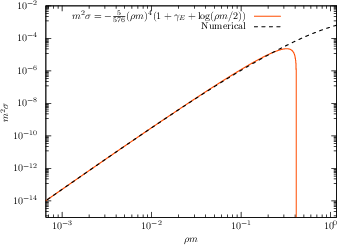
Figure 1: Dimensionless Lagrange multiplier ϕ48 vs. constrained instanton size ϕ49. Numerical results (solid) closely follow the analytic NLO prediction (dashed) for small ϕ40.
A detailed comparison of full numerical profiles with the analytic expansions (inner NLO and outer LO) for a representative ϕ41 instanton shows excellent agreement (Figure 2).
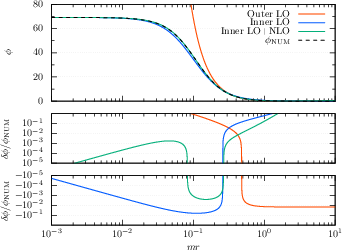
Figure 2: Numerical solution and analytic (inner LO+NLO, outer LO) profiles for ϕ42 in massive ϕ43 theory; lower panels quantify the relative deviation from numerics.
Yang–Mills–Higgs Theory with Spontaneous Symmetry Breaking
The investigation then turns to ϕ44 Yang–Mills fields coupled to a complex doublet (Higgs sector), undergoing spontaneous symmetry breaking. In the broken phase, instantons are no longer stationary points due to the scale sensitivity introduced by the Higgs potential and covariant kinetic terms.
A gauge-invariant constraint operator, such as ϕ45, is imposed to fix the instanton size. Again, the asymptotics are constructed by a double expansion in ϕ46, where ϕ47 and ϕ48 are the gauge and Higgs boson masses, respectively. The radial profiles for the gauge field and Higgs modulus are solved iteratively in the core and asymptotic regions and then matched. The crucial NLO source terms from the constraint are demonstrated to be subleading in the overlap region, ensuring the regularity and smoothness of the profile.
Numerical minimization of the constrained action, subject to the appropriate boundary conditions and using the specified ansatz for the gauge and Higgs fields, validates the analytic construction. The relation between the Lagrange-multiplier parameter ϕ49 and constrained size parameter ρ0 is found to obey the NLO analytic prediction ρ1 in the small-size regime, independent of the Higgs mass ratio ρ2 (Figure 3).
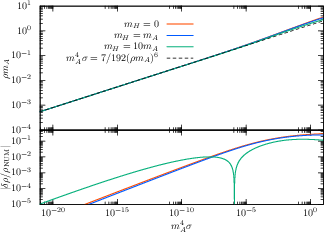
Figure 3: Numerical and analytic NLO predictions for ρ3 as a function of ρ4 for ρ5; agreement is observed for ρ6.
The corrected instanton action beyond leading order is also reproduced numerically as a function of ρ7, tracking the analytic expression up to terms of ρ8 (Figure 4).
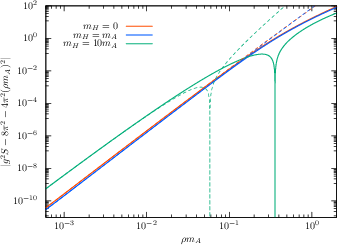
Figure 4: Numerically computed ρ9 corrections to the action versus size: analytic (dashed) and numerical (solid) results agree for small m=00 across a range of m=01 ratios.
Resolution of the Matching Obstruction and Implications
The formal and numerical results produced here demonstrate that the inner-outer matching procedure based on gauge-invariant constraints is consistent at both LO and NLO. The claimed obstruction by N&N is resolved: the difficulty arises only if outer expansions are improperly truncated, omitting relevant sub-leading orders. When these are included, all matching and finiteness criteria are met. The demonstration is robust in both scalar-only and Yang–Mills–Higgs settings, and for a broad class of higher-dimensional constraint operators.
This result underpins the reliability of constrained instanton methods for calculations involving:
- Baryon and lepton number-violating processes via electroweak instantons (“sphaleron” physics).
- The small-instanton (ultraviolet) contributions to axion potentials and masses in models with broken gauge sectors.
- Path integral evaluations where semiclassical tunneling effects persist in the presence of spontaneous symmetry breaking.
Conclusion
Through explicit asymptotic analysis and extensive numerical validation, the paper demonstrates that conventional, gauge-invariant constrained instanton techniques provide a sound and consistent basis for semiclassics in massive scalar and Yang–Mills–Higgs gauge theories. The inner-outer matching is successfully carried out at NLO, contrary to previous claims of insurmountable obstruction. The work supplies systematic methods and numerical benchmarks for future studies of nonperturbative phenomena, including baryon/lepton number violation and axion physics, in field theories with spontaneous symmetry breaking. The techniques and insights developed are central for advancing both perturbative and nonperturbative computations in high-energy theory.