- The paper develops a mathematical framework for adaptive conduction delays in spiking Haken Lighthouse networks, highlighting effects on phase locking and synchrony.
- It utilizes event-driven stability analysis and bifurcation theory to reveal how fixed and adaptive delays induce multi-stability and dynamic instabilities.
- Adaptive delays, mimicking myelination plasticity, are shown to enable phase-preserving information transfer and flexible network coordination.
Adaptive Conduction Delays and Phase Locking in Spiking Haken Lighthouse Networks
Introduction and Context
The Haken Lighthouse model occupies a unique analytical niche in computational neuroscience by bridging the descriptive power of pulse-coupled spiking networks and the tractability of phase oscillator and rate-based models. In "Adaptive conduction delays and phase locking in spiking Haken Lighthouse networks" (2606.21508), the authors develop a systematic mathematical framework for phase-locked states in event-driven spiking networks under both fixed and adaptive delayed coupling, highlighting the dynamical implications of myelination-driven white matter plasticity for network synchrony, multi-stability, and the organization of conduction delays.
The fundamental model structures the dynamics of each node by a phase variable θi evolving according to its synaptic drive ψi, subject to temporally filtered, weighted, and delayed spike trains from presynaptic partners. The firing rate nonlinearity S and synaptic kernel η enable the explicit calculation of spike timing and the corresponding postsynaptic response. By formulating the network in terms of firing events and explicit delay structure, the framework is both analytically accessible and biologically instructive.
Existence and Stability Theory for Phase-Locked States
For static delays, self-consistency equations are derived for phase-locked network states, directly relating periodicities and phase offsets to the underlying network topology and conduction delays. The stability analysis is elegantly formulated in terms of perturbations in firing times, yielding a spectral characteristic equation for the eigenvalues governing the fate of synchronous and asymmetric phase-locked solutions.
Autapse: Minimal Delayed Feedback
The bifurcation structure of a single delayed self-coupled neuron (autapse) exposes the generic features of delay-driven multistability and dynamic instabilities, including onset of spike train jittering via secondary bifurcations in interspike intervals. Explicitly, the emergence of folds and oscillatory instabilities in the period–delay plane can be rigorously traced to the event-driven stability condition.
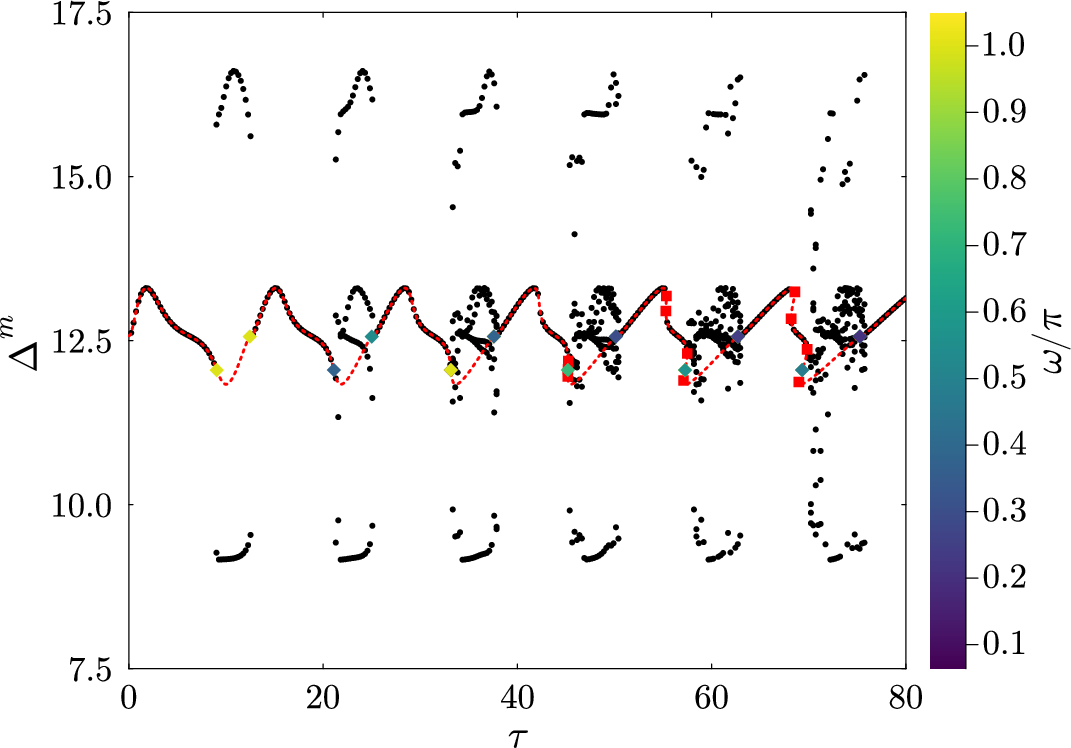
Figure 1: Bifurcation analysis of the delayed Haken autapse reveals stable and unstable periodic solutions and the transition to jittering via dynamic instabilities.
Reciprocal Two-Node Network
Moving to two reciprocally coupled units, the theory captures not only synchrony and anti-synchrony but also the onset of asymmetric phase-locked states via pitchfork bifurcations at branch extrema, directly linking their existence and stabilities to geometric features of the (τ,T) bifurcation landscape. The stability criteria also predict multistability and robust switching patterns between distinct phase-locked conformations.
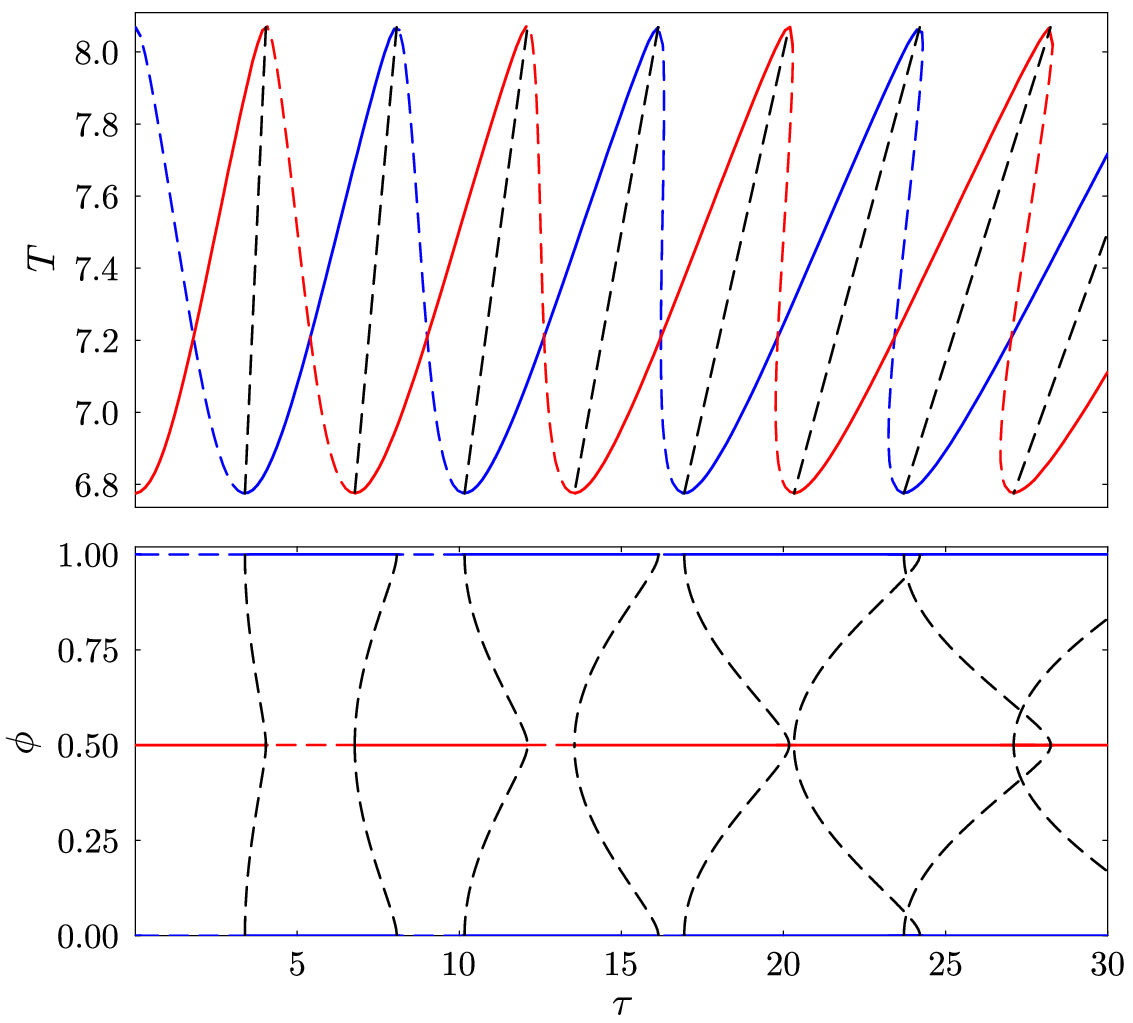
Figure 2: Bifurcation diagram for a two-node network, illustrating the locations of stable and unstable phase-locked solutions as delay is varied.
Symmetric Ring Networks and Modal Decomposition
For networks with circulant topology and spatially structured delays, the approach permits a modal analysis of stability: synchronization, splay, and general twisted solutions are classified by their Fourier mode content, and the construction of the linearized operator's spectrum elucidates the stability domains as delay parameters and conduction velocities are varied.
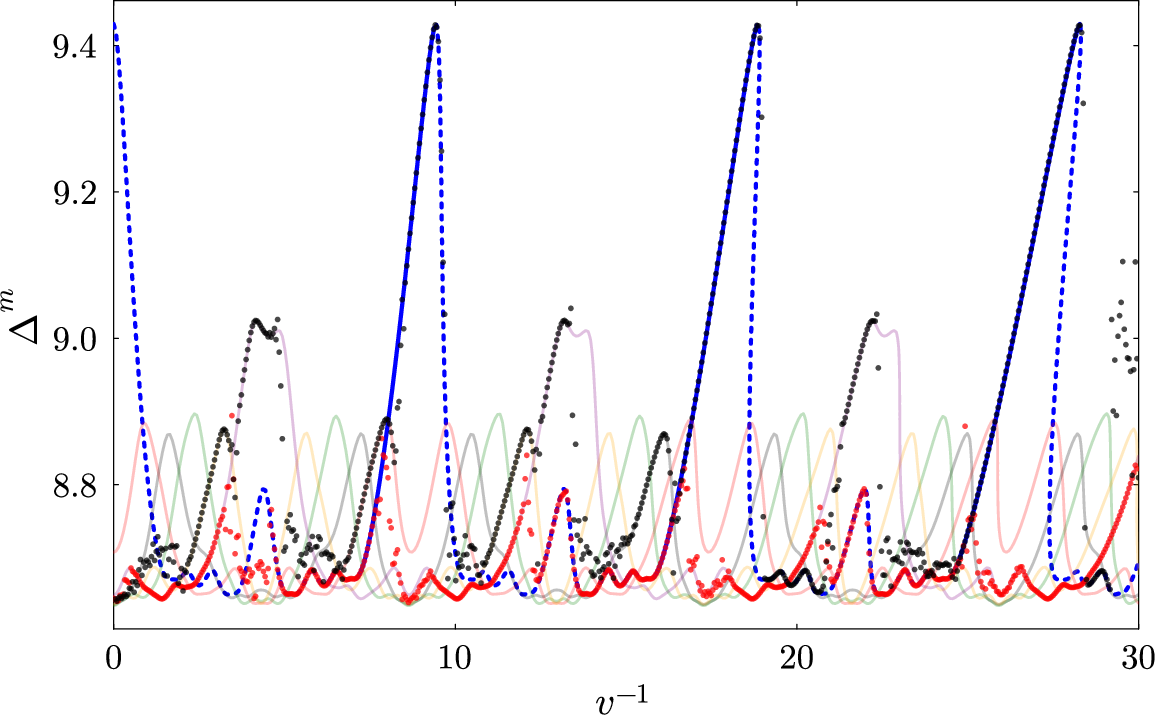
Figure 3: Branch structure for an 11-node ring network with distance-dependent delays, demonstrating how the attractor landscape and possible synchrony patterns depend on conduction speed.
Adaptive Delays via White Matter Plasticity
Central to the paper is the extension to activity-dependent conduction delays, mimicking plasticity of myelination as observed in biological white matter. The model introduces a timescale-separated, slow–fast system in which conduction speeds, and hence delays, evolve under a nonlinear function of presynaptic activity, following experimental motifs for activity-dependent myelination.
Formally, the conduction speed along each edge adapts slowly according to a tanh-shaped plasticity rule driven by temporally averaged presynaptic firing activity over the fiber's propagation window. This state-dependent delay formulation leads to a coupling between the fast spiking event dynamics and the slow drift of conduction parameters.
Slow–Fast Dynamics and Dynamical Consequences
Within this slow–fast formalism, static-delay phase-locked branches act as a critical manifold for the slow flow of conduction speeds. The structure of the adaptive dynamics is determined by both the spectral stability of the frozen event-driven system and the existence of slow fixed points or relaxation oscillations in the conduction delay space. When delays and firing periods attain integer ratios ("commensurability"), the plasticity dynamics can freeze, leading to phase-preserving information transfer across long-range pathways.
Numerical Illustration: Two-Cell and Mesoscale Networks
The authors' simulations corroborate the theoretical predictions, showing trajectories that first relax to attracting portions of frozen phase-locked branches and then drift in delay space, ultimately converging to a fixed point or undergoing slow oscillatory switching between solution branches depending on the interplay of plasticity parameters and branch geometry.
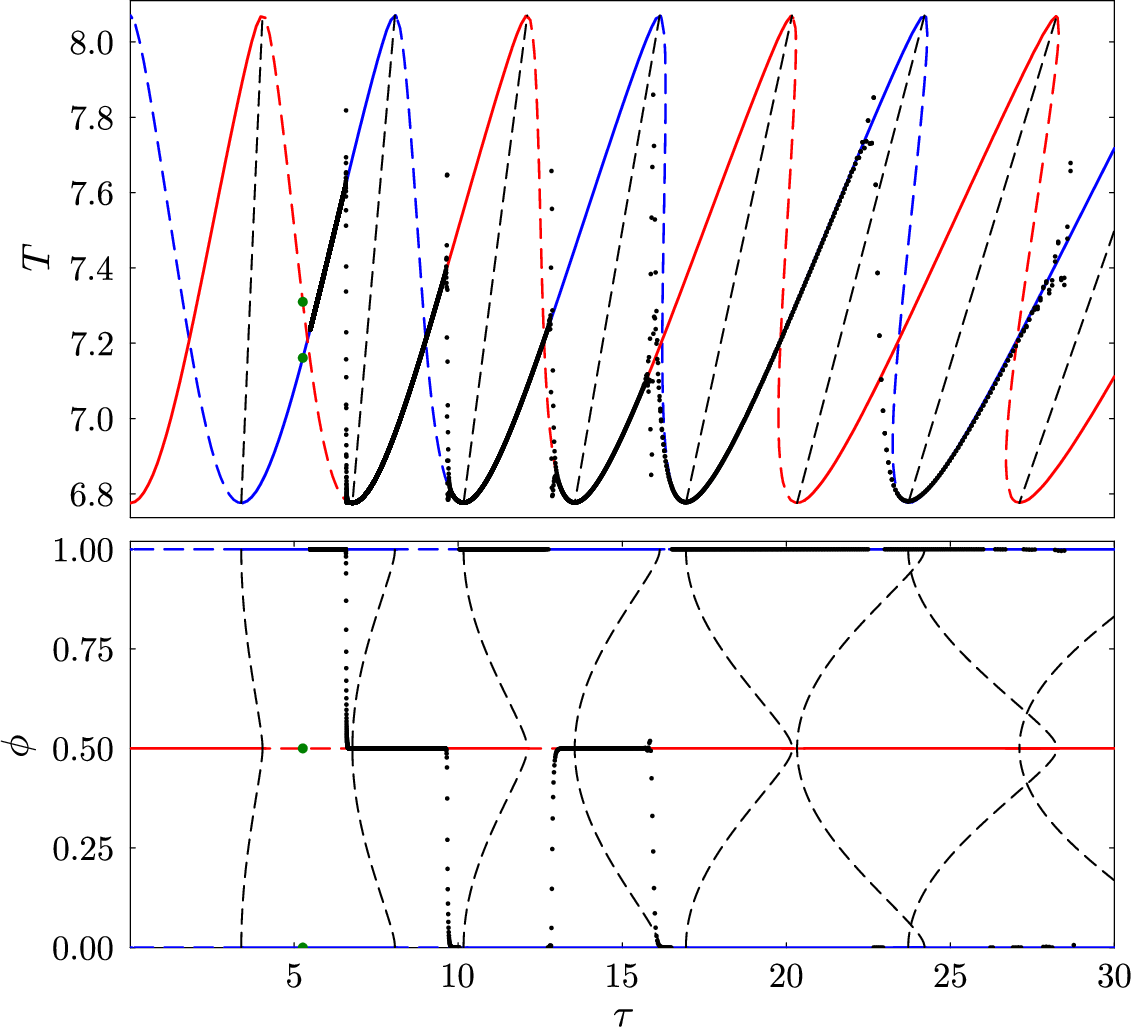
Figure 4: Adaptive two-node simulations reveal slow drift to a fixed point and switching between symmetric branches under white matter plasticity.
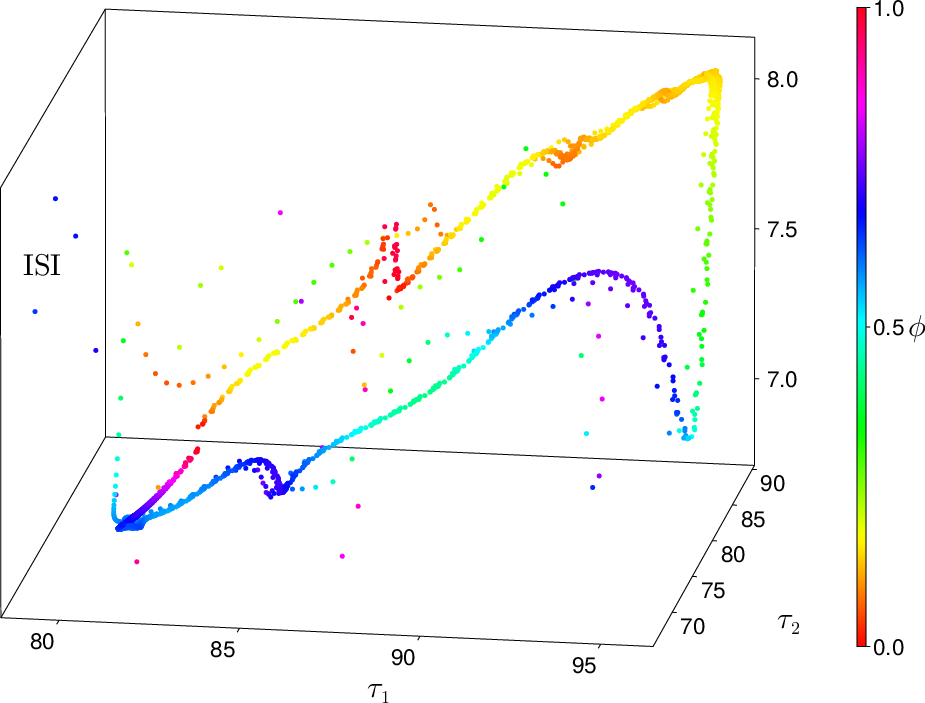
Figure 5: Under asymmetric adaptive delays, relaxation-type oscillations with switching between low and high ISIs emerge.
Delay Sculpting and Commensurability Classes
By appropriately tuning edge-specific plasticity thresholds to target integer multiples of a node's characteristic period, the adaptive rule organizes the distribution of conduction delays into discrete commensurability classes, enabling preservation of temporal phase relationships over diverse pathways in large, randomly connected networks.
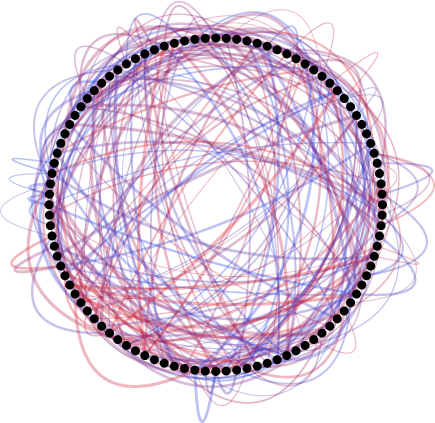
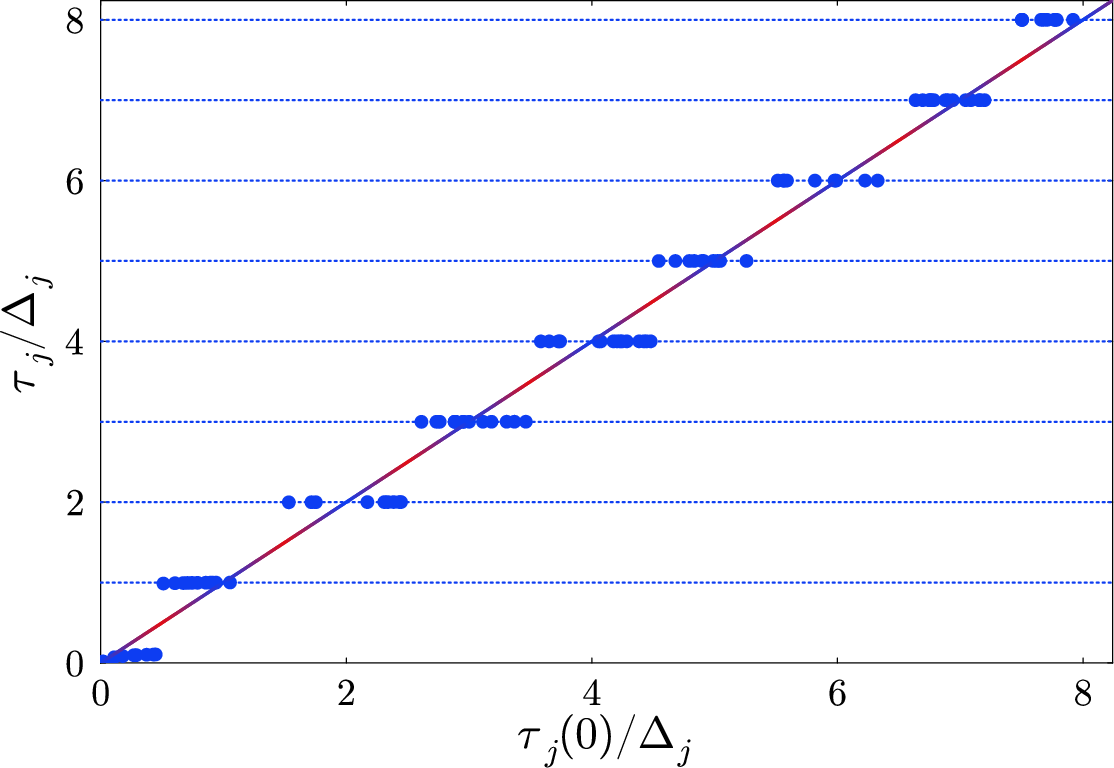
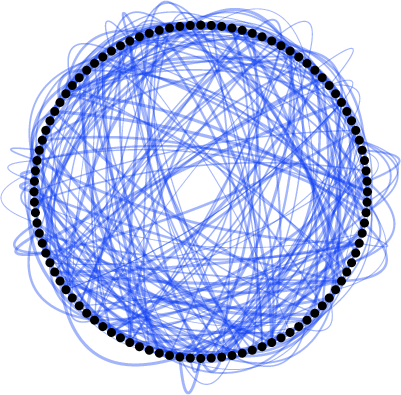
Figure 6: Adaptive white matter plasticity sculpts a random network's conduction delays into discrete, phase-preserving commensurability classes.
Implications, Applications, and Future Directions
The mathematical formalism not only retains the event-driven granularity necessary for spiking computation but also lends itself to analysis and control of temporal coordination in spiking and neuromorphic substrates.
Theoretical Implications:
- The framework provides a unification of spike-based, phase-based, and rate-based modeling, allowing translation of phase-locking and synchrony phenomena across descriptive levels.
- The event-driven stability formulation and explicit characterization of phase-locked manifolds supports rigorous bifurcation theory and geometric singular perturbation analysis in non-smooth, delay-coupled systems.
Neuroscientific and Engineering Applications:
- The results support communication-through-coherence hypotheses, positing that adaptive myelination can locally regulate the temporal transparency of white matter tracks, preserving phase relations for oscillatory signals over physiologically realistic delays.
- Adaptive delays, as opposed to static or purely synaptically plastic networks, are shown to offer flexible regulation of synchrony, switching, and memory encoding at the network level.
- For neuromorphic design, this lays analytical groundwork for incorporating dynamic delays as a degree of freedom to enhance the computational and memory capacity of event-driven hardware.
Future Research Directions:
- Mathematical extension to truly high-dimensional, connectome-like topologies; development of continuation and numerical bifurcation tools for multi-delay, event-driven networks.
- Rigorous application of singular perturbation theory and invariant manifold theorems to event-driven, state-dependent delay systems.
- Comparative exploration with rate or phase-amplitude (isostable) reductions; study of robustness under demyelination, network heterogeneity, or input-driven switching.
- Investigation of attractor sculpting via delay plasticity for sequential computation and memory in spiking networks, with relevance for both biological and artificial intelligence systems.
Conclusion
This work crystallizes a comprehensive, analytically accessible, and biologically grounded theory for adaptive conduction delays in event-driven spiking networks, directly connecting white matter plasticity to the regulation of network phase locking, synchrony, and temporal coding. The explicit event-based stability calculations, coupled with a biologically plausible adaptive rule, provide both rigorous mathematical tools and conceptual insight into how neural systems and future spiking AI architectures can leverage adaptive transmission delays for robust information processing and flexible coordination across scales.

