- The paper introduces a constructive protocol using linear code information sets for local decoding in LOSR networks to distribute GHZ states.
- It leverages hypergraph network structures and fixed local unitaries to achieve fidelities (e.g., 1/2 in a four-node example) that surpass bipartite limitations.
- Optimality under local unitary operations is proven, offering significant implications for low-latency and scalable quantum network designs.
Introduction
The paper "Optimal GHZ-State Distribution in LOSR Quantum Networks via Local Decoding from Information Sets" (2606.21500) rigorously studies the distribution of multipartite entangled states—specifically GHZ states—in quantum networks restricted to local operations and shared randomness (LOSR). The central contribution is an analytic, constructive protocol for GHZ-state preparation utilizing multipartite sources, exploiting a deep connection between hypergraph network structure and linear coding theory. The work settles a previously conjectured quantum advantage for multipartite-source networks, establishes optimality under local unitary operations, and precisely characterizes the conditions under which LOSR networks outperform the bipartite bound.
LOSR Networks and Entanglement Distribution
Quantum networks (QNs) are foundational for distributed quantum information processing, demanding scalable entanglement distribution. Networks governed by LOSR protocols mitigate quantum memory and latency costs that afflict LOCC-based approaches by relying exclusively on local operations and pre-shared randomness, dispensing with real-time classical communication. Bipartite-source LOSR networks have been theoretically proven incapable of preparing GHZ states for N>3 nodes beyond the classical product benchmark, restricting their utility in scalable scenarios. This limitation motivates the exploration of multipartite entangled sources as a means to circumvent the bipartite-bound obstruction.
The protocol proposes associating the hyperedges of an m-regular, k-uniform hypergraph network with coordinates of a linear code over Fd. If every node's incident edges constitute an information set in the code, each node applies a fixed local decoder (corresponding to a permutation unitary) to its registers. This yields a product unitary transformation UIS=⨂i∈VUi, where each Ui permutes the local computational basis according to the information set's decoding. All operations are local and predetermined, thus preserving the LOSR constraints.
Given M hyperedges in total and m edges per node, the fidelity attained with the target N-partite GHZ state, $\ket{GHZ{N}{d^m}$, is analytically given by m0.
Optimality and Quantum Advantage
For the complete hypergraph m1 (i.e., m2-uniform network over m3 nodes), the protocol achieves fidelity m4. The authors provide a rigorous upper bound, proving that this fidelity is optimal under all local unitary strategies, while general local channels may potentially surpass this bound. The quantum advantage is precisely characterized: multipartite sources provide a strictly higher fidelity than any bipartite-source LOSR network exactly when m5, i.e., the total number of hyperedges is less than twice the number of edges per node.
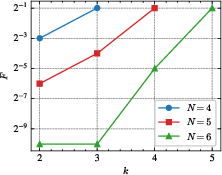
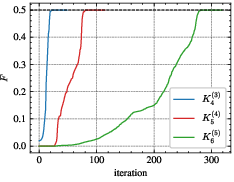
Figure 1: Numerical local-unitary benchmark for m6. (a) Information-set fidelity m7 (log scale) vs. source arity m8 for m9, (b) optimization history; the dashed line denotes the analytical optimum k0.
Numerical Benchmarking
The local unitary optimization in the product-unitary manifold corroborates the analytic results. Benchmarks for k1 demonstrate that, for boundary networks k2, the information-set decoder attains the analytical optimum k3, with convergence becoming slower as k4 increases (due to exponential growth in local Hilbert dimensions). For networks with k5, numerical local unitary search consistently retrieves the constructed fidelity, further validating the protocol albeit not certifying global optimality beyond the analytically proven cases.
Explicit Circuit Construction and the Four-Node Example
The explicit four-node network (k6) is detailed, employing a binary k7 single-parity-check code to coordinate the decoders. The constructed local decoder circuits map raw source labels to a unified message ordering k8, realizing the GHZ state with fidelity k9, thus exceeding the bipartite benchmark Fd0 by a factor of four. The protocol utilizes only fixed local unitaries (swap and cnot gates), requiring no classical communication at runtime.
Implications and Prospects
The results have significant practical implications for low-latency quantum networks: multipartite-source LOSR networks can distribute multipartite entanglement at higher fidelities, overcoming operational and scalability bottlenecks inherent in LOCC-based designs. The constructive mapping from quantum network hypergraph topology to coding-theory information sets formalizes a resource-theoretic equivalence, establishing that shared randomness combined with multipartite entangled sources can substitute for real-time classical communication. Analytically characterizing optimality sharpens the delineation of operational boundaries in quantum network design.
Future research directions include exploring fidelity dependence on source arity (Fd4) for fixed Fd5, optimizing regular hypergraph architectures for entanglement distribution, targeting alternative multipartite entangled states (e.g., cluster, W states), and extending optimality proofs to general local channels and source state variations. Hybrid network architectures combining CC and SR may further optimize scalability and latency trade-offs.
Conclusion
The paper delivers an analytic, constructive, and optimal protocol for multipartite entanglement distribution in LOSR quantum networks with multipartite sources, settling long-standing conjectures regarding GHZ-state preparation. By precisely mapping quantum network structure to linear code information sets, the protocol achieves the maximal possible fidelity under local unitary operations, fundamentally altering the capabilities of LOSR networks for scalable quantum information distribution. The work opens a clear path for future theoretical developments and practical implementations in quantum network engineering.

