- The paper demonstrates that adaptive quantum measurement circuits achieve significantly lower error rates than non-adaptive protocols by leveraging feed-forward operations.
- It provides a rigorous analysis of noisy two-outcome POVMs, such as imperfect Z measurements, with analytical derivations that highlight key parameter regimes.
- The study extends its framework to general POVMs and qudits, establishing adaptive protocols as a critical resource with tangible experimental implications.
Introduction and Motivation
Measurement error in quantum systems is an inevitable consequence of practical device imperfections. While increasing control precision represents an engineering solution, the complementary approach is circuit-level optimization: how to combine multiple noisy measurements for maximal information extraction. Historically, parallel (non-adaptive) measurement schemes have dominated error mitigation strategies. This paper introduces and rigorously analyzes adaptive (feed-forward) measurement circuits, where each measurement can condition subsequent quantum processing and measurement choices, establishing both their superior theoretical performance and fundamental limits.
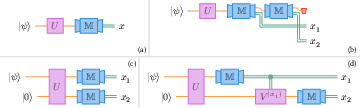
Figure 1: Illustration of multiple measurement schemes, from single-use to parallel and adaptive circuits, emphasizing the role of classical control pathways and sequential decision-making.
The analysis focuses primarily on the task of distinguishing qubit states via noisy two-outcome POVMs, particularly the imperfect Z measurement family, parametrized by (p,q) representing asymmetric state misidentification probabilities. For any quantum measurement circuit taking a qubit as input and outputting a classical bit, error rates ε0 and ε1 are defined for misclassifying input basis states. The total error η=ε0+ε1 is the operational figure of merit, minimized over circuit structure, quantum pre-processing, measurement scheduling, and classical post-processing.
Optimality Landscape: Non-Adaptive vs Adaptive Circuits
Non-Adaptive Protocols
The characterization of optimal non-adaptive protocols is facilitated by two key reductions:
- Quantum Preprocessing: Only the computational basis vectors need to be considered for input states prior to measurement, given that off-diagonal elements do not influence outcome probabilities for diagonal POVMs.
- Classical Postprocessing: The optimal decision rule is maximum likelihood decoding over measurement outcomes.
For the case of three uses of the imperfect Z measurement, the search space collapses to a small finite set of circuits, whose error expressions are analytically derived and described. The optimal circuit alternates between repetition code-inspired majority voting and quantum encoding, contingent on parameter regimes in (p,q).
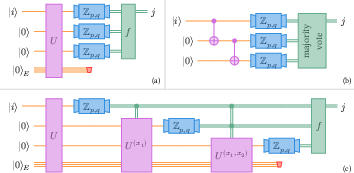
Figure 2: General non-adaptive circuit topology for three uses of Z measurements, including quantum encoding and classical post-processing.
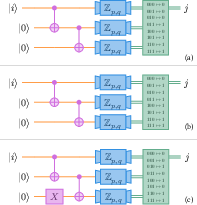
Figure 3: Three candidate non-adaptive circuits for optimality with three imperfect Z measurements, identifying regions where quantum approaches outperform classical repetition codes.
Adaptive Protocols and Unbounded Advantage
Adaptive circuits allow for intermediate unitary transformations conditioned on previous measurement outcomes (feed-forward). The paper rigorously demonstrates that adaptive strategies can achieve lower total error than all non-adaptive circuits, given suitable measurement imperfections and sufficient device usage. Adaptive advantage emerges as early as N=3 for most (p,q)0 values, and is generically present for (p,q)1 except in symmetry-constrained or trivial cases.
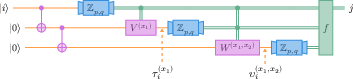
Figure 4: Recursive structure of optimal adaptive circuits, illustrating conditional quantum operations based on sequential outcomes.
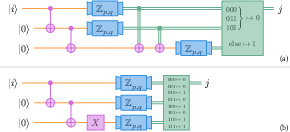
Figure 5: Explicit circuit diagrams for optimal adaptive circuits in distinct parameter regimes, highlighting the structural distinctions underpinning adaptive advantage.
A striking result is that the ratio of non-adaptive to adaptive minimal achievable error can be made arbitrarily large in the limit of carefully chosen measurement parameters and increased (p,q)2. Theoretical construction shows this ratio scales at least linearly with (p,q)3 in carefully engineered asymptotic regimes.
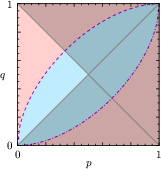
Figure 6: Parameter space plot for (p,q)4 and (p,q)5, demarcating zones where adaptive advantage emerges as a function of (p,q)6.
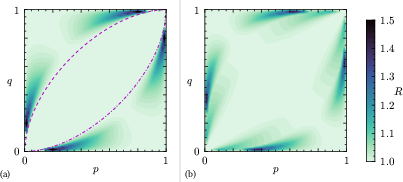
Figure 7: Contour plots quantifying the relative adaptive advantage for (p,q)7 uses, emphasizing the existence of regions where classical strategies are exponentially suboptimal.
Extension to General POVMs and Qudits
The methodology generalizes to arbitrary finite-dimensional POVMs and (p,q)8-dimensional qudit inputs. Non-adaptive optimality reduces to maximizing spectral diameter sums for pre- and post-processing. For abelian POVMs, efficient reductions to finite combinations of quantum encodings and classical rules are formalized.
Adaptive protocols are shown to have a recursive structure, represented as a tree of circuit fragments, with achievable error sets forming convex polygons (or polyhedra in higher dimensions). The recursive minimization enables identification of optimal vertices, whose total error defines the adaptive minimum.
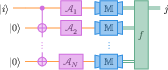
Figure 8: Simplified optimal non-adaptive circuit schematic for abelian POVMs, illustrating the efficient mapping via CNOT chains and local channels.
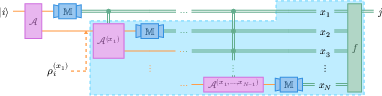
Figure 9: General adaptive circuit schematic for arbitrary POVMs, demonstrating the classical conditioning pathway for measurement-dependent operations.
Detailed Example Classes and Implications
The analysis is substantiated with detailed examples:
- Imperfect Z: Adaptive advantage is generic except for symmetric or trivial parameter edge cases; minimum error decays exponentially with device uses.
- Trine Measurement: No adaptive advantage exists—error decay is strictly determined by non-adaptive protocols.
- Qubit SIC-POVM: Adaptive advantage present for any (p,q)9, with explicit construction providing the best achievable rate.
- Generalized Imperfect Z (qudits): Asymptotic upper and lower bounds demonstrate error minimization scales exponentially, with rates determined by device characteristics.
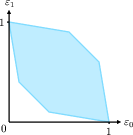
Figure 10: Achievable error set visualization for specific measurements, manifesting the geometric interpretation of recursive adaptive protocols.
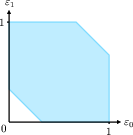
Figure 11: Polygonal error sets for recursive adaptive circuits, showing contraction toward the origin as measurements accumulate.
Practical and Theoretical Implications
Theoretical implications are twofold:
- Resource Theory: Adaptivity is established as a fundamental operational resource in quantum measurement protocols, with circuit-level feed-forward yielding improved error rates beyond classical coding analogues.
- Measurement Reproduction: Any non-trivial measurement device can approximate projective measurements with exponentially vanishing error, but optimal rates require adaptive scheduling.
Practically, implementation challenges include assuming negligible gate noise, classical control latency, and operational cost. Recent experimental demonstrations in quantum information processing substantiate near-term feasibility of adaptive advantage realization. The findings also influence quantum state discrimination protocols and coding theory analogues in quantum circuits.
Future Directions
Opportunities for future research:
- Tight characterization of adaptive vs non-adaptive error exponents for arbitrary POVMs and input dimensions
- Investigation of adaptive advantage for alternative figures of merit and post-selection strategies
- Concrete experimental architectures for realizing adaptive measurement protocols with minimal overhead
- Extension to multi-shot and entanglement-assisted measurement settings
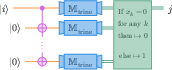
Figure 12: Optimal circuit for ε00 uses of the trine measurement, illustrating algorithmic application of post-processing for maximal error reduction.
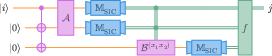
Figure 13: Adaptive circuit topology for three uses of SIC-POVM, underlining the recursive exploitation of classical conditioning for error minimization.
Conclusion
Adaptive measurement circuits significantly extend the toolkit for measurement error reduction in quantum systems. The analysis rigorously quantifies their superiority for most non-trivial measurement devices and demonstrates fundamental limits and optimality structures. These results underscore adaptivity as a critical resource, warranting further theoretical and practical exploration in quantum algorithm design, fault-tolerant measurement, and state discrimination.

