- The paper finds that finite-amplitude interfacial roughness spectra determine distinct nonlinear routes to salt-finger mixing.
- The study uses high-resolution DNS to quantify spectral modal participation, salinity flux, and vertical plume penetration.
- Results indicate that broad and mixed interface conditions optimize scalar transport, highlighting the role of inherited interface features.
Interfacial Roughness Spectra and Finite-Depth Route Selection in Salt-Finger Mixing
Introduction
This work investigates the role of initial interfacial roughness spectra in dictating nonlinear salt-finger evolution and scalar transport across the classic two-layer thermohaline interface. Salt fingering—canonical double-diffusive instability—drives irreversible vertical fluxes between layers where temperature and salinity gradients are of opposing sign. Extant DNS and mean-field analyses typically presuppose homogeneous or idealized initial states, thus omitting the role of inherited finite-amplitude roughness generated by waves, prior mixing, or instabilities. The primary research question addressed is whether the horizontal spectral content of such roughness acts as a dynamical selector of the route to plume-forest development, affecting modal population, vertical reach, scalar exchange, and interleaving geometry.
Numerical Experimental Design
High-resolution direct simulations of the nonhydrostatic, incompressible Boussinesq equations are performed at Prandtl number Pr=7, diffusivity ratio τ=0.01, and density ratio Rρ=1.2—firmly in the classical salt-fingering regime. The computational domain is finite-depth, horizontally periodic, and vertically bounded by relaxation layers that preserve a symmetric two-layer structure. The interface is initialized with controlled, finite-amplitude displacements: a low-mode (broad), a high-annulus (short-scale), and a mixed spectrum (linear combination of both). All cases are spectrally consistent and matched in amplitude, domain size, grid (384×192×960), and other physical/numerical parameters.
Morphological, spectral, transport, and geometric diagnostics are formulated to measure route selection, including branch population tracking, salinity flux, modal participation ratios, vertical activity envelopes, and interface gradient statistics. This separation allows for unbiased attribution of all observed differences to the imposed roughness spectrum.
Route Selection Phenomenology
The imposed roughness spectrum selects three qualitatively distinct routes to nonlinear mixing and vertical scalar exchange:
- High-annulus (short-scale) forcing: The flow remains locked to the imposed short-wavelength branch and exhibits minimal nonlinear coarsening, small salinity-modal population (Neff=3.26 at t=45), and limited vertical penetration.
- Low-mode (broad-scale) forcing: The system immediately occupies the broad branch, yielding the strongest salinity transport and fastest connection between interface and boundaries (FS=0.2007 at t=45). Plumes vertically extend and occupy a thick interleaving layer.
- Mixed-spectrum forcing: The evolution is velocity-led, where vertical velocity reorganizes onto the broad branch before salinity, and the scalar field develops the richest planform spectral population (Neff=86.66 at t=45, rising further at later times). Despite intermediate transport, this route uniquely combines a broad organizing scale with extreme modal richness.
The plume-forest morphologies at an early, pre-boundary-contact time (τ=0.010) directly visualize this route selection.
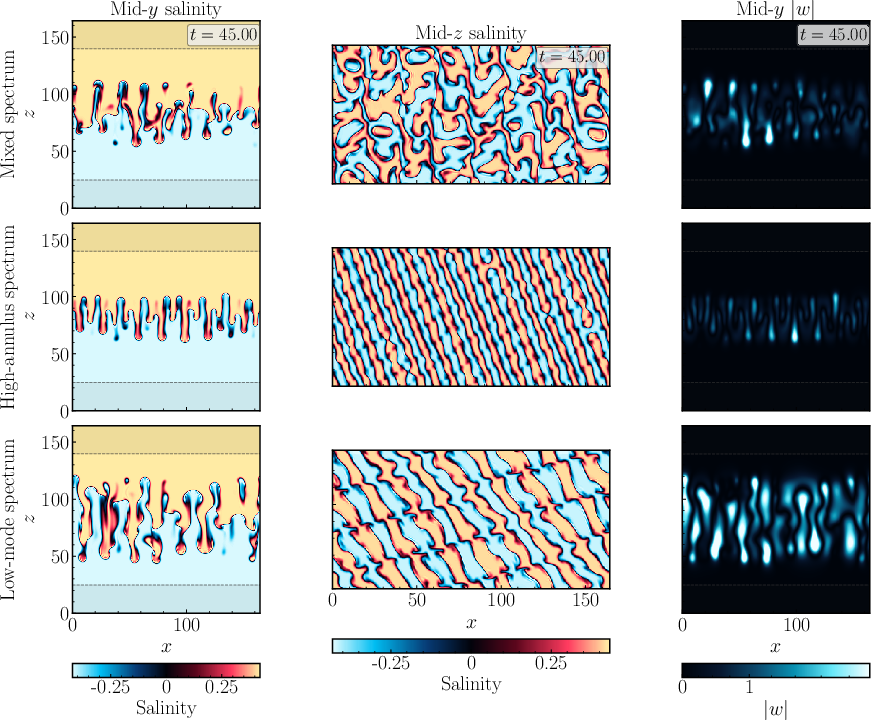
Figure 1: The three imposed spectra produce visually and dynamically distinct plume-forest morphologies at τ=0.011.
Branch topology analysis, including angular anisotropy and signed branch measures, confirm that the diagonal orientation and breadth in the mixed case are not mere superpositions of endpoint behaviors but reflect genuinely new organization. Probe-based asymmetry statistics demonstrate strong local intermittency and side-bias in plume passage under mixed forcing, yet global upper/lower volume measures remain nearly parity, excluding spurious conclusions based on local probes alone.
Spectral Redistribution and Scalar Transport
Transport and spectral richness are mechanistically decoupled. The low-mode case maximizes interior salinity flux and kinetic energy but retains moderate scalar modal richness; the high-annulus case is weakly transporting and spectrally narrow. The mixed case is transport-intermediate but achieves an order-of-magnitude increase in τ=0.012, reflecting enhanced modal redistribution without necessarily maximizing scalar exchange. Time-wavenumber diagrams illustrate that the dominant salinity band in the mixed case migrates toward broad scales as modal population explosively increases.
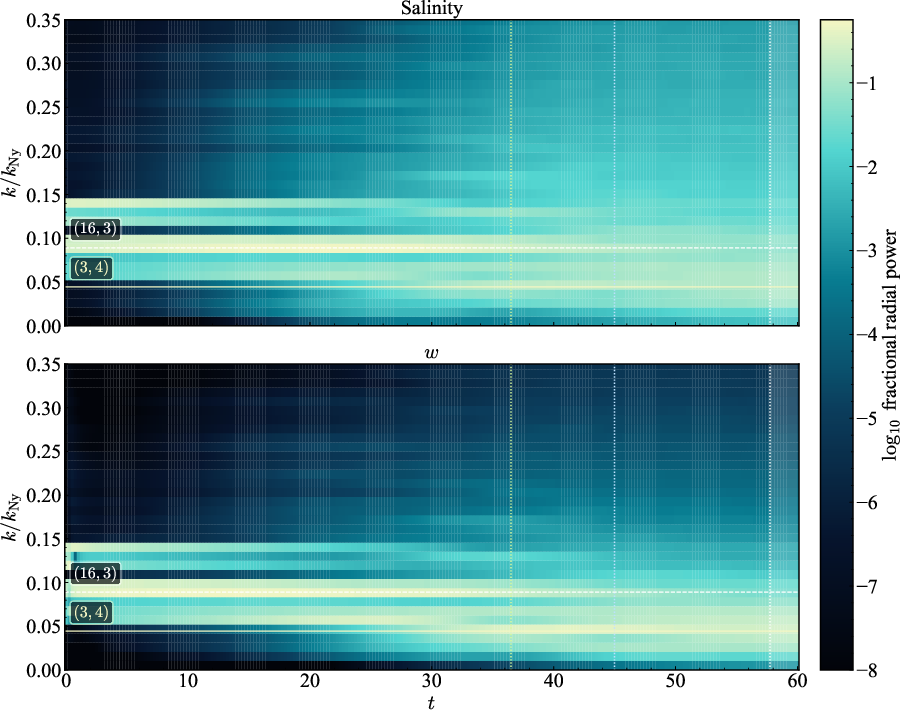
Figure 2: In the mixed case, the dominant salinity wavenumber broadens and the planform distribution rapidly fills, distinguishing this route from endpoint scenarios.
Salinity transport history consolidates the interpretation: broad-scale roughness yields early, strong transport and vertical reach; mixed roughness exhibits delayed but complex modal transition accompanying gradual growth; short-scale roughness remains a trapped, inefficient exchange pathway.
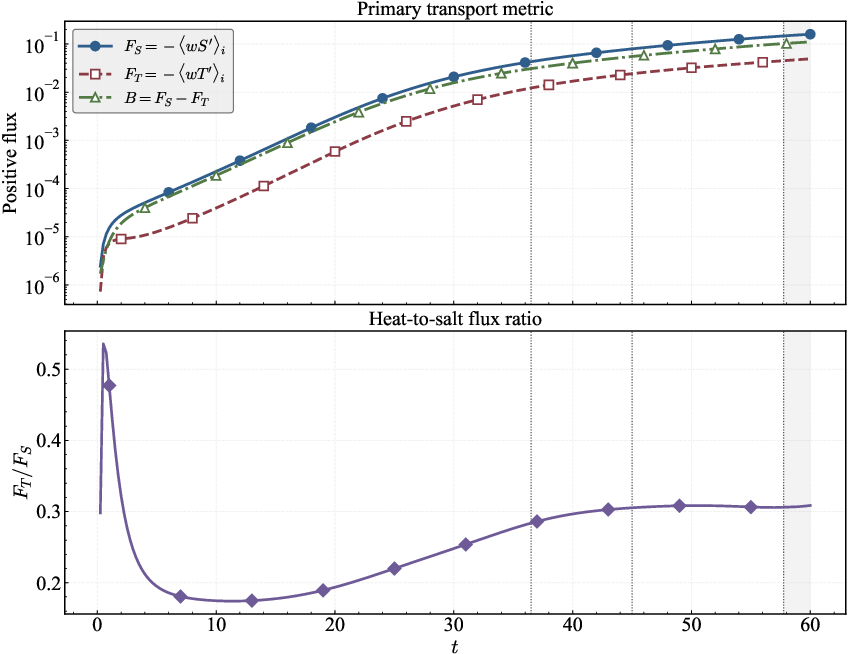
Figure 3: The evolution of interior-comparison salinity flux demonstrates the low-mode maximum and mixed-spectrum trajectory.
Interface Geometry and Scalar Interleaving
Interface diagnostics show multifaceted impacts of route selection. Low-mode forcing yields the largest interface displacement and thickest scalar-gradient layer, reflecting efficient scalar transfer. The mixed case, despite intermediate displacement, creates the richest and most intricate active-gradient interface, demonstrating that plume-forest complexity and transport decouple.
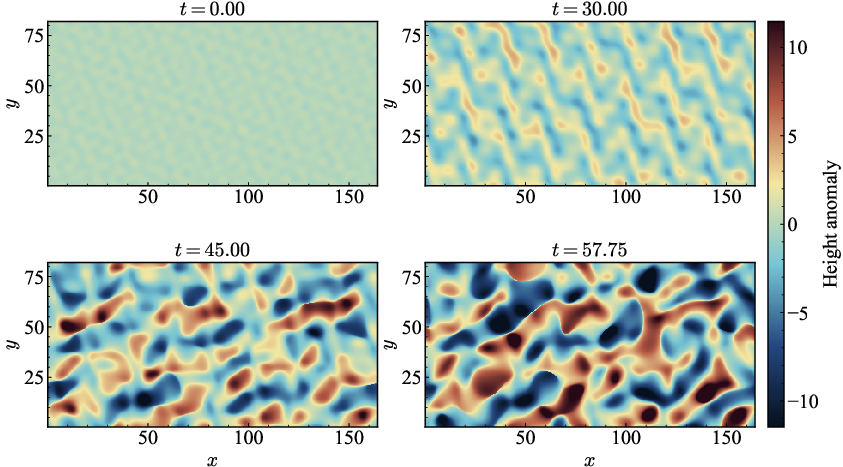
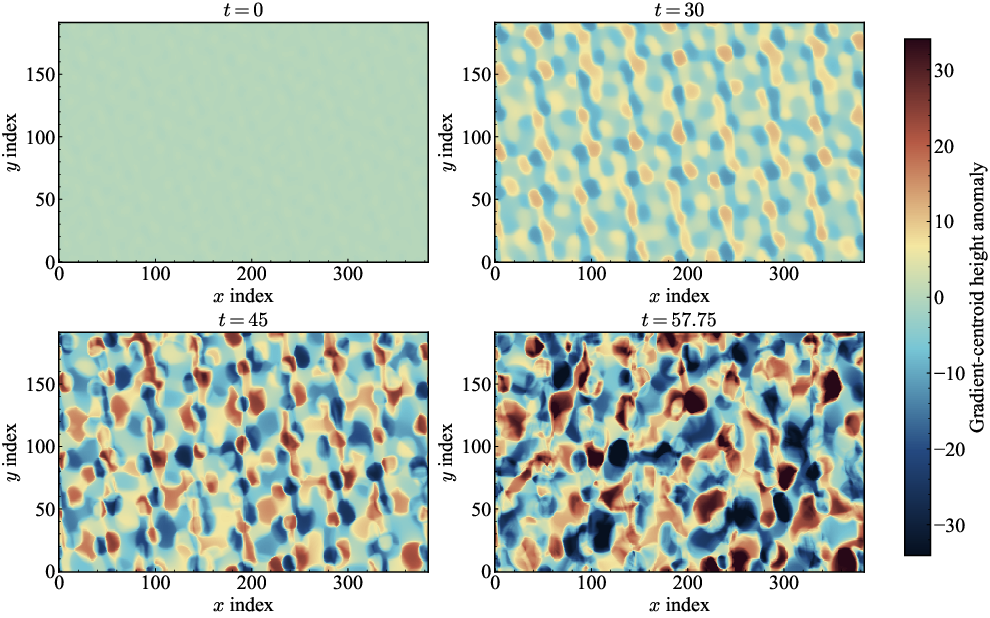
Figure 4: Spatial maps of temperature-zero and salinity-gradient interfaces highlight maximal interleaving structure under mixed forcing.
Finite-Depth Penetration
The vertical activity envelope metric quantifies how rapidly a given spectrum enables plumes to reach remote layers (the edges of the interior zone). Low-mode (broad) initial conditions enable the fastest finite-depth connection—reaching the relaxation-zone threshold before τ=0.013; mixed is delayed; high-annulus remains confined for the duration. Threshold sensitivity confirms this ordering is robust across activity definitions.
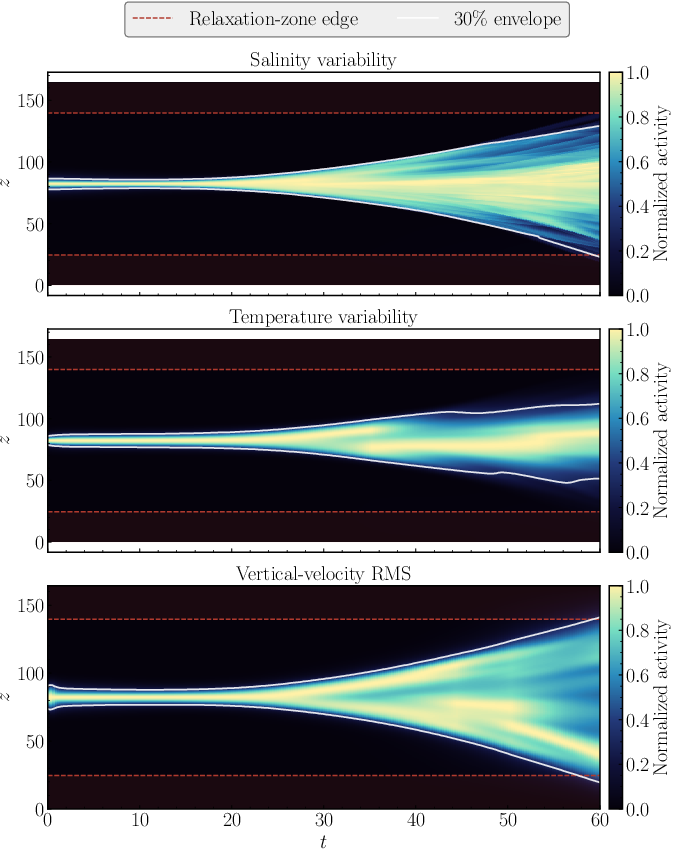
Figure 5: Envelopes for salinity, temperature, and vertical velocity showing rate of upward/downward plume advance for the mixed route.
Robustness and Resolution
A replicate mixed-spectrum with randomized phase and noise preserves the velocity-led transition order, dominant scale, effective mode count, transport, and interface statistics, confirming that observed phenomena are robust and not sensitive to specific initial phases. Scale-resolution diagnostics, including grid/timestep adequacy and tail energy, are more than adequate; a τ=0.014 refine confirms all key conclusions.
Implications and Future Directions
The study makes the assertion that finite-amplitude interfacial roughness spectrum is a dynamical selector of the nonlinear route to vertical salt-finger mixing under double-diffusive instability. Importantly, shorter scale imposed roughness does not guarantee finer nor more effective plume development; instead, broad or mixed content can rapidly connect layers, and mixed content creates scalar-rich environments, with differential timings for velocity and scalar field reorganization.
These results codify a practical mechanism for spectral memory in diapycnal exchange: oceanic or laboratory interfaces undisturbed in density-ratio/diffusivity space can nonetheless display dramatically distinct transport and interleaving, contingent on inherited roughness. This suggests that, in observational or experimental studies, pre-existing interfacial spectrum must be considered a critical parameter, on par with traditional thermohaline properties.
Future directions include systematic exploration of route selection across density/diffusivity ratios, amplitude, and non-ideal boundary treatments, and quantification of the link between roughness-induced route and emergent staircase formation or internal wave generation. Such inquiries are directly relevant for parameterizing double-diffusive mixing in ocean/climate models where interfaces rarely reset to spectral neutrality.
Conclusion
The influence of spectral content in initial interface roughness fundamentally alters the nonlinear progression of salt-finger mediated scalar exchange in finite-depth stratified fluids. Under strictly controlled conditions and credible numerical resolution, distinct routes—locked, broad, and velocity-led scalar-rich mixed—emerge, each imprinted by initial spectral selection and resilient to random-phase perturbations. These findings underscore the necessity of treating inherited roughness as a first-order state variable in the prediction and parameterization of oceanic and geophysical mixing phenomena (2606.21131).